


How to Relieve Lower Back Pain at Home: Steps That Work
-
You're halfway through the afternoon, the chair has won, and your lower back is tight again. Standing at the sink didn't clear it. A long stretch on the couch made the next sit-down worse. You want to know how to relieve lower back pain at home without a random list of poses and a hope that one of them sticks.
Treat the flare as a dosing problem. Heat, cold, massage, and walking each have a length, a frequency, and a stop point. The benefits in the research are real and usually modest. They make movement more comfortable. They don't erase the reason the back got irritable.
If the pain is ordinary and stable, you can start the sequence below today. If urgent symptoms show up, you leave the home plan and get assessed.
Table of Contents
- Choosing Heat, Cold or Massage for Each Flare
- How to Run Your First Week at Home
- Stretches and Exercises to Try During a Flare
- How Much Movement Helps and When to Stop
- Posture, Sitting and Sleep Changes That Reduce Strain
- When to Stop Home Care and See a Clinician
Choosing Heat, Cold or Massage for Each Flare
When your lower back tightens after a lift or a long spell in one position, the right option depends on what feels comfortable and how your symptoms respond. For acute or subacute non-specific lower back pain, superficial heat is a supported home-care choice. A 2017 American College of Physicians guideline recommends non-drug options first, including superficial heat, massage, acupuncture, or spinal manipulation. Across four trials, heat improved pain by an average of 1.06 points on a 0 to 5 scale, about 21 points on a 0 to 100 scale, compared with placebo or usual care. That is a modest short-term benefit, not a cure. The finding applies to pain that does not shoot down the leg. Weakness, worsening numbness, or significant sciatica calls for more than heat alone.
| Option | Best for | Session length | Main caution |
|---|---|---|---|
| Heating pad or wrap | Stiffness and muscle tightness, especially before getting out of bed | 15-20 minutes | Use a cloth barrier and never sleep on it |
| Microwavable pad (SunnyBay body pad) | Warmth while sitting in a chair or on a sofa | Up to 20 minutes, reheat as needed | Check the heat before applying and keep the cover on |
| Cold pack | Fresh sharp pain after a lift or a twist in the first day or two | 10-15 minutes wrapped in cloth | Never apply ice directly to skin |
| Air-activated heat patch with belt | Hands-free warmth during desk work or errands | As directed on the package | Do not stack patches or apply to broken skin |
| Self-massage with hands or a massage tool | Tight glutes and muscles beside the spine | 2-5 minutes per spot | Avoid pressing directly on the spine or bony areas |
SunnyBay's extra-large body pad measures about 10 by 24 inches, is filled with flax seed or lava sand, and has washable covers. It can be warmed or frozen, so it can provide either heat or cold. Those product features do not change the dose: keep heat sessions to 15-20 minutes and cold sessions to 10-15 minutes.
Practical rule: Put cloth between your skin and a heat or cold source. Limit heat to 15-20 minutes and cold to 10-15 minutes. Check your skin during use, especially if sensation is reduced, and never sleep on a heated pad.
Warmth can ease muscle guarding, making it more comfortable to move. Cold may feel better for some people after a fresh, sharp flare. Try one option at a time and stop if discomfort increases or your skin becomes painful or unusually red. For more detail on choosing between heat therapy and cold therapy, compare how each feels for your symptoms.
How to Run Your First Week at Home
Run the week as a graded sequence, not as bed rest with occasional stretching. NICE guidance supports advice that helps you manage the pain yourself and keep up normal activities, with exercise chosen for your needs, preferences, and capacity. A review that informed World Health Organization work found structured exercise probably reduces chronic low-back-pain intensity (standardized mean difference −0.33, 95% CI −0.58 to −0.08) and functional limits (SMD −0.31, 95% CI −0.57 to −0.05), on moderate-certainty evidence. Those are meaningful, modest shifts. The World Health Organization also points to activity, sleep, a steady weight, staying at work, and simpler workstation setups as ways to ease symptoms or cut the chance of another episode.
The first-week flow below is the short version of that sequence.
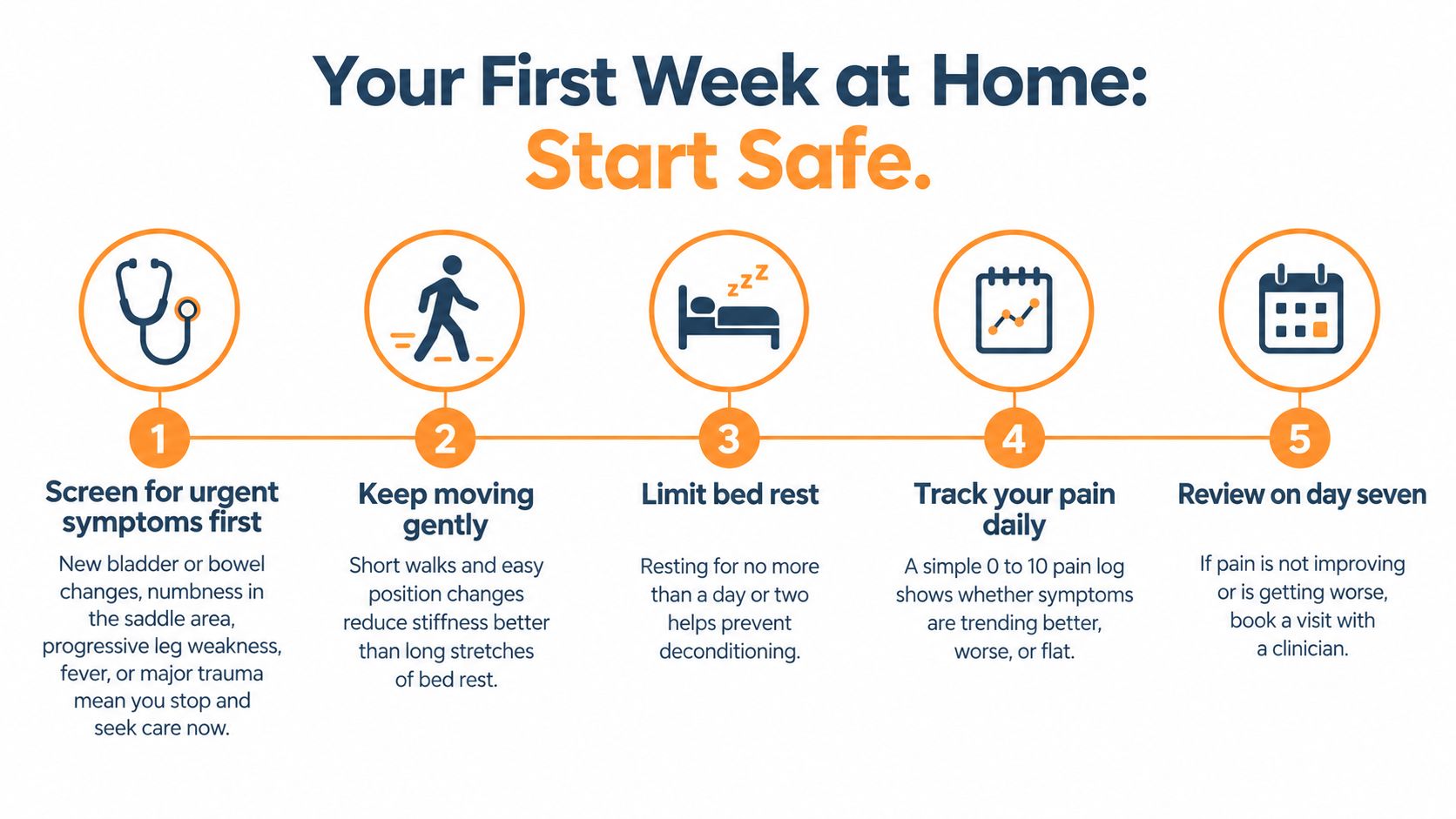
The seven doses
- Screen before you treat. New bladder or bowel changes, saddle numbness, progressive leg weakness, fever, major trauma, or unexplained weight loss mean you stop and get assessed. Home care is for uncomplicated pain that is stable or easing.
- Match the pack to the flare. If nothing urgent is present, use superficial heat for 15 to 20 minutes with a cloth barrier. If the pain started within a day or two after a lift or a twist and feels sharp, use a wrapped cold pack for 10 to 15 minutes instead.
- Walk before you "exercise." Take 5 to 10 minutes at an easy pace, indoors or outside. That short bout is your normal movement, not a workout you have to earn.
- Add two short movement sessions. Once or twice a day, do pain-tolerable trunk and hip movements like the options in the next section. Keep them easy enough that you could talk through them.
- Break up sitting. Stand or change position about every 30 minutes. Long stillness reloads the same spot the pack just calmed.
- Log a number. Rate pain from 0 to 10 each morning and evening in a notes app. You're watching the trend, not chasing a zero.
- Progress only on a stable trend. Add walking or exercise time after several days of pain that is flat or better. Don't add load on the first easier afternoon.
Two pitfalls that restart the week
Temporary relief isn't proof the tissue has "healed," so a heavy lift the same day often brings the flare back. The other trap is quitting all activity because movement feels uncomfortable. A bit of ache during easy motion is common. A sharp spike is a reason to change the dose, not to take to bed for the week.
Supervised programs can beat unsupervised home exercise in the short term. If disability is still limiting work or sleep after a consistent week, a physiotherapist or clinician should take the next step.
Stretches and Exercises to Try During a Flare
Stretching is the default tip, which is why it feels mandatory. A 2024 JMIR review of 69 low-back-pain self-management apps found that 51 apps, or 73.9%, recommended muscle stretching. Evidence that any single stretch outperforms the others is weak. Use the list as options to test, not as a fixed sequence you must finish.
A gentle knee-to-chest is a reasonable first test when the back feels guarded in the morning.
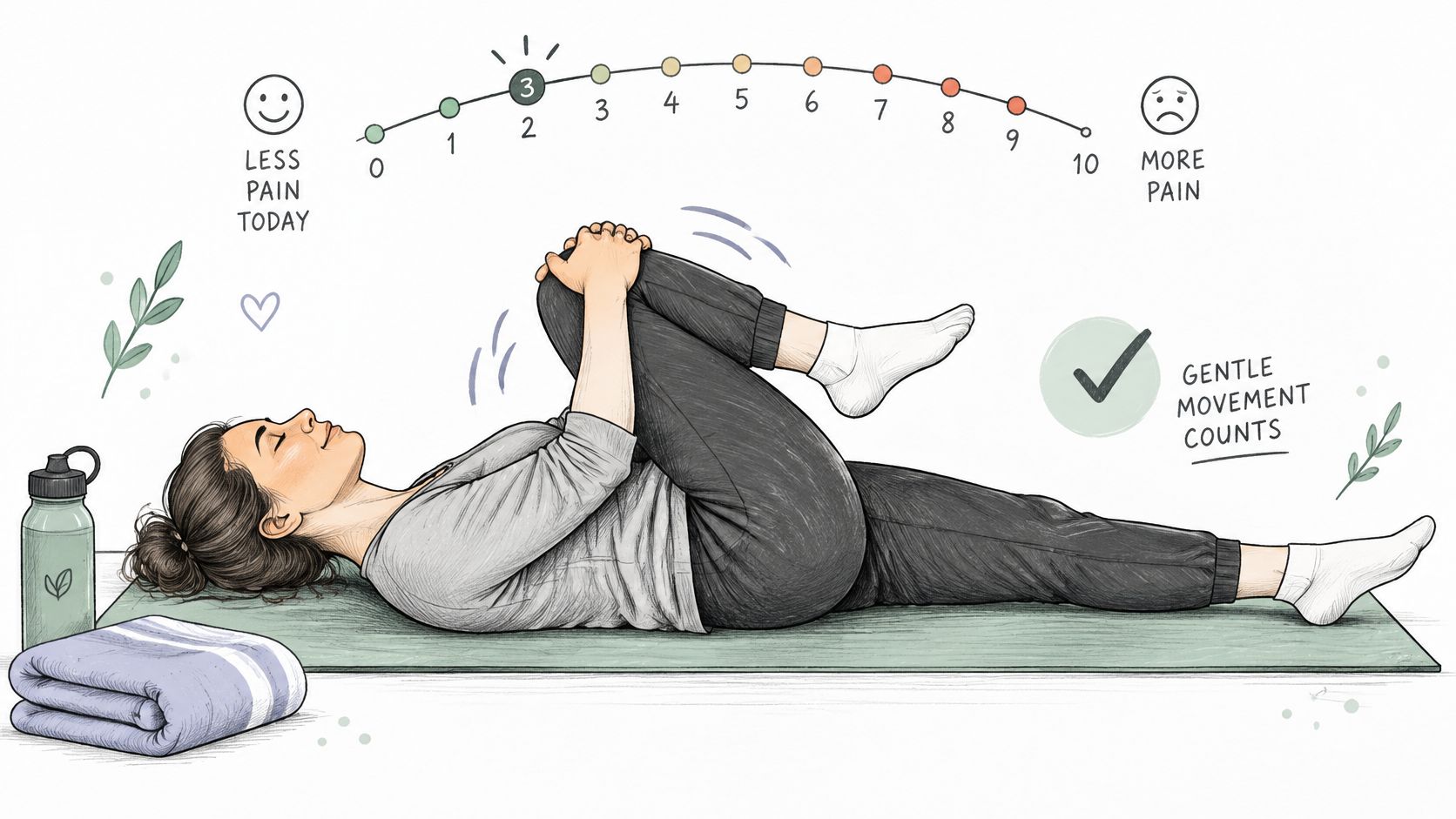
How to choose a starting move
Start with the movement that eases pain fastest, and do it once or twice a day. Keep the effort low enough that you could hold a conversation. A bird dog or a glute bridge is a simple entry to control work: the trunk stays quiet while the hips do a small job. If one option irritates you, drop it and try a smaller one. You don't get extra credit for completing the table.
| Exercise | How to do it | Starting dose | Stop if |
|---|---|---|---|
| Knee-to-chest stretch | Lie on your back and draw one knee toward your chest | 2 holds of 30 seconds per side | Pain shoots down the leg |
| Cat-cow | On hands and knees, slowly arch then round the back | 8-10 slow reps | Pain rises during the movement |
| Pelvic tilt | Lie with knees bent and gently flatten the lower back | 2 sets of 10 | Pain increases as you tilt |
| Glute bridge | Lie with knees bent and lift hips, then lower slowly | 8-12 reps | Cramping or sharp pain in the back |
| Bird dog | On hands and knees, extend opposite arm and leg | 8 reps per side | Loss of balance with pain |
| Child's pose | Kneel, sit back toward heels and rest forward | 1-2 minutes | Pain in the knees or hips |
If pain spreads down the leg, or it sharpens and stays sharp for more than a few minutes after a rep, that exercise is finished for the day. Switch to an easier movement or to the short walk. For pain that already travels into the leg, pair these doses with the limits in this guide to relieve sciatica pain naturally, and don't force a stretch through that line of pain.
A short demo helps when the bird dog feels vague on paper. Watch the pace more than the range.
How Much Movement Helps and When to Stop
A flare can make even a short walk feel like too much. Treat movement as a dose: adjust how long you move, how often you repeat it, and whether symptoms settle afterward. A 2025 umbrella review of 70 systematic reviews found low-to-moderate-certainty evidence that exercise and leisure-time activity offer modest improvements in pain and disability. Pilates, motor-control exercise, and yoga showed particular short-term promise. The review reported adverse events in fewer than 31% of the reviews; reported events were generally temporary soreness or increased pain, especially with yoga. A 2025 British Journal of Sports Medicine review found regular moderate-to-high leisure-time activity may lower the risk of chronic low back pain by 11% to 16% compared with inactivity. NICE recommends continuing normal activities and choosing exercise that fits your abilities, rather than following one stretch routine.
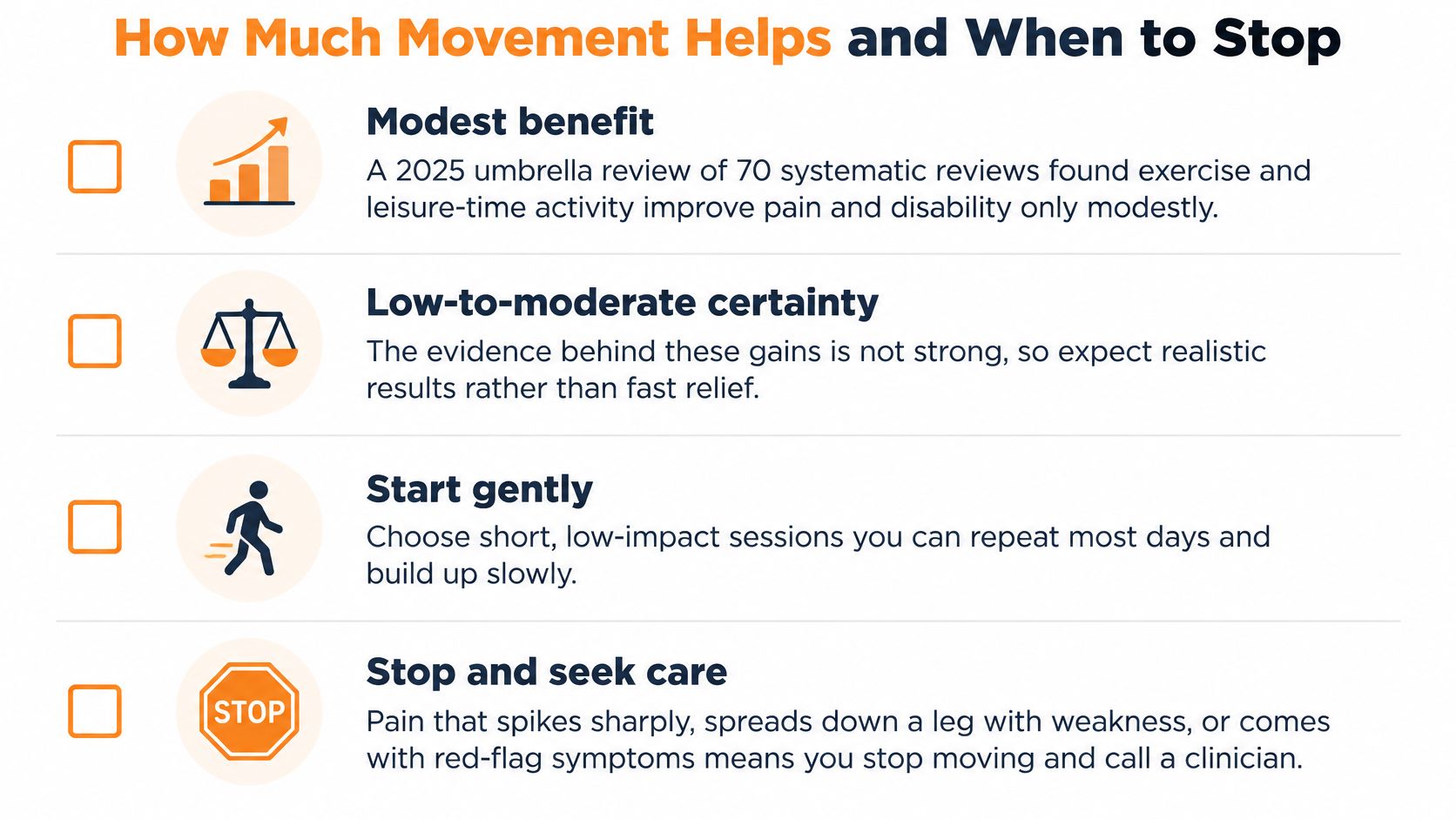
A traffic light for the next day
Judge the dose by how you feel afterward, not just by the first uncomfortable moment. Mild soreness can be acceptable if it eases and your movement returns to normal.
| Signal | What you notice | Action |
|---|---|---|
| Green | Mild ache for 24 to 48 hours that eases with the next warm-up and is back to baseline by morning | Continue the same dose |
| Yellow | Pain rises during a set, lasts beyond two days, or changes how you walk | Reduce repetitions or use an easier movement for a few days |
| Red | Pain travels below the knee, numbness, weakness, or another red-flag symptom | Stop exercising and get assessed |
Green example: After a ten-minute walk, your back aches that evening, then settles during the next morning's warm-up. Keep the walk at the same length.
Yellow example: Bridges feel manageable, but you limp for two days afterward. Halve the repetitions or switch to pelvic tilts until you can walk normally.
Red example: Cat-cow sends pain below the knee, or your foot feels weak. Stop the session and get assessed rather than trying to walk it off.
Yoga had the most reported soreness in the umbrella review, so start with shorter holds than a class video recommends. If a movement keeps provoking symptoms, change it instead of forcing a fixed routine. A short period of heat before an easy walk may help tight muscles feel looser. Stop that approach if leg symptoms or severe pain worsen.
Posture, Sitting and Sleep Changes That Reduce Strain
The everyday positions often keep a calmed back irritated. Change the setup for the place you're in right now, and keep each change small.
At a desk, set the chair so the hips sit slightly above the knees. Support the low back with a small rolled towel or a lumbar cushion, and put the screen at eye level so you aren't leaning toward it. Every 30 minutes, stand and walk for a minute or two. A practical desk reset is covered in this guide on how to improve posture at a desk.
In the car, slide the seat close enough that the knees stay soft, and add a lumbar support. On a long drive, stop about every hour and walk a short loop before you sit again.
When you lift, bend at the hips and knees, keep the load against your body, and don't twist while you're holding it. If one trip hurts, split it into smaller loads. The goal is a dose your back already tolerated this week.
Getting out of bed is a common trigger. Roll onto your side, let the legs drop over the edge, and push up with your arms instead of sitting straight up from flat on your back.
For sleep, lie on your side with a pillow between the knees, or on your back with a pillow under the knees. Pick a mattress that supports the natural curve rather than a very soft sink. A dedicated neck support pillow can steady your position if the setup feels unstable. It isn't a back treatment on its own.
When to Stop Home Care and See a Clinician
Home care is for a familiar, stable flare. Stop and seek urgent assessment now if you develop new bladder or bowel changes, numbness around the groin or inner thighs (saddle numbness), or worsening leg weakness. Fever, major trauma, unexplained weight loss, or pain spreading below the knee also warrant prompt clinical assessment. New bladder or bowel problems, saddle numbness, or progressive weakness need emergency care now. For the other warning signs, contact a clinician today rather than continuing home treatment.
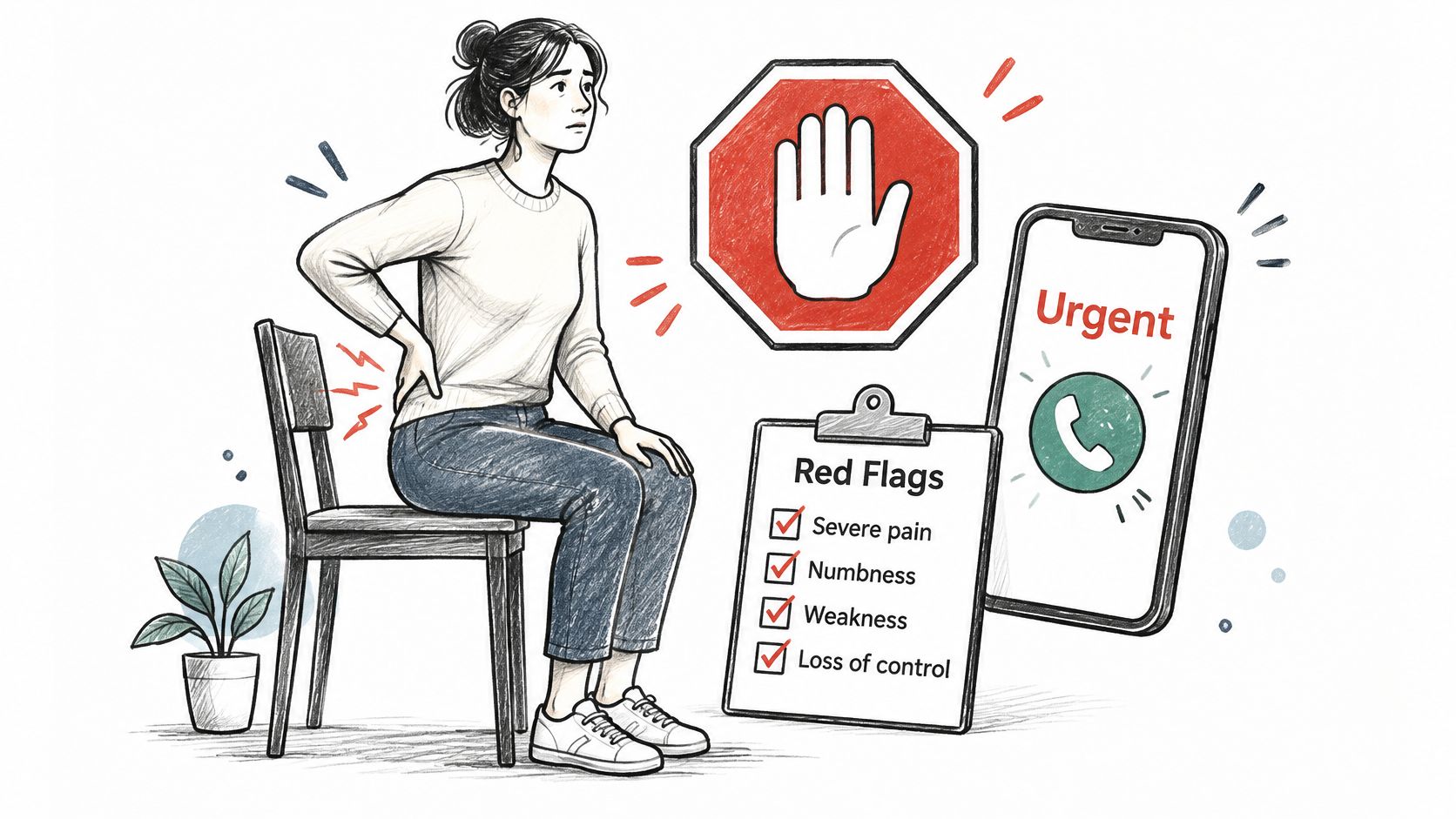
When the picture has changed
A clinical guideline on low back pain describes a first episode of severe pain after age 50, widespread neurological signs, and serious symptoms as reasons to consider escalation. Age alone does not confirm an emergency; the severity, accompanying symptoms, and clinical assessment matter. Pain below the knee can involve the leg, so ask a clinician for guidance instead of relying on heat alone. Seek prompt review if weakness is progressing.
Diabetes, neuropathy, or reduced feeling in your back or legs can make it harder to notice a heat pack getting too hot. Ask a clinician before using heat regularly. Check your skin during each session, and stop if it becomes numb or blistered, or if pain increases. Use the same caution if you cannot reliably judge temperature.
If pain is stable or improving and movement remains manageable, continue with measured self-care and reassess over the coming weeks. Book a doctor or physiotherapist if pain worsens, does not ease despite consistent care, or limits work or sleep. A visit helps determine what to try next when home measures provide only modest relief.
SunnyBay makes reusable microwavable hot and cold pads, air-activated heat patches, and simple massage tools for short, timed sessions. If a covered pad suits your plan, browse SunnyBay and choose a size that fits your back, following the label rather than extending heat time.


