


How to Improve Posture at Desk: Simple Fixes for Pain and Energy
-
If you want to fix your posture at a desk, the two most important things to focus on are adjusting your chair and monitor to support your spine's natural curve and making a conscious effort to stop slouching. Think about keeping your shoulders back and your head aligned right over your torso. This isn't just a quick fix; it's a proactive strategy to prevent the daily strain that builds up into chronic pain and bad habits.
Why Your Desk Is Wrecking Your Posture
Ever finish a workday and feel that nagging ache in your shoulders or a dull throb in your lower back? You're definitely not the only one. Our modern desk setups are built for productivity, but they have a nasty habit of becoming the root cause of our posture problems. It doesn't happen overnight, but the small, daily misalignments really add up, leading to serious discomfort and even long-term health issues.
The biggest problem is that desk work keeps us still. Our bodies are made to move, yet many of us are parked in a chair for eight hours or more every day. Sitting for that long weakens the very muscles in your back and core that are supposed to hold you upright, which makes it even harder to maintain good posture naturally.
The Rise of Tech Neck
One of the most common issues I see is "tech neck," which is just a term for forward head posture. It happens when you constantly lean your head forward to stare at your screen, putting a massive strain on your neck and upper back. It’s a bit shocking, but for every inch your head juts forward, it adds about 10 extra pounds of weight for your spine to deal with.
Think about it this way: holding a bowling ball close to your chest is pretty easy. Now, try holding it with your arms stretched straight out in front of you. You feel that strain? That’s exactly what your neck muscles are going through all day. This constant tension is a huge contributor to headaches, shoulder pain, and can even affect your breathing because slouching compresses your chest.
Unconscious Habits and Environmental Triggers
Most of the time, we don't choose to have bad posture. It’s an unconscious reaction to our workspace. Have you ever caught yourself leaning toward your screen when you're really concentrating on a tough task? That subconscious lean pulls your spine into an unhealthy C-shape.
Other common environmental culprits include:
- A monitor that’s too low or too high, forcing you to look down or tilt your chin up for hours.
- A chair that lacks good lumbar support, which lets your lower back round and slump.
- A desk that’s too high, making you shrug your shoulders and hold tension there all day.
The real danger of poor desk posture is that the damage is cumulative. What begins as a little stiffness can slowly snowball into chronic pain, compressed nerves, and musculoskeletal issues that affect your life well beyond your 9-to-5.
These factors create a vicious cycle. Your muscles get strained, so you shift into what feels like a more comfortable slouched position, but that only weakens the muscles you need for good posture even more.
Breaking this cycle means getting intentional about your setup and habits. For a deeper dive, check out our top 5 tips to prevent body aches while working from home for more strategies. Simply recognizing these subtle warning signs is the first, most important step toward fixing the problem and getting back to feeling good.
Setting Up Your Ergonomic Workstation
We've all been there: you look up from your screen and realize your neck is aching, your shoulders are hunched, and your back is screaming. It’s often a sign that your desk setup is quietly working against you. The good news is that you can fight back. Building an ergonomic command center is the single most impactful thing you can do, and it’s less about buying fancy gear and more about adjusting what you already have to fit you.
The cornerstone of a great ergonomic setup is what we call the 90-90-90 rule. It's a simple guideline: aim for roughly a 90-degree angle at your ankles, knees, and hips. This posture is your body’s neutral sweet spot, creating a stable base that takes the strain off your joints and spine.
Nailing Your Chair and Desk Height
Everything starts with your chair. Sit down and get your lower back right up against the lumbar support—no slouching away from it! Your feet need to be flat on the floor. If they’re dangling, grab a footrest or even a thick book. This solid foundation prevents a chain reaction of bad posture from starting at your feet.
Next up is the desk. With your feet planted and back supported, place your hands on your keyboard. Your elbows should be bent at that same 90-degree angle, with your forearms running parallel to the floor. If your shoulders are hiked up toward your ears, your desk is too high. If you're reaching down, it's too low. This simple check stops shoulder and neck tension before it starts.
For a deeper dive into what to look for when shopping, check out these excellent tips for selecting ergonomic desks and chairs.
As you can see below, something as simple as a poorly positioned monitor or an unsupportive chair can be the main culprit behind the dreaded "tech neck."
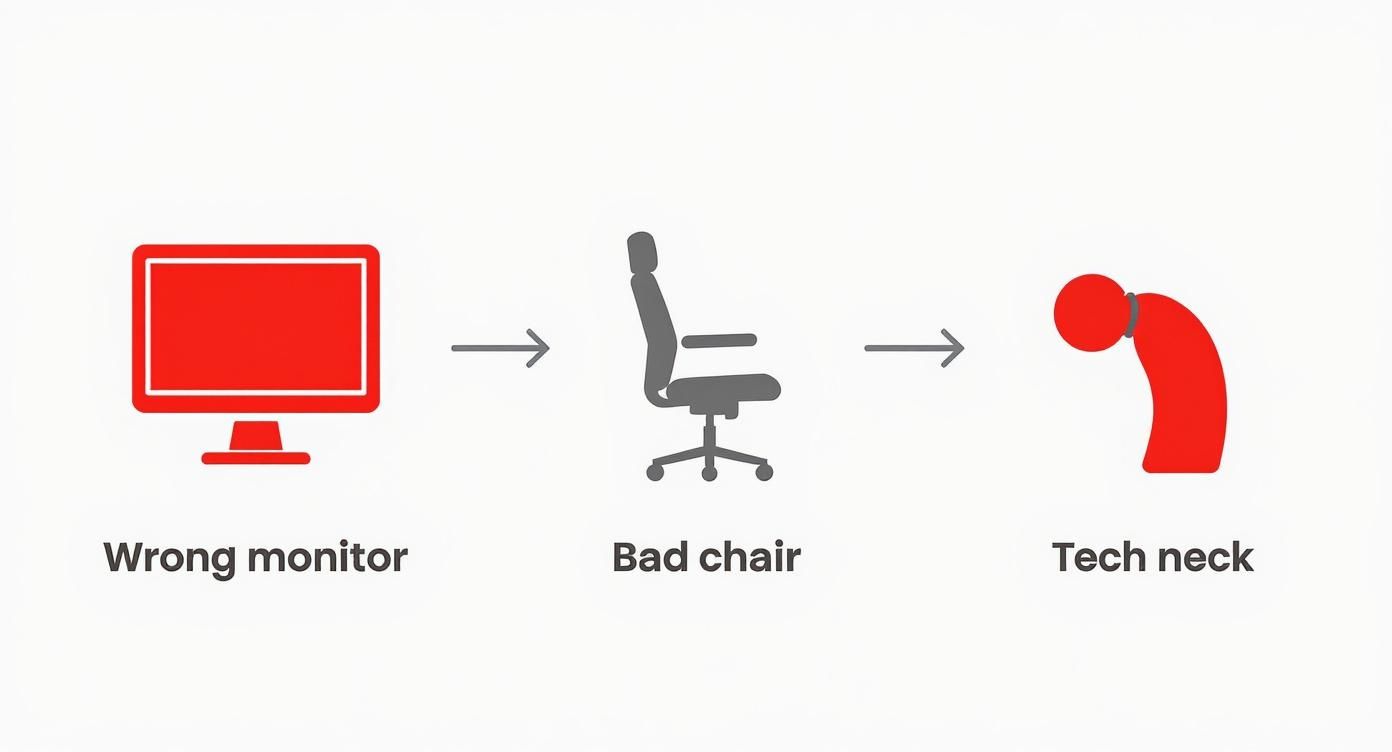
This image really drives home the point that your environment can literally force your body into painful, unnatural positions over hundreds of hours.
Placing Your Monitor and Peripherals
Now that your body is in alignment, let's sort out your screen. Position your monitor so the very top of it is at or just a hair below your eye level. It should also be about an arm's length away. This adjustment is critical; it keeps your head balanced naturally over your spine instead of jutting forward.
Your keyboard and mouse should be close enough that you don’t have to reach for them, maintaining that relaxed 90-degree bend in your elbows. If wrist pain is a constant companion, it might be time to look at some specialized gear.
- Vertical Mice: These feel a bit weird at first, but they keep your wrist in a natural "handshake" position, which takes a ton of pressure off your forearm muscles.
- Split Keyboards: By literally splitting the keyboard in two, these devices let your wrists and arms stay straight, preventing that inward angle that strains your tendons over time.
To help you get everything just right, here's a quick checklist you can run through.
Ergonomic Desk Setup Checklist
Use this table as a quick-reference guide to make sure every piece of your workstation is set up for success.
| Component | Ideal Position | Common Mistake to Avoid |
|---|---|---|
| Chair Height | Feet flat on the floor, knees at a 90-degree angle. | Feet dangling or tucked under the chair. |
| Back Support | Lower back is firmly against the lumbar support. | Sitting on the edge of the seat, creating a gap. |
| Desk Height | Elbows at a 90-degree angle, forearms parallel to the floor. | Shrugging shoulders (desk too high) or reaching down (too low). |
| Monitor Height | Top of the screen is at or slightly below eye level. | Cranking your neck up or looking down at the screen. |
| Monitor Distance | Roughly an arm's length away from your face. | Leaning in too close or squinting from too far away. |
| Keyboard/Mouse | Close enough to use without reaching, keeping elbows bent. | Stretching your arm forward to reach the mouse or keyboard. |
Treat this as a tune-up for your workspace. A few small tweaks can make a massive difference in how you feel at the end of the day.
The Game-Changing Power of Sit-Stand Desks
If there's one piece of equipment that can truly revolutionize your desk life, it's a sit-stand desk. The ability to switch between sitting and standing is a postural game-changer. It breaks up the static load on your spine, gets your blood flowing, and engages different muscle groups throughout the day.
This isn't just about feeling better, either. One landmark study found that giving employees sit-stand desks actually boosted their productivity by around 6.5%. The participants in the study stood for an average of 47 minutes at a time and reported far less back pain and general discomfort. It's a clear win-win. Simply avoiding long, uninterrupted stretches of sitting is one of the most powerful habits you can build.
Simple Habits and Stretches for Better Posture
Having the perfect ergonomic workstation is a fantastic start, but it's only half the battle. Let's be real: an adjustable chair and a well-placed monitor can't stop you from slouching if your muscles are tight and your habits are ingrained. The real, lasting change comes from transforming your posture from a static goal into a dynamic, conscious practice throughout your day.
This is where "micro-habits" are absolute gold. These are small, consistent actions you can weave into your workday to actively fight against the forward slump. Think of them as quick resets for your body that counteract the pull of gravity and the screen. They don't take much time, but their cumulative effect is powerful.
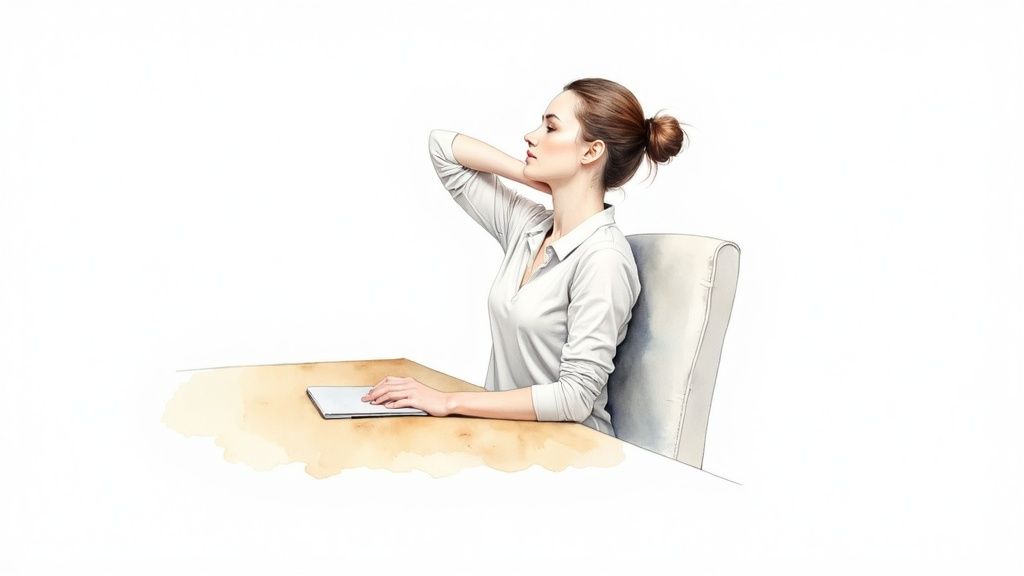
Posture-Correcting Micro-Habits for Your Desk
Integrating a few simple movements into your routine can make a world of difference. Try setting a recurring reminder on your calendar or just stick a note on your monitor until they become second nature.
Here are two of my favorite, most effective micro-habits you can start right now:
- The Chin Tuck: This is your secret weapon against "tech neck." Sit tall and gently pull your chin and head straight back, like you're trying to make a double chin. You should feel a nice stretch at the base of your skull and the muscles in the front of your neck working. Hold for 5 seconds and release. Aim to do this 10 times every hour to get your head back over your spine where it belongs.
- Scapular Retractions: To fight those hunched shoulders, sit upright and squeeze your shoulder blades together as if you're holding a pencil between them. This is amazing for opening up your chest and pulling your shoulders back into proper alignment. Hold that squeeze for 3-5 seconds and repeat 10-15 times. This little move strengthens the key upper back muscles that are often weak and overstretched.
The point isn't to hold a rigid, perfect posture all day long. It's about frequently interrupting poor posture with these corrective movements, which gradually teaches your body a better default sitting position.
Simple Stretches to Undo Desk Damage
Beyond those quick habits, dedicated stretching is crucial for releasing the tension that builds up from hours of sitting. When muscles in your chest, neck, and shoulders get tight, they physically pull you into a slouch. These simple stretches help lengthen those muscles, giving you the mobility you need to sit upright comfortably.
1. The Doorway Stretch This is one of the best ways I know to open up a tight chest.
- Stand in an open doorway. Place your forearms on the frame with your elbows bent at a 90-degree angle.
- Gently step one foot forward until you feel a comfortable stretch across your chest and the front of your shoulders.
- Hold this for 20-30 seconds, remembering to breathe deeply. Don't arch your back.
For example, if you notice your shoulders rounding forward after a long meeting, a quick doorway stretch can immediately counteract that and provide instant relief.
2. Upper Trapezius Stretch This one targets the muscles running from your neck to your shoulders—an area that gets incredibly tight for most of us.
- Sit tall in your chair and gently tilt your right ear toward your right shoulder.
- To deepen the stretch, you can place your right hand on top of your head and apply very light pressure.
- Hold for 20-30 seconds, then slowly repeat on the left side.
The Power of Heat Therapy for Muscle Relief
Sometimes, your muscles are so tight and knotted from poor posture that stretching alone doesn't quite cut it. This is where heat therapy becomes an invaluable tool. Applying warmth to tense areas isn't just about feeling good; it's a therapeutic process that boosts circulation. This increased blood flow brings fresh oxygen to your tired muscles, helping to flush out the waste products that cause soreness and allowing the muscle fibers to relax, making them far more receptive to stretching.
Imagine this: after a long day hunched over a keyboard, your shoulders feel like a block of concrete. Applying a microwavable heat pack for 15-20 minutes not only melts away that tension but also makes it easier to hold good posture the next day. It’s like warming up clay before you try to mold it—the heat makes change possible. For stubborn knots, learning how to relieve upper back tension effectively can be a game-changer for long-term comfort.
Massage Therapy for Deeper Release
While heat is fantastic for general relaxation, massage offers a more targeted approach to breaking down those specific, chronic knots—often called trigger points. These are nasty little spots in your muscles that can cause pain right where they are and even in other parts of your body.
A professional massage therapist can find and release these knots, restoring mobility and letting your muscles finally work correctly. The benefits are significant: you get immediate pain relief and release the underlying tension that’s sabotaging your posture. For example, a therapist can work on deep knots between your shoulder blades that constantly pull you forward, something you can't easily address on your own. This doesn't just feel good; it physically stops the force that pulls you into a slouch, giving you a clean slate to build better habits.
And don't forget to move! Research from the 'Take-a-Stand Project' found that cutting sitting time by just 66 minutes per day led to a 54% reduction in upper back and neck pain. These findings highlight how vital small changes and active recovery really are. By combining these habits, stretches, and recovery methods, you create a powerful system for actively improving your posture at your desk.
Building Core Strength to Support Your Spine
An ergonomic setup is a great start, but it only creates the potential for good posture. The real work of holding yourself upright all day comes from within. True, effortless alignment isn't something your chair can give you; it comes from a strong, resilient core that holds your spine in place naturally.
Think of your spine like the mast of a sailboat. Without strong support ropes pulling evenly from all sides, it’s going to lean and buckle under the slightest pressure. Your core muscles—along with your upper back and glutes—are those support ropes. When they're weak, your lower back and neck have to pick up the slack, leading directly to the chronic pain and fatigue you're trying to fix.
Strengthening these key areas creates a "postural foundation" that makes sitting upright feel like second nature instead of a constant chore. The goal here is to build the stability needed to stop posture problems before they even start.
Essential Exercises for a Stronger Postural Foundation
You don't need a gym membership or fancy equipment to build the muscles that support a healthy spine. A few simple, targeted exercises done consistently at home can make all the difference.
Here are three of my go-to exercises for clients:
- Bird-Dog: This move is fantastic for core stability and balance. Start on your hands and knees. Keeping your back perfectly flat, extend your right arm straight forward and your left leg straight back. Hold for a few seconds, then switch sides. The trick is to keep your core tight and avoid arching your back—imagine you have a glass of water balanced on your lower back and you can't let it spill.
- Glute Bridges: Strong glutes are your lower back's best friend. Lie on your back with your knees bent and feet flat on the floor. Squeeze your glutes and lift your hips toward the ceiling until your body forms a straight line from your shoulders to your knees. Hold that squeeze for a moment at the top before slowly lowering back down.
- Resistance Band Pull-Aparts: This is the perfect antidote for a day spent hunched over a keyboard. It targets those weak, overstretched muscles in your upper back. Stand tall, hold a light resistance band with both hands, and extend your arms straight out. Now, keeping your arms straight, pull the band apart by squeezing your shoulder blades together.
The real benefit of these exercises goes beyond just muscle strength. You're actually training your mind-muscle connection, making you more aware of how to engage the right muscles to hold yourself upright throughout the day.
Integrating Strength Into Your Routine
When it comes to building postural strength, consistency beats intensity every time. You don't need to go all out. Just aim to perform a short routine of these exercises 3-4 times per week.
You could do them first thing in the morning to "wake up" your postural muscles for the day ahead. Or, try them in the evening to reverse some of the damage from a long day of sitting.
Even small, targeted efforts can produce surprisingly fast results. Research has shown that combining neck and shoulder exercises with the use of a standing desk can lead to measurable postural improvements in just four weeks. One study found this simple combination helped correct forward head posture, improving the craniovertebral angle from an average of 62.08° to 63.40°. It’s a perfect example of how being proactive directly improves your alignment. You can learn more about these posture findings and see the data for yourself.
Building this strength is one of the best investments you can make for your long-term health, ensuring you stay pain-free and upright at your desk—and everywhere else.
Using Heat and Massage for Posture Recovery
After a long day wrestling with your computer, it's no surprise that your muscles feel tight, knotted, and just plain sore. We often focus on exercises and stretches for long-term posture correction, but what about immediate relief? That's where active recovery methods like heat and massage come in. Think of them less as a treat and more as essential maintenance for undoing the daily strain of desk work.
When your muscles are constantly tensed up, they physically pull your body out of alignment, making it feel almost impossible to sit up straight. Targeted therapy can break that cycle.
The Soothing Power of Heat Therapy
Applying warmth to your neck and shoulders is more than just comforting—it’s therapeutic. Heat therapy, or thermotherapy, works by boosting blood flow to the area. This increased circulation rushes oxygen and nutrients to your aching muscle tissues, which helps flush out the waste products that build up and speeds up the healing process.
Picture this: you've spent the afternoon hunched over a project, and now your upper back feels like a block of concrete. Applying a heated neck wrap for just 15-20 minutes can work wonders, relaxing those cramped muscle fibers. It’s a simple trick that can stop a tension headache in its tracks and makes it far easier to sit properly the next day because you’re not fighting against your own body. Knowing when to use which therapy is important; our guide on when to ice and when to heat can clear up any confusion.
Heat therapy essentially "melts" away muscle tightness, making them more pliable and receptive to stretching. It preps your body for recovery, turning a stiff, tense area into one that is relaxed and ready to heal.
Using Massage to Work Out Stubborn Knots
While heat provides a wonderful, widespread sense of relief, massage gets right to the point—breaking up those stubborn knots, also known as trigger points. These are those nasty, irritable spots in your muscles that don't just cause pain right where you press, but can also send pain shooting to other places, like up into your head or down your arm.
These knots are often a direct result of holding a poor posture for hours on end. While nothing beats a professional massage, you can get a lot of relief right at home.
- Self-Massage: Grab a massage ball or even a tennis ball, place it between your shoulder blades and a wall, and gently roll to apply steady pressure to those tight spots.
- Targeted Tools: For nagging neck pain, a smart electric neck massager with heat function can be a great way to deliver focused relief right where you need it most.
By directly targeting these knots, you’re releasing the very tension that's pulling your shoulders forward and your head down. When you combine regular heat with targeted massage, you create a powerful one-two punch for recovery. It's a proactive routine that gives you immediate comfort while supporting your long-term goal of better posture.
Got Questions About Desk Posture? We’ve Got Answers.
Even after dialing in your setup and starting new habits, you're bound to have questions. That's a good thing! It means you're paying attention to your body. Think of improving your posture as a journey, not just a destination—and it's totally normal to need a little guidance along the way. Here are some of the most common questions I hear from people trying to undo years of slouching.
How Long Does This Actually Take?
It’s the first thing everyone wants to know, and the most honest answer is: it depends. Real, lasting change doesn't happen overnight. It likely took months, if not years, for your current posture to become second nature, so it's going to take some time and patience to create a new normal.
Most people start to feel a real difference within the first 1-2 weeks. You'll notice you're more aware of when you're slouching, and you might even feel some initial relief from pain. But for that new, upright posture to become your body's automatic go-to? You're probably looking at 3 to 6 months of consistent work. Consistency is everything—sticking with your ergonomic setup, exercises, and daily habits is what makes the change stick.
Are Those Posture Corrector Straps a Good Idea?
You've probably seen them online—the strap-like braces that physically pull your shoulders back. They can be a bit of a mixed bag. On one hand, they can be a fantastic short-term tool. They give you the physical sensation of what correct alignment feels like, which can be a lightbulb moment. Think of them like training wheels for your body.
But here's the catch: relying on one for too long can backfire. If the brace is doing all the work, the very muscles in your upper back that you need to strengthen can get lazy and even weaker. My advice? Use them sparingly, maybe for 15-30 minutes at a time, to build that muscle memory. Just don't let them become a permanent crutch.
Can Heat and Massage Really Help With Posture?
Absolutely. While they won't magically straighten your spine on their own, heat and massage are crucial recovery tools that make the whole process so much easier. Bad posture creates a vicious cycle of tight, knotted muscles in your neck, shoulders, and back.
It’s a physical problem: those tense muscles are literally pulling your skeleton out of alignment. Heat therapy is brilliant because it boosts blood flow, which helps relax those stubborn muscle fibers and ease stiffness. It’s like melting away the tension, making it easier to stretch and sit tall without feeling like you’re fighting your own body.
Massage gets even more specific, breaking up those deep, stubborn knots (or trigger points) that often cause tension headaches and nagging shoulder pain. When you release them, you're not just getting pain relief—you're restoring mobility and stopping the constant pull that sabotages all your hard work. Basically, exercises build your strength, but heat and massage clear out the roadblocks that get in the way.
What if I Keep Forgetting to Sit Up Straight?
First of all, welcome to the club. Forgetting is completely normal, especially when you're deep in concentration. Nobody can hold a perfect, rigid posture for eight hours straight—and that's not even the goal. The real aim is to build mindfulness and constantly interrupt the slouch before it settles in.
Here are a few tricks that actually work:
- Set a Nudge: Use your phone or a simple browser timer to ping you every 30-45 minutes. When it goes off, just do a quick check-in. Shoulders back? Head over your spine? Done.
- Use a Visual Cue: Stick a small Post-it note on the corner of your monitor. A simple word like "TALL" or "SHOULDERS" is all you need to jolt your memory.
- Habit Stack: This one is my favorite. Link a posture reset to something you already do dozens of time a day. Every time you take a sip of water, answer the phone, or hit "send" on an email, take one second to sit up straight.
Before you know it, these little conscious checks will become second nature. You'll find yourself adjusting your posture without even thinking about it.
For those days when the muscle tension is winning, having a great recovery tool ready to go makes all the difference. SunnyBay offers a whole line of microwavable heat wraps designed to give you deep, soothing relief right where you need it most. Our U.S.-made neck and shoulder wraps are perfect for melting away that stiffness from sitting at a desk, which in turn makes it easier to maintain a healthy posture day after day.
Ready to find your go-to for drug-free pain relief? Explore the SunnyBay collection.


