


How to Relieve Sciatica Pain Naturally
-
To get a handle on sciatica pain naturally, the best approach is often a combination of gentle exercises, specific stretches, and simple therapies like using heat and cold packs. These work together to calm down inflammation and loosen up the tight, angry muscles that are making things worse. It’s all about soothing that irritated sciatic nerve with the right movements and a few key lifestyle tweaks, giving you a way to manage the pain yourself.
Why Sciatica Flares Up and How You Can Find Relief
That shooting pain running down your leg isn't really a "condition" on its own—it's a massive clue that something else is going on. Sciatica happens when your sciatic nerve, the longest and thickest nerve in your body, gets pinched, compressed, or seriously irritated. Imagine stepping on a garden hose; the pressure creates a big problem further down the line. That's what's happening in your back.
This nerve starts in your lower back, travels deep through your hips and buttocks, and goes all the way down each leg. When something puts pressure on it, it fires off pain signals that can range from a dull, persistent ache to a searing, burning sensation or even a jolt that feels like an electric shock.
The Usual Suspects Behind Sciatic Nerve Pain
A few common issues are usually to blame for aggravating this nerve. Figuring out the likely culprit helps you pick the right natural strategies to start feeling better.
- Herniated Disc: This is the big one. The soft, jelly-like cushion between your vertebrae bulges out and presses directly on the nerve root.
- Piriformis Syndrome: Deep in your glutes, you have a muscle called the piriformis. If it gets too tight or spasms, it can clamp down on the sciatic nerve, which often runs right underneath it (and for some people, straight through it).
- Spinal Stenosis: This is simply a narrowing of the canal your spinal cord runs through. Less space means more potential for nerves to get squeezed.
- Bone Spurs: Sometimes, little extra growths of bone can form on your vertebrae, and these can poke into the space where the nerve is trying to exist peacefully.
If you're dealing with this, you're in good company. Sciatica is a massive global health issue, and it's estimated that anywhere from 10% to 40% of people will experience it at some point in their lives. It tends to show up most often when people are between 30 and 50 years old, with millions of new cases popping up around the world each year.

Taking Back Control With a Whole-Body Plan
Here’s the good news: most of the time, you can manage sciatica really well with natural, at-home care. This guide is designed to give you a complete plan, starting with gentle movements and therapies and moving into small but incredibly effective lifestyle changes. The real goal here is to fix the root of the problem, not just put a temporary bandage on the pain.
By learning how to release muscle tension, fix your posture, and build a stronger core, you’re not just fighting this flare-up—you're building a solid foundation for long-term spinal health to keep it from coming back.
This well-rounded strategy isn't just for sciatica; it shares a lot of principles with other effective methods, like those in our guide to natural pain relief for back pain. Once you understand why you're hurting, you can move forward with confidence, knowing you're choosing the right techniques to finally get some lasting relief.
Gentle Stretches to Soothe an Angry Sciatic Nerve
When that sharp, zinging pain shoots down your leg, your first instinct is probably to freeze. Moving seems like the worst possible idea. But here’s the thing I’ve seen time and again: gentle, targeted stretching is one of the best things you can do to calm down an irritated sciatic nerve.
The right kind of movement creates space around the nerve and coaxes those tight, clenching muscles in your lower back and glutes to finally let go. Think of it like trying to untangle a delicate necklace chain—you can't just yank on it. You need slow, patient, and precise movements to get things sorted out.
This chart breaks down the process: you start by figuring out what’s causing the problem, which helps you understand the mechanics, and then you can take targeted action.
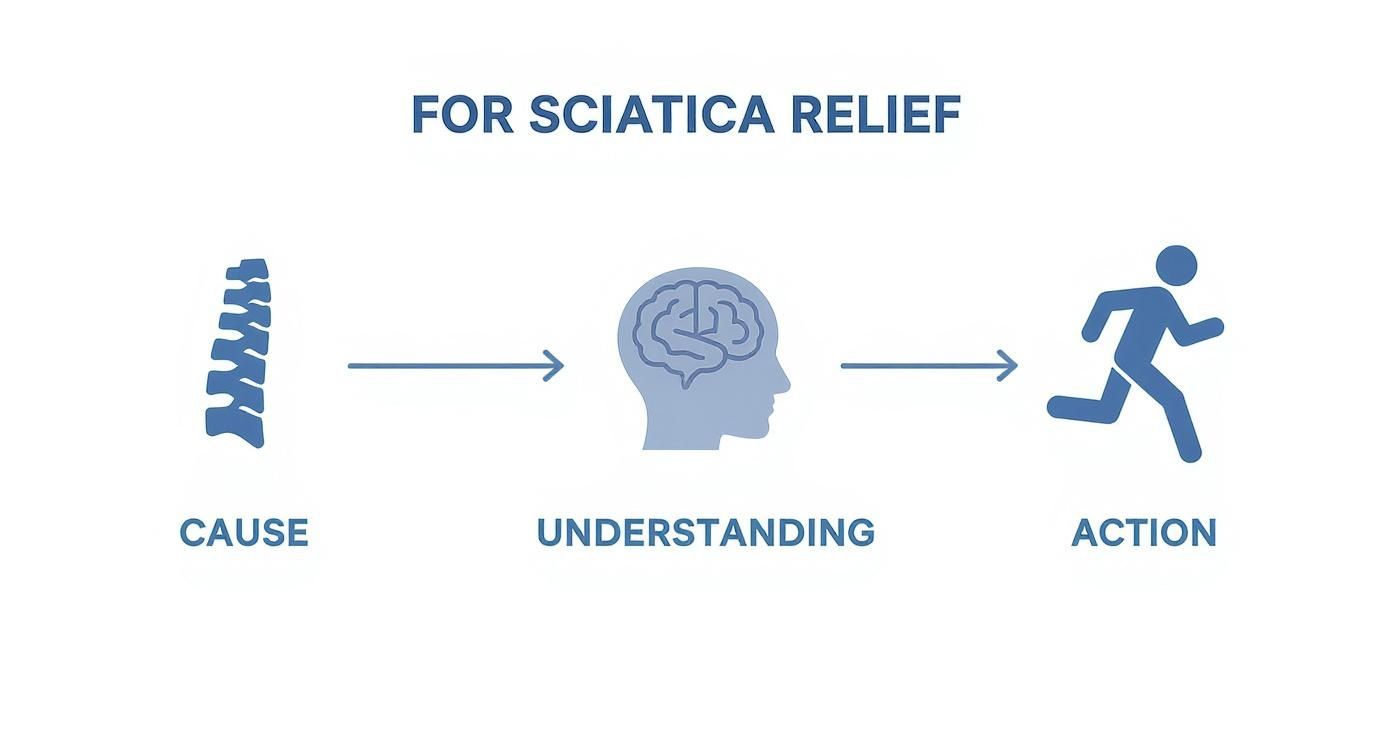
It’s a logical flow. Once you know why it hurts, you can apply the right stretches to address the root of the problem.
Foundational Stretches for Immediate Relief
Before you dive into deep stretches, it’s really important to warm up your back. Don't skip this. A simple routine can make a world of difference, especially first thing in the morning. Try starting your day with just five gentle cat-cow flows on your hands and knees. It’s a fantastic way to wake up your spine and get everything moving smoothly.
Once you’re feeling a bit looser, you can try these specific stretches that are known for providing sciatic relief.
- Reclining Pigeon Pose: This is my go-to recommendation because it’s a much gentler way to hit the piriformis muscle than the standard yoga pose. Lie on your back with your knees bent. Cross your right ankle over your left knee to make a "figure four" shape. Now, gently pull your left thigh toward your chest until you feel a nice, easy stretch in your right glute. Hold it for 30 seconds.
- Knee-to-Opposite-Shoulder Stretch: Another great one that doesn't put any strain on the lower back. While lying on your back, pull your right knee into your chest. From there, gently guide it across your body toward your left shoulder. You should feel this in the glute and piriformis. Hold for 20-30 seconds, then switch sides.
- Seated Spinal Twist: Sit on the floor with your legs straight out in front of you. Bend your right knee and place your right foot on the outside of your left thigh. Put your left elbow on the outside of that right knee and gently twist your torso to the right. This mobilizes the spine and stretches all the little supporting muscles.
The golden rule here is to aim for a mild pulling sensation, never sharp pain. If any movement makes that nerve pain worse, back off immediately. Your body is your best guide—listen to it.
Building Core Strength for Long-Term Prevention
Stretching is fantastic for immediate relief, but if you want to prevent sciatica from coming back, you need to build strength. A weak core means your lower back muscles are constantly overworked and strained, which is often what leads to nerve compression in the first place.
Building a stronger core doesn't require a punishing gym routine. It's about creating a natural "corset" of muscle to support and protect your lumbar spine. For a deeper dive into back care, our guide on how to treat chronic back pain has some great complementary strategies.
Simple Exercises to Strengthen Your Core
Forget about intense crunches. We're talking about gentle, controlled movements that build real, functional strength.
- Glute Bridges: Lie on your back, knees bent, feet flat on the floor. Slowly lift your hips up, making sure to squeeze your glutes at the very top. This is a powerhouse move for strengthening your glutes and lower back, which work together to keep your pelvis stable.
- Bird-Dog: Get on all fours. Slowly extend your right arm straight forward while extending your left leg straight back at the same time. The trick is to keep your back perfectly flat—don't let it sag. This is one of the best exercises for balance and for strengthening the deep stabilizer muscles along your spine.
Remember, consistency beats intensity every time. Try to work these simple exercises into your routine 3-4 times a week. Over time, you’ll build the muscular support system needed to take the pressure off your sciatic nerve for good.
Using Heat And Cold Therapy For Immediate Relief
When a sciatica flare-up hits, that sharp, radiating pain demands fast relief. This is where simple heat and cold therapy can be your best friend. These are two of the most reliable and easy-to-use tools in your pain management toolkit, but the trick is knowing which one to grab and when.
Think of it this way: for the first 48 hours of a new flare-up, your body is in full-on inflammation mode. Swelling and sharp pain are the main events. During this initial window, cold therapy is what you need. Applying an ice pack constricts the blood vessels, which helps dial down the swelling and provides a welcome numbing effect to take the edge off that intense pain.
After those first couple of days, it's time to switch gears. Your focus shifts from fighting inflammation to relaxing the tight, spasming muscles that are likely compressing the sciatic nerve. This is where the magic of heat therapy comes in. Applying warmth is a powerful signal to your body to relax. It opens up the blood vessels, boosting circulation and bringing a soothing wave of oxygen-rich blood to the tense muscles in your lower back and glutes, encouraging them to finally let go. For example, applying a warm pack for 20 minutes before you stretch can make the muscles more pliable, allowing you to get a deeper, more effective release with less discomfort.
To make it even clearer, here’s a quick guide to help you decide which therapy is right for the moment.
Heat Therapy vs Cold Therapy for Sciatica
| Therapy Type | Best For | How It Works | Example Application |
|---|---|---|---|
| Cold Therapy | The first 48 hours of a new, acute flare-up with sharp pain and inflammation. | Constricts blood vessels, reduces swelling, and numbs the area to dull sharp pain. | Apply an ice pack (wrapped in a towel) to your lower back for 15 minutes. |
| Heat Therapy | After the initial 48 hours, for dull, persistent aches and muscle stiffness. | Dilates blood vessels, increases blood flow, relaxes tight muscles, and soothes stiffness. | Use a microwavable heat pack on your lower back or hip for 20 minutes before stretching. |
Remember, this isn't a strict rule—sometimes a little heat feels good even in the early stages, or you might find cold helps with a lingering ache. Listen to what your body is telling you.
Why Moist Heat Works Better
Here’s a pro tip: not all heat is the same. A standard electric heating pad provides dry heat, which is fine, but it mostly just warms the surface of your skin. Moist heat is different. It penetrates much deeper into the muscle tissue, reaching those deep, stubborn knots that are often at the root of sciatic pain, like the piriformis muscle.
This is why I often recommend microwavable heat packs, like the ones from SunnyBay, which are filled with natural grains that release moist heat.
Picture this: you've been sitting too long, and that familiar ache starts creeping down your leg. You grab a heat pack, pop it in the microwave, and spend 20 minutes lying down with it draped over your lower back. You can feel that penetrating warmth sinking in, coaxing those wound-up muscles to relax their grip on the nerve. It’s a simple, powerful way to interrupt the pain-spasm cycle right in its tracks.
A Simple At-Home Protocol
To get the most out of these therapies, it helps to have a game plan. Knowing exactly when to ice and when to heat is the key.
Here’s a practical routine you can follow the next time sciatica strikes:
- For Acute Flare-Ups (First 2 Days): Grab a cold pack, wrap it in a thin towel, and apply it to the most painful spot for 15-20 minutes. Do this every few hours to keep inflammation in check.
- For Lingering Aches (After Day 2): Now it's heat's turn. Use a moist heat pack for 15-20 minutes to warm up your muscles, especially before you do any gentle stretching. It’s also fantastic at the end of the day to soothe away tension.
- Always Be Safe: Never put a heat or cold pack directly on your skin. Always use a towel or some kind of cloth barrier to prevent burns or skin damage.
You’re not alone in looking for solutions like this. Between 2008 and 2019, web searches for sciatica doubled, and YouTube searches grew an incredible six-fold. It’s clear that more and more people are actively seeking out practical, natural ways to manage their pain at home. By mastering these simple techniques, you're doing just that.
Fine-Tuning Your Daily Habits to Protect Your Spine
Lasting relief from sciatica often boils down to the small, consistent choices you make every single day. While stretches and heat therapy are fantastic for immediate comfort, tweaking your daily habits is like building a long-term protective shield for your spine, preventing those painful flare-ups from ever starting. The way you sit, stand, lift, and even sleep can either constantly aggravate that sensitive sciatic nerve or create an environment where it can finally heal.
https://www.youtube.com/embed/riD8Xt8r1MQ
This isn't about a massive, life-altering overhaul. Think of these as small, mindful adjustments that add up over time, leading to a huge improvement in how you feel day in and day out.
Your Workspace: The Unsuspecting Sciatica Trigger
For so many of us, the real enemy is the desk chair. Hours of prolonged sitting, especially in a poorly configured workspace, can force your spine into a slumped, unnatural C-shape. This puts relentless pressure on your lower back and is a surefire way to irritate the sciatic nerve.
A few simple ergonomic tweaks can make a world of difference.
- Get Your Chair Height Right: Your feet should be flat on the floor, with your knees bent at roughly a 90-degree angle. If your feet are dangling, grab a small stool or a stack of books to use as a footrest. This simple fix helps keep your pelvis in a neutral, happy position.
- Insist on Lumbar Support: Your chair needs to support the natural inward curve of your lower back. If it doesn't, you'll slouch. An easy fix is to roll up a towel or use a small cushion and wedge it into the small of your back.
- Check Your Monitor Position: The top of your computer screen should be at or just a hair below eye level. This prevents you from craning your neck forward, a bad habit that creates a domino effect of poor posture all the way down your spine.
The single most important habit? Get up! Set a timer on your phone or computer to stand, stretch, and walk around for a minute or two every 30-45 minutes. This is non-negotiable. It resets your posture and gets crucial circulation flowing to your spinal discs.
Master the Art of Everyday Movement
Sciatica pain can be triggered by seemingly harmless activities, like loading the dishwasher or picking up a box. The key is to learn how to move with your spine in mind—making it a conscious, foundational skill for a pain-free life.
One of the biggest culprits is lifting things incorrectly. Every time you bend at the waist to pick something up, you’re putting all that strain directly on the small, vulnerable muscles and discs in your lower back. It’s a recipe for disaster.
Instead, always lift with your legs. Get close to the object, keep your back straight, and bend at your knees and hips. Use your powerful leg and glute muscles to do the heavy lifting. This technique shields your spine from dangerous pressure and is one of the most important habits you can possibly adopt.
Hidden Aggravators: What’s in Your Pocket and on Your Feet?
Sometimes, the source of sciatic nerve irritation is something you’d never suspect. Two of the most common—and surprising—culprits are your wallet and your shoes.
Ever heard of "wallet sciatica"? It's a real thing. Sitting on a bulky wallet in your back pocket throws your pelvis out of alignment. This creates an uneven surface that twists your spine and can directly compress the sciatic nerve over time. The fix couldn't be simpler: always take your wallet out of your back pocket before you sit down.
Your footwear choices also play a huge role. High heels can completely alter your body's alignment, increasing the curve in your lower back and putting a ton of extra stress on it. At the same time, shoes with zero arch support can cause your feet to roll inward, which can misalign your legs and hips, eventually leading to back pain. Opt for supportive, comfortable shoes whenever you can.
How to Sleep Your Way to a Healthier Spine
Sleep is when your body does most of its healing and repair work, but the wrong sleeping position can undo all your good efforts from the day. The goal all night long is to keep your spine in a neutral, straight line.
A supportive mattress is the foundation of good sleep posture. For a deep dive into choosing the right one, you can explore this guide on how to find the best mattress for back pain relief.
Once you have a good surface, a few strategically placed pillows can work wonders:
- Back Sleepers: Slide a pillow under your knees. You'll feel your lower back relax immediately as this takes the pressure off the arch.
- Side Sleepers: Place a firm pillow between your knees. This is crucial for preventing your top leg from sliding forward and twisting your pelvis and lower back out of alignment.
- Stomach Sleepers: Try your best to avoid this position. It forces your neck to twist at an extreme angle and can flatten the natural, healthy curve of your spine, putting unnecessary strain on your entire back.
The Role of Massage and Professional Therapies
While your daily stretches and smart habits are the foundation for managing sciatica, sometimes you need to call in the professionals. When the pain is stubborn or feels more complex, a hands-on approach from an expert can make a world of difference, getting to the root of the problem in a way that self-care alone just can’t.
Think of it this way: your at-home routine is like daily maintenance for your car. But when a specific part is acting up, you take it to a skilled mechanic. Professional therapy is that tune-up for your body, targeting the exact issue causing all the trouble.
The Power of Targeted Massage Therapy
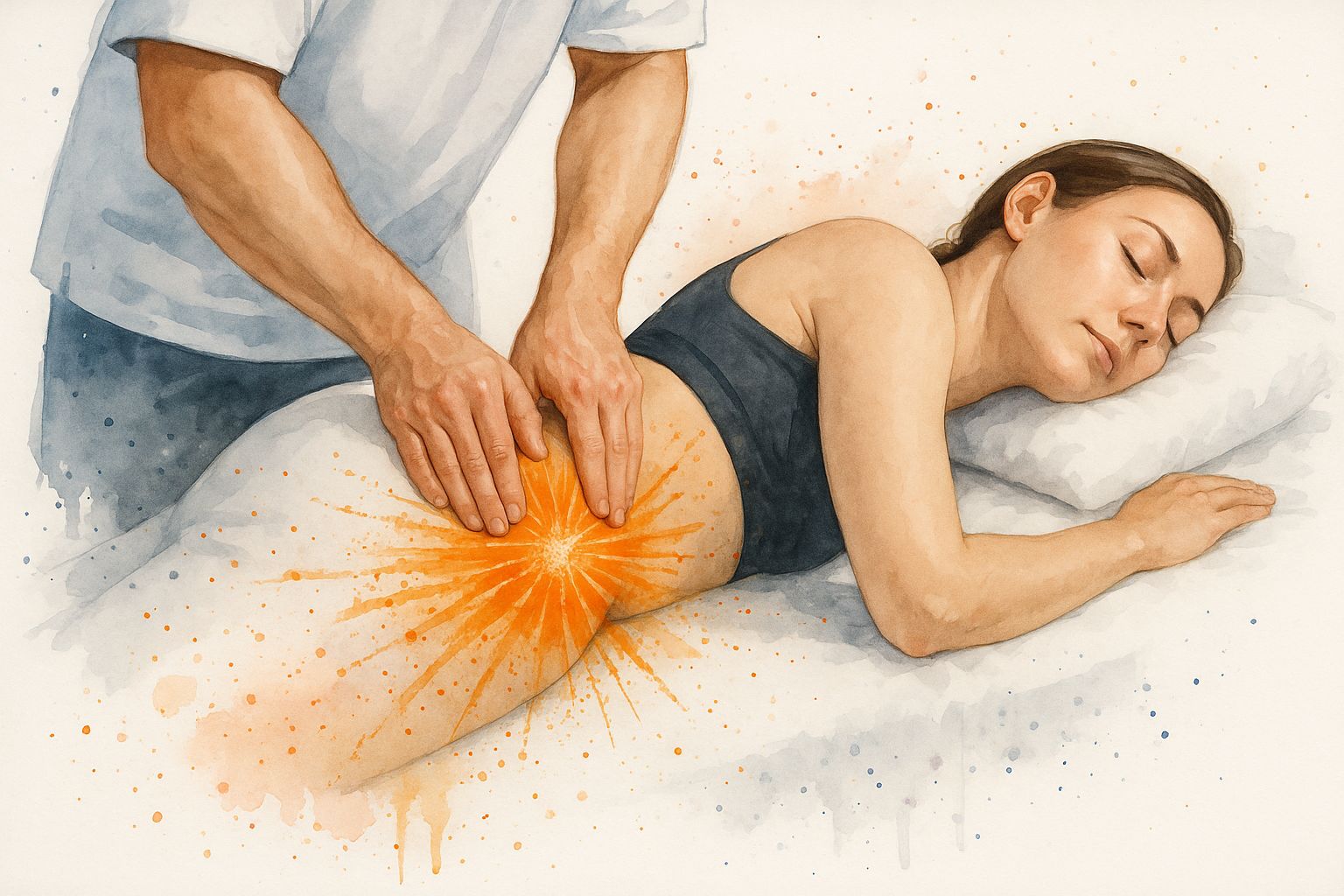
Massage is often mistaken for a simple luxury, but for sciatica, it’s a serious therapeutic tool. It’s not about a gentle, relaxing spa day, but focused manual therapy designed to release the very muscles that are clamping down on your sciatic nerve. The benefit here is undeniable: a skilled therapist can achieve a level of muscle release that is nearly impossible to do on your own.
A good therapist can use techniques like deep tissue massage and trigger point therapy to zero in on the piriformis and other deep gluteal muscles. Imagine the relief when they apply precise, sustained pressure to a deep, painful knot in your hip. You can almost feel the muscle finally letting go, and with it, the radiating ache down your leg starts to fade. This isn't just about temporary relief; it's about physically creating more space for the nerve to function without being compressed. For many, regular massage becomes a cornerstone of their long-term management plan, preventing tightness from building up in the first place.
Expert Tip: To get the most out of your session, use a moist heat pack on the area for about 20 minutes before you go. This warms up the muscles, making them more pliable and letting your therapist work more deeply and effectively right from the start.
Understanding Other Professional Options
Massage is fantastic, but it's not the only game in town. Several other professional therapies can bring excellent results, each tackling the problem from a slightly different angle. The best fit for you often depends on what’s causing your sciatica in the first place.
- Physical Therapy: A physical therapist is essentially your personal coach for recovery. They’ll assess how you move and build a custom program of stretches and strengthening exercises to correct imbalances and give your spine the long-term support it needs.
- Chiropractic Care: A chiropractor’s primary focus is spinal alignment. Using gentle adjustments, they can help realign vertebrae that might be out of place, which can take direct pressure off the nerve roots and get your joints moving correctly again.
- Acupuncture: This ancient practice uses ultra-thin needles inserted at specific points on the body. The goal is to stimulate the nervous system, which can help trigger the release of endorphins—your body’s own powerful, natural pain relievers.
As you explore different therapies, you might come across treatments like dry needling. It's always smart to be informed about any procedure you're considering, and understanding things like what happens if dry needling hits a nerve is part of making a well-rounded decision.
Knowing When to See a Doctor
These natural therapies work wonders for most cases of sciatica. But it's absolutely crucial to know when to stop self-treating and see a doctor. Some symptoms point to something more serious, and ignoring these red flags can potentially lead to permanent nerve damage.
You need to seek immediate medical attention if you experience any of these symptoms:
- Loss of Bladder or Bowel Control: This can signal a rare but serious condition called cauda equina syndrome, which is a medical emergency.
- Progressive Leg Weakness: If you notice your foot "dropping" when you walk or you're stumbling more often, it's a sign of significant nerve compression.
- Numbness in the "Saddle" Area: Any loss of feeling in your inner thighs, groin, or buttocks is another major red flag.
- Pain After a Traumatic Injury: If sciatica symptoms began right after a major fall or a car accident, you need a proper medical evaluation.
Sciatica is a widespread issue, and its impact is growing. The global market for its treatment was valued at USD 5.38 billion in 2024 and is projected to more than double by 2032. This trend shows just how many people are looking for relief and underscores the importance of having a clear plan that combines both consistent self-care and professional guidance when you need it.
Your Top Questions About Sciatica Relief, Answered
When you're dealing with sciatica, it's natural to have questions. You want to know what to expect, what tools to use, and how to navigate daily life without making things worse. Let's walk through some of the most common concerns I hear from people trying to manage their sciatica pain at home.
How Long Does It Take for Natural Relief Methods to Work?
This is the big question, and the answer is: it depends. You can get immediate, short-term relief in as little as 15-20 minutes from something like a heat pack or a gentle stretch. It’s a great way to take the edge off right now. For example, after 20 minutes with a warm pack on your lower back, you might find you can stand up with less pain and move more freely than before. That’s an immediate, tangible benefit.
But for real, lasting change, you need to be patient and consistent. Most people start to feel a significant improvement after one to four weeks of sticking with a routine. The severity of your nerve compression and what’s causing it are the biggest factors here. If you've been diligent for a few weeks and the pain is sticking around or getting worse, that's your cue to see a professional.
Can I Use a Massage Gun for Sciatica Pain?
A massage gun can be a fantastic ally, but only if you use it with caution. It’s designed to work on muscle, so it’s great for loosening up the tight glutes, piriformis, and hamstring muscles that often contribute to sciatica. By relaxing these muscles, you can sometimes indirectly ease the pressure on the sciatic nerve.
Here's the crucial part: never use it directly on your spine, bones, or right over the sciatic nerve itself. If you feel a sharp, shooting pain, you’re hitting the wrong spot. Always start on the lowest setting and stick to the meaty part of the muscle. If it makes the nerve pain worse, stop immediately.
Is It Better to Rest or Stay Active with Sciatica?
It’s all about finding the right balance—what we often call "active recovery." Long periods of bed rest are actually counterproductive; they lead to more stiffness and weakness, which can prolong your recovery. Of course, you absolutely need to avoid anything that causes that sharp, searing pain, like heavy lifting or high-impact exercise.
Gentle movement is your best friend. It’s not just safe; it’s essential. Short walks and the targeted stretches we've covered in this guide are perfect. They increase blood flow, reduce inflammation, and get nutrients to the injured area. The golden rule is to listen to your body. Rest when the pain is sharp, but make gentle activity a daily goal.
What Is the Best Sleeping Position for Sciatica?
The goal is to keep your spine neutral and take the pressure off your lower back. Small adjustments can make a world of difference overnight.
- Back sleepers: Slide a pillow under your knees. This little bit of elevation helps your lower back maintain its natural curve, instantly reducing strain.
- Side sleepers: Pop a firm pillow between your knees. This is key to preventing your top leg from sliding forward and twisting your pelvis and spine out of alignment.
And if you can, try to avoid sleeping on your stomach. It tends to flatten your spinal curve and can twist your neck into an uncomfortable position for hours on end.
For over 20 years, SunnyBay has been a trusted name in clinics and homes, providing simple, drug-free pain relief that just works. See for yourself how our microwavable heat packs can deliver targeted moist heat to become a key part of your sciatica recovery. Visit https://sunny-bay.com to find the right solution for you.


