


Heat or Ice for Neck Pain: When to Use Each
-
Ice fits roughly the first 48 to 72 hours after a new neck strain, and gentle heat fits the stiffness that lingers once that window closes. When one research team gave 60 people with acute neck or back strain either a 30-minute heat pack or a cold pack, alongside ibuprofen, the two groups finished within two points of each other on a 100-point pain scale. Neither tool wins outright.
That answer disappoints anyone who came for a verdict. It satisfies anyone who thinks like a clinician, because the useful question was never heat versus ice in the abstract. It's which stage your neck is in right now, and how long either pack can safely sit against your skin.
A neck that got rear-ended on Tuesday and a neck that's been craned toward a laptop since March are not the same problem. One is inflamed soft tissue that needs calming. The other is muscle guarding that needs loosening before it will move. Same body part, opposite first move.
Three things settle it. Whether there was an injury. Whether the neck is puffy or merely tight. Whether anything neurological is happening in the arm or hand. Get those three right and the pack choice stops being a debate.
Table of Contents
- Heat or Ice Depends on the Pain Stage
- How Long and How Safely to Treat the Neck
- What a Head to Head Trial Found
- Heat Before Movement for Chronic Stiffness
- What the Small Heat Studies Actually Show
- Stop Home Care for These Warning Signs
- Match the Tool to the Stage You Chose
Heat or Ice Depends on the Pain Stage
Cold comes first when the tissue is fresh. A sudden strain, a jolt from a fall, a whiplash-style snap, a neck that swelled after a knock: that's an inflammatory moment. Cold slows blood flow near the surface and dulls the local nerve signals that make a new injury throb. Heat at that stage pulls more blood into tissue that's already puffy, which is why people who reach for a heating pad on night one often wake up stiffer than they went to bed.
Once the swelling settles and the main complaint shifts to tightness, the logic flips. Warmth increases circulation, relaxes guarding, and makes movement feel less locked. That's the stage where a warm wrap earns its place, ideally right before you ask the neck to turn or stretch.
No injury at all? A dull ache that built across a week of screen work, a stiff morning after a bad pillow: start with heat. Nothing is inflamed. Something is tense.
Head-to-head studies don't crown a universal winner, so treat the table below as a situation matcher rather than a scoreboard.
| Situation | Better first choice | Why it fits | Skip it when |
|---|---|---|---|
| Sudden strain or crash jolt in the first 48 to 72 hours | Ice | Fresh pain and possible swelling | Skin is numb or the pain is worsening fast |
| Visible puffiness after a new injury | Ice | Cold is preferred while inflammation is new | There is an open wound or poor circulation |
| Residual tightness after the acute window | Gentle heat | Stiffness and muscle guarding remain | The area is still hot, swollen, or newly injured |
| Desk or screen tension with no trauma | Heat | Warmth eases guarding before movement | Pain shoots into the arm or grip is weak |
| Chronic nonspecific stiffness | Heat, then movement | Low-level warmth can make stretching easier | It replaces prescribed exercise entirely |
| Mixed puffiness and tightness | Alternate, with a long break | Each tool has a different job | Sessions are stacked back to back |
| Numbness, arm weakness, fever, or major trauma | Neither as the plan | These are medical warning signs | Home packs are used instead of an exam |
Walking the rows
The first two rows describe the same neck at different intensities, and both point to cold. A crash jolt or a tweak while lifting produces micro-tearing and inflammation, and cold is the tool that matches that state. The exception matters: if the skin over the neck is numb, or the pain is climbing fast, a colder pack is the wrong response. That pattern needs a person, not a compress.
Row three is where you arrive after two or three days. The swelling has calmed, the neck is stiff and guarded, and gentle warmth now helps more than cold. Don't apply it to an area that's still hot to the touch or visibly swollen, because that's the acute phase talking.
The desk-tension row needs no ice at all. Warm the neck and shoulders for a timed session, then do the chin tucks and slow turns while the tissue is loose. The red flag there is pain that travels into the arm or a hand that suddenly feels weak, which points away from muscle tension and toward a nerve.
Chronic stiffness is the row where the evidence is friendliest, and warmth is a prelude to movement rather than a substitute for it. On a mixed day, when the neck is both puffy and tight, alternate the two, but leave a long gap between them instead of stacking sessions back to back. And the last row isn't a treatment decision at all.
Pick the single row that describes today, follow it, and ignore the rest until the pattern changes. The clock and the session limits matter as much as the choice itself, and they're specific enough to be worth following exactly rather than improvising. Heat and cold logic doesn't stop at the neck either, since the same staging applies to joints, and this osteoarthritis heat and cold guide works through how arthritis patients sequence the two. If cold is the choice this week, shape counts as much as temperature, and a contoured neck ice pack that follows the curve of the cervical spine stays in place better than a bag of frozen peas balanced on a collar.
How Long and How Safely to Treat the Neck
For an acute strain or a sudden painful episode, major clinical guidance puts cold at roughly the first 48 to 72 hours, commonly for up to 15 minutes per session, and reserves gentle heat for the residual stiffness and muscle tension that follow, as an NHS neck pain leaflet sets out. The same leaflet gives a tighter operational benchmark for either pack: wrap it in a towel, apply for 10 to 15 minutes, repeat three to four times daily, and leave at least two hours between applications.
Read what those parameters describe. A moderate, stable temperature. Broad contact across the neck and shoulder. No direct skin exposure. A pack that runs hotter than that isn't delivering more treatment, it's delivering a burn risk.
Six steps for either pack
- Check the skin before anything else. Skip areas that are broken, bright red, white, blistered, or numb. Numb skin can't warn you when something's going wrong.
- Put a layer in between. A thin towel between pack and neck, every time. Ice never touches bare skin, because cold injury can start without clear warning.
- Time it. Set the timer before the pack lands, not after it starts feeling like too much.
- Take it off and look. Recheck color and comfort before you decide whether to do anything else.
- Wait at least two hours. Cap the day at three or four sessions rather than topping up whenever it aches.
- Don't sleep with it. No heating pad and no ice bag overnight, no exceptions.
Why longer isn't a stronger dose
The research doesn't hand you a best temperature, a best duration, or a best delivery format. A 2025 guideline recommends self-applied heat for nonspecific neck pain while describing the broader evidence for thermotherapy as weak, which the review of the thermotherapy evidence base makes explicit. The one head-to-head pack trial used a single timed application, not a home protocol, and the modest improvement it found may have owed as much to the ibuprofen both groups took as to the temperature itself. More heat, or a hotter pad, isn't a bigger dose.
Practical rule: Set the timer before the pack touches your neck. A pack you have to remember to remove is a pack that stays on too long.
Sensation changes everything here. Anyone with diabetes, neuropathy, or reduced skin sensation needs shorter intervals and more frequent checks, because burns and cold injury can begin before pain registers as a warning. That's also why a reusable wrap beats a loose heat source: you can feel where it sits.
If you use a microwavable pad, learn its real limits before the first session, and the heating pad safety basics cover the microwave timing and cover questions that decide whether it helps or burns. Reusable wraps, molded cold packs, and portable patches differ in fit, coverage, and portability. They don't differ in proven clinical superiority. And when pain doesn't ease after a correctly timed trial, the next step is an exam, not more minutes.
What a Head to Head Trial Found
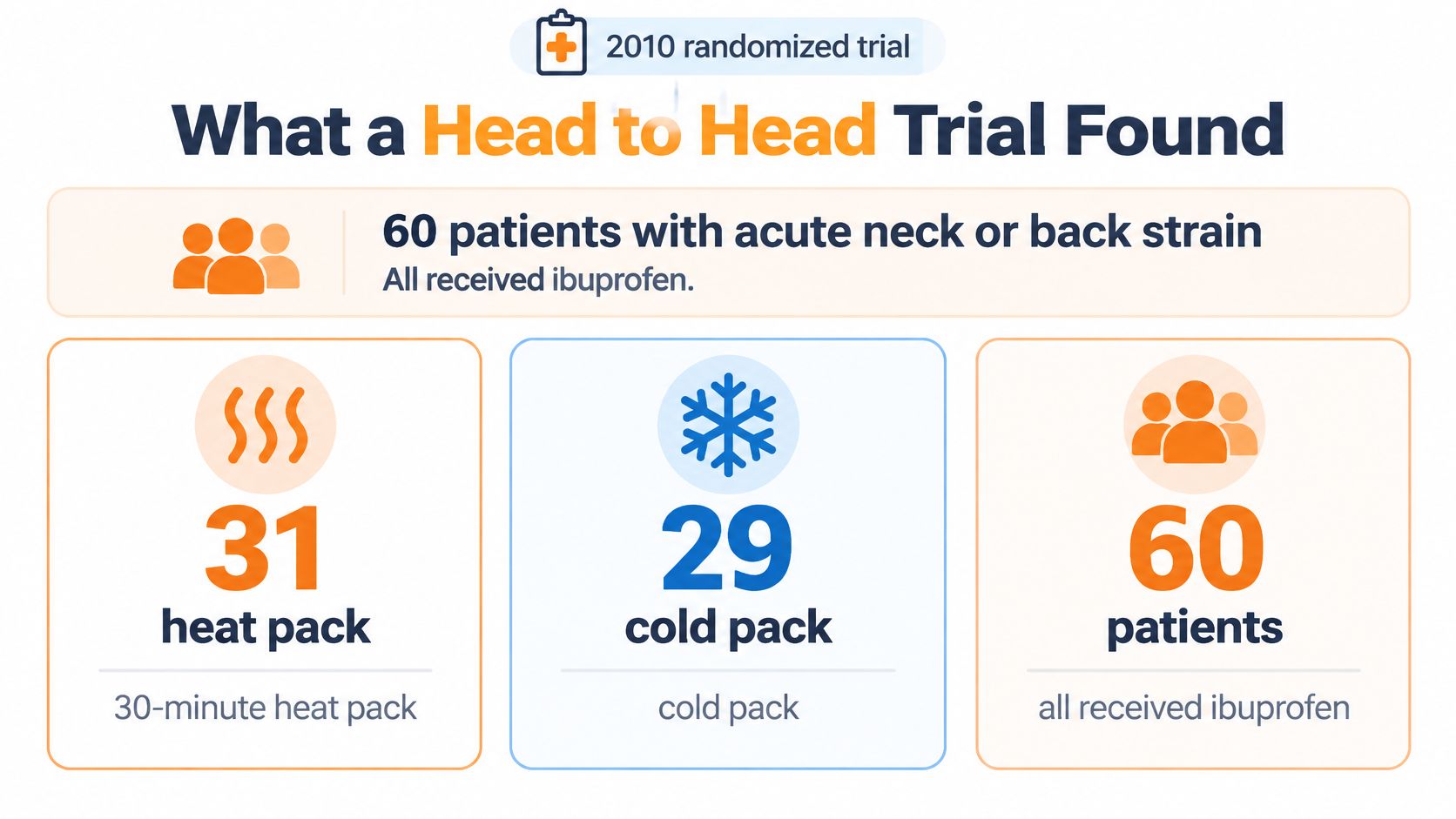
The cleanest consumer comparison available is a 2010 randomized controlled trial that gave everyone ibuprofen and then split them: 31 people got a 30-minute heat pack, 29 got a cold pack, and all 60 had acute neck or back strain, as reported in the published trial. Before treatment, average pain sat at 75 mm on a 100-mm scale in the heat group and 72 mm in the cold group.
After the session, those scores fell to 66 mm and 64 mm. The gap between groups wasn't statistically significant before treatment (p = 0.56) or after it (p = 0.75). Neither option clearly outperformed the other.
Patient impressions tracked the same way. 16 of 31 heat users (51.6%) rated their pain better or much better, against 18 of 29 cold users (62.1%), with p = 0.27. Asked whether they'd choose the same treatment again, 80.6% of heat users and 75.9% of cold users said yes, p = 0.65.
| Measure | Heat pack (n=31) | Cold pack (n=29) | Comparison |
|---|---|---|---|
| Pain before treatment | 75 mm | 72 mm | p = 0.56 |
| Pain after one 30-minute session | 66 mm | 64 mm | p = 0.75 |
| Rated better or much better | 16 of 31 (51.6%) | 18 of 29 (62.1%) | p = 0.27 |
| Would choose the same treatment again | 80.6% | 75.9% | p = 0.65 |
What the trial cannot tell you
A single 30-minute add-on to ibuprofen can't prove that longer heat, colder ice, or one particular pad beats another. The authors described the improvement as mild and similar across both groups, which is the honest reading of a two-point difference.
What the numbers do support is a decision rule. Choose by stage and by what feels relieving, then stop looking for a winner. A person who likes the numbing effect of cold on a fresh strain and a person who relaxes under warmth on a stiff evening are both making defensible choices. Neither is being misled by marketing.
The next question is the one the trial never asked, which is what happens when warmth is paired with rehabilitation instead of used alone.
Heat Before Movement for Chronic Stiffness
Continuous low-level heat does more than feel pleasant when the neck has been stiff for weeks. In a randomized controlled trial of 92 patients, low-level continuous heat used as an adjunct to physical therapy significantly reduced pain and Neck Disability Index scores while increasing cervical range of motion and neck strength compared with control conditions (p < 0.01), according to the trial report. It also improved adherence to prescribed home exercises (p < 0.05).
That adherence finding is the one worth circling. People who felt warm and looser did their exercises more consistently, and consistency is what rebuilds capacity in a chronic neck.
Translate it into a routine. On a stiff day, warm the neck and shoulders first, then run through the mobility and strengthening work while the tissue feels less guarded. Heat opens the door. The exercise walks through it.
Set up the wrap so it helps
- Broad, even contact beats concentrated heat. A wrap that lies along the neck and across the shoulder tops distributes warmth better than a small pad pressed into one spot.
- Warm, not painfully hot. If you're bracing against the temperature, it's too hot, and bracing defeats the relaxation you came for.
- No excessive pressure. A wrap should rest on the neck, not clamp it, since compression on a guarded neck can recreate the guarding.
- A cover and a check. Fabric between pack and skin, plus a glance at the skin afterward, catches problems early.
- A timer, every time. The session ends on the clock, not on a feeling.
The mismatch to keep straight is timing. New trauma, visible swelling, or suspected acute inflammation still starts with cold, and heat waits until that phase has settled. Applying warmth to a two-day-old injury because it feels good in the moment is how a mild strain turns into a miserable week.
One honest caveat about the evidence. That trial tested a clinical low-level continuous heat protocol, so its results aren't proof that every microwavable product delivers the same temperature control or the same duration of warmth. A wrap that cools in ten minutes isn't equivalent to four hours of controlled heat.
Used well, warmth makes a rehabilitation plan easier to follow, which is why the pairing shows up so often in broader back and neck pain relief routines. Used as a substitute for the plan, it's just a comfortable delay.
What the Small Heat Studies Actually Show
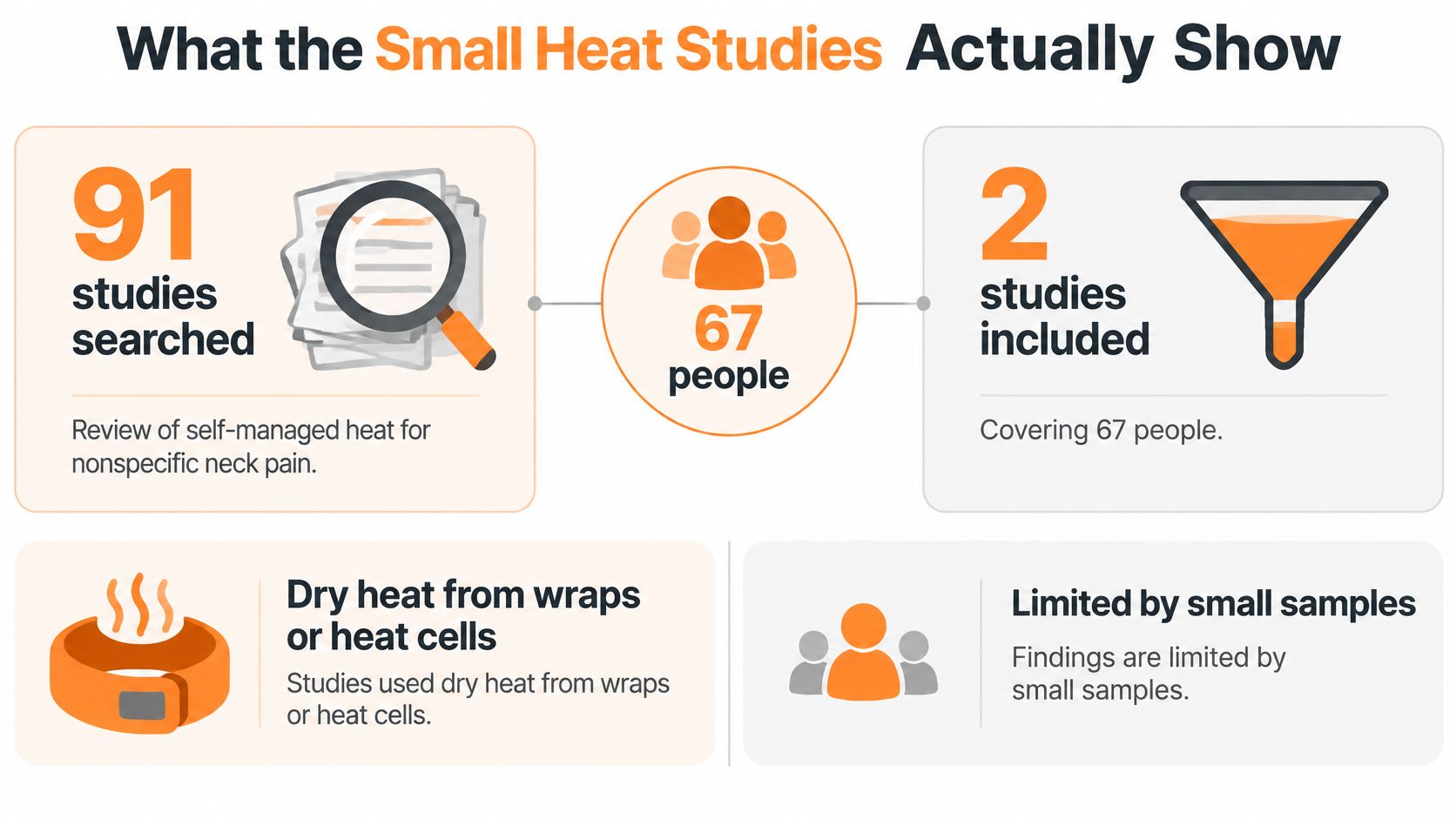
The evidence for self-managed heat in nonspecific neck pain is thinner than the confident advice suggests. A review identified 91 studies, yet only 2 met its inclusion criteria, covering 67 participants in total, per the review of self-managed heat therapy. Both eligible studies tested dry heat from heat wraps or heat cells.
That limitation matters. Two small studies can show a direction, like a compass needle leaning north, but they cannot tell you which product is superior or how every neck will respond. They also cannot turn heat into a universal treatment for every kind of neck pain. The useful question is narrower: when stiffness is the main feature and there are no red flags, does sustained warmth make symptoms more manageable?
The first study was randomized and included 20 adults whose neck pain had lasted at least a month. Heat at approximately 41.0 ± 0.5°C was applied to the shoulder area for 4 hours. Pain measured on a visual analog scale fell significantly compared with sham treatment (p = 0.002), with a reported Cohen's d of 0.81 for the between-group effect.
Read that as a controlled research setup, not a home instruction. Four hours of carefully delivered heat is a way to test whether warmth has an effect. It is not a target to copy by sitting under a hot pack all afternoon. The second study reported that pain after 2 weeks of heat therapy decreased to 19.0 ± 12.5 (p < 0.05), although the control group also improved by 8.9 mm. Heat was not the only thing changing in that picture.
A 2025 clinical guideline nonetheless recommends self-applied heat for nonspecific neck pain and allows cold when it feels agreeable or relieving to the patient. That is a cautious endorsement of comfort and preference, not a declaration of a champion.
Four hours in a study is not four hours on your sofa
The practical takeaway is modest but useful. Heat has a reasonable place in stiffness without trauma, especially when the goal is to make movement and daily activity easier. A new strain still starts with cold during the acute window. A day that feels both puffy and tight uses one modality at a time, with a clear gap in between.
Warmth that helps a stiff neck is moderate and sustained. It is never maximal.
The numbers do not establish a definitive effect size for all users. They do not show that one wrap, patch, or pad beats another. They support the stage-based choice: heat for the tight, non-acute phase, cold for the early inflamed phase, and comfort as a guide within safe limits. That is a smaller claim than "heat cures neck pain," and it is the one the evidence supports.
Stop Home Care for These Warning Signs
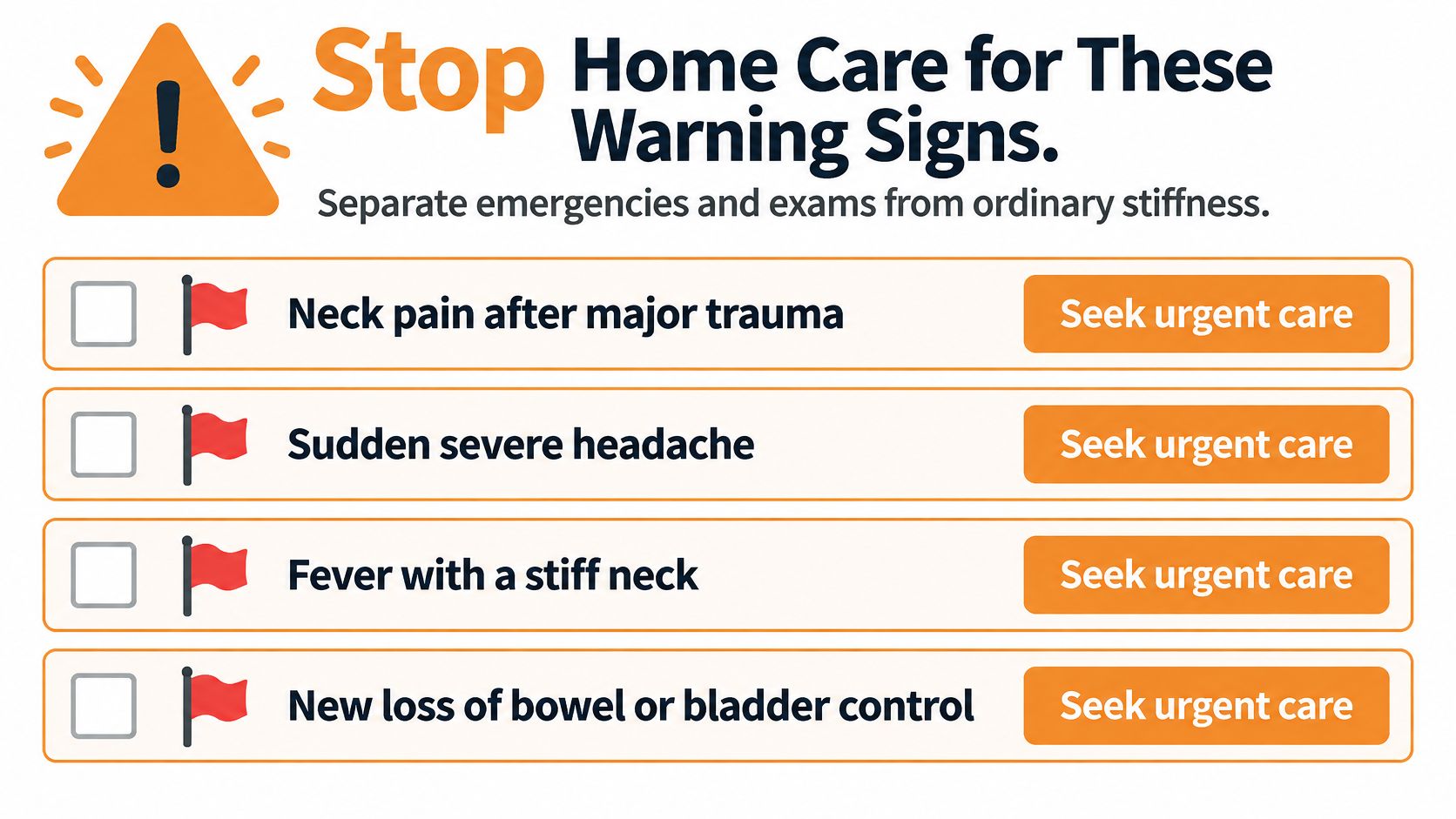
Most neck pain is ordinary and settles. A small share isn't, and those cases need to be separated out before anyone reaches for a pack.
Seek urgent care for neck pain after major trauma, a sudden severe headache, fever with a stiff neck, new loss of bowel or bladder control, rapidly worsening weakness, or neck pain that follows a fall in an older adult. These are the patterns where minutes matter and a compress is irrelevant.
Book a prompt appointment for pain that outlasts a short home trial, pain or tingling running into an arm, dropping objects, marked weakness, a change in balance, or night pain that keeps intensifying. Fever with neck stiffness belongs on the urgent list, not the wait-and-see list.
Packs change comfort. They don't diagnose a disc, a fracture, an infection, or a nerve problem, and adding sessions while you wait for an answer just delays the answer. Many nonspecific aches still resolve with time, gentle movement, and simple analgesia used as directed, so a red flag is a change in pattern, not every sore morning.
The stop rule that saves you a worse morning
If a correctly timed session makes the pain sharply worse, or a new symptom appears while the pack is on, remove it and get advice. Don't switch temperatures, and don't extend the session to see whether it settles.
A pack tells you how your neck feels. It doesn't tell you what's wrong with it.
One more habit worth building: write down what you used, where, and for how long, plus how the neck felt an hour later. That record turns a vague story into something a clinician can use.
For a walkthrough of safe application on a sore neck, this short demonstration covers placement and timing.
Match the Tool to the Stage You Chose
A reader who needs cold this week and warmth next week doesn't need two gadgets cluttering a drawer. A dual-temperature wrap covers both jobs, and our Microwavable Neck Heat and Ice Wrap measures 26 by 5 inches in navy high-performance fabric at $34.99, warming in the microwave and freezing for cold relief. It's reusable with long-lasting heat and warms up quickly, which matters when the session is short.
For the classic first-48-hours job, our Large Ice Bag with Strap costs $23.99 and holds ice or hot water for hot and cold therapy, with the strap keeping it still through a timed session. Both options fit the same safety frame.
Which one to reach for
- Choose the wrap when the usual problem is screen-day stiffness. Broad, even contact across the neck and shoulder does more for guarding than a small concentrated pad.
- Choose the strapped ice bag for a fresh strain. A cold pack that stays where you put it lets you keep to a short session without holding it in place.
- Choose one, not both at once. Alternating means a long gap between applications, not back-to-back sessions.
- Choose the cover every time. Towel or fabric layer between product and skin, plus a skin check afterward.
Microwave or freeze only as that specific product allows. Keep the timer, keep the two-hour gap, and don't sleep with either one in place, since overnight use is where burns and cold injury happen.
If numbness, arm weakness, fever, or pain after major trauma is part of the picture, get examined instead of shopping for a hotter option. No product resolves a warning sign.
When your neck needs cold tonight and warmth by the weekend, one wrap that does both saves you from buying two things that each do half the job. SunnyBay has been making reusable hot and cold therapy products since 2002, including the microwavable neck wrap and the strapped ice bag described above, so you can follow the stage rule without improvising. Visit SunnyBay to see the full neck and shoulder range and pick the shape that fits how you use it.


