


Warm Compress for Blepharitis: Safe Use Guide
-
A towel can feel warm against your eyes without staying warm enough to help blocked eyelid glands. Like a forgotten mug of tea, it loses heat while you're still using it. That's why a useful warm compress for blepharitis depends more on steady, comfortable warmth than on how hot the cloth feels at the start.
The practical goal isn't to tolerate more heat. It's to choose a safe session you can finish, follow it with gentle lid care, and recognize when irritated eyes need an examination instead of another compress.
Table of Contents
- What a Warm Compress Can and Cannot Do
- How Long and How Warm the Compress Should Be
- Why Eyelid Heat Softens Oil and Loosens Crust
- Towels Masks and Devices Compared
- How to Apply a Warm Compress Step by Step
- When Warmth Should Stop and Care Should Start
- Set a Routine You Will Actually Repeat
What a Warm Compress Can and Cannot Do
A warm compress is a core home-care step for blepharitis, not a cure. Blepharitis means inflammation around the eyelid margins, and it often settles down and returns. Heat can make daily care more effective, but it doesn't identify or remove every cause.
Say you wake with lashes stuck together and gritty eyes. The visible crust might suggest that the whole problem sits on the surface. But different parts of the eyelid can be involved, sometimes together.
Different locations need different care
With anterior blepharitis, flakes and crust collect around the lash bases like dried glue. Moisture helps soften that material so gentle cleansing can lift it without pulling at the lashes.
With posterior blepharitis, the meibomian glands along the eyelid margins may produce oil that's thickened like cold butter. Sustained warmth helps soften those secretions before gentle massage.
The American Academy of Ophthalmology's blepharitis guidance identifies warm compresses as particularly helpful for posterior blepharitis and meibomian gland dysfunction, while eyelid cleansing is especially useful for anterior disease. These aren't competing treatments. They do different jobs.
Keep expectations realistic: A cleaner, more comfortable eyelid doesn't necessarily mean the underlying condition has gone away.
Bacterial, allergic, Demodex-related, and severely inflamed eyelids may need clinician-directed treatment. Don't assume that every red lid needs the same home remedy, especially when only one eye is affected or symptoms are changing.
Think of warmth as preparation rather than the whole treatment. It can make thick secretions or stubborn crust easier to manage, but prescribed medicines and appropriate cleansing still matter when your eye-care professional recommends them.
How Long and How Warm the Compress Should Be
For meibomian gland dysfunction, the TFOS DEWS II management report describes an outer-eyelid compress temperature of approximately 45°C (113°F) for at least 5 minutes, with replacement about every 2 minutes to prevent cooling. That's a therapeutic heating specification, not permission to put painfully hot material on your eyes.
Your eyelid separates the compress from the glands you're trying to warm. Skin, underlying tissue, the firm supporting plate inside the lid, and circulating blood all affect heat transfer. A briefly hot cloth may warm the surface without maintaining useful warmth deeper inside.
Choose a schedule, not a heat challenge
Different guidance addresses different questions. General blepharitis advice describes a daily care routine; MGD guidance also considers whether enough heat reaches obstructed glands. Your clinician's instructions and your compress manufacturer's safety limits take priority over a generic schedule.
Warm compress time and heat targets for blepharitis
| Source | Duration | How often | Heat target |
|---|---|---|---|
| MedlinePlus 2024 blepharitis care | 5 minutes | At least 2 times a day | Warm, not specified in degrees |
| TFOS DEWS II for MGD | At least 5 minutes | Session guidance, not a full-day plan | About 45°C (113°F), refresh about every 2 minutes |
| 2024 review, practical daily plan | About 10 minutes | Once daily | Moist heat that stays warm for the whole session |
| Schedules linked to steadier improvement in that review | 10 minutes or 5 minutes | Once daily or twice daily, respectively | Eyelid kept near or above 40°C, not a briefly hot cloth |
Read the rows as alternatives to discuss, not treatments to add together. The general-care row suits someone following standard blepharitis instructions. The MGD row explains temperature maintenance rather than prescribing an entire day's treatment.
The practical daily plan reduces the burden of repeated setup. The paired schedules offer another way to fit care around work, caregiving, or a clinician's treatment plan. Don't combine them because more sounds better.
Keep temperature targets separate from safety checks
A wrist test can flag obvious overheating, but it can't confirm the temperature inside your eyelid or guarantee that a mask has no hot spots. Don't estimate a microwave heating time from these degree targets, and don't increase the printed heating time to chase them.
Burning is a stop signal, not evidence that treatment is working. Choose the schedule you can repeat comfortably, and ask your eye-care professional to help if your compress cools too quickly or your skin is unusually sensitive.
Why Eyelid Heat Softens Oil and Loosens Crust
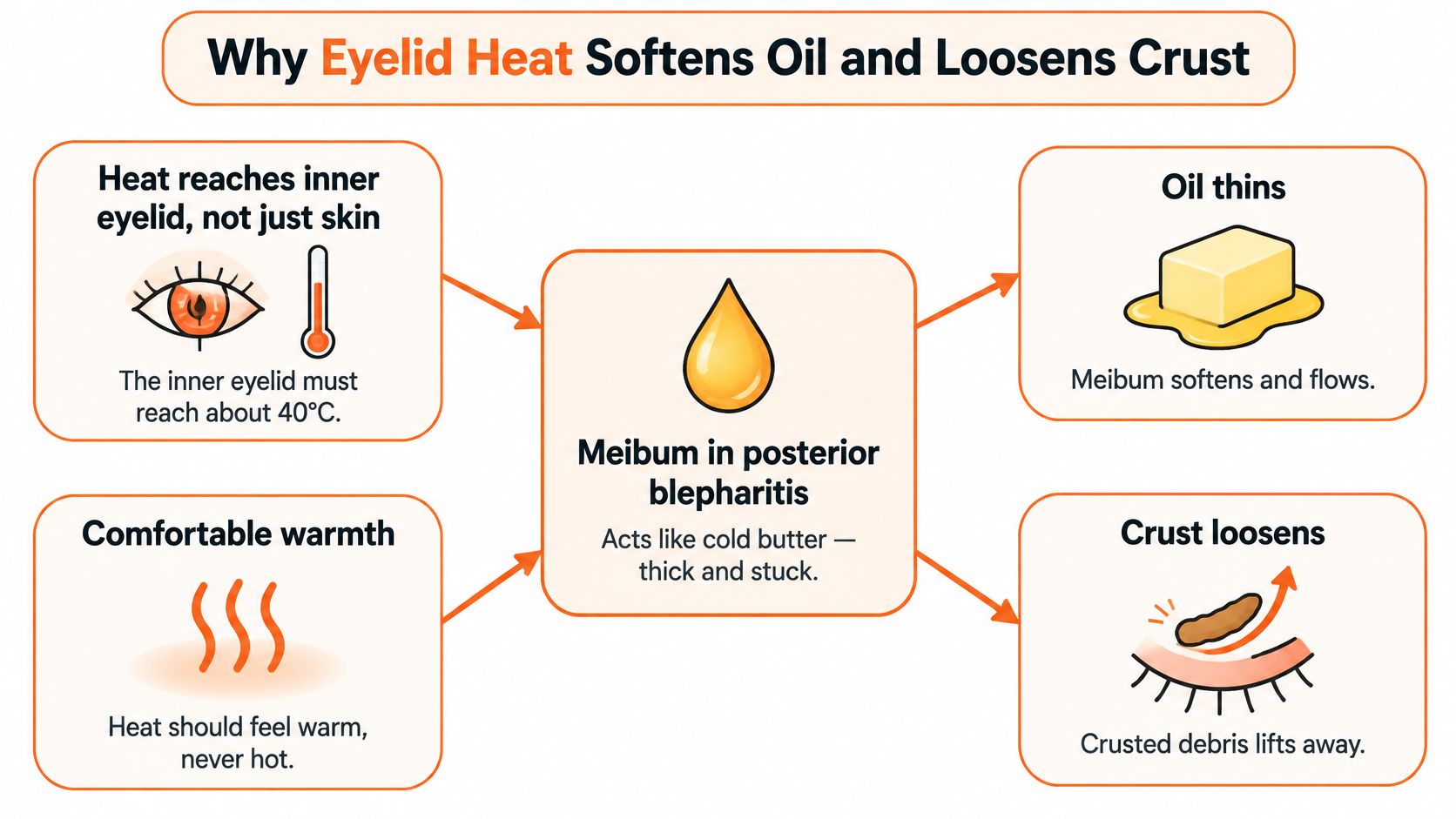
The meibomian glands supply oil to the tear film. When their secretions become thick and difficult to release, warming them can make them flow more easily. Think of a clogged highway: softening the obstruction helps traffic move, but it doesn't guarantee that every lane immediately opens.
Our explanation of meibomian gland dysfunction describes the gland problem behind this type of eyelid care. The important distinction is between warming the skin and delivering sustained heat to the glands underneath it.
The diagram separates the oil-softening and debris-loosening jobs.
Why pleasant surface warmth can fall short
Laboratory comparisons summarized in a 2024 review of warm-compress methods found that, among eight methods tested, only a bundled wet towel raised all measured eyelid surfaces to at least 40°C. That finding concerns particular methods under test conditions, not a promise that any bundled towel will deliver the same result at home.
It helps explain why touch alone is an incomplete guide. A cloth may feel soothing while failing to maintain the warmth needed for obstructed oil. Conversely, starting with excessive heat creates a burn risk without solving poor heat retention.
The two treatment jobs remain distinct:
- For lash crust: Moisture softens attached debris so cleansing can remove it gently.
- For thick gland oil: Sustained warmth prepares secretions to move with light massage, when appropriate.
What symptom improvement actually means
In a 2014 randomized controlled trial of 75 participants with MGD, 54.2% of the warm-towel group reported less frequent discomfort after one month, while 50.0% reported reduced symptom severity. Those are patient-reported improvements, not cure rates for every type of blepharitis.
The trial compared towels directly with eyelid-warming devices and followed participants beyond an immediate application. Its useful message is that conventional compresses can help symptoms, while the way heat is delivered can influence results.
Relief also isn't proof that every gland is functioning normally. Keep the distinction between feeling better and resolving the underlying eyelid problem, especially if symptoms return whenever care stops.
Towels Masks and Devices Compared
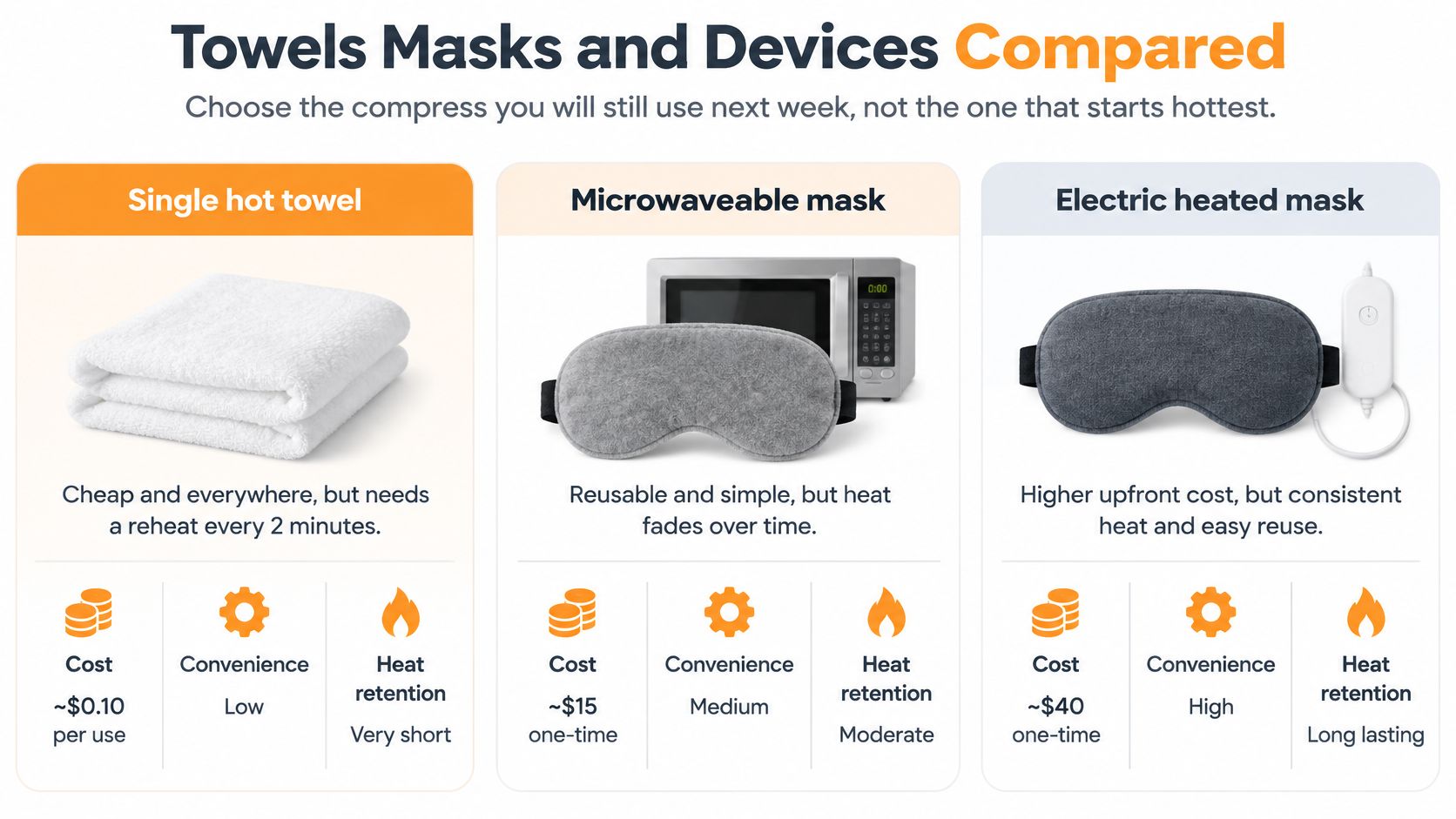
Which compress will you still use next week? That question is usually more useful than asking which one starts hottest. A method that requires awkward reheating, difficult handling, or equipment you can't access may be a poor fit even if it works well under ideal conditions.
Choose by heat maintenance, preparation, and safe handling rather than appearance. Our guide to choosing a warm compress for eyes offers additional format considerations.
This comparison highlights the practical differences.
Match the format to the task
Compress formats by heat hold and daily effort
| Method | Heat behavior | Daily effort | Fits best when |
|---|---|---|---|
| Single hot towel | Loses useful warmth quickly unless refreshed | Repeated trips to rewarm or replace it | A sink is available and reheating is manageable |
| Bundled wet towel | Can retain heat better than an unbundled cloth; preparation matters | Folding, wetting, and reheating | You prefer a home towel method and can manage the setup |
| Reusable microwavable eye mask | Designed to distribute warmth; retention is product-specific | Heat according to instructions and check for hot spots | Hands-free use would make care easier |
| Disposable warming mask | Generates warmth without towel reheating | Open and use as directed; recurring purchase cost | You need an option without a microwave |
| Heated lid device such as Blephasteam | Uses a device-controlled warming process | Equipment setup, cleaning, and cost | Your clinician recommends a device-based approach |
A single towel is inexpensive and easy to find, but you have to maintain it. A bundled towel may improve heat retention, although it still ties the routine to water and preparation. Neither is useful if handling hot water makes the session unsafe.
A reusable mask can remove the need to hold a cloth in position. For someone with stiff fingers, that may be a meaningful advantage. For someone with low vision, however, reading heating instructions and identifying uneven warmth may require help.
The best format is one you can prepare correctly, use comfortably, and keep clean without improvising.
Convenience doesn't prove equivalent treatment
Disposable masks and powered devices aren't interchangeable with each other or with microwavable masks. Check the intended use, operating instructions, cleaning requirements, and fit rather than assuming every eye-shaped warmer delivers the same treatment.
Microwave heating deserves particular care. Extra heating can create unsafe temperatures, and a mask may contain hotter areas even when part of its surface feels comfortable. Never add heating time because a previous session seemed less warm.
If travel is the main obstacle, consider what heat source you'll have. If caregiving interruptions are the problem, choose a time when you can sit with your eyes closed safely. Convenience should support correct use, not encourage wearing a compress while walking or doing household tasks.
How to Apply a Warm Compress Step by Step
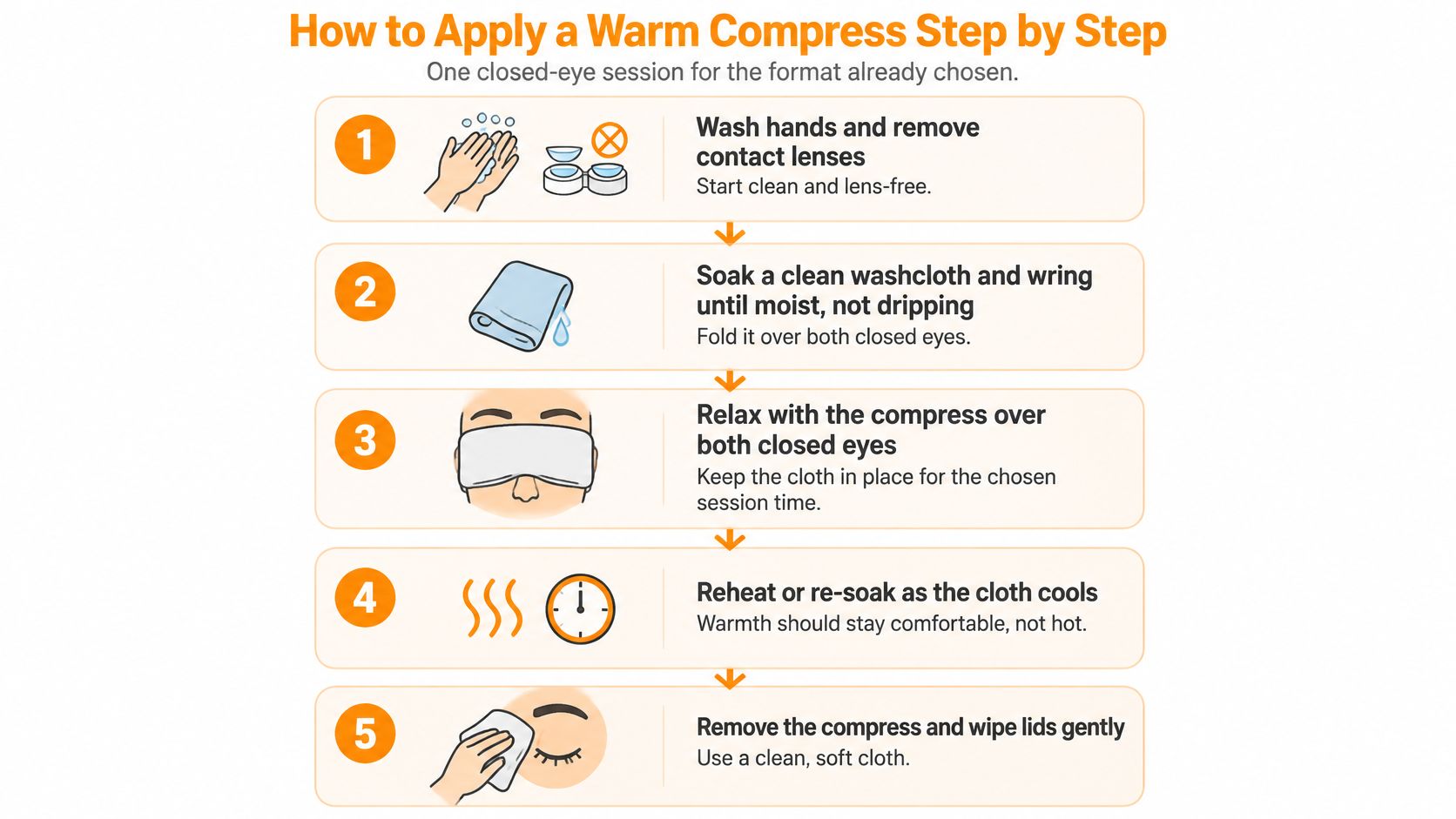
Prepare everything before you close your eyes: a clean compress, a timer, a clean towel for drying, and your recommended eyelid cleanser. If you're using washcloths, arrange a safe way to refresh them without carrying dripping hot water while your vision is covered.
The visual guide shows the basic sequence for a towel session.
Prepare and apply without pressure
- Wash your hands and remove contact lenses. Start with clean hands and a clean compress. Remove eye makeup gently so you're not pressing a warmer over residue.
- Prepare your chosen format. Soak a clean washcloth in warm water, wring it until moist rather than dripping, and fold it to cover the closed lids. For a microwavable mask or eye pillow, use only the manufacturer's printed heating instructions, including any required resting or heat-distribution steps.
- Check for excessive heat. Test the compress against your inner wrist before it touches your eyelids. Check across its surface, not just one corner, and allow it to cool if it feels hot. This is an overheating screen, not a precise temperature measurement.
- Rest it over closed eyes. Sit or recline securely and let the compress make gentle contact without pressing on the eyeballs. Don't tighten a strap to force the mask into the eye sockets.
Ordinary hot towels commonly keep the eyelid above 40°C for only about 1 minute, falling below the target within roughly 2 minutes, so replacing or reheating them at 2-minute intervals better maintains warmth, according to the 2024 warm-compress evidence review.
For a mask, follow its intended session instructions rather than repeatedly microwaving it while you're using it. If the warmth is uneven or the product becomes uncomfortable, remove it. Don't compensate by pressing harder.
Finish with gentle lid care
- Massage only if appropriate. With your eyes closed, use a clean fingertip to move gently toward the lash line. Guide the upper lid downward and the lower lid upward without rubbing the eye itself. Stop if this hurts, and ask your clinician to demonstrate if you're unsure.
- Clean the lash margins. Use the eyelid cleanser or wipe your clinician recommended, following its directions. Use diluted baby shampoo only if your clinician specifically advised it, rather than inventing a concentration or using an undiluted household product near your eyes.
- Pat dry instead of rubbing. Use a clean, soft cloth and handle the lid skin lightly. Don't pick off attached crust or pull at lashes to make the eyelid look completely clear.
This video offers another view of the application technique.
Finish at the planned endpoint rather than stretching the session because you're still sitting comfortably. Put the compress away according to its care instructions so the next use starts clean.
When Warmth Should Stop and Care Should Start
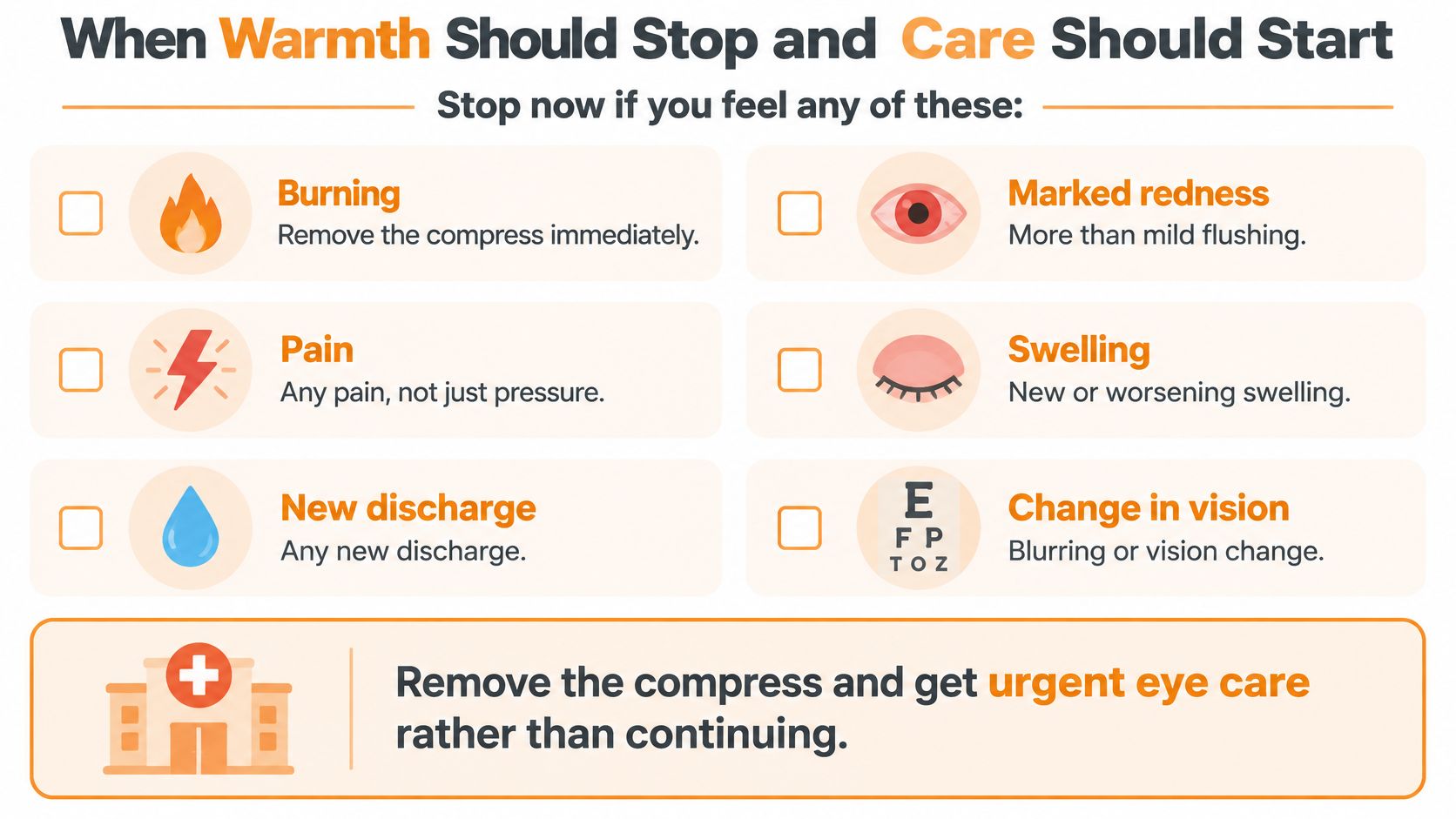
Remove the compress if you develop burning, marked redness, pain, new or worsening swelling, new discharge, or a change in vision. Don't try another hotter round to see whether it clears the problem. Seek prompt eye-care advice, with urgent assessment for pain, vision changes, or substantial inflammation.
These warning signs take priority over completing the timer.
More heat doesn't treat every cause
An eyelid can look crusty for different reasons. Bacterial disease may require prescribed drops or ointment, an allergy requires attention to its trigger, and Demodex-related disease needs treatment directed at the mite problem.
A 2024 multicenter registry study presented at ASCRS reported that 45% of patients with Demodex blepharitis used warm compresses to manage symptoms. That describes a common habit, not evidence that compresses eliminate mites.
Likewise, a painful localized bump isn't automatically the same problem as inflammation along the lash margins. Our guide to a warm compress for a stye addresses that distinction, but a new or worsening lump still deserves assessment when its cause is uncertain.
Don't escalate the heat to match worsening symptoms. Worsening symptoms are a reason to reconsider the diagnosis and treatment.
Check comfort without setting a cure deadline
Improvement can be gradual, and symptom comfort doesn't necessarily change at the same pace as gland function. Use a brief symptom note to help you describe what's happening rather than deciding that every uncomfortable day requires a longer session.
Useful checkpoints include:
- Morning stickiness: Are your lids easier to open, with less attached debris?
- Evening comfort: Is end-of-day burning easing rather than intensifying?
- New symptoms: Have pain, discharge, swelling, or visual changes appeared?
Book an examination if symptoms remain troublesome despite a manageable routine, repeatedly return, or mainly affect one eye. Don't wait for a home-care experiment to finish when warning signs appear.
Contact-lens wearers with red or painful eyes should leave lenses out and seek professional advice. After recent eye surgery, follow the surgeon's instructions before applying warmth or massage. If reduced skin sensation makes heat difficult to judge, get help choosing a safer approach rather than relying on a wrist test alone.
Set a Routine You Will Actually Repeat
Make the routine repeatable before making it more elaborate. Choose the schedule that fits your clinician's advice, attach it to an existing habit, and keep the necessary supplies together. A calm seated session after evening toothbrushing may be easier to maintain than an ambitious plan squeezed between errands.
Use a simple checklist rather than relying on memory. Record whether you completed the session and whether your eyes felt better, unchanged, or worse afterward. Don't use the checklist as a reason to continue through discomfort.
Remove the obstacle that makes you skip care
If repeated towel preparation is the obstacle, consider a reusable format. If cleaning supplies are the obstacle, keep the recommended cleanser beside a fresh cloth. If handling heated materials is difficult, ask someone to help with preparation rather than increasing the starting temperature.
Our purple Dry Eye Therapy Eye Mask, Reusable Microwavable Odorless Heat Therapy, is $15.98, and the 2-pack is $19.98. It can be microwaved for warmth or frozen for cooling relief; use the printed heating directions, check that it has cooled to comfortable warmth, wipe it with a damp cloth after use, and let it fully cool before reheating.
- Keep the method stable: Avoid changing the compress, temperature, and cleansing product all at once.
- Review how your eyes feel: Note morning stickiness, evening burning, and any new symptoms.
- Keep medical care in the plan: Persistent irritation calls for an examination, not extra microwave time.
Cooling isn't a substitute for assessment when lids become newly hot, painful, or swollen. The aim is a comfortable routine that supports the right treatment, not a home remedy you have to endure.
SunnyBay offers reusable eye masks for warm-compress care, with hot and cold options for different comfort needs. Visit SunnyBay to explore the eye-care range and choose a format that fits your clinician-recommended routine.


