


What Is Meibomian Gland Dysfunction?
-
Meibomian gland dysfunction is a chronic disorder of the eyelid oil glands, usually from blocked ducts or altered oil, that destabilizes the tear film and commonly drives evaporative dry eye. Your eyes can water, burn, and still be dry, because the problem often isn't a lack of watery tears. It's a missing oil layer that should keep those tears from evaporating between blinks.
That counterintuitive detail explains why eyedrops sometimes help for minutes, then the grit returns. Understanding what is Meibomian gland dysfunction starts with the glands, not the drops.
Table of Contents
- What Meibomian Gland Dysfunction Actually Is
- How Common MGD Is Around the World
- How Blocked Glands Dry the Eye and What an Exam Checks
- A Warm Compress Routine People Can Keep
- Why One Routine Does Not Fit Every Gland
- Book the Exam or Start a Gentle Routine
What Meibomian Gland Dysfunction Actually Is
Say your eyes feel tired by mid afternoon. The screen blurs, you blink hard, vision clears, then it drifts again. That pattern can happen when the tear film loses its top oil layer and breaks apart faster than your blink can rebuild it.
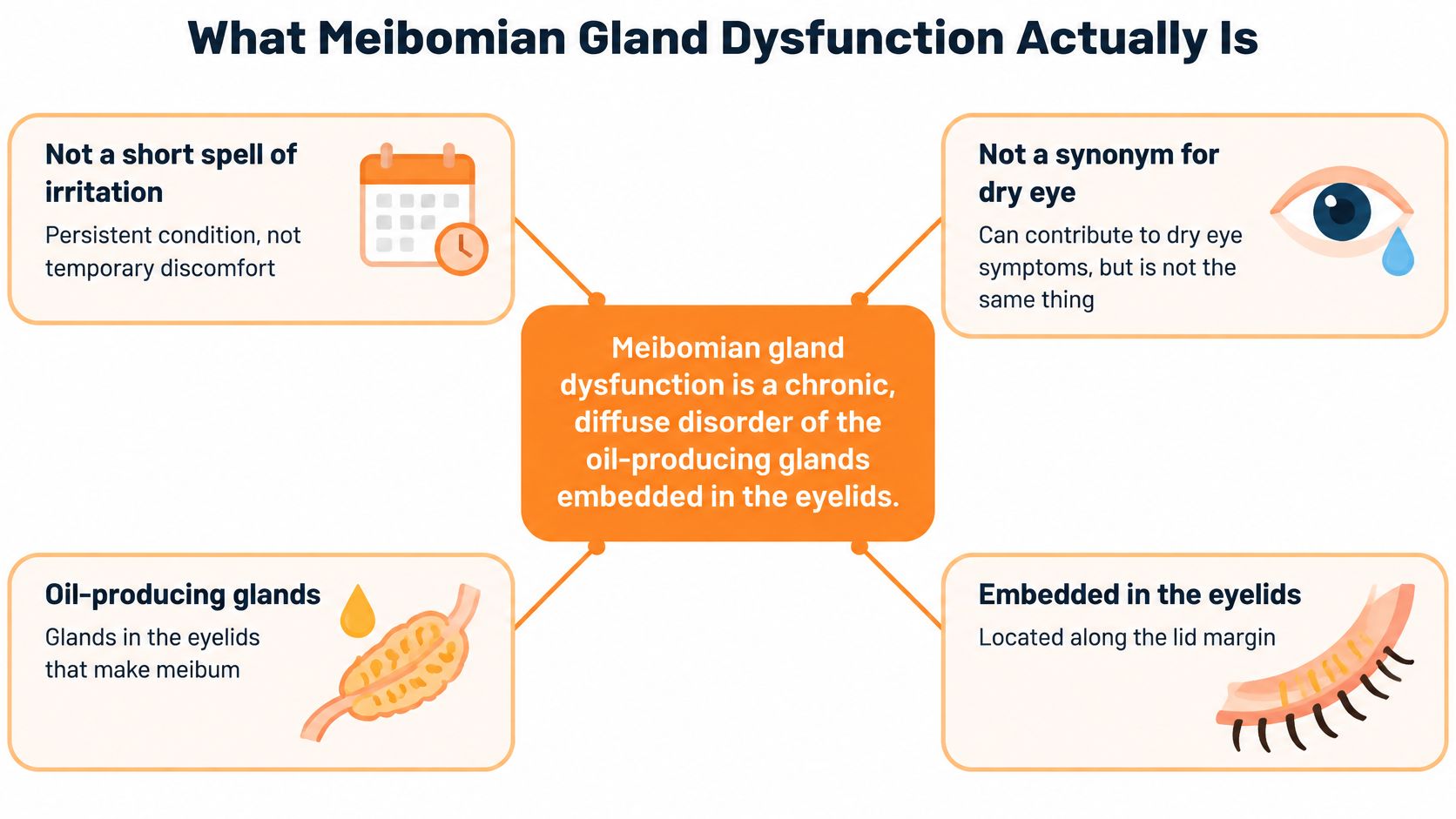
Meibomian gland dysfunction, or MGD, is a chronic, diffuse disorder of the oil-producing glands embedded in the eyelids. It's not a short spell of irritation after a late night, and it's not a synonym for dry eye. It's a gland problem that can contribute to dry eye and keep returning if the glands stay blocked or produce poor oil.
The concept map below places that definition at the center and separates it from temporary discomfort.
The Oil Slick on a Wet Road
Your tear film has a watery middle layer. On top sits oil, spread thin like a slick on a wet road after rain. You barely see it, but it changes what happens to the water underneath. Without that slick, wind and air pull moisture away quickly.
The TFOS DEWS II pathophysiology report describes approximately 30 to 40 meibomian gland openings in the upper lid and 20 to 30 in the lower lid, releasing meibum, a lipid rich secretion that spreads across the aqueous tear layer and slows evaporation. That lipid layer is described as roughly 100 nanometers thick, although its structure is more complex than a simple uniform coating.
A healthy oil layer doesn't add more tears. It helps the tears you already make stay on the eye longer.
When the oil is clear and flows easily, each blink paints a new coating across the surface. When it thickens, the coating becomes patchy. Dry spots appear, light scatters unevenly, and vision can fluctuate until the next blink temporarily smooths it out.
Blocked Ducts and Changed Oil
Terminal duct obstruction means the tiny opening at the lid margin gets capped, so oil can't exit normally. The other problem is change in the oil itself, in amount, quality, or both. Either issue can reduce lipid delivery, and both can occur together.
That distinction matters. A gland can still make oil but fail to release it. Another can release oil that doesn't spread well. In both cases, the tear film becomes unstable, the eye feels irritated, inflammation can appear, and ocular surface disease can develop over time.
Gentle eyelid warming has a clear physiological rationale here. Warmth is intended to soften thickened meibum and support gland expression, the release of oil from the gland. Warming doesn't diagnose you, though. An eye care professional still needs to confirm that MGD is the cause and choose treatment that fits what the exam shows.
How Common MGD Is Around the World
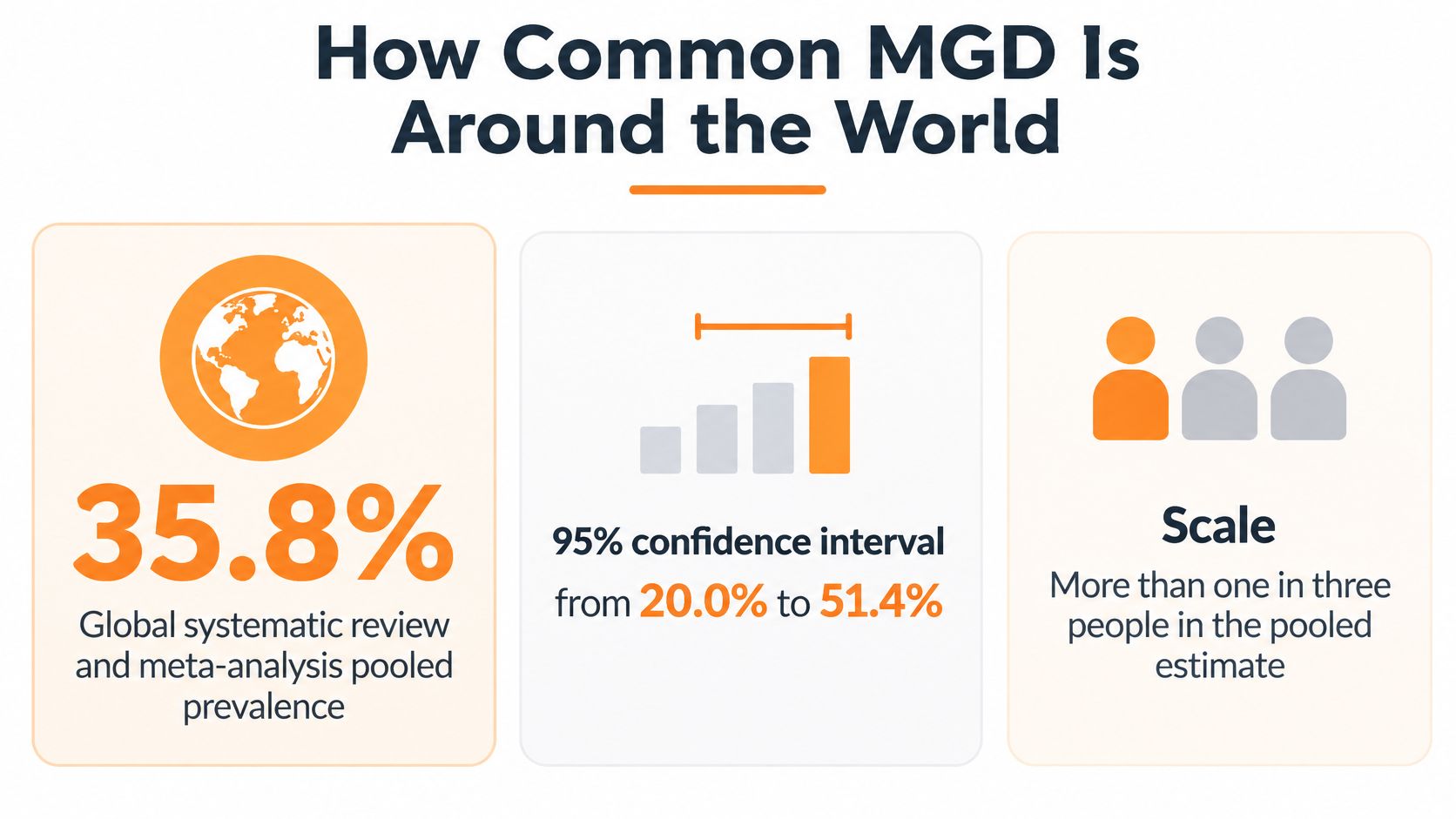
The figures below show the scale first, before any interpretation. A single headline percentage doesn't capture how much rates shift by population and study method.
The prevalence display below puts the pooled global estimate in one place.
| Group or setting | Estimate | Interval or note |
|---|---|---|
| Global pooled | 35.8% | 95% CI 26% to 46% |
| Clinical studies | 35.8% | Same meta-analysis |
| Population-based studies | 35.9% | Nearly identical to clinical |
| United States pooled | 21.2% | Prediction interval 0% to 100% |
| African and Caucasian populations | 21.2% to 29.5% | Lower end of geographic range |
| Hispanic populations | 67.5% | Markedly higher than Caucasian estimates |
| Arab populations | 71.0% | Highest reported group in the review |
| Men versus women | Odds ratio 1.24 | 95% CI 1.01 to 1.52 |
| People with dry eye, no other listed comorbidities | Up to 70.4% | 37 studies, 16 countries, 26,063 patients |
A global systematic review and meta-analysis estimated pooled prevalence at 35.8%, with a 95% confidence interval of 26% to 46%. That interval is wide, and that width is part of the story, not a footnote.
Why the Estimates Swing So Much
Studies don't all draw the line in the same place. One team may count early gland changes on exam, another may require symptoms plus specific signs, and a third may study clinic patients who already sought help. Populations differ by age, ethnicity, and setting, so the percentages move.
The short video below gives a visual walkthrough that complements these numbers.
The United States estimate shows the uncertainty clearly. Limited representative national data and inconsistent methods leave a prediction interval so broad that it shouldn't be quoted as a precise national rate. Geography and study design shape the headline you get.
One more finding surprises many readers. People without symptoms can still show substantial gland abnormalities on examination. A normal feeling eye isn't proof the glands are clear, just as gritty eyes alone aren't proof that MGD is the cause.
How Blocked Glands Dry the Eye and What an Exam Checks
A blocked meibomian gland does not stop making oil. It changes when and how that oil reaches the tear surface. The tear film works like a two-layer raincoat: water underneath, oil on top. The oil layer slows evaporation. When the gland duct narrows or the oil thickens, the top layer turns patchy, and tears leave faster than they are replaced.
A common workday shows the pattern. You start clear in the morning. Hours of screen work follow, with fewer complete blinks because you are concentrating. Thick oil stays parked in the ducts instead of coating the tear film. By late afternoon, words soften at the edges. A drop helps, briefly. Then burning and grit return, because the drop added fluid but did not restore a durable oil barrier. That mismatch, evaporation outrunning supply, is the core problem in evaporative dry eye driven by MGD.
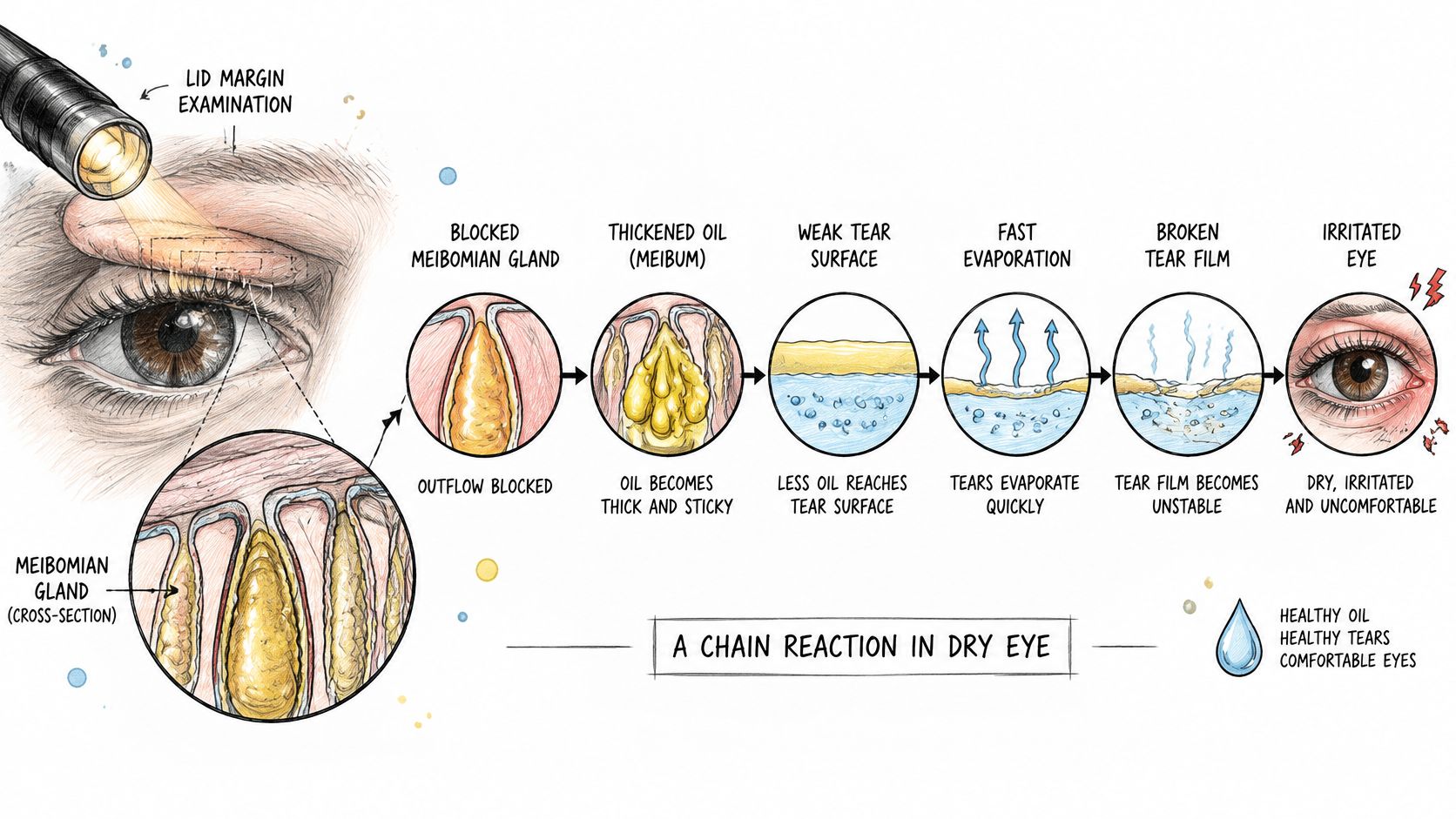
The diagram below tracks that chain from blocked gland to irritated surface.
One Chain, Link by Link
Obstruction or altered meibum reduces lipid delivery to the tear surface. The evaporative barrier weakens. Tears leave too fast, the film breaks up between blinks, and the exposed surface dries. Irritation follows, vision fluctuates, and inflammation can join the loop, making the lid margins look red and the glands perform worse.
The TFOS DEWS II pathophysiology report page frames diagnosis around more than symptoms, including gland orifice plugging, lid margin vascularity, quality and quantity of expressed secretion, gland expressibility, lipid layer behavior, tear film breakup, and gland structure. Symptoms start the conversation. They do not finish it.
Practical rule: Burning that keeps returning is a reason to book an exam, not a reason to make a compress hotter.
MGD can also coexist with aqueous tear deficiency, where the watery layer itself is low. Those mechanisms are not mutually exclusive. A person can produce too little watery tear and too little usable oil at the same time, which is why one home remedy may only partly help.
Look-Alikes and Visit Triggers
The same gritty, red, tired feeling can come from other causes. Anterior blepharitis inflames the front lid margin near the lashes. Allergy tends to itch and swell. Infection can add discharge and worsening redness. MGD's pathway does not prove itself from symptoms alone.
Book an examination if you notice these patterns.
- Persistent burning or grit: Discomfort that returns most days, not only after one poor night of sleep.
- Fluctuating vision: Blur that clears with a blink, then creeps back during reading or screen use.
- Contact lens intolerance: Lenses that feel dry hours earlier than they used to.
- Capped or red lid margins: Tiny plugs at gland openings or visible redness along the edge.
For broader context on overlapping causes before a visit, this guide to dry-eye symptoms and solutions from Healtsy is a useful companion resource. Our own overview of dry eye syndrome relief options covers comfort measures, but neither replaces an exam that names your specific cause.
What the Clinician Records
The visit splits into two questions: what the glands look like, and what the tear film does. During the exam, the clinician looks along the lid margin for plugged orifices and increased blood vessels, called vascularity. Gentle pressure on the lid tests expressibility, whether oil comes out at all and what it looks like. Healthy secretion is clear and flows. Troubled glands may release thick, toothpaste-like material, or nothing.
The clinician also watches how the lipid layer behaves, times how fast the tear film breaks up, and may use imaging to check gland structure and gland dropout, where glands have shortened or disappeared. The clinician records these findings. They are exam shorthand, not a score you assign yourself at home.
| Pattern | Secretion and lids | Expressibility | What the person may notice |
|---|---|---|---|
| Mild MGD | Thinner or intermittently reduced secretion; gland openings mostly clear | Reduced | Burning, grit, or tired eyes that come and go |
| Moderate MGD | More frequent plugged orifices and reddened lid margins; thicker or reduced secretion | Poorer | Fluctuating vision, lens intolerance, lids that look capped or red |
| Either pattern on exam | Secretion quality varies; lipid layer, tear breakup, and gland structure also checked | Recorded gland by gland | Symptoms can be mild or absent despite gland change |
Read the table as a map of the visit, not a self-test. Two people can report the same burning and leave with different findings, because one has thick but expressible oil and the other has plugged orifices with gland loss. Treatment follows those findings. If burning keeps coming back, the exam gives you a named target instead of another guess.
A Warm Compress Routine People Can Keep
Heat helps only if the protocol is right and repeatable. A quick splash of warmth that fades in two minutes doesn't give thickened oil time to soften. Neither does a routine so demanding that you abandon it by Thursday.
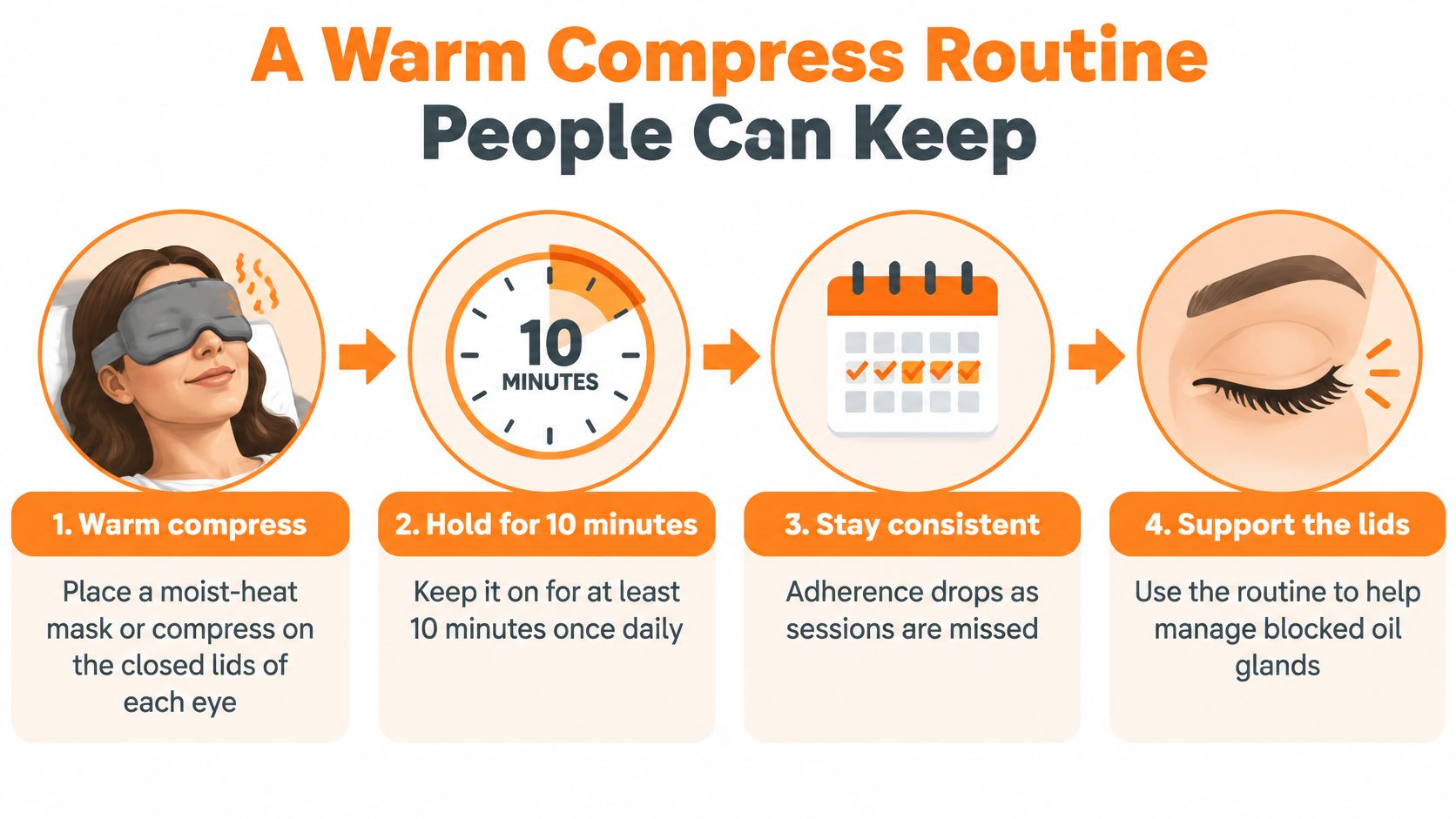
The process flow below shows the daily sequence at a glance.
The Numbered Routine
Evidence-based guidance summarized in a 2024 review of eyelid warming masks recommends a moist heat mask or compress applied to each eye for at least 10 minutes once daily, while noting adherence falls as treatment frequency increases.
- Wash your hands and sit down. Choose a spot where you'll stay still for the full 10 minutes, not a sink you'll leave to rewet a cloth.
- Warm to comfortably warm, not hot. Test the mask or compress on your inner wrist first. Eyelid skin is thin, and heat that feels fine on a fingertip can be too much on a closed lid.
- Cover both closed eyelids and leave it in place. Keep it on for at least 10 minutes once a day. Set a timer so you don't guess. Guessed sessions almost always run short.
- Follow with lid care only as taught. If an eye care professional has shown you lid expression or lid hygiene, do it right after warming, when oil is softer and moves more easily. Don't improvise firm squeezing from a video.
- Stop if it stings or reddens sharply. Remove the compress and let the skin cool. Pain isn't a sign the glands are opening.
Comfort during the mask feels good, but it doesn't prove the ducts have cleared. Symptom relief and gland expression are related, not identical.
Time and Steady Heat Beat Intensity
The question people ask is whether a towel works. It can, if it stays warm for the full session. The problem is physics. A wrung out washcloth loses heat fast, so you rewet it repeatedly, the temperature swings, and the session shrinks. Inconsistent temperature, duration, or technique can make a reasonable treatment look like a failure.
That same review reports a 12 week study with compliance of 88.6% for disposable warming masks versus 81.5% for hot towels. Convenience and heat consistency influence real world use. The gap doesn't prove towels never work. It shows why a routine you can repeat the same way every day often beats a theoretically fine method you perform unevenly.
A reusable moist eye mask holds time and temperature more steadily than a cooling cloth, which is why many people find it easier to sustain. Our comparison of heated eye mask options for a daily routine explains what to look for in fit and heat retention.
Don't respond to a poor week by applying more heat or for longer. Skin injury won't open glands faster, and increasing heat can obscure the underlying issue, which may be gland loss, inflammation, or a different diagnosis entirely. Persistent symptoms after careful, consistent use still require an eye care evaluation.
Why One Routine Does Not Fit Every Gland
Two people can follow the same timed warm-compress routine and get different results. In one lid, heat softens thick, paste-like oil and the glands express. In another, glands have already dropped out, so there is less tissue left to respond. Same mask, different biology.
A plugged gland behaves like a tube of toothpaste with thickened paste. A gland that has dropped out is a tube that is no longer there. Warming can soften the first. It cannot rebuild the second.
MGD is a family of problems, not one blocked pipe. Gland blockage, altered oil quality, inflammation, tear film instability, and gland loss appear in different proportions. That mix, not willpower, often decides how far warming alone can take you.
Why Your Friend's Result Is Not Your Prognosis
A symptom score copied from someone else tells you little about your own lids. Imaging that shows gland structure and an expression test that shows oil quality tell you much more. A clinician can see whether glands are present but plugged, producing poor oil, or partly gone. From those findings, standard options such as lid hygiene, in-office gland expression, and prescription therapy can be matched to the actual problem.
Our detailed overview of Meibomian gland dysfunction treatment pathways lays out how clinicians match treatment to exam findings rather than symptoms alone.
How to Read New Treatment Headlines
A 2025 review of emerging MGD therapies describes investigational approaches beyond simple warming. These include agents targeting possible cholesterol crystal deposits and the investigational drug AXR-270, with some AXR-270 findings still unpublished in peer-reviewed literature. Unpublished means other scientists have not yet formally scrutinized the full methods and results.
The same review context notes early phase 2b work on AZR-MD-001, with a larger phase 3 study described as ongoing. Phase 2b is a middle stage. It tests dose and early benefit. It does not settle long-term safety or real-world performance.
The practical takeaway is narrower than a headline. Early results do not mean a product is approved, broadly available, or superior to standard care. An early report is a reason to ask your clinician what it might mean later, not a new home protocol for tonight.
The common leap also needs correcting. Not every dry eye complaint comes from blocked glands. Low watery tears, allergy, and infection remain separate answers. The useful move is an exam that names which mix you have before anyone chases a newer molecule.
Book the Exam or Start a Gentle Routine
Some situations shouldn't wait on home care. Book an eye care visit soon if burning, grit, fluctuating vision, or contact lens trouble has lasted beyond a short spell. Book sooner if vision drops, or if you have pain, light sensitivity, discharge, or a worsening red eye.
Also book if a careful daily routine hasn't changed symptoms after the period your clinician suggested. A professional can separate MGD from low watery tears, blepharitis, allergy, and infection. From there, expression, lid care, prescription therapy, or gland imaging may belong in the plan, chosen from findings rather than guesswork.
What You Can Safely Do Tonight
If you've already been told to use warm compresses, or you're waiting for a visit and have no alarm symptoms, tonight's step is modest. Apply comfortably warm moist heat to closed lids for at least 10 minutes once today. Don't go hotter to force a result, and stop and get checked if symptoms escalate while using any mask.
Consistency is easier with equipment built for the job. We introduced a washable moist eye mask in 2019, and our Dry Eye Therapy Eye Mask, 2-pack is priced at $19.98. One verified buyer, Juniper, described the experience.
"It provides some relief for my dry eyes.", Juniper, Verified Buyer
That kind of modest, daily relief is the practical goal while you wait for, or follow, professional care. A purpose-made mask holds heat more evenly than a towel cooling on your face, so the 10 minutes you planned is the 10 minutes you get. Pair that steady routine with an exam that names your gland mix, and you've covered both halves of the problem, comfort now and a diagnosis that guides what comes next.
If your clinician has recommended daily warm compresses, SunnyBay offers reusable, microwavable dry eye therapy masks designed to deliver steady moist heat for the full session, so your routine stays consistent night after night. Browse the options and find a mask that fits your schedule at SunnyBay.


