


Meibomian Gland Dysfunction Treatment That Works
-
You finish a long workday, blink at the screen, and feel sand under your eyelids. Your vision clears after a few blinks, then blurs again. Rubbing helps for a moment, but by evening your eyes burn, water, and feel too tired to keep open. That pattern often points to more than “just dry eyes.” It can reflect meibomian gland dysfunction treatment needs, where blocked oil-producing glands allow tears to evaporate too quickly.
Table of Contents
- The Daily Reality Behind Gritty, Tired Eyes
- Why Heat and Lid Care Sit at the Center of Care
- The Step-by-Step Home Warm Compress and Massage Routine
- Comparing LipiFlow, IPL, and In-Office Procedures
- How Antibiotics and Anti-Inflammatories Fit Into MGD Care
- Why High-Tech Treatments Do Not Always Change How Your Eyes Feel
- Choosing and Using a Reusable Warm Compress Safely
- Red Flags, Maintenance Habits, and Your Long-Term Plan
The Daily Reality Behind Gritty, Tired Eyes

After hours of reading or screen work, a person with meibomian gland dysfunction may notice gritty eyes, burning, or vision that clears briefly after blinking. The problem often begins inside the eyelids, where the meibomian glands produce meibum, an oily material that spreads across the tear film. This layer slows evaporation and helps the watery part of the tears stay on the eye long enough to protect the cornea.
If gland openings narrow or become blocked, meibum can thicken and move poorly. The tear film then loses part of its oil barrier, allowing tears to evaporate more quickly. Symptoms may include burning, grittiness, fluctuating vision, redness, reflex tearing, and fatigue that worsens later in the day.
MGD is a common contributor to evaporative dry eye. A meta-analysis of population-based studies estimated pooled global prevalence at 35.9%. Separate U.S. estimates place prevalence at about 70% among adults over age 60, as reported in a review of MGD prevalence and treatment. The figures come from different population estimates, so they should not be treated as one universal rate.
Evaporative and aqueous-deficient dry eye
The type of dryness matters because treatment needs to address the mechanism causing symptoms.
- Evaporative dry eye: Watery tears are present, but they disappear too quickly because the lipid layer is inadequate or unstable. MGD is a major cause.
- Aqueous-deficient dry eye: The lacrimal glands produce too little watery fluid, leaving the eye short of both moisture and protection.
- Mixed dry eye: Evaporation and reduced tear production occur together, which is common when symptoms persist.
Two people can describe their eyes as “dry” for different reasons. One may have enough tears but develop grittiness after screen use because the oil layer breaks up. Another may produce very little tearing and feel uncomfortable from morning onward. Artificial tears may help both, yet the first person also needs attention to meibum flow, while the second may need treatment that supports tear production or reduces inflammation.
MGD can affect gland structure over time. Repeated obstruction and inflammation may contribute to gland dropout, where some gland tissue is lost. An eye examination can assess gland openings, secretion quality, tear stability, eyelid inflammation, and the ocular surface before selecting the appropriate treatment layer.
Why Heat and Lid Care Sit at the Center of Care
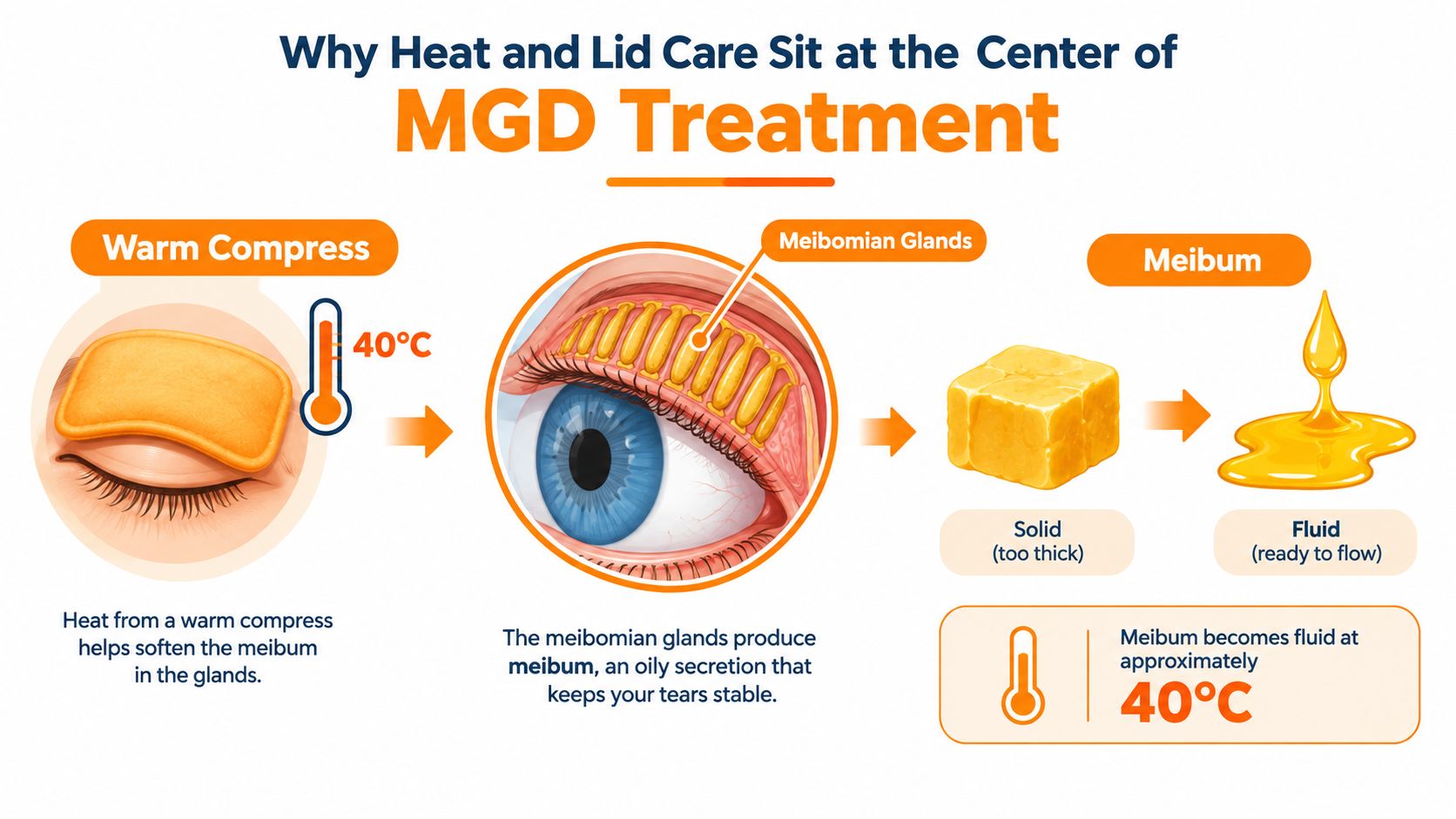
For someone whose eyes feel gritty by mid-afternoon, the problem may begin with oil that no longer moves freely. MGD is partly a material-flow problem: thickened meibum behaves more like wax or softened butter than liquid oil. Warming the eyelids can reduce its viscosity, making it easier to move toward the gland openings.
The physiological target matters. Evidence-based reviews describe meibum becoming fluid at approximately 40°C. Thermal treatment therefore depends on keeping the eyelids warm for long enough, rather than applying a quick burst of heat. A cloth warmed under a tap may feel soothing, yet it can cool before heat reaches the deeper gland contents.
Temperature is only half the equation
Thickened meibum behaves like butter left in a cold pan. Warming softens it, but warmth alone does not move it through a blocked outlet. Gentle pressure and a clear opening still matter.
Warmth prepares the meibum. Massage and expression help move it. Lid hygiene reduces debris around the openings. If the softened secretion remains near the gland, it may not reach the tear film where its protective oil layer is needed.
Historical guidance has recommended eyelid warming and massage as first-line care. Older instructions described hot compresses around 110°F, or 43°C, for 2 to 5 minutes, with longer routines for recurrent disease. More recent reviews support thermal therapies as part of a broader treatment plan that can also include prescription medication and procedures. Heat-and-expression remains the physiological foundation, while those other options address inflammation, gland obstruction, or persistent disease from different angles.
The evidence is not equally clear for every severity of MGD. A treatment that helps severely obstructed glands in a clinic may offer less noticeable benefit for mild disease, especially when symptoms arise from several causes. An eye-care professional can help match the treatment intensity to gland function and ocular-surface findings.
Practical rule: A compress should be warm enough, long enough, and followed by appropriate lid care. Comfort alone does not prove that the glands reached a useful therapeutic temperature.
People comparing home devices with professional thermal systems may find it helpful to read about why clinics choose infrared heat lamps, particularly when they want to understand how controlled heat differs from a rapidly cooling washcloth.
The Step-by-Step Home Warm Compress and Massage Routine
A home routine works best when it treats the eyelids as a connected system rather than as two separate tasks. Heat softens the secretion, massage encourages movement, and cleaning keeps the lid margin clearer. Start gently, because forceful squeezing can irritate the eyelid and ocular surface.
Four phases for daily care
- Prepare the eyes and hands. Wash your hands, remove contact lenses, and take off eye makeup. Spend roughly 1 to 2 minutes getting the materials ready. Clean hands reduce the chance of transferring debris to the lid margin.
- Apply moist heat. Place a comfortably warm mask over closed eyes for 8 to 10 minutes. The mask should rest evenly across the lids without pressing hard on the eyeballs. Heat needs time to reach the glands, so repeatedly reheating a cooling cloth may provide less consistent treatment than a mask designed to retain warmth.
- Massage the lids. Immediately after warming, close your eyes and use clean fingers. Massage the lower eyelid upward toward the lash line and the upper eyelid downward toward the lashes. Use light, controlled strokes for about 1 to 2 minutes per eye. The direction matters because you're encouraging softened meibum toward the gland pores, not rubbing randomly across the lid.
- Clean the lid margin. Use a clinician-approved diluted tea-tree cleanser or hypochlorous cleanser along the lash line for about 1 to 2 minutes. This step removes crusting, oil, and surface debris. Don't put household tea-tree oil directly into the eye, and stop if the cleanser stings or causes redness.
- Leave clinical expression to a professional when needed. Gentle home massage is different from squeezing individual glands with forceps or specialized tools. If the openings remain blocked or the secretions are unusually thick, an optometrist or ophthalmologist can assess whether in-office expression is appropriate.
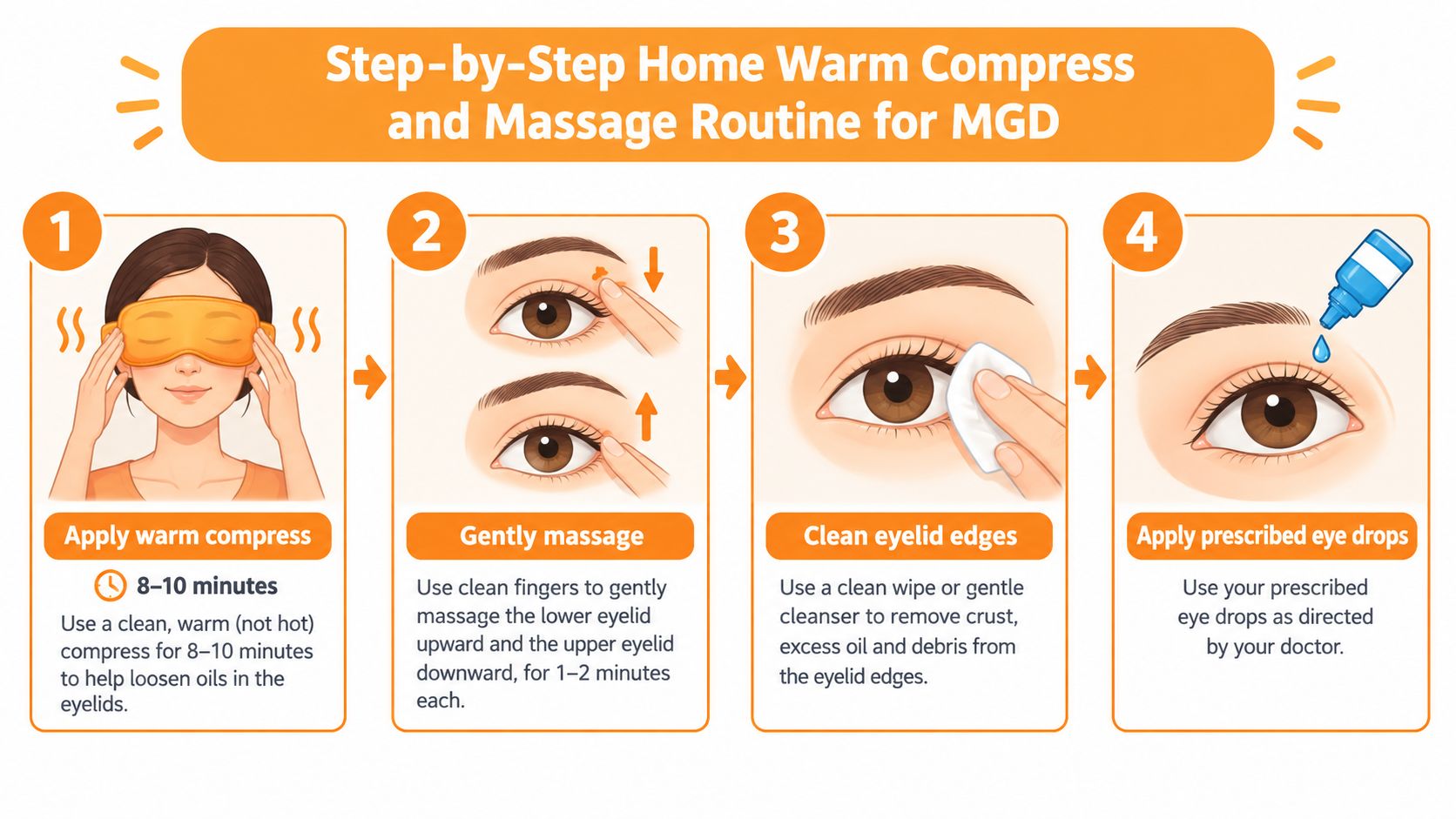
For an initial intensification phase, many clinicians use this sequence once or twice daily for 4 to 6 weeks, then adjust it according to symptoms and examination findings. Morning care may help clear overnight stagnation. Evening care can be easier after a day of screen exposure, when reduced blinking and visual concentration have left the eyes feeling dry.
This dry eye syndrome relief guide can provide additional context for building a consistent comfort routine.
Stop if you experience pain, marked redness, worsening vision, or swelling. A warm compress should feel soothing, not hot, sharp, or abrasive.
Comparing LipiFlow, IPL, and In-Office Procedures
When home care doesn't control obstructive MGD, an eye-care professional may discuss a procedure. These treatments aren't interchangeable. Some primarily apply heat and pressure, some target inflammation around the eyelids, and others mechanically open individual glands.
LipiFlow thermal pulsation combines eyelid heating with mechanical pressure. A systematic review identified 12 randomized trials involving 628 patients and 1,164 eyes evaluating a single 12-minute LipiFlow treatment, as reported in a systematic review of thermal pulsation. That evidence makes it one of the better-studied device-based options, though its benefit can vary by disease severity.
IPL uses light-based treatment around the eyelids and is often considered when MGD overlaps with facial or ocular rosacea and lid-margin inflammation. Protocols vary, so results are harder to compare directly. If you're researching provider selection, a resource about the best IPL clinic in Ontario may help you understand what questions to ask about assessment, skin safety, and treatment protocols.
| Procedure | Mechanism | Session time | Evidence strength | Durability | Cost range | Best for |
|---|---|---|---|---|---|---|
| LipiFlow | Heat plus eyelid pressure | About 12 minutes in the reviewed trials | Relatively robust randomized evidence | May last months, with some reported benefits up to 12 months | Varies by clinic and coverage | Obstructive MGD with reduced gland function |
| IPL | Light-based periocular treatment, often followed by expression | Varies by protocol | Promising, but protocols differ | May require repeat treatment | Varies by clinic and coverage | MGD with rosacea or visible lid inflammation |
| iLux | Localized heat and manual expression | Varies | More limited comparative evidence | Variable | Varies | Focal obstruction and clinician-directed expression |
| TearCare | Eyelid-applied thermal therapy | Varies | Device evidence is developing | Variable | Varies | Patients needing controlled warming with clinician support |
| Manual expression | Direct pressure clears softened meibum | Varies by gland burden | Longstanding clinical use | Often temporary without maintenance | Usually lower than device procedures | Thick secretions accessible after warming |
| Probing | A probe opens selected obstructed gland ducts | Varies | Reserved for selected cases | Individual response varies | Varies | Persistent focal obstruction after conservative care |
The table deliberately avoids fixed prices because charges depend on location, provider, equipment, and insurance. Coverage also influences the practical choice. A treatment that appears attractive in advertising may be less appropriate than a lower-cost option matched to your examination findings, tolerance, and ability to continue maintenance.
For home support between appointments, some patients consider a reusable dry eye therapy eye mask. It won't replace an examination or a procedure when glands are severely obstructed, but consistent heat-and-lid care remains relevant after clinical treatment.
How Antibiotics and Anti-Inflammatories Fit Into MGD Care
Antibiotics do not cure the gland obstruction itself. Clinicians prescribe them because certain medicines have anti-inflammatory or lipid-modulating effects, rather than because bacteria caused the blockage.
Oral doxycycline, minocycline, and azithromycin may be considered when inflammation, rosacea, recurrent blepharitis, or poor-quality meibum continues despite lid care. Topical medicines such as bacitracin or metronidazole may help when anterior blepharitis occurs alongside posterior lid disease. The choice depends on the examination, medical history, other medicines, and whether treatment targets surface bacteria, inflammation, or both.
Medication can support the foundation
A recent review reported that oral and topical antibiotics can improve symptoms, tear-film stability, staining, meibum quality, and lid-margin findings in the short term. It also reported that oral azithromycin may be at least as effective as doxycycline with fewer adverse events. However, the ideal dose and duration, long-term safety, and the chance of recurrence after treatment stops remain uncertain. These findings are summarized in the PubMed review of antibiotic strategies for MGD.
Medication and heat address different parts of the problem. Reducing inflammation doesn't necessarily reopen every obstructed gland, just as calming swelling around a clogged drain does not clear the material inside it. Heat and massage soften and move thickened meibum, while lid hygiene reduces debris around the gland openings. Medication can calm the inflammatory environment that contributes to poor gland function, but secretion quality may worsen again after treatment ends.
Clinicians may also prescribe cyclosporine 0.05%, lifitegrast 5%, or a short course of topical steroid when ocular-surface inflammation or mixed dry eye contributes to symptoms. These medicines require supervision. Oral treatments can cause gastrointestinal intolerance or photosensitivity, and prolonged topical steroid use can create serious eye risks.
A useful prescription discussion covers the treatment target, expected duration, side effects, stopping plan, and maintenance routine. Ask which part of the disease the medicine is treating and how heat, massage, and lid care will preserve the result.
Why High-Tech Treatments Do Not Always Change How Your Eyes Feel
A patient may leave a procedure with better clinical measurements yet notice little day-to-day relief. This can feel confusing, especially when marketing implies that one procedure will restore comfortable eyes. The reason is that MGD has several interacting parts, and a treatment may improve one without correcting the others.
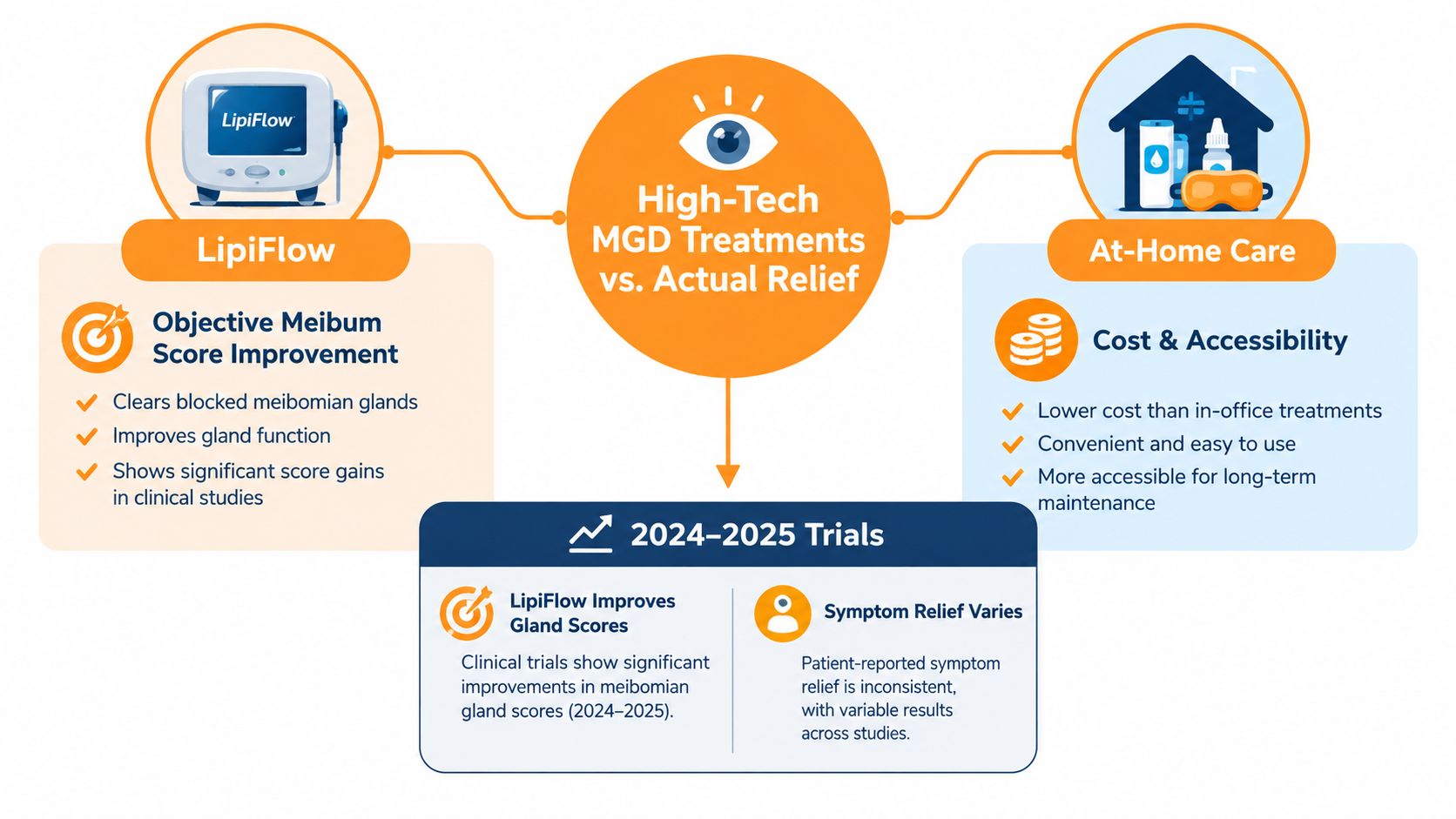
A 2025 systematic review found that LipiFlow improved objective measures such as tear break-up time, meibomian gland function, and corneal staining. It did not find a significant overall improvement in lipid layer thickness or OSDI symptom scores. The findings are reported in this 2025 analysis of MGD interventions.
Why signs and symptoms can disagree
Your symptoms may persist for several reasons:
- Corneal staining: Surface injury can remain irritating even after gland flow improves.
- Aqueous deficiency: Thermal pulsation does not increase watery tear production.
- Neurosensory factors: Sensitive corneal nerves can amplify discomfort beyond visible surface changes.
- Daily variability: Screens, reduced blinking, poor sleep, moving air, and allergens can alter symptoms from one day to the next.
The available evidence also suggests that LipiFlow may help more when baseline MGD is severe than when disease is mild or moderate. That does not rule out benefit in milder cases. It means starting severity should shape expectations and the value discussion.
Ask which outcome the procedure is meant to change: gland expressibility, tear stability, inflammation, staining, or comfort during screen use. Heat and expression remain the physiological foundation because softened meibum still needs a path out of obstructed glands. If consistent home care has not been optimized, an in-office procedure may be premature.
Choosing and Using a Reusable Warm Compress Safely
A reusable eye mask should do more than feel warm for a few moments. It needs to maintain even contact and therapeutic warmth across the eyelids without creating hot spots. Moisture retention, weight distribution, fit around the nose, and washability all affect whether you can use it consistently.
What to look for
- Fabric: Flannel and cotton covers feel soft against the skin. Bead-filled or natural-fill designs may retain heat well, but the filling should stay evenly distributed.
- Weight: A mask with enough gentle weight can remain in contact with both eyelids. Excess weight may feel uncomfortable or press on the eyes.
- Heating method: Microwaveable masks are simple and portable but require careful heating. USB-warmed designs may provide more controlled temperature, though they depend on electrical components and a suitable power source.
- Nasal fit: The mask should sit around the bridge of the nose without leaving the inner eyelid uncovered.
- Cleaning: A removable, washable cover helps reduce buildup of skin oils and debris. Follow the manufacturer's care instructions rather than soaking an insert that isn't designed for water.
The practical difference between a therapeutic mask and a damp washcloth is heat retention. A heavier moist-heat design may hold approximately 40 to 45°C longer than a cloth, but the exact performance depends on the product, heating method, and room conditions. The relevant question is whether the eyelids stay comfortably warm for the full session, not whether the mask feels hot when first applied.
A safety check before every use
Test the mask on the inside of your wrist. Apply it for 8 to 10 minutes, inspect it for hot spots, and stop if the skin feels painful or excessively hot. Remove it immediately if the eye becomes more irritated.
Don't use a warm mask after recent eye surgery or over an active skin infection unless your eye-care professional specifically approves it. Replace a mask with fraying, damaged seams, uneven heating, or a persistent odor that cleaning doesn't remove. People with reduced facial sensation or cognitive impairment may not be able to judge heat safely and should ask a clinician or caregiver about a safer alternative.
For additional buying considerations, see this guide to the best warm compress for eyes. SunnyBay offers a microwavable eye mask designed to warm the eyelids as part of a reusable home-compress routine.
Red Flags, Maintenance Habits, and Your Long-Term Plan
MGD usually behaves more like a relapsing condition than a blocked pipe that gets cleared once and stays open forever. The glands can improve, then become sluggish again when inflammation, screen-related reduced blinking, eyelid debris, or other triggers return.
A practical plan starts with the least invasive layer that matches your findings: warmth, lid hygiene, massage, and appropriate tear support. Some clinicians also discuss dietary omega-3 intake, but supplements aren't suitable for everyone and should be reviewed alongside medicines and health conditions. If symptoms persist, the next layer may include prescription anti-inflammatory treatment, clinical expression, thermal devices, IPL, or selected procedures.
When to seek prompt care
Arrange an eye examination promptly for:
- Sudden vision changes, especially if they don't clear with blinking.
- Significant eye pain or strong light sensitivity.
- Persistent redness, swelling, or discharge.
- Symptoms that continue despite four weeks of consistent home care.
- One-sided or rapidly worsening symptoms, particularly after injury, surgery, or infection.
During stable periods, a clinician may help you taper from frequent care to a maintenance rhythm, such as warm compresses a few times each week. During a flare, daily sessions may be appropriate again. The exact schedule should follow your symptoms and examination, not a rigid calendar.
Improvement in comfort may arrive before measurable changes in gland structure. That doesn't mean the plan has failed, but it does mean follow-up should consider both how you feel and what the clinician sees.
Think of eyelid care like dental hygiene. You don't brush once, remove plaque, and expect permanent protection. You maintain the result because the underlying environment continues to change. Regular review also helps identify mixed dry eye, ocular-surface inflammation, allergy, infection, or gland loss that home heat alone can't correct.
If your eyes are persistently gritty or tired, schedule an evaluation rather than escalating randomly between products and procedures. A clinician can determine whether MGD is the main driver, measure gland function, and build a stepwise plan that protects your long-term ocular surface health.
SunnyBay offers reusable eye-therapy masks designed for warm-compress routines that help soften eyelid secretions as part of ongoing MGD care. Visit SunnyBay to explore the eye-care options and choose a heat tool that fits your daily maintenance plan.


