


Best Heated Eye Mask: Specs, Methods and Safety in 2026
-
The most popular advice about heated eye masks is also the least useful: choose one that gets hotter and stays warm longer. For dry-eye care, neither feature is enough. A mask can feel luxurious while delivering inconsistent eyelid warmth, or retain excessive heat that you shouldn't put near your eyes.
The best heated eye mask is the one that delivers controlled warmth, fits without pressure, and makes a repeatable routine practical. That calls for a different buying process: inspect the temperature claim, compare heating methods, and test a candidate's eye-facing surface before relying on it for treatment.
Table of Contents
- Heated Eye Mask Specs That Decide Performance
- Heating Methods Compared for Daily Use
- How to Test Eye Mask Temperature at Home
- Safety Controls and Burn Risks Beyond the Spec Table
- Fit, Fill and Cleaning Tradeoffs
- Session Length and Frequency That Work
- What Dry Eye Evidence Does and Does Not Prove
- Choosing the Right Heated Eye Mask for Your Routine
Heated Eye Mask Specs That Decide Performance
The hottest mask is often the wrong mask. Warming thickened meibum, the oily secretion produced by the meibomian glands, requires controlled heat delivery rather than a brief temperature peak.
The College of Optometrists' discussion of eye compresses identifies approximately 40°C at the eyelid for about 5 minutes as a useful therapeutic benchmark and notes increasing discomfort and burn risk as contact temperatures approach approximately 43–45°C. Those are treatment considerations, not a guarantee that any particular mask setting is safe for every user.
Heated eye mask performance targets
| Spec | Target | Why it matters |
|---|---|---|
| Eyelid-surface temperature | Aim for controlled therapeutic warmth, below the discomfort range described above | Insufficient warmth may inadequately soften meibum; excessive heat increases injury risk |
| Heat retention | Holds useful warmth throughout the intended session | A warm start doesn't establish sustained gland warming |
| Warm-up time | Reaches its stated operating range promptly | Heating time shouldn't be confused with treatment time |
| Heat uniformity | Comparable warmth at the center and both edges | A satisfactory average can conceal a hot spot |
| Overheat protection | Automatic shutoff plus temperature limiting, or explicit microwave heating limits | A timer alone doesn't prevent excessive starting temperature |
| Stated surface temperature | Published for the eye-facing contact surface | Heater temperature doesn't establish eyelid exposure |
| Fit | Covers both eyelids without repositioning | Gaps and shifting make contact inconsistent |
Read the temperature claim carefully
A listing that advertises a heater temperature hasn't necessarily told you what reaches your eyelids. Heat must pass through filling, fabric, and any gaps between the mask and your skin. Conversely, a comfortable outer shell doesn't rule out a hotter area beneath it.
Mask-surface temperature and actual eyelid temperature aren't interchangeable. A home surface measurement can screen for uneven heating or rapid cooling, but it can't establish the temperature inside the eyelid or prove clinical effectiveness.
Ask whether the manufacturer measures the finished product's contact surface, under what conditions it tests retention, and whether its instructions specify a session duration. Treat a heat-level display as a control setting, not independent confirmation of delivered temperature.
Buying rule: Verify the stated contact temperature, the heat-retention claim, and the return terms before purchasing. If a seller publishes none of them, you're being asked to buy without the information needed to judge performance.
Heating Methods Compared for Daily Use
Start with your routine, not the most elaborate device. A reusable mask that requires a microwave won't suit an office without one, while a disposable mask may be convenient on a trip but less attractive for ongoing use.
Heating methods by heat stability, reheating and portability
| Method | Heat stability | Reheating | Consistency | Portability |
|---|---|---|---|---|
| Hot towel | Cools quickly | Frequent reheating | Low without replacement or reheating | Easy to carry, but wet |
| Microwavable grain or gel mask | Can retain useful warmth | Reheat only as directed | Check heating accuracy and fill distribution | Portable, but needs a microwave |
| Disposable self-heating mask | Generates warmth without an external heater | None; single use | Product-specific heating profile | High |
| Electric mask with thermostat | Designed to regulate heat while powered | None during powered use | Verify actual surface regulation | Needs a cord or charged battery |
| Steam or moist-heat mask | Determined by its heat source and construction | Refill or reheat where instructed | Check moisture and temperature retention | Requires model-specific preparation |
The chart illustrates the practical differences, but its category labels aren't independent test results for every product.
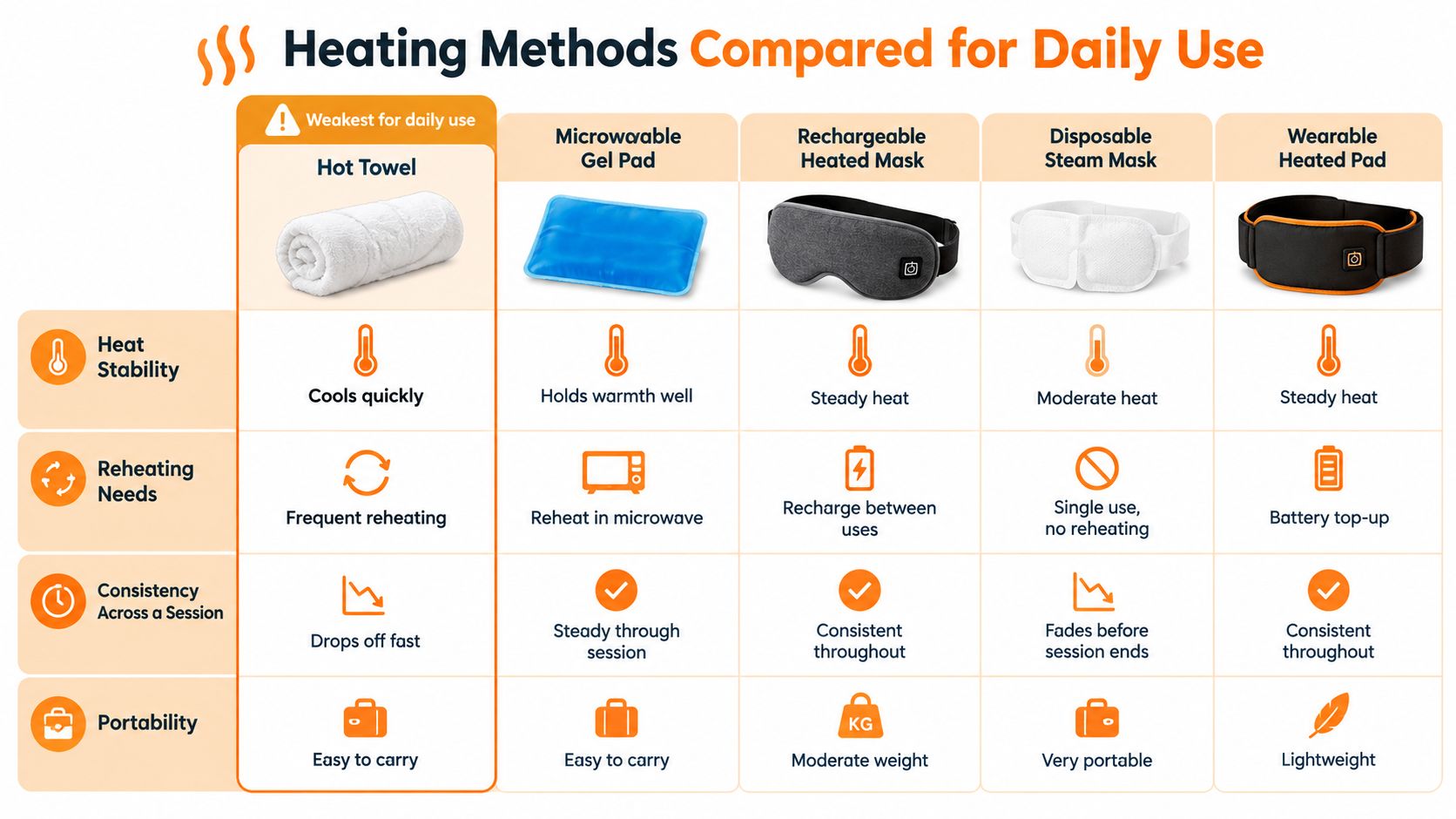
What the method changes
Hot towels offer a simple starting point, but interruption is their main drawback. The warm-compress evidence review published in Ophthalmology and Therapy describes rapid towel cooling and frequent reheating requirements, while reporting improvements with several warm-compress approaches. That makes a towel less convenient, not automatically ineffective.
Microwavable masks remove the cord during treatment. Their practical weakness is preparation: microwave power, starting temperature, and filling distribution affect the result. A guide to microwave warming bags can help explain the format, but the particular eye mask's heating instructions must govern use.
Disposable masks avoid that preparation step. In a randomized study published in 2023, 200 surgical patients received either a spontaneously heating mask or a control mask, and the heating group's non-invasive tear-breakup time increased from 6.7 ± 5.1 to 9.5 ± 5.6 seconds. That supports the studied intervention, not a claim that every disposable mask delivers the same warmth or benefit.
Powered heat and moisture are separate choices
A thermostat-equipped electric mask offers adjustable, ongoing heating, but confirm that the thermostat regulates the contact surface rather than merely the heating element. Check the cord's reach and whether a battery model maintains its claimed performance as its charge falls.
Moist heat isn't a separate power source. A moist-heat product may also be microwavable, disposable, or electric, so compare its heating mechanism first. Don't infer superior clinical performance from a softer or steamier sensation.
Choose the method you'll prepare and use consistently, not the one with the most spa-like description.
How to Test Eye Mask Temperature at Home
Use a surface-rated contact probe thermometer, a clock, and a notebook. An infrared thermometer can help screen the fabric surface, but curved surfaces, texture, and measurement distance can make readings less dependable; neither method measures the temperature within your eyelids.
The visual checklist provides a starting sequence. Extend your observations through the full intended session rather than stopping after warm-up.
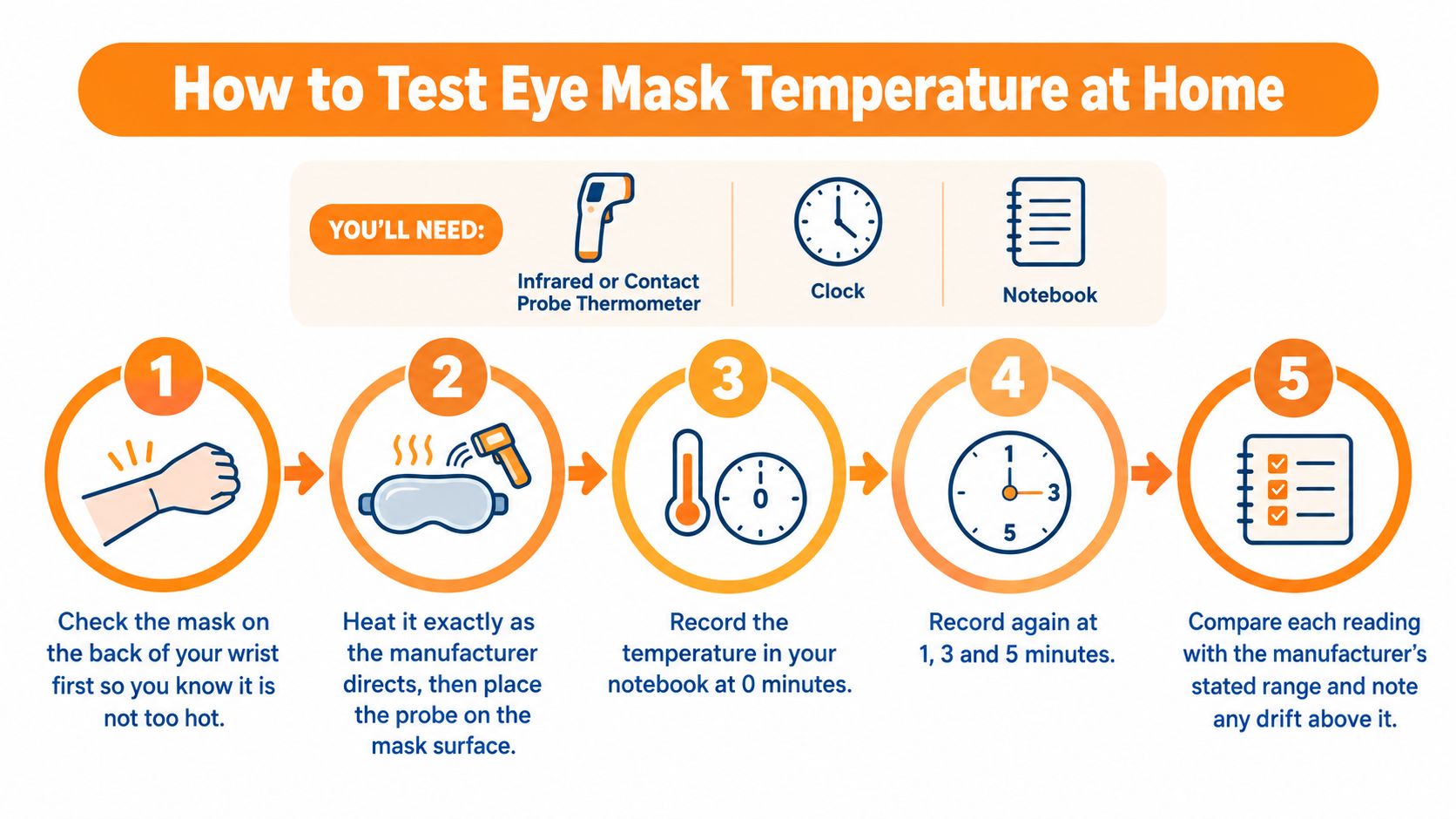
Run a repeatable surface check
- Heat exactly as directed. Use the specified microwave power and heating instructions, or the prescribed electric setting, so the result represents permitted use.
- Screen it on your wrist. Reject uncomfortable heat before considering eyelid contact, but don't treat a comfortable wrist test as proof of eye safety.
- Measure the eye-facing fabric. Keep the thermometer away from the heater, shell, or exposed filling because those aren't the intended contact surface.
- Compare the center and edges. Record each location separately so a hot area doesn't disappear inside an average.
- Track the full session. Record the initial reading, warm-up, midpoint, and endpoint to distinguish stable warmth from a short peak.
- Assess fit separately. Once the mask passes the temperature check, let it rest on closed eyelids without a probe underneath, checking for gaps or pressure.
A comparison involving five eyelid-warming masks and 12 participants found that all masks reached approximately 37°C within the first minute, while a hot-water facecloth was significantly cooler than the masks from the second minute onward. The important lesson is that initial warmth doesn't predict retention.
This demonstration offers additional context for warm-compress use.
A pleasant mask that cools rapidly has failed a retention check, even if it hasn't failed as a relaxation accessory.
Don't compensate by exceeding the heating instructions. Ask the manufacturer about the result or choose another design.
Safety Controls and Burn Risks Beyond the Spec Table
More heat isn't better treatment. A temperature limit and a timer address different hazards: the limit constrains heating, while the timer constrains duration. Neither makes an uncomfortable mask acceptable.
The clinical review in Ophthalmology and Therapy recommends reaching approximately 40°C or higher for at least 5 minutes when discussing therapeutic eyelid warming. That recommendation isn't permission to increase a device's setting until it feels intensely hot.
The following checklist highlights controls to investigate. Its incident example illustrates a possible hazard, not the frequency of burns among eye-mask users.
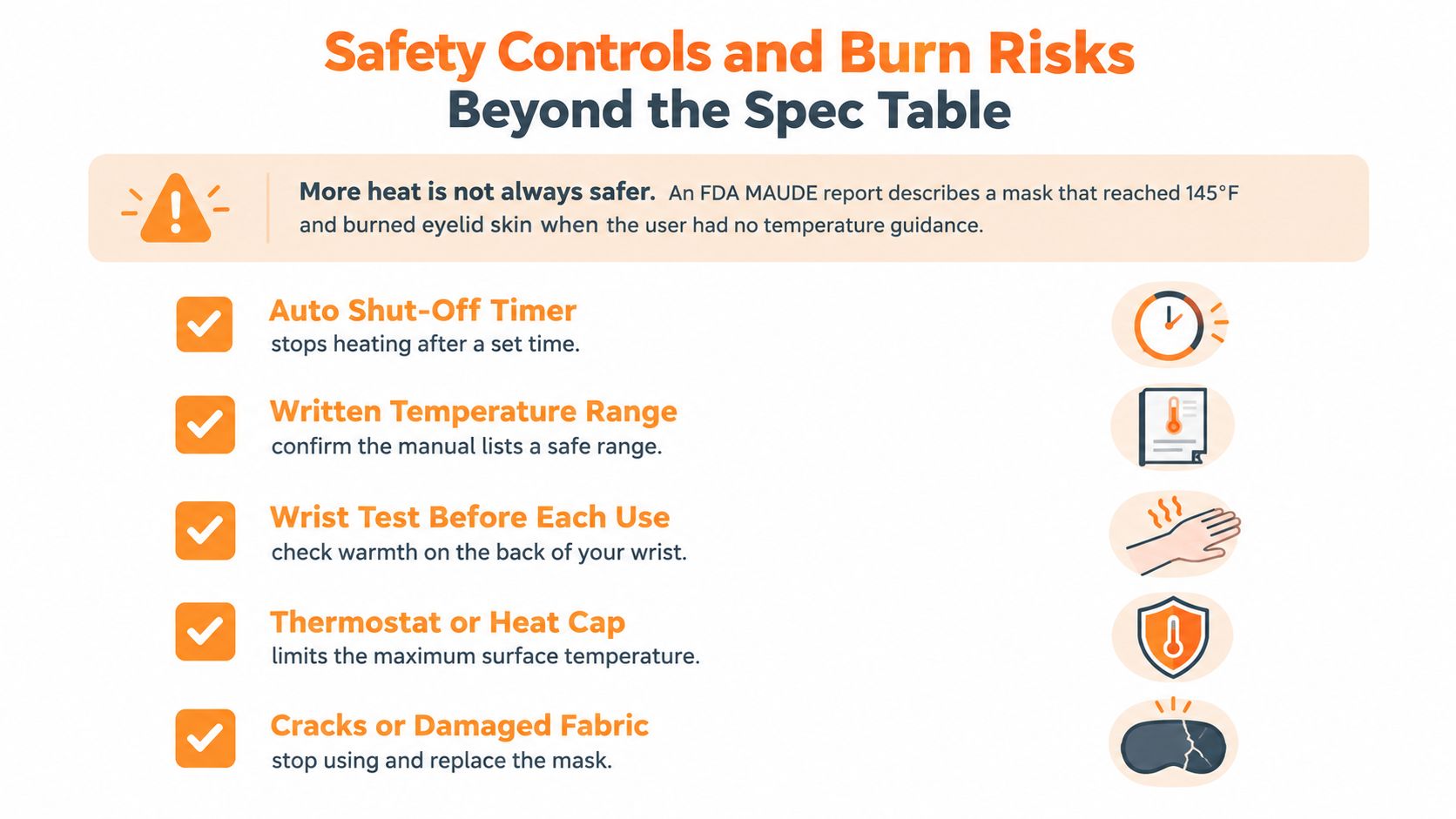
Check what the specifications leave out
- Contact barrier: Confirm that the intended fabric layer stays between the heat source and skin throughout use. Don't remove it to obtain stronger warmth.
- Reheating instructions: Look for explicit guidance about reheating a mask that's already warm. Starting another full heating cycle can produce a different result from heating a cold mask.
- Product condition: Stop using a mask with damaged fabric, leaking filling, exposed components, or a faulty controller.
- Stop rule: Remove it immediately if you experience stinging, burning, increasing redness, pain, or visual disturbance.
For preparation precautions, consult microwave-heating safety guidance, alongside the device's own instructions.
Know when not to self-treat
People with reduced corneal sensation, recent eye surgery, active inflammation or infection, or unexplained eye pain should seek clinician guidance before applying heat. If sensation is impaired, comfort is an especially unreliable warning system.
Relaxation products still need safe-use instructions. A comfortable sensation doesn't establish suitability for repeated dry-eye treatment, and permission to wear a mask while resting doesn't establish permission to sleep with it heating.
The goal is controlled exposure, not the longest possible session. Stop when something feels wrong rather than waiting for a timer to finish.
Fit, Fill and Cleaning Tradeoffs
The filling's job is to conform without creating uneven contact. A heavy grain-filled pouch may settle into the eye sockets, but that same weight can feel intrusive. A gel-filled mask may have a more defined shape, so check whether its seams leave gaps around your nose.
Don't rank materials by name alone. Flax seed, grain, gel beads, and mineral fills describe construction, not verified heat performance. Ask how the finished mask distributes its filling, whether you can redistribute it before heating, and whether the contact surface remains consistent when you lie down.
Separate the cover from the heating core
A soft fleece or cotton cover can make contact more comfortable, but softness doesn't establish retention. A thicker cover also changes how heat reaches your skin, so test the mask with the cover you'll use.
Cleaning instructions deserve the same attention as heating instructions:
- Removable cover: Check whether it can be washed separately and how it must dry before replacement.
- Filled insert: Don't assume it can be submerged because the outside looks like fabric.
- Moist-heat components: Follow the stated drying and storage process rather than sealing the product away while damp.
- Replacement signs: Investigate persistent odor, moisture, leakage, or changed heating behavior rather than reheating again.
Fit without tightening
An elastic strap should stabilize the mask, not pull it hard against your eyes. If tightening is the only way to close gaps, the mask's shape may be wrong for your face.
A good fit rests across the eyelids. It doesn't require pressure on the eyeballs to maintain contact.
Try the unheated mask in your normal treatment position. Check the nose bridge and temples for gaps, assess whether the filling slides away from either eyelid, and make sure you can remove it easily. Light blocking may matter for relaxation, but it isn't evidence of better gland warming.
Session Length and Frequency That Work
Judge a routine by retained warmth and completion, not by maximum heat or time worn. A cooling mask does not provide the same treatment as a heated mask, and a session that loses useful warmth early may not deliver its intended exposure.
Session length and frequency by routine
| Routine | Session | Frequency | Evidence basis |
|---|---|---|---|
| Minimum therapeutic benchmark | About 5 minutes at roughly 40°C | A treatment benchmark, not a complete daily prescription | College of Optometrists discussion and Ophthalmology and Therapy review |
| Clinical trial protocol | 10 minutes | Twice daily for 8 weeks | 2024 randomized-study record |
The roughly 40°C for about 5 minutes benchmark describes a minimum therapeutic session, while the trial record describes a particular study regimen. Neither establishes a universal schedule for every mask or every diagnosis. Follow the plan recommended by your clinician.
Adjust the routine, not the heating limits
If a mask loses useful warmth before the planned session ends, wearing it longer does not restore that heat. Don't reheat it beyond the product's instructions. Use an approved reheating procedure if one is provided, or choose a device that can maintain warmth for the prescribed session.
Make the routine easy to complete. Keep the clean cover, timer, and instructions together, and choose a time when you can finish without repeated interruptions. A practical starting point is a session that meets the relevant treatment plan, rather than extending wear time for comfort alone.
A brief log can track comfort, whether you completed the session, and any irritation. This gives a clearer picture than wear time alone: it distinguishes a finished, tolerable treatment from one you stopped early or endured.
Adherence doesn't excuse adverse effects. Stop if irritation develops and seek advice if symptoms persist or worsen. The useful routine is one that fits clinical guidance, maintains appropriate warmth, and remains tolerable enough to repeat.
What Dry Eye Evidence Does and Does Not Prove
The clinical need is substantial, but prevalence doesn't establish product effectiveness. A 2022 U.S. systematic review in JAMA Ophthalmology estimated pooled meibomian gland dysfunction prevalence at 21.2%, with a wide 7.2%–48.3% confidence interval, reflecting considerable uncertainty across the included populations and methods.
A 2024 Cochrane review evaluated thermal-pulsation treatment across 13 randomized trials involving 1,155 participants, with comparisons including warm compresses. Thermal pulsation isn't the same intervention as a consumer heated mask, so that evidence can't be transferred wholesale to retail products.
Separate intervention evidence from brand claims
The BMC Ophthalmology trial comparing disposable eyelid-warming masks with hot towels enrolled 144 patients, of whom 134 completed follow-up. It supports evaluating a defined treatment in a defined patient group, not declaring every product in that category superior.
Safety also requires context. A Physician's Weekly summary of the trial reported adverse events in 27 mask-group patients, or 37.5%, versus 21 towel-group patients, or 29.17%, with no severe adverse events reported.
Symptomatic comfort, improvement in a tear measurement, and proof that one commercial device outperforms another are different claims.
The defensible conclusion is narrower than many buying guides suggest: warming interventions can help some patients, but the evidence doesn't identify a universal brand winner. A broader dry-eye relief guide can help frame self-care questions, while an eye examination determines whether warming fits your diagnosis.
Choosing the Right Heated Eye Mask for Your Routine
Choose the format by where and how you'll use it, then screen the candidate for measurable performance. Starting with a brand ranking reverses that process and encourages you to overlook practical problems.
Heated eye mask choice by situation
| Your situation | Priority | Method to favor | Check first |
|---|---|---|---|
| Daily dry-eye or gland therapy | Repeatable therapeutic warmth | Microwavable, self-heating, or thermostat-controlled electric mask | Contact-surface specification and retention |
| Occasional relaxation or rest | Comfortable weight, fit, and light blocking | Grain-filled or soft-covered mask | Heating instructions and strap tension |
| Travel or office use | Convenient preparation without a nearby outlet | Disposable self-heating or battery-powered model | Heating profile, battery provision, and shutoff where applicable |
| Reduced corneal sensation, recent surgery, or eye pain | Clinical assessment | Ask a clinician before applying heat | Approval for the proposed device and routine |
These situations illustrate different buying priorities, not interchangeable treatment recommendations.
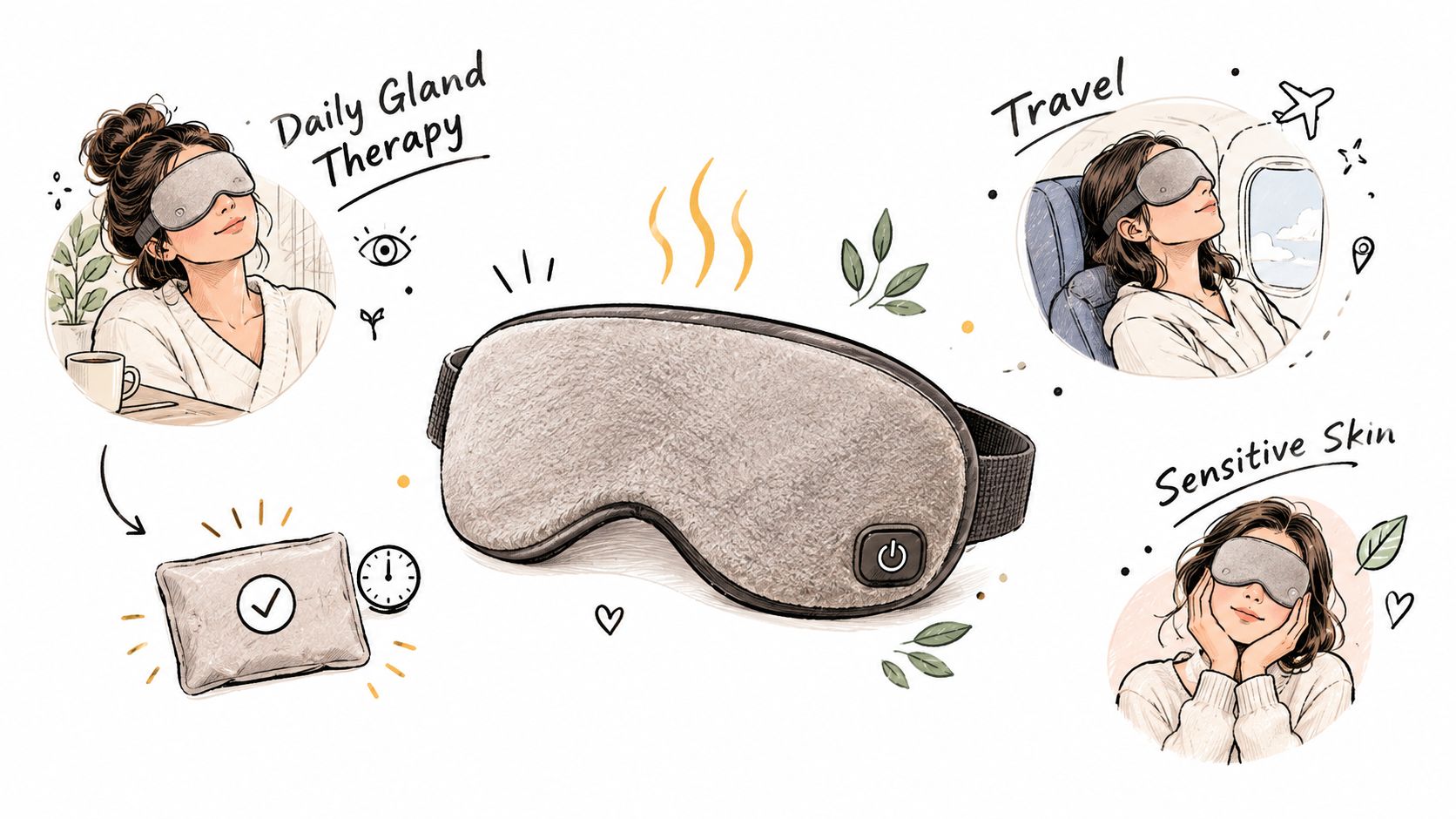
Make the final choice conditional
For regular gland therapy, favor a manufacturer that explains delivered temperature rather than advertising heat intensity alone. A microwave model may fit a home routine well; a regulated electric model may be more practical when preparation repeatedly prevents you from completing treatment.
For travel, distinguish portable to carry from usable at your destination. A microwave mask packs easily but still needs an appropriate appliance. A battery device needs charging, while a disposable product needs enough unopened replacements.
For relaxation, you can prioritize texture and light blocking without pretending those features establish clinical benefit. Don't leave a heating device running during sleep unless its instructions explicitly permit that use.
Before committing to a sustained routine, test a candidate within its permitted use and the seller's applicable return conditions. Keep your surface readings, assess fit, and confirm that cleaning and preparation are manageable. A documented, repeatable routine is a stronger basis for choosing the best heated eye mask than a hotter setting or a more luxurious description.
SunnyBay offers dry-eye therapy masks and eye pillows for warm-compress use, alongside reusable heat-therapy products. Visit SunnyBay to compare the available designs, then check the chosen model's heating instructions, cleaning requirements, and return terms before running your home surface-temperature test.


