


Microwave Warming Bags: Safe, Effective Heat Therapy Guide
-
You reach for warmth after a long day at the desk, or maybe after a workout leaves your shoulders tight and your neck stiff. A microwave warming bag looks simple in that moment, a soft pouch, a quick spin in the microwave, and relief feels close enough to grab.
That simplicity is why these products are so popular, but it's also why people misunderstand them. A microwave warming bag isn't just a cozy accessory. It's a small, reusable heat-therapy tool whose safety depends on wattage, time, filler type, and how carefully you use it.
Table of Contents
- What Are Microwave Warming Bags and Why People Use Them
- How Microwave Warming Bags Work and What Fills Them
- Safe Heating Instructions and Temperature Control
- Safety Evidence and What Consumer Testing Shows
- Best Use Cases for Neck, Shoulder, Hands, and Eyes
- Care, Longevity, and Smart Replacement Practices
What Are Microwave Warming Bags and Why People Use Them

A person doesn't usually think about heat therapy until the body sends a clear signal. Maybe it's the ache between the shoulder blades after too much screen time, or the dull stiffness that settles into the neck after a cold commute. In those moments, microwave warming bags are appealing because they deliver local warmth without cords, liquids, or a trip to the clinic.
These bags belong to a long heat-therapy tradition, where warmth is used to relax tissue and ease discomfort. The appeal is practical too. They're reusable, often chemical-free, and available in shapes made for the neck, shoulders, hands, eyes, or smaller sore spots.
A small eye pillow works differently from a large shoulder wrap, but the idea is the same. You heat the bag, place it where the body needs comfort, and let the stored warmth release gradually. That's why people often treat them as everyday household items, even though the better way to think about them is as engineered therapeutic tools.
Practical rule: If a heat product feels “simple,” that's exactly when careful use matters most.
For some shoppers, that means choosing a product for pure comfort. For others, it means picking a bag that fits a specific routine, like post-screen tension, bedtime relaxation, or a warm compress for the eyes. A well-made bag should make that decision easier, not harder.
How Microwave Warming Bags Work and What Fills Them
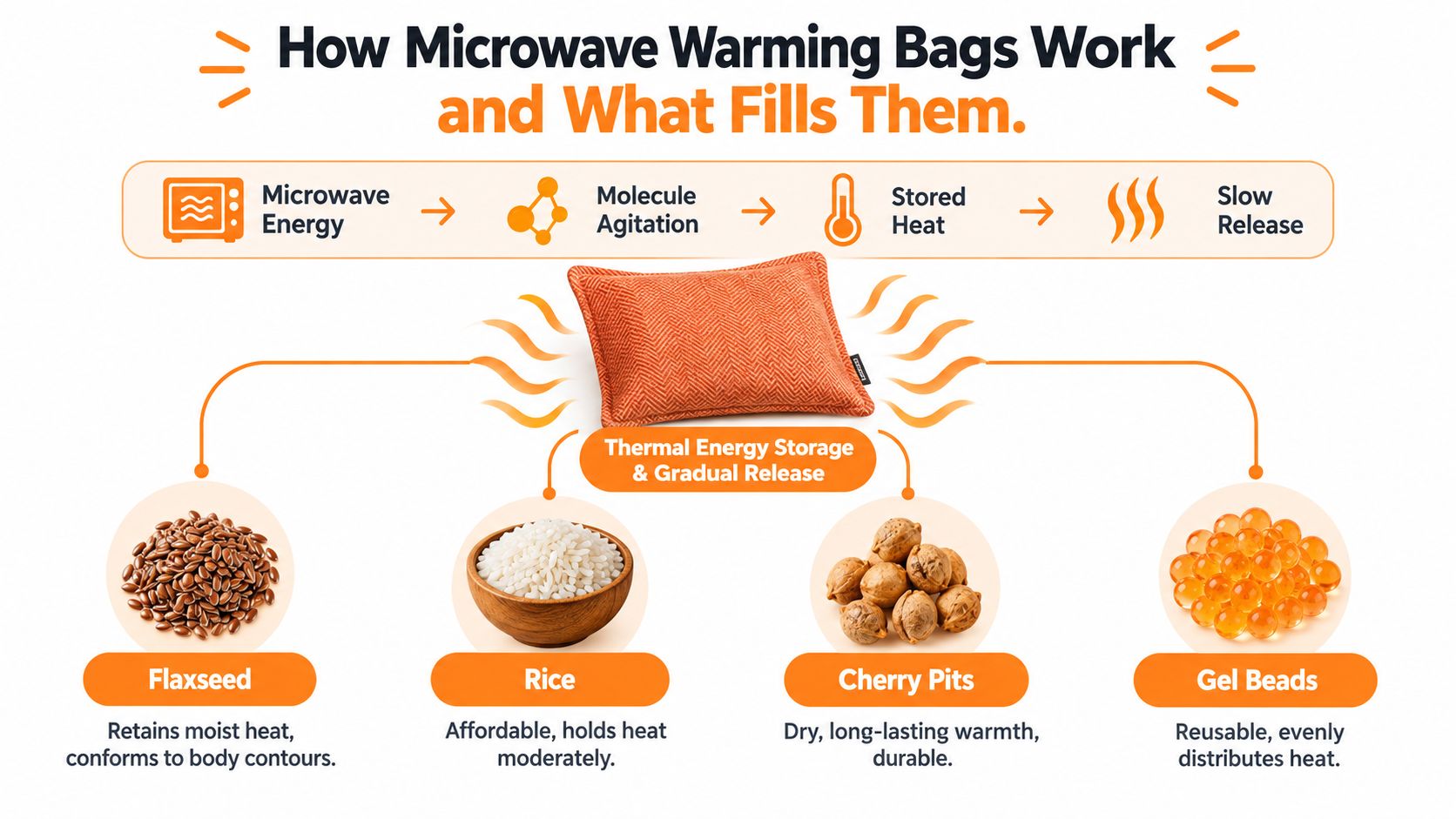
Microwave energy agitates water molecules inside the filler and surrounding material, which creates heat. The bag then stores that thermal energy and releases it slowly against the body. That's the simple version, but the details matter because the heating pattern is never perfectly even.
The filler changes the feel of the product. Flaxseed tends to mold closely to body contours. Wheat is common in reusable heat packs and gives a dense, grainy feel. Rice is familiar and affordable, while lava sand and other specialty fillers can change weight and heat retention. The right choice depends on whether you want a lighter pouch for an eye area or a heavier wrap for the shoulders.
Construction matters just as much as filler. A dual-fabric cover can improve comfort and reduce direct-contact risk, while an ergonomic shape helps the bag sit where it's supposed to sit. If the design shifts heat unevenly, the user can get a pleasant warm area in one spot and an unexpectedly hot one in another. That's why a product's seam quality, fill distribution, and outer fabric aren't cosmetic details. They're part of the safety system.
For readers comparing fills, SunnyBay's flaxseed therapy guide is useful background on why seed-based products are often chosen for conforming warmth.
The best heat bag doesn't just get hot, it heats predictably.
Some bags can also be used cold after freezing, which makes them more versatile for home care. But the core lesson stays the same. You're not buying a warm pouch, you're buying a device whose comfort depends on how the materials store and release heat.
Safe Heating Instructions and Temperature Control
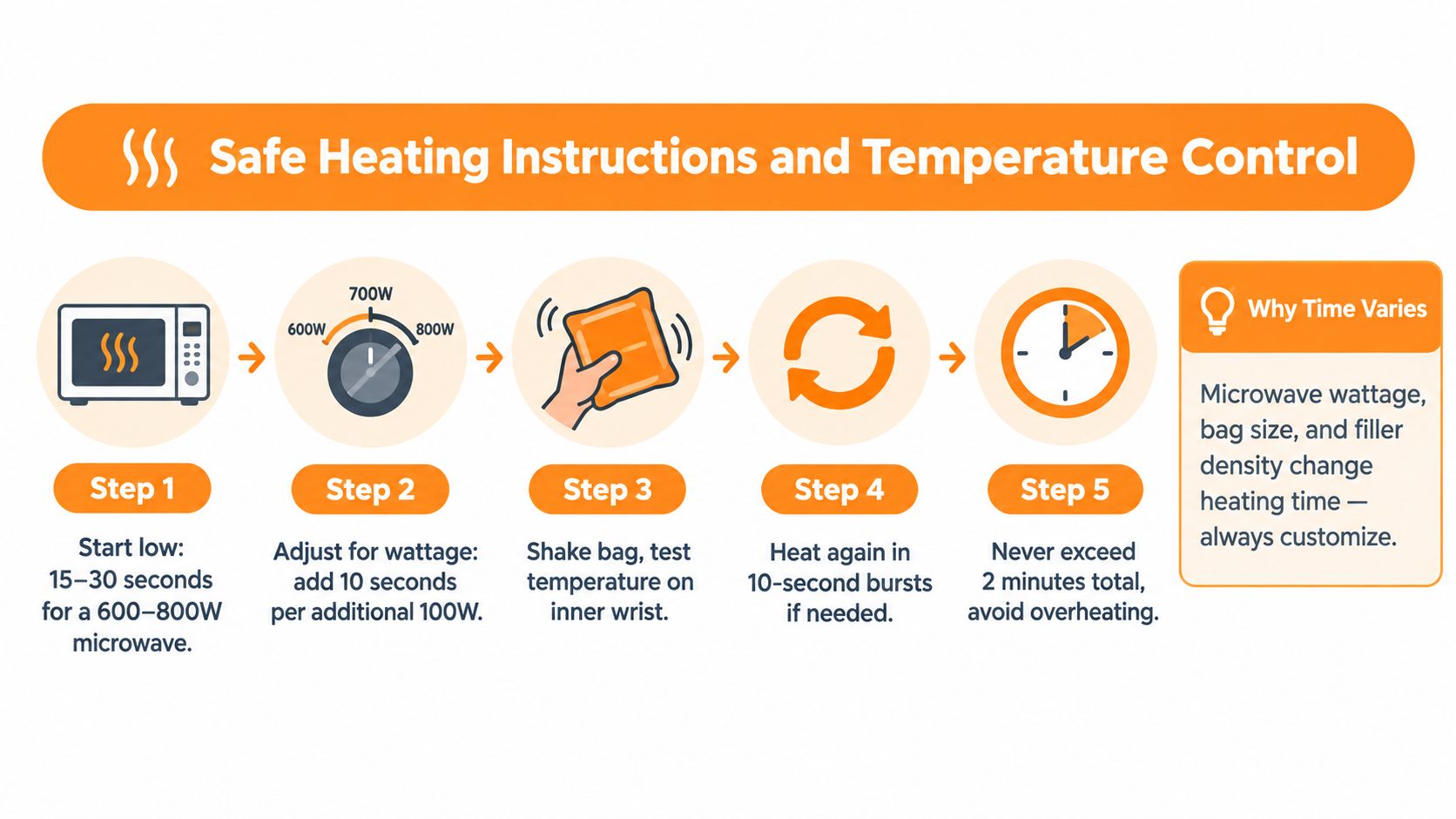
A microwave warming bag can feel gentle one minute and too hot the next. That is because it is an engineered heat device, and its behavior changes with microwave wattage, bag size, fill density, starting temperature, and how evenly the filler sits inside.
Safe use starts with the maker's instructions, then adjusts to the oven on your counter. The Hong Kong Consumer Council warned that heating directions written for lower-powered ovens may need adjustment in more powerful microwaves, which can be in the 700 to 1,000 watts range (Hong Kong Consumer Council). That is the practical issue behind inconsistent results. A bag heated in one kitchen may behave very differently in another.
SunnyBay's microwave heating safety guide gives brand-specific instructions that sit well alongside general safety rules.
- Start with a short cycle. Heat the bag briefly, then check it before adding more time.
- Shift the filling. If the design allows it, knead or redistribute the contents so one pocket does not overheat.
- Test before skin contact. Use the inside of your wrist or another sensitive area, not your palm, to judge the temperature.
- Add heat in small bursts. Short reheating steps are safer than one long run.
- Stop at warning signs. Smell, smoke, scorch marks, or a hard hot spot mean the bag should come out of service.
Safety rule: Do not treat a warming bag like food. It is a heat device, and heat devices need checking.
Never use a damaged bag, and never fall asleep with it resting directly on your skin. Prolonged contact is what turns useful warmth into a burn risk. If the bag feels too hot, let it cool before touching it again.
Safety Evidence and What Consumer Testing Shows
Consumer testing shows why caution is not overkill. A recalled microwave pre-heated warm pad was linked to a scald case in Hong Kong, and the Consumer Council warned that material held above about 43°C against the same skin area for more than 8 hours could cause a third-degree scald. Skin responds to both heat and time, so a product that feels merely warm at first can still become unsafe with prolonged contact.
Australia's Therapeutic Goods Administration examined microwavable heat packs under abuse-style conditions, including heating them for four times their stated instruction period. The regulator identified at least 12 adverse-event reports involving injury or possible injury, and in the testing four models reached internal temperatures above 150°C when overheated (TGA laboratory testing report). A pack was considered to fail when all three samples exceeded 70°C at maximum filling temperature.
That matters because the outside of the bag can be misleading. In controlled testing of wheat bags, the filler reached about 57.3°C under the bag's instructions, about 63.3°C in a 1000 W microwave, and about 69.6°C after reheating a partially cooled bag (controlled testing in PMC article). The surface and the core do not behave the same way, so a bag may feel acceptable in the hand while still holding a much hotter interior.
Organic fillers can char, clump, or ignite if a bag is heated beyond its validated limit. Abuse testing matters more than marketing language. If a product has not been validated for your microwave wattage, repeated heating, or reheating after partial cooling, you are relying on assumptions the maker may never have tested.
The safest takeaway is plain. Follow the stated time, stay nearby, and inspect for damage, odor, or scorching before each use.
Best Use Cases for Neck, Shoulder, Hands, and Eyes
A good warming bag earns its place by fitting the body, not by trying to do everything at once. For a stiff neck, a contoured wrap works better than a flat pad because it stays in place while you sit or move around. For shoulders, a longer shape helps spread warmth across the upper trapezius area instead of concentrating it in one spot.
Hands are a different case. A smaller pouch can be held briefly to warm cold fingers or ease general stiffness, but it should still be checked carefully because thinner skin and smaller contact areas can feel heat faster. Eye pillows are gentler still, and they're often used as warm compresses for comfort and relaxation around the eyelids.
That's where heat therapy gets more specific. A recent systematic review of dysmenorrhea included 57 randomized trials and 5,359 participants. Heat reduced pain versus no treatment, and compared with NSAIDs it produced comparable or slightly better relief with fewer reported adverse effects in the analyzed trials (systematic review). That doesn't mean every warming bag should be used the same way for every problem. It means heat has evidence in some situations, while other uses remain more about comfort and symptom relief.
For dry, irritated eyes, warm compress care deserves special attention. If that's your concern, a practical starting point is this guide on how to prevent dry eye, because warm compresses work best when they're part of a broader eye-care routine rather than a one-off fix.
SunnyBay's neck pain heat therapy page is another useful reference if you want to compare shape and use cases for posture-related tension.
Use heat for comfort, muscle relaxation, and short-term relief. Use medical judgment when pain is new, sharp, swollen, or unexplained.
If the area is swollen, freshly injured, numb, or unusually sensitive, heat may not be the right first choice. In those cases, cold therapy or a clinician's advice is the safer path. The product shape should follow the body part, not the other way around.
Care, Longevity, and Smart Replacement Practices
A warming bag lasts longer when you treat it like a reusable tool, not a disposable accessory. The outer cover, if it's removable, should be cleaned according to its fabric type, and it needs to dry fully before the bag goes back into service. Any trapped moisture can change heating behavior and, over time, can stress the filler.
Inspect the bag before each use. Look for seam separation, thinning fabric, persistent scorch marks, odd odors after heating, or filler that has shifted into hard clumps. Those are signs the product has moved out of safe-use territory. If the bag seems dry, brittle, or unevenly heated, stop using it.
Storage matters too. Keep it in a cool, dry place, away from dampness and clutter that can compress the fill. Don't toss it into a drawer while it's still warm, and don't reheat it before it has cooled the way the instructions expect. Reuse is fine when the product remains intact and the heat cycle stays within the validated range.
A simple maintenance habit helps a lot:
- Check before heating: Look for fabric wear, seam gaps, or odor.
- Let it cool fully: Give the filler time to reset before reheating.
- Wash gently: Clean removable covers as directed, then air-dry them completely.
- Retire it early: Replace the bag if it chars, smells burnt, leaks filler, or no longer heats evenly.
That last step matters more than people like to admit. A worn bag can still feel warm, but “still works” isn't the same as “still safe.” The goal is repeatable, predictable heat, not a pouch that gets less trustworthy every week.
If you want reusable heat therapy products that are built for everyday use, explore SunnyBay's microwavable wraps, pads, and compresses at SunnyBay. You'll find options made for the neck, shoulders, eyes, and hands, along with designs intended for practical home use and clear heating guidance.


