


Microwavable Hand Warming Mittens for Safe Heat
-
Microwavable hand warming mittens are reusable fabric mittens with a dry seed or mineral fill, heated in a household microwave for short comfort sessions of roughly 15–20 minutes, not a treatment that restores grip. They may ease coldness, pain, and stiffness, but the right heating time comes from the product's instructions and your microwave's wattage, not a universal timer setting.
You've come indoors with stiff fingers, or you're sitting at your keyboard waiting for your hands to feel ready. A soft, reheatable mitten can be useful in that moment, provided you treat it as a heat-therapy device rather than ordinary clothing.
Table of Contents
- What Microwavable Hand Warming Mittens Are
- Microwavable Mittens Next to Other Warmers
- How Fill and Mitten Shape Hold Heat
- How to Heat and Wear Them Safely
- Who Actually Gets Relief from Warm Mittens
- How to Choose a Mitten Worth Reheating
- Caring for and Storing Your Mitten
- Test One Safe Warm-Up Before You Rely on It
What Microwavable Hand Warming Mittens Are
Say you've returned from a cold commute and can't comfortably curl your fingers around a mug. Instead of plugging in a heating pad, you warm a purpose-made mitten or its removable insert, check it, and rest your hand inside.
The textile shell contains a sealed, heat-storing fill. Products may use flaxseed, rice, wheat, or a mineral material such as lava sand. The fill absorbs energy during heating and gradually transfers warmth through the surrounding fabric.
Think of it as a hot-water bottle shaped around the hand. A dry-fill design doesn't require you to pour in hot water, connect a cord, or activate a disposable chemical cartridge. It also doesn't generate fresh heat after you remove it from the microwave.
Warmth is a short symptom soother and warm-up, not proof that opening jars, typing, or dressing will become easier.
A comfort tool, not protective equipment
A warming mitten isn't an oven mitt. Don't use it to lift hot cookware, and don't assume that anything shaped like a glove is microwave-safe. Only heat the components that the manufacturer explicitly identifies as suitable.
Some designs have a removable insert; others heat as a complete unit. That distinction matters because decorative trim, fasteners, covers, and internal materials may require different handling.
- At a desk: Rest your hands during a break, then remove the mittens before typing.
- Before movement: Use comfortable warmth before gentle finger exercises.
- After coming indoors: Settle somewhere warm rather than expecting the mitten to compensate for continued cold exposure.
The useful question isn't whether a product gets warm. It's whether its heat source, handling requirements, and intended setting match the job you need done.
Microwavable Mittens Next to Other Warmers
Choose a microwavable mitten for a short, reusable warm-up with a microwave nearby. For extended outdoor use or travel without an oven, another heat source usually makes more sense.
A warmer's advertised heat duration isn't automatically its safe skin-contact duration. Battery settings, packet packaging, fabric barriers, and the manufacturer's limits all matter. Compare the operating method before comparing claims about how long something feels warm.
Hand warmers compared by job
| Warmer | Heat source | Typical warmth | Best when |
|---|---|---|---|
| Microwavable mitten | Microwave plus dry seed or mineral fill | A cooling warm-up cycle; follow the product's session limit | Home, desk, or pre-activity warm-up with an oven nearby |
| Electric heated gloves | Rechargeable battery or USB | Active heat until the battery runs down or power is disconnected | Extended time outside when charging is available |
| Air-activated packet | Iron oxidation, usually disposable | Sustained heat for the packet's labeled operating period | Sports, work, or travel with no microwave |
| Click chemical pack | Supersaturated solution, sometimes boiled to reset | A brief heating cycle until the pack cools | Backup warmth when the activation and reset method suit you |
| Insulated mitten alone | Trapped body heat | Passive insulation while worn, without added heat | Cold conditions where clothing adequately maintains warmth |
Match the warmer to the setting
For a reading break at home, a microwave-heated insert offers a straightforward routine. You heat it, rest, and let it cool. There's no battery to charge, but there's also no adjustable heat supply once you've left the kitchen.
Electric heated gloves serve a different purpose. They provide heat while you're outside, although you'll need to manage charging, controls, and any restrictions on wet-weather use. Check whether the design lets you operate the equipment you'll handle.
Air-activated packets are convenient away from power. Keep them in the position specified on their packaging rather than pressing them directly against skin or improvising a tight wrap.
Click packs activate without an oven, but reusable versions may require boiling to reset. That preparation can be less convenient than it sounds if you want frequent, spontaneous use.
Ordinary insulated gloves and mittens add no heat of their own. If you're choosing passive clothing as a present, Cashmere Boutique's cashmere accessories for winter gifting offer a separate clothing option to consider, not a substitute for a heat-therapy device.
None of these products is frostbite treatment. Persistent numbness, abnormal skin color, or suspected cold injury needs appropriate medical attention rather than a hotter warmer.
How Fill and Mitten Shape Hold Heat
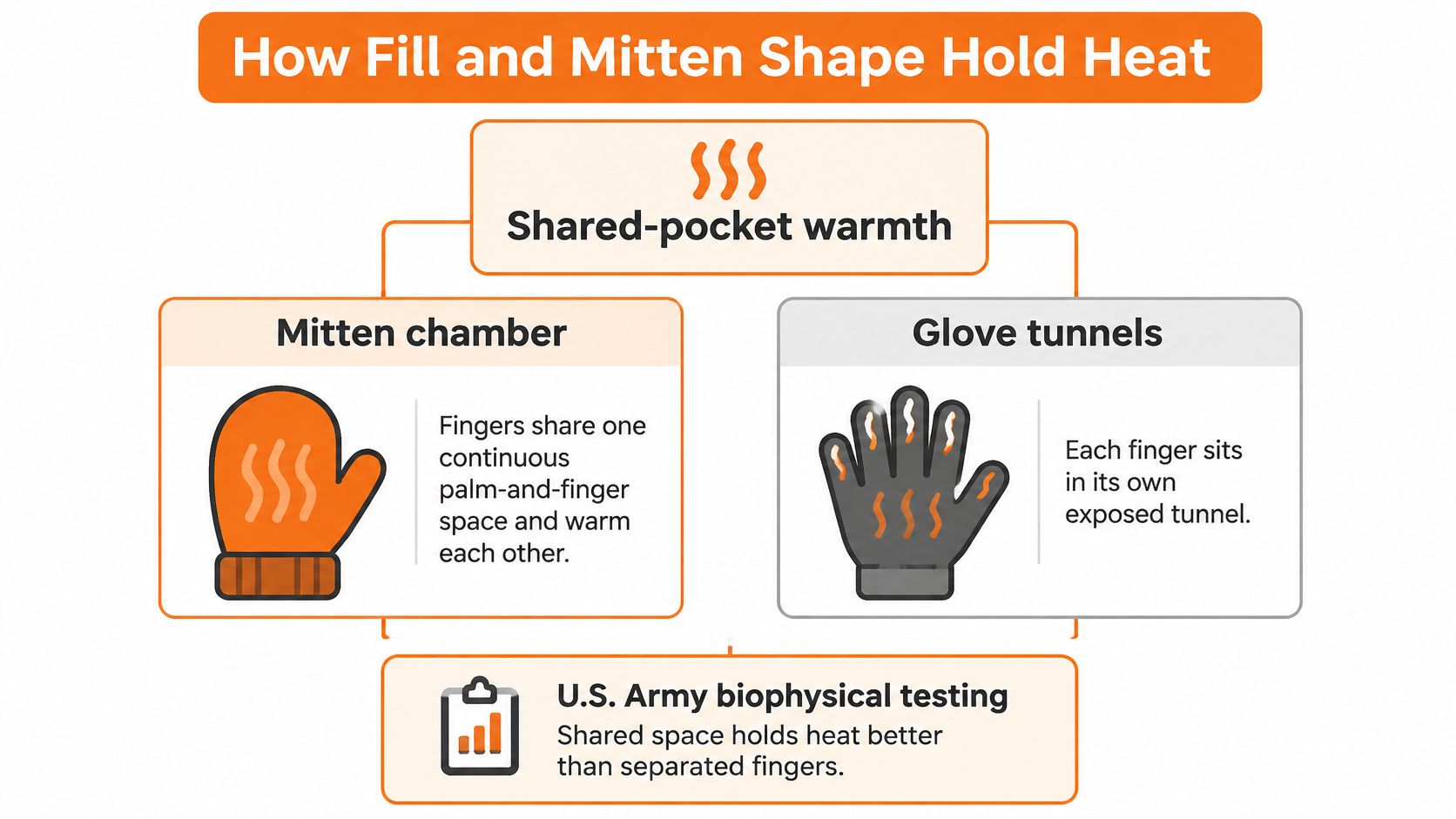
Fingers inside a mitten occupy a shared pocket. In a glove, each finger sits in a separate fabric tunnel, with more surface exposed around it.
U.S. Army biophysical testing published in Military Medicine found that mittens generally provide greater warmth, while gloves preserve better dexterity. Grouping the fingers reduces exposed surface area and lets them share heat within a common space.
That makes a warming mitten a resting heat tool first, not a work glove. Trying to grip a hot drink or handle small objects while wearing a bulky heated mitten introduces problems its shape wasn't designed to solve.
The diagram shows the shared-pocket principle.
What the fill and fabric contribute
Loose seeds, grains, and mineral particles can move inside their pouch. That movement lets you redistribute a mound of fill instead of leaving it concentrated against a knuckle or the heel of your palm. The material's name alone doesn't establish safety, even natural fill can overheat.
Construction matters just as much. A continuous hand cavity and a manageable wrist opening help contain warm air without forcing stiff fingers through a narrow entrance.
- Inner fabric: Provides the contact surface between your hand and the heated insert.
- Outer insulation: Slows heat loss but can make the mitten bulkier.
- Fill compartments: Help control shifting, though excessive partitioning can prevent useful redistribution.
- Removable cover: Separates routine cleaning from care of the heating insert.
A thicker mitten isn't automatically a better mitten. Added bulk can make insertion difficult, while a tight cuff may be uncomfortable or restrictive. You should be able to remove the device promptly without help unless assistance is already part of your care plan.
Judge distribution, not the hottest patch
A warm palm with cold fingertips is an uneven result, not evidence that you should microwave longer. Manufacturers should evaluate warmth throughout the hand cavity and at the fingertips, rather than reporting only the fill's peak temperature.
Practical rule: Look for gentle, even warmth across the hand, not one impressively hot spot.
For the broader format, this guide to microwave warming bags offers useful context. Whole-body clothing also matters outdoors; California Cowboy's guide to stay warm from slopes to fireside addresses layering, a separate job from localized hand warming.
How to Heat and Wear Them Safely
Touch is a warning signal, not an accurate thermometer. Reduced sensation can prevent you from noticing excessive heat, and soft fabric can conceal a localized hot patch.
The Hong Kong Consumer Council's warmer-safety guidance warns that prolonged contact can cause burns even around 43°C. Feeling pleasantly warm at first doesn't establish that continuous contact is safe.
Treat the mitten like a heating pad that happens to look like clothing. Overheated or deteriorating fill can burn skin, scorch, or potentially ignite.
A controlled heating routine
A review of burns from body-heating devices describes guidance to accurately measure device temperature below 140°F (60°C), check skin frequently, and limit heat application to roughly 15–20 minutes. That temperature is an upper boundary, not a target, and it doesn't guarantee safety for a particular person or contact duration.
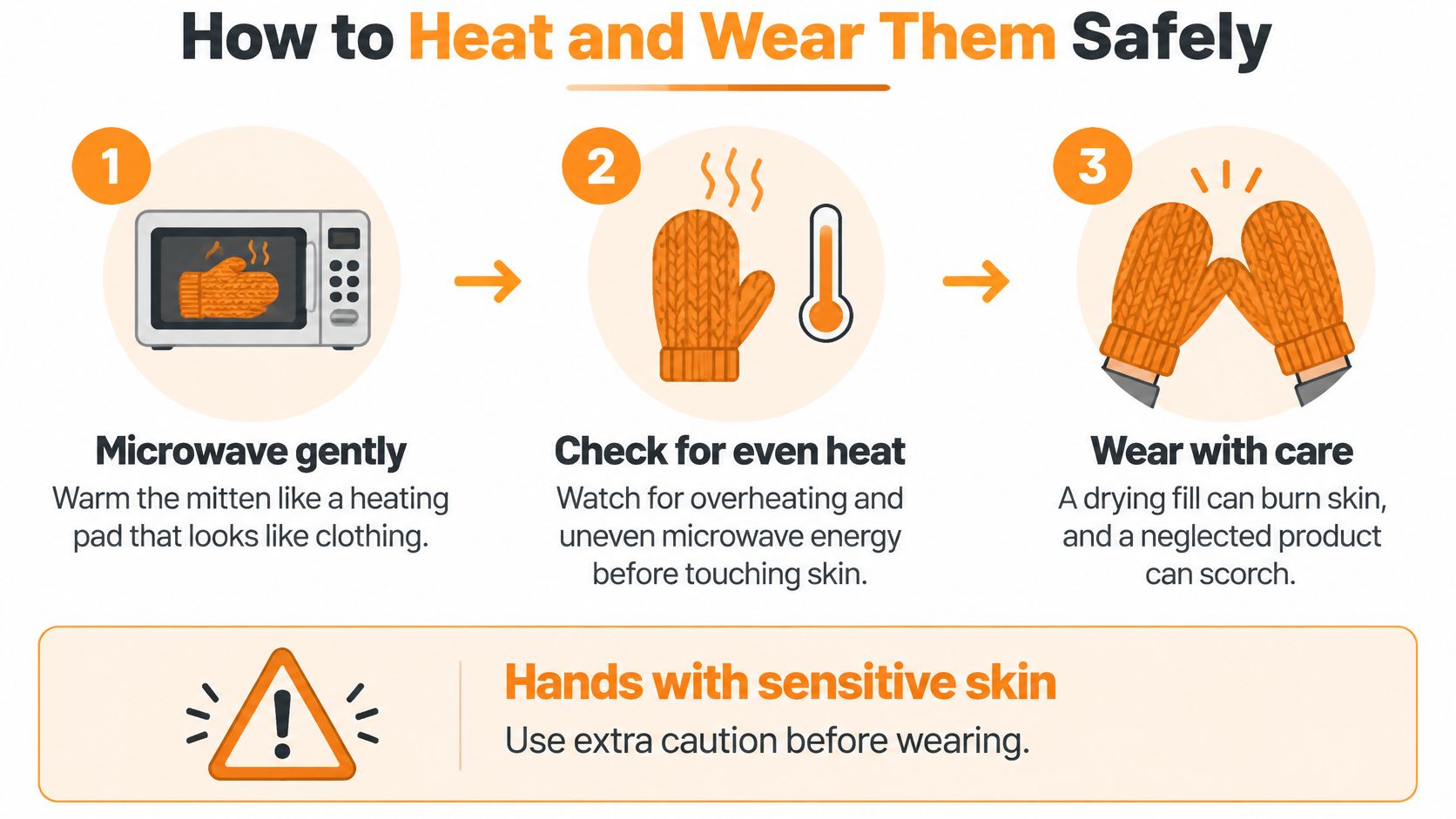
- Read the heating card before starting. Find your microwave's output wattage on its label or manual, then match it to the product's instructions. If the instructions don't cover your oven, ask the manufacturer rather than calculating a time yourself.
- Use the shortest approved heating interval. Add heat only through increments the manufacturer permits. Don't invent a universal microwave time or transfer instructions from a different warmer.
- Stay with the microwave. Never heat the mitten while wearing it, and don't leave reheating unattended. Stop if you notice smoke, scorching, or an unusual smell.
- Remove and redistribute carefully. Use the specified handling method, then gently knead or shake the fill if permitted. Don't aggressively fold a pouch or stress its seams.
- Check several contact areas. Use a suitable surface-temperature thermometer according to its instructions, then cautiously check comfort against normally sensitive skin. A wrist check alone cannot establish a safe temperature, especially when sensation is impaired.
- Set a timer and inspect your skin during use. Remove the mitten periodically rather than waiting for discomfort. Stop for stinging, unusual redness, irritation, or pain.
- Let it cool completely before reheating. A still-warm insert has a different starting temperature from a cooled one. Repeated topping-up can overheat the fill.
- Keep use awake, dry, and observable. Don't sleep in it, apply it to numb or damaged skin, or soak a dry-fill insert. Follow any required barrier-cover instructions.
- Retire damaged inserts. Scorch marks, persistent odor, damp clumps, thinning seams, and escaping fill are reasons to stop, not reasons to shorten the next heating cycle.
The visual below summarizes the handling sequence, but it doesn't replace the heating card.
When another person should help
Older adults and people with diabetes, vascular disease, impaired sensation, or cognitive impairment need particular caution. Ask a clinician whether home heat is appropriate, and arrange help with temperature and skin checks when needed.
This explanation of microwave heating safety can help you prepare questions. If you can't reliably monitor heat exposure, don't use the mitten unsupervised.
Who Actually Gets Relief from Warm Mittens
Cold hands can be awkward before they become obviously painful. A person coming indoors may struggle with a zipper or keys and assume that feeling warmer will immediately restore normal performance.
Military public-health material on cold-weather casualties and injuries describes field findings in 110 students, all of whom developed hand temperatures below 15.0°C, with 65% reaching 8.0°C or lower. Those findings concern cold exposure and impaired hand function, not proof that a particular commercial mitten reverses the problem.
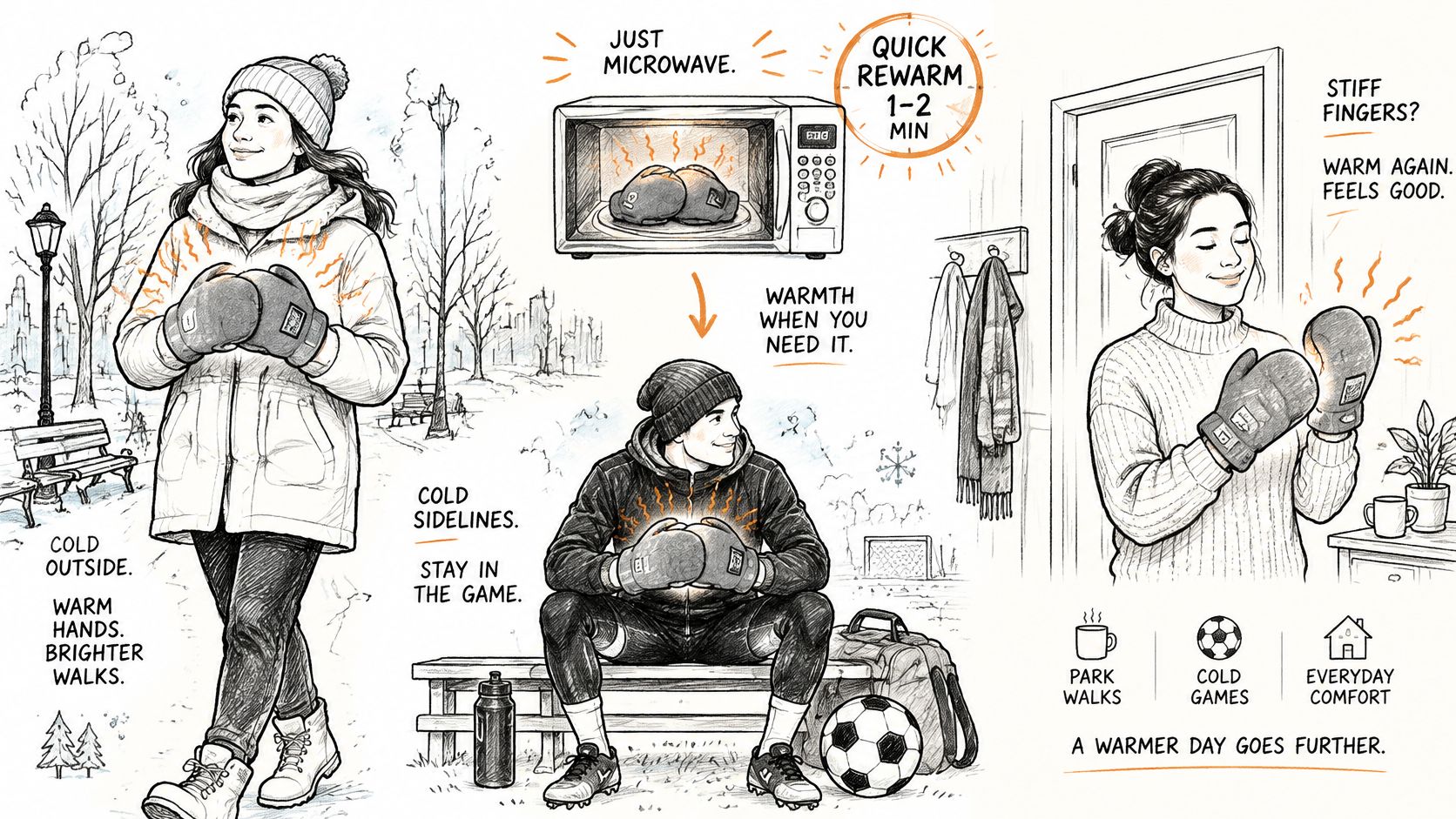
For walkers and people watching outdoor games, the sensible role is a controlled indoor warm-up, not protection that excuses staying in worsening conditions.
Pain relief and stronger hands are different outcomes
A 2024 randomized trial published in The BMJ studied 200 people with hand osteoarthritis using heated mittens for at least 15 minutes daily over six weeks and found greater improvement in pain and stiffness, but no significant improvement in physical hand function, grip strength, or overall osteoarthritis-related problems compared with control mittens.
That distinction should shape your expectations. Your hand may feel easier to move without becoming stronger or more capable of opening a tight lid. The trial also doesn't establish that every microwave-filled mitten will produce the same result.
A useful personal goal is concrete: less discomfort before gentle movement, rather than a promise to regain lost grip. For a desk worker, that might mean resting with comfortable warmth before starting the day, then checking whether ordinary tasks are easier.
Comfort can be worthwhile without being rehabilitation. Judge pain, stiffness, strength, and task performance separately.
This guide to hand heating pads for arthritis provides additional context for choosing a format. If a therapist has prescribed exercises, use their advice about timing and intensity instead of forcing movement because the hand feels temporarily better.
For a visual companion to hand-warming options, the video below is available alongside this guidance.
Similar symptoms need different decisions
Osteoarthritis, inflammatory arthritis, and Raynaud's phenomenon aren't interchangeable labels. Inflammatory arthritis may involve swelling and active inflammation that needs a treatment plan; Raynaud's involves blood-vessel spasm and characteristic color changes.
- Seek assessment: New weakness, persistent swelling, severe pain, or numbness that doesn't recover shouldn't be managed with repeated heating alone.
- Treat color changes seriously: New, persistent, one-sided changes or sores require medical evaluation.
- Check sensation first: Diabetes or neuropathy isn't a reason to improvise stronger heat. Ask a clinician before home use if sensation or circulation is impaired.
How to Choose a Mitten Worth Reheating
A useful product card tells you how to use the mitten safely, not just what the fabric feels like. If you can't find heating instructions before buying, request them.
Start with access. A stiff hand needs an opening you can enter without pulling hard, and you need a way to remove the mitten promptly. Weight should be comfortable while your forearm rests on a chair arm or table.
What to check before buying
| Check | Why it matters | Prefer |
|---|---|---|
| Fill | Concentrated fill can create uneven contact and heating | Flaxseed, grain, or mineral fill that redistributes smoothly |
| Cover | The skin-contact surface needs appropriate cleaning | Removable cotton or fleece cover with clear washing directions |
| Opening and cuff | Stiff hands need access without unnecessary restriction | Wide opening, snug but manageable cuff |
| Microwave card | Ovens differ in output power | Wattage-specific instructions plus a mandatory cool-down |
| Hot and cold | Not every heating insert is suitable for freezing | An insert explicitly labeled freezer-safe |
| Instructions | Safe use requires clear boundaries | No heating while worn, no sleeping in it, and explicit retirement warnings |
Apply the checks to the actual model
Don't assume all products from the same company have identical fill, washing rules, or heating times. A washable outer glove doesn't necessarily mean its insert can go through the washing machine.
Movable fill is useful because you can spread it out, but it doesn't make a product burn-proof. Reject claims that natural materials cannot overheat.
- Pass on convenience: The cover comes off without spilling fill, and the instructions explain how to reassemble it.
- Pass on fit: You can insert and withdraw your hand without fighting the cuff.
- Pass on clarity: The manufacturer identifies which component goes into the microwave.
- Fail on missing warnings: Instructions encourage sleeping in the mitten, ignore scorching, or provide no way to resolve wattage differences.
For swelling or a fresh injury, don't choose between heat and cold based only on which feature the product offers. Get advice appropriate to the cause. A freezer-safe label establishes material compatibility, not the right treatment for your hand.
Caring for and Storing Your Mitten
Set up a simple care routine before the first heating cycle. Keep the instruction card somewhere accessible so nobody has to guess which parts can be washed.
For a dry-fill mitten, wash only the removable cover unless the manufacturer explicitly permits another method. Follow its fabric-care label and let it dry completely before replacing the insert.
Keep cleaning separate from heating
A soft fleece cover and a seed-filled pouch need different treatment. Don't soak the insert, run dry fill through a washing machine, or add water because you think extra moisture will improve the heat.
For broader comfort-clothing care considerations, hooded robe advice from SEYANTE is a separate resource. A robe's laundering directions should never be transferred to a heating insert.
- Between sessions: Let the insert cool and air in a clean, dry place.
- Before storage: Make sure the cover and insert aren't damp.
- In the drawer: Avoid compression that strains seams or permanently bunches the fill.
- After washing: Inspect the cover for fraying, exposed fasteners, or loose stitching.
Store it where you can inspect it
Choose a dry drawer or open basket, away from a damp bathroom, direct heat, and a hot car. Keep the mitten separate from sharp objects that could puncture its pouch.
Gently redistribute the cooled fill before putting it away. If its texture changes unexpectedly, stop using it until you've checked the manufacturer's advice.
Record when you started using the insert and retain its care instructions. Follow the manufacturer's replacement guidance, but don't invent a calendar lifespan or assume that an undamaged cover proves the fill is still sound. Changes in smell, condition, or performance deserve attention before the next heating cycle.
Test One Safe Warm-Up Before You Rely on It
The right decision may be yes, no, or not yet. A microwavable mitten makes sense when you want reusable resting warmth, have an appropriate microwave, and can monitor the session.
Choose another option if your main need is sustained outdoor protection. Delay home heat if you have unexplained symptoms, unreliable temperature sensation, or no practical way to check your skin safely.
Make the first session a controlled trial
Use the product's shortest approved heating interval, redistribute the fill as instructed, and check the contact surfaces carefully. Sit somewhere you can remove the mitten easily and observe your hand.
Don't combine the first test with sleep, distraction, or another heat source. You're checking whether the product's fit, weight, warmth, and handling suit you, not testing how much heat you can tolerate.
- Continue cautiously: The warmth stays comfortable, the skin remains normal, and removal is easy.
- Stop immediately: You notice stinging, irritation, unusual redness, or worsening symptoms.
- Get medical advice: Pain, skin changes, weakness, or numbness persist after removal; seek prompt care for a suspected burn.
A successful trial supports a modest role: comfortable preparation for rest or gentle movement. It doesn't justify increasing the temperature, extending contact indefinitely, or treating recurring symptoms without assessment.
SunnyBay offers reusable microwavable hand warmers and other targeted heat-therapy products for home comfort. Visit SunnyBay to compare hand-warming options, then check the selected model's fit, fill, cleaning directions, and wattage-specific heating instructions before buying.


