


Hand Held Massager with Heat: How It Works and Is It Safe
-
Heat it up, press hard, and keep going until the knot gives. You'll hear a version of that advice from friends, from review videos, and from plenty of product pages. It's wrong on two counts. It treats heat and vibration as one intensity dial, and it assumes more of both buys more relief.
They're separate effects that happen to share a handle. Heat warms tissue and quiets stiffness. Mechanical movement works on tight muscle through pressure and repetition. Neither one screens you for the situations where warmth on skin is a bad idea: numb feet, poor circulation, a swollen joint, a bruise you haven't looked at yet.
So the useful question isn't whether a hand held massager with heat works. It's when heat helps, when motion helps, on which body part, for how long, and what should stop you before you switch the device on. That's a protocol rather than a verdict, and it's built below from clinical trials and safety reviews instead of packaging copy.
Table of Contents
- What a Hand Held Massager with Heat Actually Does
- Why Heat and Vibration Work Differently
- What the Evidence Shows About Benefits
- Setting Temperature and Session Length Safely
- Who Should Check With a Doctor First
- Pick a Heated Massager and Use It Safely
What a Hand Held Massager with Heat Actually Does
A hand held massager with heat is a compact device you hold in one hand. A heated head or pad sits at one end, a small motor adds percussion or vibration, and the grip keeps your wrist in control. You press it against the neck, shoulders, upper back, hands, or calves for a few minutes at a time, on yourself or on someone else. Some run on batteries, some plug into a wall.
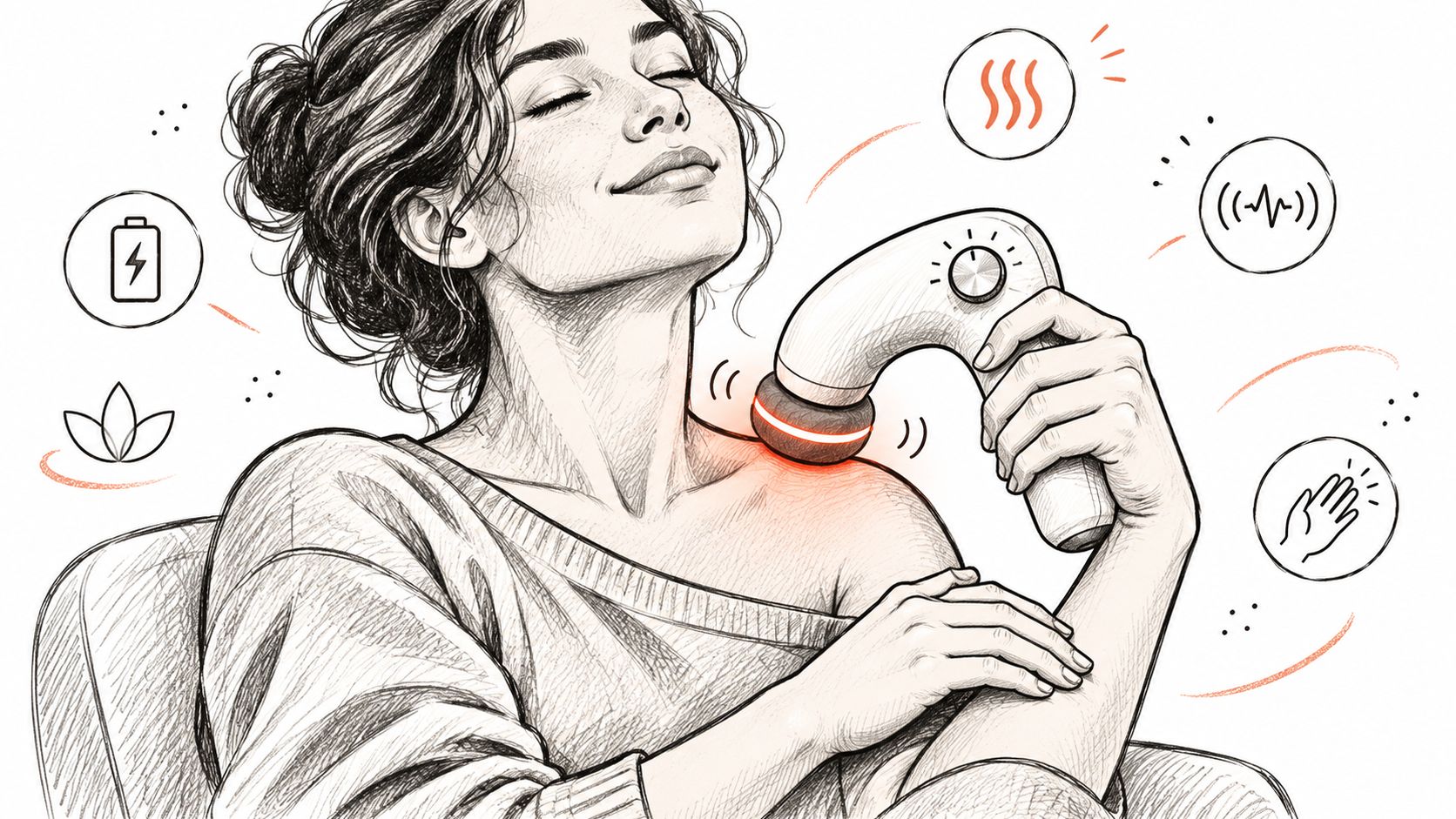
Two levers do the work, and you control both. Heat raises tissue temperature and makes a stiff area feel easier to move. Mechanical movement applies repeated pressure that eases tension out of one spot. Warm a coiled rope before you bend it and it flexes instead of cracking. Work the knots out with your thumbs afterward and the rope lies flat. Heat and vibration cooperate like that, but they aren't interchangeable.
What it isn't matters just as much. A massage gun has no heat element, so all of its effect is mechanical. A heating pad has no motor, so all of its effect is thermal. A heated massager sits between the two categories, and that's exactly why the safety questions double: you're managing a temperature and a pressure at the same time.
Three designs cover most of what's sold:
- Fixed-heat wands: one heat level, a vibrating tip, a slim handle. Simple and inexpensive, but you can't dial the warmth down once your skin is already warm.
- Heated pads with a motorized head: a broad contact area that spreads pressure across a whole shoulder rather than a single knot. Better for general stiffness than for pinpoint work.
- Combined heat-and-percussion units: adjustable heat plus adjustable speed or stroke. Usually the priciest, and the most sensible for a two-effect device, because each effect gets its own control.
The category is crowded. The global heat massager market was valued at US$2.9 billion in 2024, according to HTF Market Intelligence, which means a lot of units and very uneven documentation.
The decision in front of you isn't whether warmth feels good. It's whether your particular pain pattern fits a device you hold and move, or whether it needs a clinician's eyes first.
Why Heat and Vibration Work Differently
A heated massager has two settings that feel like one. Turning both up seems logical: more warmth, more movement, more relief. A controlled study of healthy volunteers tested that assumption by measuring skin temperature after several different treatments, and the results don't line up with what shoppers expect.
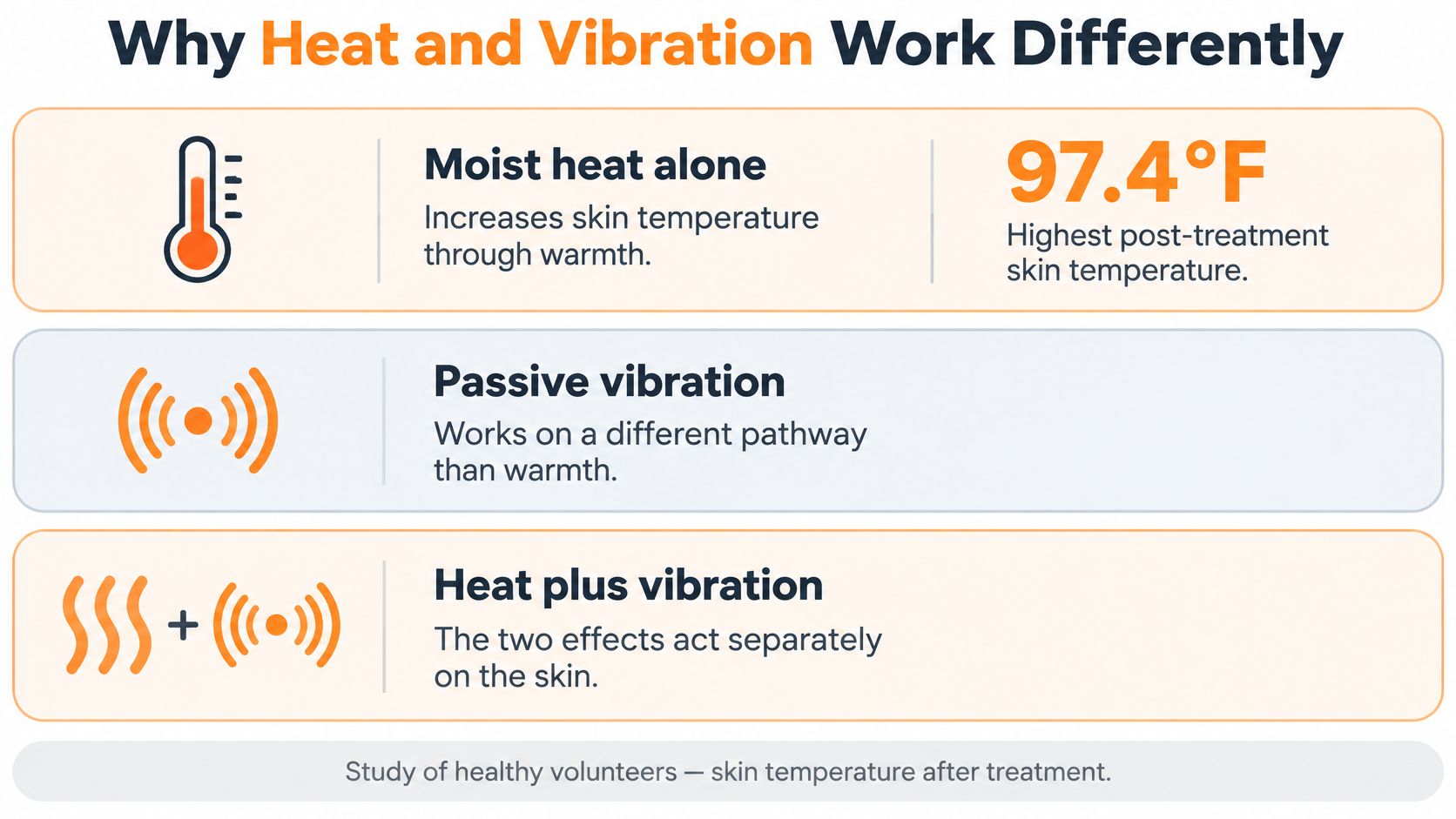
In the controlled study of healthy volunteers, ten minutes of passive vibration raised mean skin temperature from 95.4°F to 97.0°F, while moist heat alone produced the highest post-treatment temperature at 97.4°F. A massaging heating pad and active vibration both landed lower, at approximately 95.2°F and 95.1°F. Read the table one row at a time and each row becomes a setting decision.
| Treatment | Skin-temperature result | Practical takeaway |
|---|---|---|
| Moist heat alone | Highest post-treatment temperature, 97.4°F | Strongest thermal effect, so heat level matters most |
| Passive vibration | Rose from 95.4°F to 97.0°F over 10 minutes | Non-thermal option for readers sensitive to burns |
| Massaging heating pad | About 95.2°F | Lower temperature than moist heat alone |
| Active vibration | About 95.1°F | Lower temperature; prolonged contact can cause friction irritation |
| Passive vibration plus moist heat | No significant gain beyond the control condition | Stacking maximum settings adds little in the short term |
What Stacking the Settings Actually Buys You
Two rows deserve more than a glance. Vibration lifted skin temperature almost two degrees with no heat element at all, which is why a percussive tool without heat still feels warming on a cool morning. And passive vibration combined with moist heat produced no significant increase in skin temperature or short-term blood-flow effects beyond the control condition.
That's the result buyers get wrong. If the two modalities ran on the same pathway, combining them would compound the effect. They run on separate pathways, so you tune them separately.
Practical rule: keep heat at a comfortable middle and use the vibration setting to control how much mechanical work you want. Two dials at maximum isn't a better session, it's just more variables at once.
If your skin is burn-sensitive, vibration is the lower-risk lever, because the non-thermal modality doesn't carry the same burn mechanism as moist heat. Prolonged contact in one spot can still irritate skin through friction, so the head keeps moving either way.
Design follows from the same table. A device needs a compliant skin interface, stable pressure distribution, thermal regulation, and a session limit, because a flat pad held against a shoulder behaves nothing like a small head pressed into one point. Stop if you see persistent redness, burning, or discomfort, and don't run the head over damaged skin or an area with impaired sensation.
What the Evidence Shows About Benefits
The strongest clinical test of this combination so far is a 2023 randomized controlled feasibility trial that paired simultaneous heat massage with conventional physical therapy for lower-back pain. Researchers compared a heat-massage group with a conventional-therapy group over four weeks and evaluated 40 participants after six people withdrew. Both groups improved in lower-back pain and pain-related disability.
Then came the part that gets skipped in marketing. The combined heat-massage treatment was not superior to conventional physical therapy alone, according to the trial report in Healthcare. The trial also recorded a drop in Beck Depression Inventory scores in the heat-massage group, from a mean of 10.83 at baseline to 7.61 after four weeks, a reminder that comfort and mood move together with chronic pain.
Read that carefully, because both halves count. Heat delivered alongside massage may contribute to symptom improvement inside a broader rehabilitation program. The trial does not establish that a handheld heated massager independently outperforms standard physical therapy, and it doesn't show the device does nothing.
Two Realistic Scenarios
Neck tension from screen work. An office worker with tight upper trapezius muscles runs one short session over the meaty band between shoulder and neck, using light pressure and a mid-range heat setting. The point is to stay off the front of the neck, where the airway, major vessels, and sensitive structures sit.
Hand stiffness from arthritis. A different reader uses the lowest heat level on the palm and thumb base, warm rather than hot, and stops the moment the fingers tingle or go numb. Arthritic hands often have reduced sensation alongside stiffness, so the tingling signal outranks the discomfort signal.
The same evidence standard applies to anything else you stack onto a routine. If you're comparing supplements and land on a page about Pycnogenol and arginine dosing, ask the question you'd ask of a massager: what was measured, in how many people, and against what comparison?
Customer reviews describe comfort and relaxation, and that experience is real. It's also not clinical evidence. The defensible claim for this category is symptom relief and comfort inside a self-care routine, paired with a plan for the days it doesn't help. If post-exertion soreness is your main complaint rather than chronic tension, our guide to muscle soreness relief covers the recovery side.
Setting Temperature and Session Length Safely
A warm setting does not guarantee safe skin temperature. Device output, contact pressure, and time all affect how much heat reaches one spot, so choose a massager with a stated, moderate maximum surface temperature, a closed-loop sensor, and an automatic cutoff. Start at the lowest setting that feels comfortable, and lower it or stop if the warmth becomes unpleasant.
Heat and percussion are separate effects. A controlled heat-and-percussion protocol used a 39°C heated attachment and found increased ankle dorsiflexion range of motion and reduced passive stiffness. The improvement appeared with or without heat, which supports the framing in the thermal-therapy review: heat may support comfort and tissue extensibility, but it is an adjunct, not a substitute for mechanical treatment. A study setting does not establish a safe home-device temperature.
What to look for on the box: a stated, moderate maximum surface temperature, closed-loop temperature sensing at the skin-contact surface, and an automatic cutoff if the sensor fails.
Pressure Changes the Temperature You Actually Get
Pressure matters as much as the dial. Pressing the head hard into one spot can make the contact feel hotter and more uncomfortable than gliding it lightly. Keep the device moving over muscle, reposition regularly, and use a thin barrier if your skin is sensitive. More pressure is not a shortcut to better relief.
Time, Bony Areas, and the Rules That Don't Move
Mayo Clinic guidance recommends limiting heat exposure to roughly 15 to 20 minutes, using gentle pressure, avoiding bony areas, and stopping when symptoms worsen, as summarized in the Mayo Clinic heat and massage guide. Keep the head on muscle rather than the spine, kneecap, elbow, or shin. Never leave the device running unattended or overnight. Falling asleep removes your ability to notice discomfort and stop the session.
What the Safety Evidence Does and Doesn't Show
A 2016 evidence review found that research on safe therapeutic heat application consisted mainly of case reports, expert opinion, and a small number of observational studies. It found no systematic reviews or randomized controlled trials addressing heat-application safety directly. The same review of heat-application safety documented burn-injury case reports involving microwave-heated materials.
This does not mean heated massagers are dangerous by default. It does mean temperature controls and session limits matter, and no device should be treated as risk-free.
Stop the session if you notice:
- Pain that sharpens instead of easing as the head moves.
- Tingling, numbness, or weakness in the arm, hand, or leg being treated.
- Skin discoloration, or redness that has not faded several minutes later.
- Unusual sensitivity to a temperature you tolerated before.
Heat decisions need more care when a diagnosis is involved. Even sauna use during cancer treatment is something to discuss with the treating team first. A massager that applies heat directly to the skin also warrants that conversation.
Who Should Check With a Doctor First
Some conditions change the risk of heat and pressure enough that a clinician should weigh in before the first session. The table below maps the common ones to the reason and the precaution.
| Condition or medication | Why heat changes the risk | Precaution |
|---|---|---|
| Blood-clotting disorder or blood thinners | Clot and bleeding risk changes the response to heat and pressure | Get clinical advice before any use |
| Recent fracture or surgery | Pressure and heat can reach healing tissue | Ask the clinician; avoid direct use over surgical hardware |
| Osteoporosis | Fragile bone can be harmed by concentrated pressure | Use lowest pressure and get clinical approval |
| Significant numbness or diabetes-related neuropathy | A burn can develop without pain | Check skin before and after; keep sessions short |
| Uncontrolled hypertension or peripheral vascular disease | Circulation changes how the body responds to heat | Medical guidance before use |
| Implanted cardiac device or embolism history | Device and clot-related risks | Clinician approval before use |
| Pregnancy-related concerns | Heat exposure is not established as safe | Ask a clinician first |
| Infection, open wounds, swelling or bruising | Heat can worsen the affected area | Do not apply heat to that area |
The American Physical Therapy Association's consumer guidance advises medical consultation for people with blood-clotting disorders or blood thinners, recent fracture or surgery, osteoporosis, significant numbness, pregnancy-related concerns, infection, wounds, or skin conditions, and it says to stop when pain or unusual symptoms increase. Manufacturer-style lists add uncontrolled hypertension, peripheral vascular disease, implanted cardiac devices, embolism history, neurologic sensory loss, and direct treatment over surgical hardware.
Why Reduced Sensation Is the Highest-Risk Row
Numb skin deserves the slowest read. A heated head at a perfectly safe temperature still becomes a hazard when the person can't feel it, because the feedback loop that makes heat self-limiting is gone. You feel too hot, you move the device. Take that signal away through diabetes-related neuropathy, nerve injury, or medication-related sensory loss, and nothing tells you to move.
Reduced circulation works the same way from the other direction. Tissue that clears heat slowly holds it longer, so a session that's comfortable on a healthy calf can leave a mark on one with peripheral vascular disease.
Bone and bleeding risks are about pressure rather than warmth. Concentrated force on osteoporotic bone, or on tissue still healing after surgery, can do damage a light glide would not. That's why the practical instructions for those rows are about pressure limits and clinician approval, not just a lower heat setting.
"Chemical-free" and "reusable" describe materials, not risk. The hazard comes from temperature, duration, pressure, and impaired sensation.
A Self-Check Before and After Every Session
Older adults with arthritis, several daily medications, and fragile skin have the most to weigh, but the routine is short enough for anyone. Before you start, look at the skin over the area and run a hand across it to confirm you feel normal sensation there. Start on the lowest setting and warm up gradually. Afterward, check for redness, tenderness, or a mark that wasn't there before.
If pain persists, spreads, or comes with tingling, weakness, or numbness, book a clinical assessment instead of repeating self-treatment. Our guide to heat therapy contraindications lists further situations where warmth works against you.
Pick a Heated Massager and Use It Safely
A heated massager combines two separate effects: warmth and vibration. Choose it for the body area you want to treat, then keep pressure gentle and use the lowest comfortable settings. A feature list cannot guarantee a safe session, so check both the device instructions and your own response.
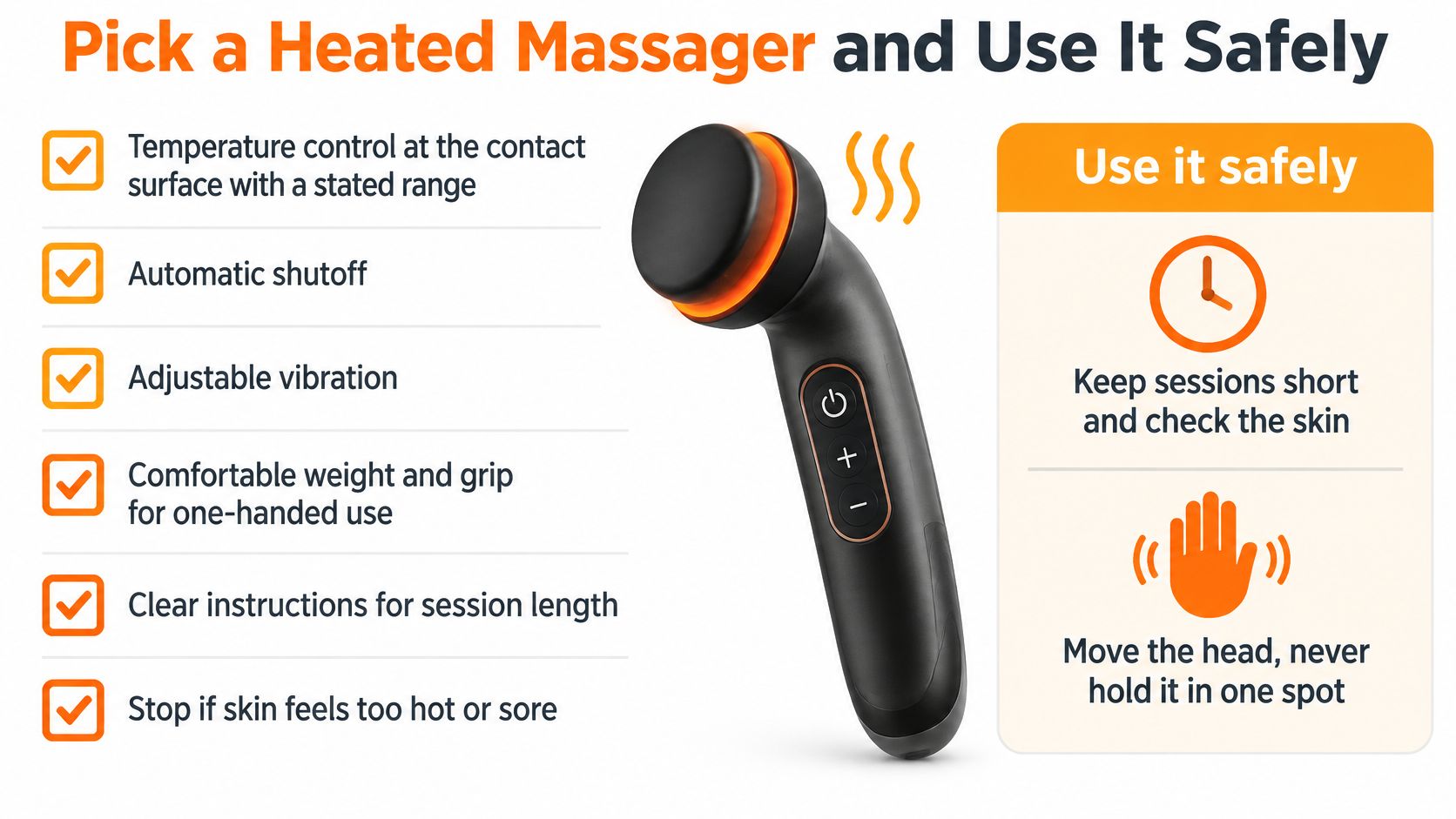
Before buying, look for temperature control at the contact surface, with a stated range. A surface reading describes the part that touches your skin, unlike a temperature measured inside the heating element. Automatic shutoff can end operation if you lose track of time. Adjustable vibration lets you reduce percussion while keeping comfortable warmth. A clear pressure guide and session timer can help you avoid pressing too hard or staying in one area too long. Check for guidance on who should avoid use, and choose a weight and grip you can hold steadily throughout a session.
A Routine You Can Repeat
- Screen first. Consider your health conditions and medications, and follow any clinical advice about using heat or massage.
- Start with the lowest comfortable heat and vibration. You can adjust these separately, so begin gently rather than increasing both at once.
- Stay on soft muscle. Use light pressure over the muscle belly and keep the head moving. Avoid bones and the front of the throat.
- Follow the timer. Reposition the device instead of holding it in one spot, and do not use it unattended.
- Check your skin afterward. Stop if you notice pain, tingling, weakness, discoloration, or a new change in sensitivity.
If you prefer a kit without a motor, compare the manual options in this guide to massage tools for home.
A two-hand massage tool for personal use or massage therapists is part of SunnyBay's product timeline for 2024 to 2026. A manual tool offers massage without a motor or heat setting, while a heated massager lets you use warmth and vibration together.
Choose one device for one body area, then keep a brief log of the date, area, settings, session length, and how you feel that evening and the next morning. If the pain worsens or does not shift, seek a clinical review rather than increasing the intensity.
SunnyBay has served consumers since 2002 through its online store, offering reusable heat therapy products from microwavable neck wraps and body heating pads that hold heat for about 30 minutes to hand and eye warmers built for daily use. A wrap applies warmth without a motor, battery, or setting to monitor during use. Visit SunnyBay to compare options for the body area that bothers you most.


