


Warm Facial Mask Guide: Safe Temperatures and Uses
-
If a warm facial mask feels soothing against your cheeks, does that mean it's safe for your skin or effective for dry eyes? Most beauty articles and product pages treat facial warmth as universally calming, as if comfort alone proves a mask is doing good.
That assumption hides an important gap. Demand for heated skincare and eye-care products keeps growing, with the global self-heating face mask market reaching USD 1.22 billion in 2024 according to Growth Market Reports. Yet clinical evidence separates targeted eyelid compresses from full-face cosmetic masks, because heat behaves like a measurable tool rather than a harmless spa extra. Getting real relief requires matching the right temperature, timing, and mask style to your exact goal, while knowing when warmth does more harm than good.
Table of Contents
- Safe Temperatures and Session Times at a Glance
- How a Warm Facial Mask Differs From a Warm Compress Mask
- Who Should Test a Small Area First or Skip Warm Masks
- Step-by-Step Routine for an Eyelid Warm Mask
- How Warmth Works and What the Trials Show
- Decide Whether a Warm Facial Mask Fits Your Routine
Safe Temperatures and Session Times at a Glance
An eyelid-focused warm mask should reach 40 to 45°C at the eyelid surface and stay there for about 10 minutes per eye, applied once or twice daily as directed by an eye-care professional. For example, a ClinicalTrials.gov crossover study protocol pairs an approximately 40°C controlled compress with 10 minutes daily sessions, while multi-week dry-eye care often relies on twice-daily use.
In this context, "warm" means steady and controlled, never hot. Your skin's comfort gauge isn't a reliable thermometer, especially around thin eyelid tissue or reactive cheeks. Before microwaving any reusable cloth or seed-filled mask, review our guide on whether microwave heating is safe so you avoid uneven hot spots.
| Use case | Target temperature | Session length | Frequency |
|---|---|---|---|
| Eyelid warm compress for meibomian gland dysfunction | 40 to 45°C at the eyelid surface | About 10 minutes per eye | Once or twice daily, as directed by an eye-care professional |
| Full-face cosmetic warm mask | Comfortable warmth; no clinical target set | Follow the manufacturer's label; no clinical duration exists | Use per label directions only after a small-area patch test |
| Heat-sensitive or rosacea-prone skin | Lower than the eyelid target; no validated figure | Keep shorter than standard sessions and stop at first flushing | Follow guidance from a dermatologist |
Read each row as a boundary rather than a target to push past. Only the eyelid compress row carries a clinically studied temperature and interval; the other two rows give decision rules because researchers haven't established validated figures for cosmetic warming or rosacea-prone skin.
Practical check: A well-calibrated session feels steadily warm from start to finish, leaves your skin free of stinging or deep flushing, and lets your timer run out without needing a mid-session reheat.
How a Warm Facial Mask Differs From a Warm Compress Mask
Think of an eyelid warm compress mask like a precision heating pad built for one narrow line of oil glands, while a full-face warm facial mask acts like a spa towel designed to wrap your cheeks, forehead, and chin. Both deliver heat, yet they serve very different biological targets and carry different risks.
| Criterion | Eyelid warm compress mask | Full-face warm facial mask |
|---|---|---|
| Main target | Meibomian glands and eyelid oil flow | Skin comfort, relaxation and general warmth |
| Contact area | Closed eyelids and orbital area | Forehead, cheeks, chin and neck |
| Temperature standard | Clinical range of about 40 to 45°C | Set by the manufacturer; no clinical standard |
| Evidence base | Clinical trials in dry eye with MGD | Mostly consumer and marketing claims |
| Main risk | Overheated eyelid skin and pressure on the eye | Flushing and barrier irritation in sensitive skin |
Matching the Product to Your Goal
A single mask can occasionally claim both relaxation and eye comfort, but you should evaluate any product strictly against the job its label promises. Cosmetic full-face masks prioritize pleasant scent, soft fabric, or steamy comfort rather than sustained heat delivery at the eyelid margin. If you're building a general skincare schedule rather than treating dry eyes, Skin Perfection shares an organic face mask routine for estheticians that helps organize cosmetic mask frequency around skin type instead of guesswork.
If dry eyes are your main concern, pick a contoured compress engineered for closed eyelids and stick to its temperature and timer; if facial relaxation is your goal, treat the mask as a cosmetic tool and patch test it first.
Don't rely on packaging buzzwords to tell these categories apart. Terms like "soothing," "purifying," or "detoxifying" describe a marketing mood, not whether a device maintains safe eyelid heat or respects delicate facial skin.
Who Should Test a Small Area First or Skip Warm Masks
Conventional beauty advice insists that warm compresses relax every face, yet facial physiology tells a different story. Local heating triggers facial vasodilation, widening tiny blood vessels just beneath the surface. As a dermatology review on rosacea and skin-barrier function in PMC explains, rosacea is closely linked to heat-triggered flushing, impaired barrier function, and higher transepidermal water loss. Rather than calming reactive skin, trapping warmth across your cheeks can amplify redness, burning, dehydration, and barrier stress.
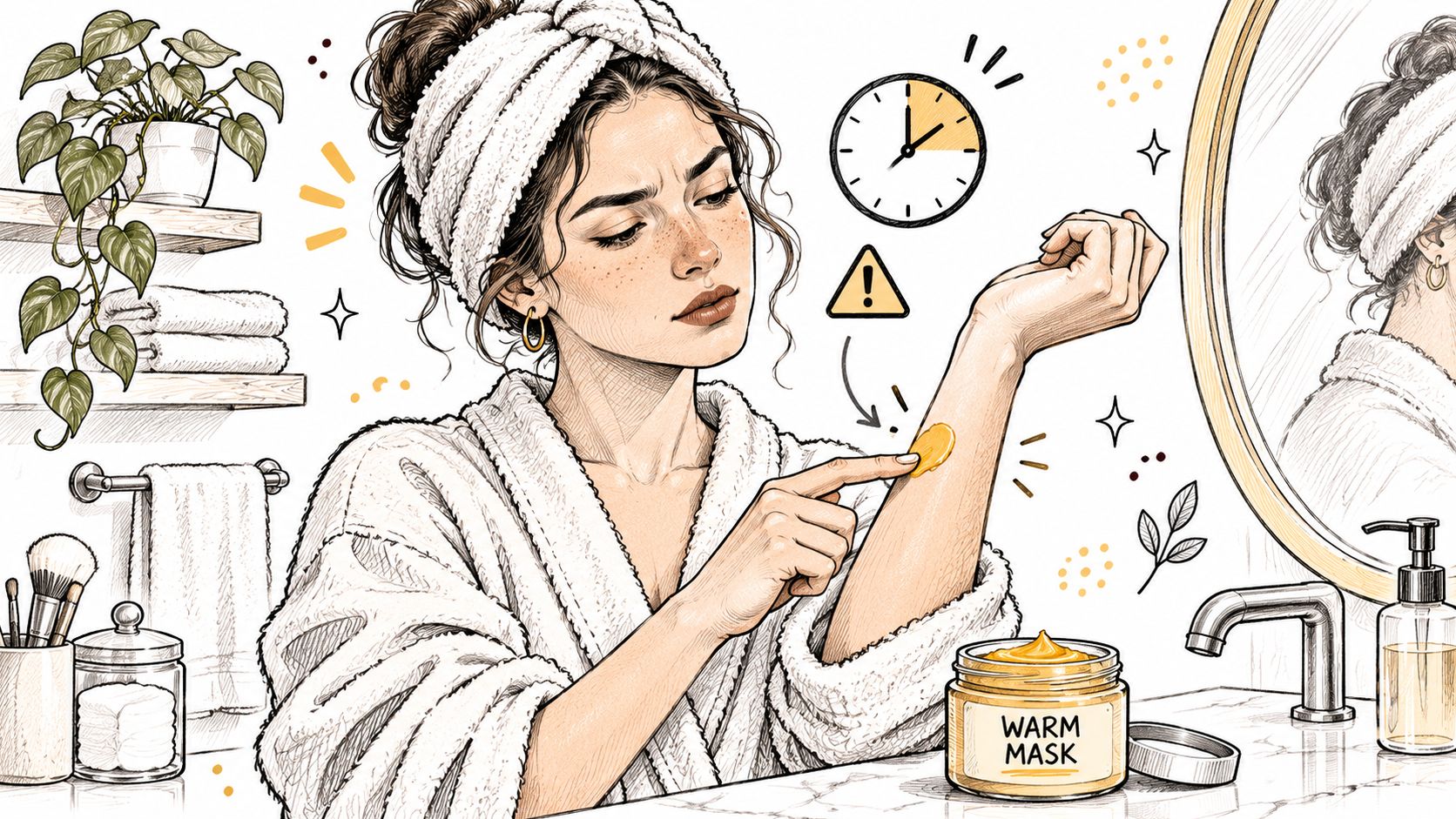
Before placing any heated mask directly on your face, test a small patch of skin first so you can observe how quickly redness fades.
| Situation | Approach | Stop or ask a clinician when |
|---|---|---|
| Rosacea or flushing-prone skin | Test a small area first; keep sessions short and cooler | Flushing persists or burning starts |
| Active dermatitis or irritated skin | Avoid full-face masks until the skin settles | Rash spreads, swells or hurts |
| Recent facial procedure or treated skin | Wait for clearance from the treating clinician | Before resuming heat; follow your clinician's recovery timeline |
| Reduced heat sensation | Check temperature with a thermometer, not comfort | Any redness or blistering after use |
| Eye pain, vision changes or suspected eye disease | Do not rely on heat alone | Symptoms persist or vision changes |
Recognizing Overlooked Sensitivity Factors
Several situations make "feels comfortable" an unreliable safety signal. Certain prescription topicals, oral medications that heighten skin sensitivity, and nerve conditions that blunt heat perception can let mild overheating damage skin before you notice pain. People prone to heat-triggered pigmentation, such as melasma, also need caution because repeated facial warming can darken existing patches.
If you manage chronic skin conditions or altered sensation, check our guide to heat therapy contraindications before starting regular warm-mask sessions. Keep the central trade-off in mind: gentle targeted warmth can assist sluggish eyelid oil glands while simultaneously aggravating inflammatory or vasoreactive cheek skin, so one mask can serve one goal well and fail another.
Step-by-Step Routine for an Eyelid Warm Mask
Vague instructions to "warm the mask until comfortable" leave too much room for burns or underheated sessions. According to evidence-based ophthalmic guidance in PMC, effective eyelid compress therapy should reach approximately 40°C or higher and hold that temperature for at least 5 minutes, using a moist-heat method for at least 10 minutes per eye while following the manufacturer's device directions.
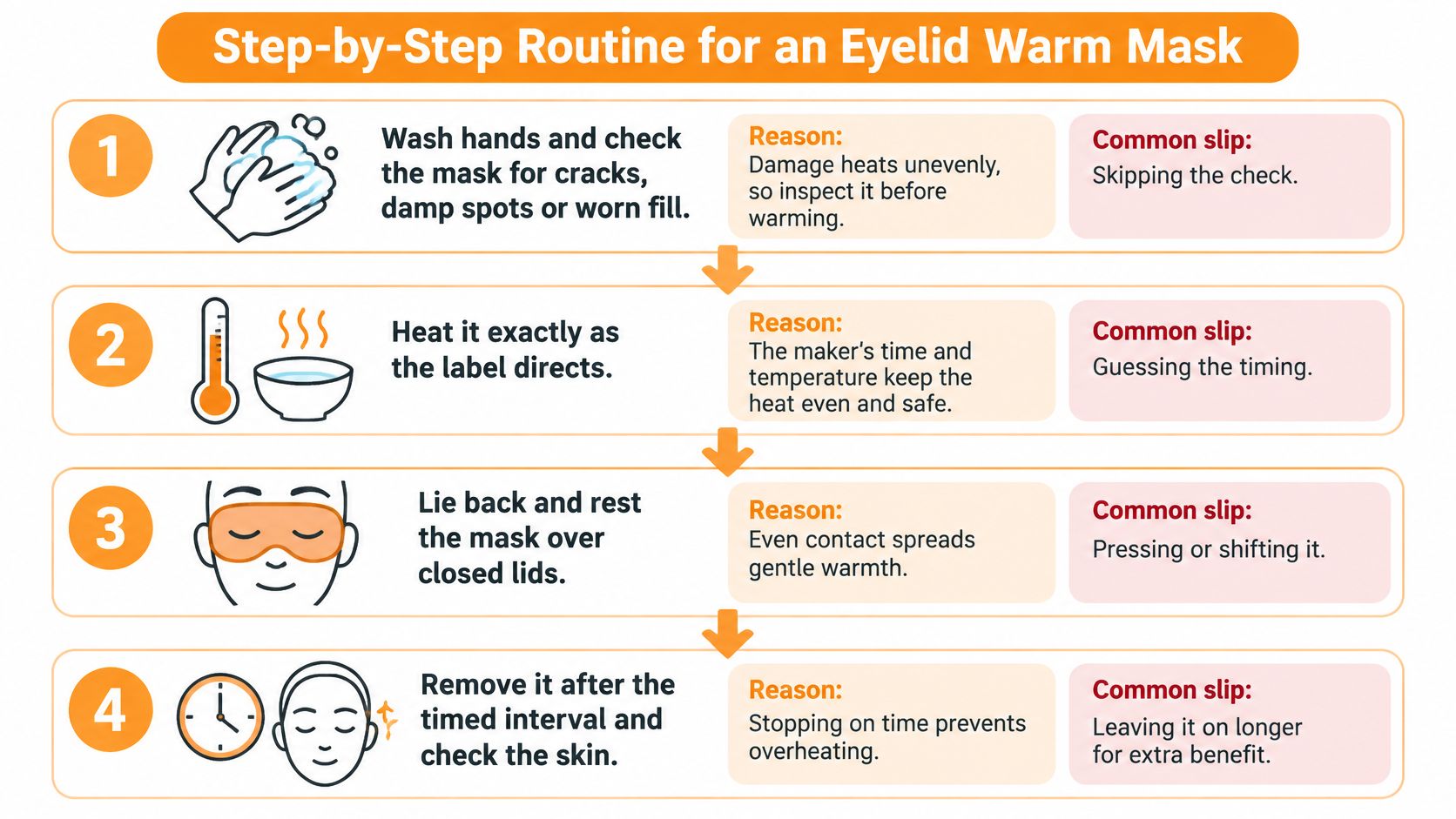
The visual summary below highlights the four core checkpoints that anchor a safe session before you walk through the complete routine.
Eight Steps for a Controlled Session
- Wash your hands and inspect the mask. Look closely for cracked seams, damp spots, or bunched fill before warming, because damaged pockets heat unevenly. People often skip this ten-second check and discover a scorching patch only after putting the mask on their eyelids.
- Heat strictly to the label and check with a thermometer. Use a simple infrared or digital contact thermometer against the fabric surface so you know you're in the target range. Adding "just a few extra seconds" in the microwave is the fastest way to overshoot into burn territory.
- Test the warmth on your inner wrist. Your wrist skin is far more sensitive than your fingertips and catches excessive heat before it reaches your face. Relying on palm touch alone frequently underestimates how hot a compress feels on thin eyelid skin.
- Remove contact lenses and eye makeup. Heat can warp soft lenses, irritate the cornea, and melt mascara or eyeliner right into the tear film. Always start with bare, clean eyelids.
- Rest the mask lightly over closed eyelids. Lie back so gravity holds the compress gently in place without tightening straps or pressing with your palms. Pressing on the eyeball adds uncomfortable intraocular pressure without helping oil flow.
- Run a timer for the full moist-heat interval. Set a kitchen or phone timer so you hold steady warmth for the entire planned session rather than guessing when time is up. Taking the mask off early cuts heat transfer short, while leaving it on too long risks irritated skin.
- Follow any clinician-recommended lid care. Once the timer ends, lift the mask away and complete any gentle lid hygiene or massage step your eye doctor advised while the oils remain soft. Don't invent aggressive scrubbing techniques on your own.
- Cool, clean, and store dry. Let the mask return to room temperature before washing removable covers or wiping down surfaces per the maker's care instructions, then keep it in a clean, dry pouch so bacteria don't transfer back to your lash line.
Watching a guided demonstration makes positioning and light eyelid contact much easier to picture in practice.
What a Good Session Feels Like
A properly run routine feels steady, gentle, and uneventful from the first minute to the last. Your eyelids should feel relaxed afterward without stinging, throbbing, blurred vision, or bright red marks across the brow. If your eyes ache or feel grittier after warming, stop immediately and contact an eye-care professional instead of reheating the compress.
How Warmth Works and What the Trials Show
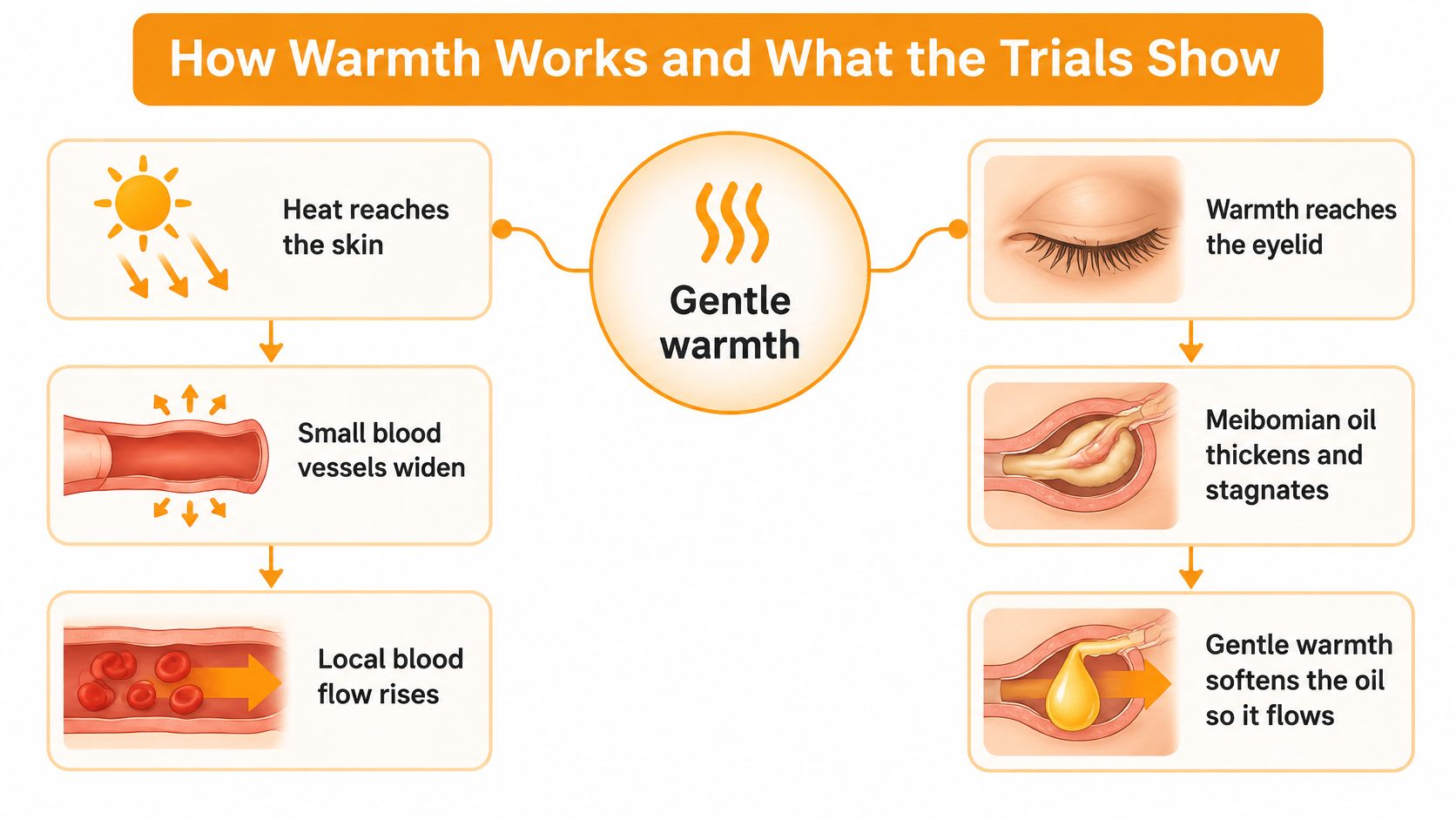
When gentle warmth reaches facial tissue, two physical effects happen at once. Across the skin, small blood vessels widen and local circulation rises. Inside the eyelids, sustained heat warms thickened, stagnant meibum (the lipid secretion produced by meibomian glands) so it softens and flows into the tear film, the way a cold stick of butter softens until it spreads easily.
One caution before weighing the evidence: a mask that feels pleasantly warm across the whole face may never hold the eyelids in a therapeutic range. The trial results below concern devices that concentrate heat on closed lids, so comfort alone is not proof the oil glands reached useful temperatures.
Why Steady Heat Matters More Than Peak Heat
A high peak temperature held for thirty seconds will not reliably soften stagnant eyelid oils. An in-vivo comparison of five eyelid-warming masks on PubMed measured how designs performed on living eyelids rather than lab heaters. All five masks reached roughly 37°C within the first minute, yet their heat retention diverged sharply over 12 minutes. Effective eyelid therapy depends on holding 40 to 45°C at the ocular surface over a controlled interval: designs that spike too high raise discomfort and skin-injury risk, while masks that cool quickly fail to warm the glands consistently.
For a closer look at how thermal transfer behaves across body tissues, read our overview on understanding the basics of heat therapy.
Comparing Clinical Trials on Warm Eyelid Masks
Clinical studies reinforce two practical lessons: hotter isn't automatically better, and daily follow-through matters as much as device design.
In a 2015 randomized, paired-eye trial of 41 subjects on PubMed with mild-to-moderate dry-eye symptoms, participants applied a portable warming mask to one eye and a microwave-heated flaxseed eye bag to the other. Both options produced statistically significant improvements from baseline in noninvasive tear-film breakup time (NIBUT) and lipid-layer grading (p < 0.05). Even though the flaxseed bag raised outer-lid temperature by 3.5 ± 1.0°C compared with 2.4 ± 0.8°C for the portable mask (and inner-lid temperature by 3.5 ± 1.0°C versus 2.5 ± 0.9°C, p < 0.001**), the two treatments showed no significant difference in NIBUT or lipid-layer improvement (**p > 0.05). The warmer device did not produce better outcomes.
Longer-term use tells a similar story. A 2024 clinical trial of 144 patients with MGD-related dry eye on PubMed compared disposable eyelid-warming masks against hot towels used twice daily for 12 weeks. Mask users completed 9,824 of 11,088 scheduled applications (88.6% compliance), outpacing 9,311 of 11,424 hot-towel sessions (81.5% compliance), and showed improvements in meibum quality and expressibility. Safety logs also recorded 40 adverse events among 27 mask-treated patients (37.5%) versus 34 events among 21 hot-towel patients (29.17%), with no serious events reported. Routine heat therapy still demands careful temperature control and hygiene.
| Study | Design | Main result | Limit |
|---|---|---|---|
| 2015 paired-eye trial, 41 subjects | Portable warming mask vs microwave flaxseed eye bag | Both improved tear-film breakup time and lipid grading; flaxseed bag warmed lids more (+3.5°C vs +2.4°C outer lid) | No significant difference between devices on main outcomes |
| 2024 two-center trial, 144 patients | Disposable warming masks vs hot towels, twice daily for 12 weeks | Compliance 88.6% vs 81.5%; improved meibum quality and expressibility | Adverse events 37.5% in mask group vs 29.17% in controls |
Smaller crossover comparisons echo the same pattern: steady, controlled warming tends to deliver more consistent short-term tear-film results than uncontrolled or self-heating heat, even when day-to-day symptom scores stay similar between devices.
Steady, repeatable warmth and consistent daily follow-through drive results far more than peak temperature or marketing labels, and current evidence doesn't justify claiming that every warm facial mask improves dry eye.
Decide Whether a Warm Facial Mask Fits Your Routine
A warm facial mask fits your routine when you have a concrete goal and a controllable device. It's a poor fit when you're hoping vague heat will fix an undiagnosed skin flare, persistent eye pain, or flushing-prone cheeks.

Pre-Use Checklist Before You Buy or Heat
- Define one clear goal: Decide up front whether you're supporting eyelid oil-gland comfort or enjoying brief facial warmth for relaxation.
- Verify heat control: Choose a product with explicit heating instructions, predictable heat retention, or a timer instead of relying on guesswork.
- Check the fit over closed lids: Make sure the mask contours lightly across your orbital area without pressing on your eyeballs.
- Confirm simple hygiene: Look for clear cleaning rules, washable covers, or defined replacement timelines so oils and bacteria don't build up.
- Pass a small-area patch test first: Anyone with reactive or sensitive skin should test a limited patch before warming the whole face.
If your goal is straightforward, repeatable eyelid warmth without gels or chemicals, our Dry Eye Therapy Eye Mask, Reusable Microwavable Odorless Heat Therapy, Purple uses natural fresh flax-seed filling and is available at a sale price of $15.98 (regularly priced at $15.98, with 25% off when buying 3).
Before turning warmth into a daily habit, run a single test session with a thermometer and a timer, then observe how your skin and eyes feel over the next hour. If dryness, redness, or irritation persists, worsens, or affects your vision, schedule an exam with an eye-care professional rather than relying on heat alone. Ultimately, your timed routine and temperature checks, not the promises printed on the box, decide whether a warm mask delivers safe relief.
Since 2002, we've crafted reusable, chemical-free flax-seed and lava-sand heat therapy wraps, dry-eye therapy masks, and targeted hot-and-cold relief tools built for steady, comfortable home use. Whether you need a contoured microwavable eye compress for daily eyelid care or a hands-free wrap for neck and shoulder tension, explore our full collection at SunnyBay to find a controllable fit for your routine.


