


Shoulder Heating Pad Reviews: Best Picks by Use Case
-
A heating pad can feel reassuring without proving that it's useful for your shoulder. The Cochrane review of thermotherapy for rheumatoid arthritis evaluated treatment methods, not retail shoulder wraps, an important distinction when a product listing borrows credibility from heat therapy research.
Good shoulder heating pad reviews separate three questions: does heat suit the situation, does the pad maintain useful contact, and can you use it without creating avoidable burn risks? The recommendations below are design-based picks, not laboratory-tested product winners. Where independent temperature measurements are missing, a product's performance remains unverified.
Table of Contents
- Top Shoulder Heating Pad Picks by Use Case
- Design Types Compared Side by Side
- Fills, Covers and Scent Options Compared
- Measuring Heat, Fit and Straps That Matter
- Safety Limits to Check Before You Buy
- Confirm the Right Pad Before You Order
Top Shoulder Heating Pad Picks by Use Case
| Use case | Pick type | Deciding feature | Reference price |
|---|---|---|---|
| Rotator cuff strain | Contoured wrap with broad deltoid contact | Stable temperature plateau and a strap that holds without body weight | General AASSOO listing benchmark, not a joint-wrap price |
| Frozen shoulder | Shoulder joint wrap with automatic shutoff | Controllable heat and easy skin checks | Confirm the selected model's current price |
| Travel | Lightweight air-activated patch or compact wrap | No outlet or microwave needed during use | Compare pack cost and replacement needs |
| Desk and office tension | Microwaveable hands-free neck and shoulder wrap | Convenient preparation and secure seated fit | $12.99 general neck-and-shoulder listing in Woot's 2025 snapshot, not a verified microwaveable-wrap price |
| Massage or spa use | Extra-large pad or wrap with washable cover | Broad coverage and practical cleaning between clients | Confirm pad and spare-cover costs |
The price references are general retail comparisons, not proof that either listed product matches the recommended design. Woot's neck-and-shoulder listing also recorded 43 customer reviews and a 4.0-out-of-5-star rating in that snapshot. Those ratings don't establish deltoid coverage, temperature stability, or suitability for a particular joint problem.
Choose the contact area before the extras
For rotator cuff discomfort, shortlist wraps that reach around the shoulder cap rather than stopping at the base of the neck. For frozen shoulder, prioritize a fastening arrangement you can manage without forcing the painful arm into an awkward position. Neither design recommendation establishes that heat is appropriate for every stage of either condition.
Desk tension calls for a different shape: coverage across the upper shoulders may matter more than enclosing the joint. Travel shifts the priority toward a heat source you can use at your destination. In a treatment room, removable covers and repeatable cleaning procedures deserve more attention than decorative fabric or scent.
A relaxing setting is a separate choice from therapeutic performance. Aroma Warehouse's guide to using incense and oils for relaxation offers context for people considering fragrance as part of a home routine, but scent shouldn't influence a pad's heat or safety grade.
Buying rule: Match the pad to the shoulder problem first, then compare features. A comfortable neck drape isn't automatically a shoulder-joint wrap.
Design Types Compared Side by Side
Choose the shape for contact and the power source for your routine. A contoured wrap is the stronger starting point when you need coverage around the joint. A neck drape, flat pad, or disposable patch may be more practical when the target is surrounding muscle tension or portable warmth.
| Design | Power source | Fit on the shoulder | Best fit for |
|---|---|---|---|
| Contoured wrap | Microwave or electric, according to model | Shaped around the deltoid and upper trapezius | Joint-focused coverage when heat is appropriate |
| Flat electric pad | Mains outlet | Rectangular surface that may bridge over the curved joint | Stationary use without leaning against or compressing it |
| Microwaveable hands-free wrap | Microwave | Flexible construction with model-specific fastening | Desk tension and home use |
| Air-activated disposable patch | Air exposure | Flexible, single-use placement according to its label | Travel and cold outdoor work |
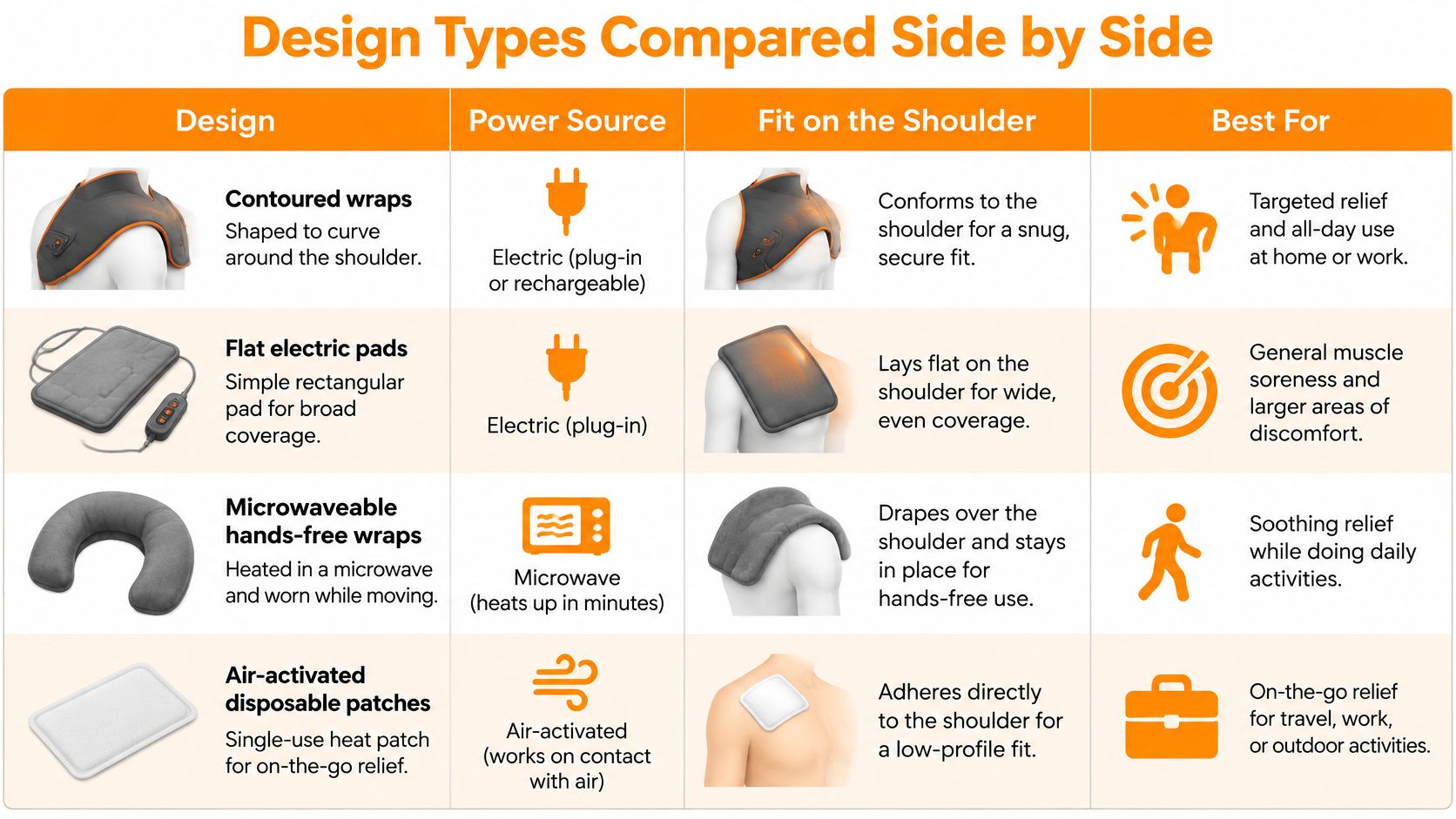
Shape and power solve different problems
A flat pad can cover a broad area, but the shoulder isn't flat. Inspect whether the fabric follows the shoulder cap or hangs between contact points. Don't solve poor contact by pushing the pad against a chair back or trapping it beneath your body.
A contoured design offers a better opportunity for broad contact, but its name isn't a fit guarantee. A wrap can still be too loose around a smaller shoulder or pull uncomfortably across a larger upper arm. Look at the fastening path, not just the product photograph.
Electric models require an accessible outlet and a cord route that doesn't pull the wrap sideways. Microwaveable wraps remove the tether during use, but you'll need access to a microwave and a practical reheating routine. Neither power source proves better temperature control.
Match the design to the setting
Consider someone managing shoulder discomfort during desk work. A microwaveable wrap may make sense if they can prepare it nearby, position it independently, and remove it easily. An electric joint wrap may be more convenient if they remain seated near an outlet and want adjustable controls.
A traveler without access to either appliance has a different decision. An air-activated patch removes the preparation problem, but its placement, clothing requirements, and disposal instructions need checking before purchase. Don't assume every adhesive patch belongs directly on skin.
Some microwaveable wraps are also labeled for cold use after freezing. That can be useful when a clinician recommends changing the approach during a shoulder flare, but dual-use suitability must be confirmed for the particular model. A heatable product isn't automatically freezer-compatible, and a frozen shoulder diagnosis doesn't itself determine whether heat or cold is appropriate today.
Fills, Covers and Scent Options Compared
Choose the contact surface and cleaning method before paying extra for a fill or fabric claim. Where a dual-fabric wrap's instructions permit it, the cotton side can serve as the skin-facing comfort surface. Don't assume that a soft cover makes unrestricted direct-skin use safe.
| Option | Typical use | Trade-off | Care |
|---|---|---|---|
| Flax seed fill | Flexible microwaveable wrap | Assess moldability and total product weight rather than assuming lightness | Check whether only the cover is washable |
| Lava sand fill | Weighted wrap with heat-retention claims | Added weight may be unwelcome on a sore shoulder; retention needs measurement | Keep the fill enclosure intact and avoid overheating |
| Graphene-infused cover | Marketed for heat distribution | Independent comparative performance isn't established here | Follow the model's cleaning instructions |
| Dual fleece and cotton cover | Alternative comfort surfaces | Fabric feel doesn't establish thermal uniformity | Machine-wash only when explicitly labeled |
| Lavender scent | Optional sensory feature for home use | Not evidence of shoulder treatment benefit; unsuitable for some fragrance-sensitive users | Check cleaning and scent-care instructions |
Judge the finished wrap, not the ingredient
Flax seed can make a flexible filling, but the useful question is whether the finished compartments settle around your shoulder without bunching. The guide to flaxseeds in hot and cold therapy provides product-material context. It shouldn't replace a comparison of actual fit, weight, and measured heat delivery.
Treat lava sand similarly. A heavier wrap may feel secure to one person and burdensome to another. Without comparable measurements, there's no defensible basis for declaring that a particular fill keeps every shoulder warmer for longer.
Graphene deserves the same skepticism. A material name isn't a temperature-uniformity result. Before accepting a heat-spreading claim, look for measurements from different parts of the finished pad, taken under the same conditions.
Keep comfort separate from care
Lavender is an optional preference, not a reason to select a pad for rotator cuff strain or restricted movement. Choose unscented construction if fragrance bothers you, and don't add oils to a heatable insert unless the manufacturer explicitly permits it.
For cleaning, distinguish the removable cover from the filled or powered insert. Wash only the components labeled washable, don't submerge an insert unless its instructions allow that, and let washed parts dry completely before reassembly or reheating. In shared settings, confirm that the manufacturer's cleaning method fits your hygiene requirements before buying spare covers.
Measuring Heat, Fit and Straps That Matter
Warmth is a sensation, not the clinical outcome. The 2021 systematic review and meta-analysis of local heat found immediate improvements in pain and other musculoskeletal outcomes across included comparisons, but the results were highly heterogeneous and most studies had an unclear risk of bias. That supports heat's potential as a short-term adjunct, not a claim that every shoulder pad delivers equivalent benefit.
The meaningful outcomes were pain, stiffness, function, disability, and range of motion. A useful review should therefore explain both what the device delivers and what the wearer can do comfortably while using it. A high setting or enthusiastic comfort rating answers neither question by itself.
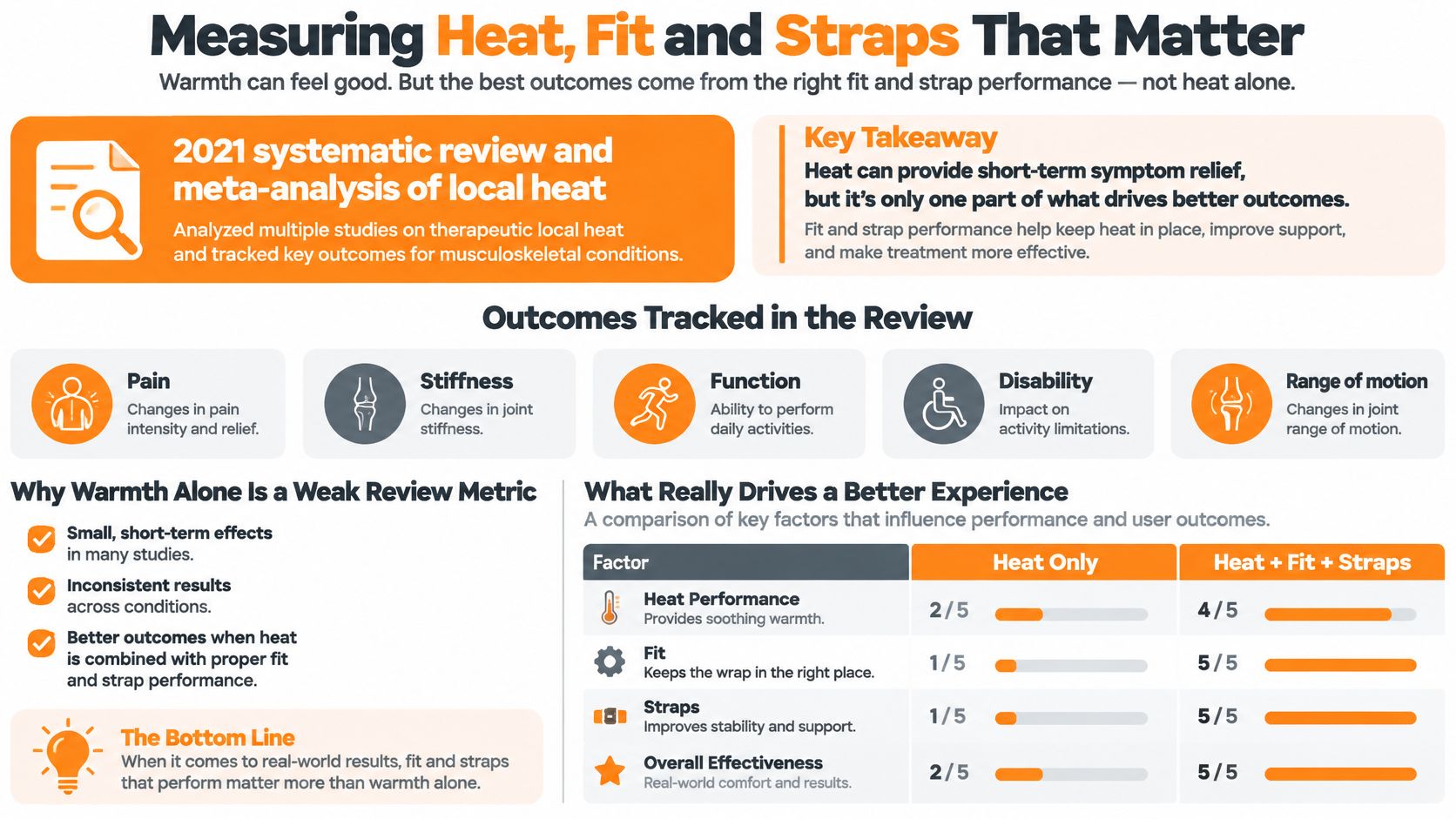
Use a benchmark, not a maximum-heat contest
A clinical review of superficial heat describes 38–42°C as a general temperature range and 15–30 minutes as a practical session duration for neck, shoulder, and back discomfort, while acknowledging limited standardized protocols. These are comparison benchmarks, not universal guarantees of safety or instructions to override a product label or clinician.
| Metric | Reference target | How to measure |
|---|---|---|
| Warm-up time to the reference range | Record rather than assume | Time preparation or power-on to the first skin-side reading within the benchmark |
| Temperature at the earlier session checkpoint | Within the benchmark range if permitted by the label | Probe the joint center and trapezius edge under consistent room conditions |
| Temperature at the later checkpoint | Stable, without large cycling swings | Repeat at the same contact points |
| Maximum skin-side temperature | Within labeled limits | Log the peak during repeated heating cycles |
| Center-to-edge spread | Narrow and stable | Compare joint-center and trapezius-edge readings |
| Automatic shutoff | Present and labeled on electric models | Confirm operation without extending body exposure; not applicable to an unpowered wrap |
The FDA heating-device guidance calls for manufacturers to provide device output and estimated skin-surface temperatures. That distinction matters: a control setting, heating-element temperature, and actual contact temperature aren't interchangeable.
For repeatable comparisons, use a suitable contact-temperature probe or thin thermocouple, not touch alone. Measure at several locations across the intended shoulder-contact area, including the center and edges. Keep ambient conditions, cover layers, preparation method, and placement consistent.
Repeat the procedure across multiple heating cycles. Record the warm-up curve, peak, and subsequent decline or cycling, rather than reporting a single favorable reading. A review that publishes only the highest temperature has omitted the information needed to judge sustained delivery.
Grade fit while the arm moves
Start with the wrap resting on top of the body, supported by its own design and fastening. Don't add body weight to improve contact. Inspect whether the deltoid, top of the shoulder, and intended trapezius area receive broad coverage without tight pressure points.
Then move the arm through its comfortable everyday range. If raising it toward shoulder height is comfortable and permitted, observe whether the wrap slides backward, opens an air gap, or tightens across the upper arm. Don't force that movement to complete a product test.
The shoulder-wrap wearing guide can help with positioning, but the decisive question remains whether the particular wrap stays secure on your body.
Use a simple grading framework:
- Heat delivery: Favor a repeatable plateau over a brief peak followed by rapid cooling.
- Contact: Favor broad coverage over a hot center surrounded by poorly contacting fabric.
- Fastening: Favor accessible closures that hold without uncomfortable tension.
- Usability: Favor controls and removal methods you can manage with the affected shoulder.
- Evidence quality: Mark unmeasured heat-hold and heat-spreading claims as unverified, not as passing results.
Run a cautious home acceptance check
Before heating, try the wrap cold to assess reach, closures, and removal. Prepare it exactly as directed, begin with the permitted conservative setting, and inspect the contact surface before placement. If you have suitable measurement equipment, compare readings across the intended contact area without compressing the pad.
During use, check for slipping, concentrated warmth, uncomfortable pressure, or difficulty removing the wrap. Record whether ordinary movement changes those findings. If you don't have a suitable probe, you can assess fit and usability, but you can't certify temperature stability.
A slower pad with stable, appropriate contact is a better candidate than one that heats quickly and overshoots. The highest setting deserves no extra credit merely for feeling hotter.
Safety Limits to Check Before You Buy
Gentle warmth doesn't mean no burn risk. The FDA's guidance for heating and cooling devices calls for warnings about serious burns, especially over sensitive skin or areas with poor circulation, and cautions against unattended use by children or incapacitated people.
A lower setting isn't a substitute for checking placement and skin condition. Pressure, folding, or prolonged contact can create unsafe local exposure even when the pad appears to operate normally. An automatic shutoff is a useful safeguard, not permission to sleep with the device.
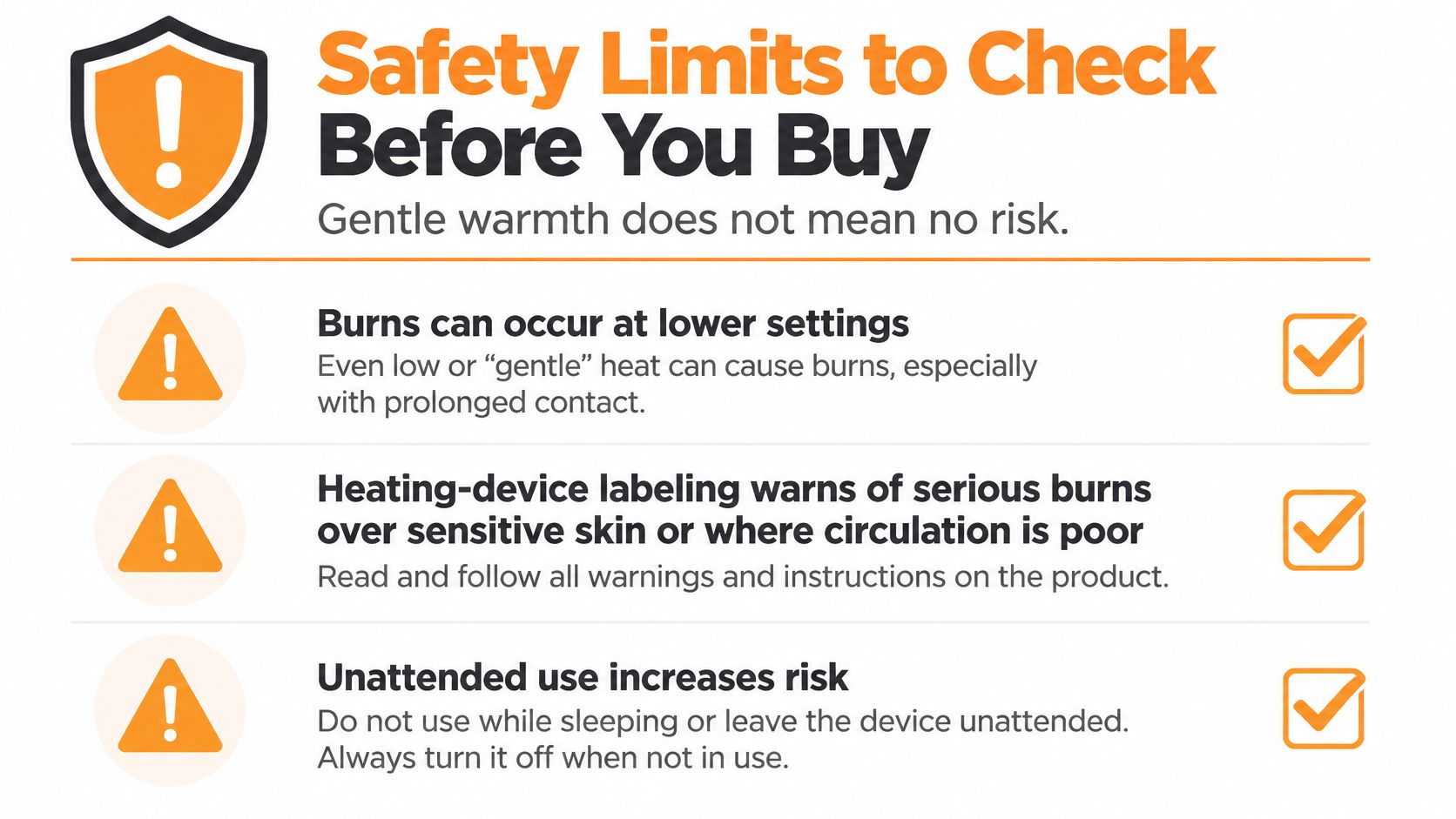
Check the user and the placement
- Stay awake and attentive: Don't sleep with a heating pad or leave someone who can't monitor or remove it using it unattended.
- Keep weight off the pad: Don't lie or sit on it, wedge it behind your shoulder, or crush it under a strap.
- Inspect throughout use: Check the skin during each session rather than relying only on how warm the pad feels.
- Ask before use with reduced sensation: Seek clinician advice if you have diabetes, neuropathy, poor circulation, or difficulty detecting heat.
- Check electrical safeguards: Confirm the stated shutoff behavior and stop using a device with damaged wiring, erratic controls, or visible deterioration.
- Follow the contact instructions: Use the specified cover or clothing layer. Don't assume direct-skin contact is allowed.
Different heat sources need different checks
For electric pads, review the controller, cord, temperature labeling, and shutoff instructions. For microwaveable wraps, preparation is the critical control point: use the specified microwave procedure, inspect for damage, and don't improvise extra heating because the outside feels cool.
The microwave-heating safety guide is useful background, but the instructions for your particular fill, cover, and microwave preparation take precedence.
For disposable patches, confirm where the patch belongs and how to remove it. A patch that doesn't require an outlet still requires skin monitoring and compliance with its wear instructions. None of these formats earns a risk-free label.
Stop rule: Remove the heat source if skin becomes red, feels painfully hot, or stays hot after removal. Don't resume heating irritated skin; seek medical advice for persistent redness, blistering, or suspected burns.
Confirm the Right Pad Before You Order
Order only after the intended use, physical design, and temperature instructions all make sense together. A discount is irrelevant if the product can't reach the target area or you can't remove it comfortably.
Run the buying checklist
- Name the problem. Distinguish shoulder-cap discomfort from upper-trapezius tension, and note whether the symptoms are new, persistent, or changing. Don't use a product category as a diagnosis.
- Choose the necessary shape. Decide whether you need a joint-enclosing wrap, a neck-and-shoulder drape, broad-area coverage, or portable heat. Check photographs of the fastening arrangement and the actual coverage rather than relying on the product title.
- Verify the operating instructions. Look for understandable temperature information, preparation directions, contact-layer requirements, and electric shutoff details. If the seller can't supply basic instructions before purchase, choose a product with better documentation.
- Compare ownership cost, not just sticker price. In 2025, Woot listed an AASSOO graphene-infused neck-and-shoulder heating pad at $25.99, against a $39.99 reference price. That historical general listing doesn't establish joint-specific performance; check included covers, replacement needs, and washability before treating a discount as value.
- Plan the fit check. Confirm dimensions and fastening reach before ordering. Once it arrives, test placement unheated, then assess ordinary comfortable arm movement without forcing the shoulder.
- Read checkout terms. Verify the seller's current return window, shipping charges, hygiene restrictions, and cover-care rules. No seller's current policies are verified here, so don't assume you can return a heated or opened product.
- Know when to seek clinical advice. Persistent rotator cuff symptoms or frozen shoulder limitations deserve assessment rather than repeated purchases. Get advice before use if sensation or circulation is impaired, and don't let temporary comfort delay evaluation of worsening pain.
Require a reason for every upgrade
Pay extra only for something you can identify and use: better coverage, manageable fastening, clearer controls, a removable cover, or documented temperature performance. A premium material name without comparative measurements isn't the same as a demonstrated improvement.
The strongest buying decision is specific: the wrap reaches the intended area, fits your routine, and comes with instructions you can follow. That's a more defensible standard than choosing whichever listing promises the deepest or longest-lasting warmth.
SunnyBay offers shoulder joint wraps, microwaveable hands-free neck wraps, and air-activated patches as different options for targeted heat use. Visit SunnyBay to compare their shapes, preparation requirements, and care instructions, then shortlist the format that fits your shoulder and daily routine.


