


Neck Heating Pad and Massager: Safe Use Guide
-
A neck heating pad and massager provides warmth first, then gentle pressure, in short sessions to ease muscle tension rather than cure neck pain. Use it to make comfortable movement easier, not to keep working in the same position that left your neck sore.
The useful question isn't how much heat or pressure you can tolerate. It's whether you can finish a session, move more freely, and change the desk habit that keeps bringing the discomfort back.
Table of Contents
- What a Neck Heating Pad and Massager Is
- Formats and Session Times to Start With
- How Warmth Prepares Muscle for Massage
- Relief You Can Expect and Its Limits
- Fills Fabrics and a Hands-Free Fit
- Safety Rules Before You Add Heat
- Match the Session to the Workday
What a Neck Heating Pad and Massager Is
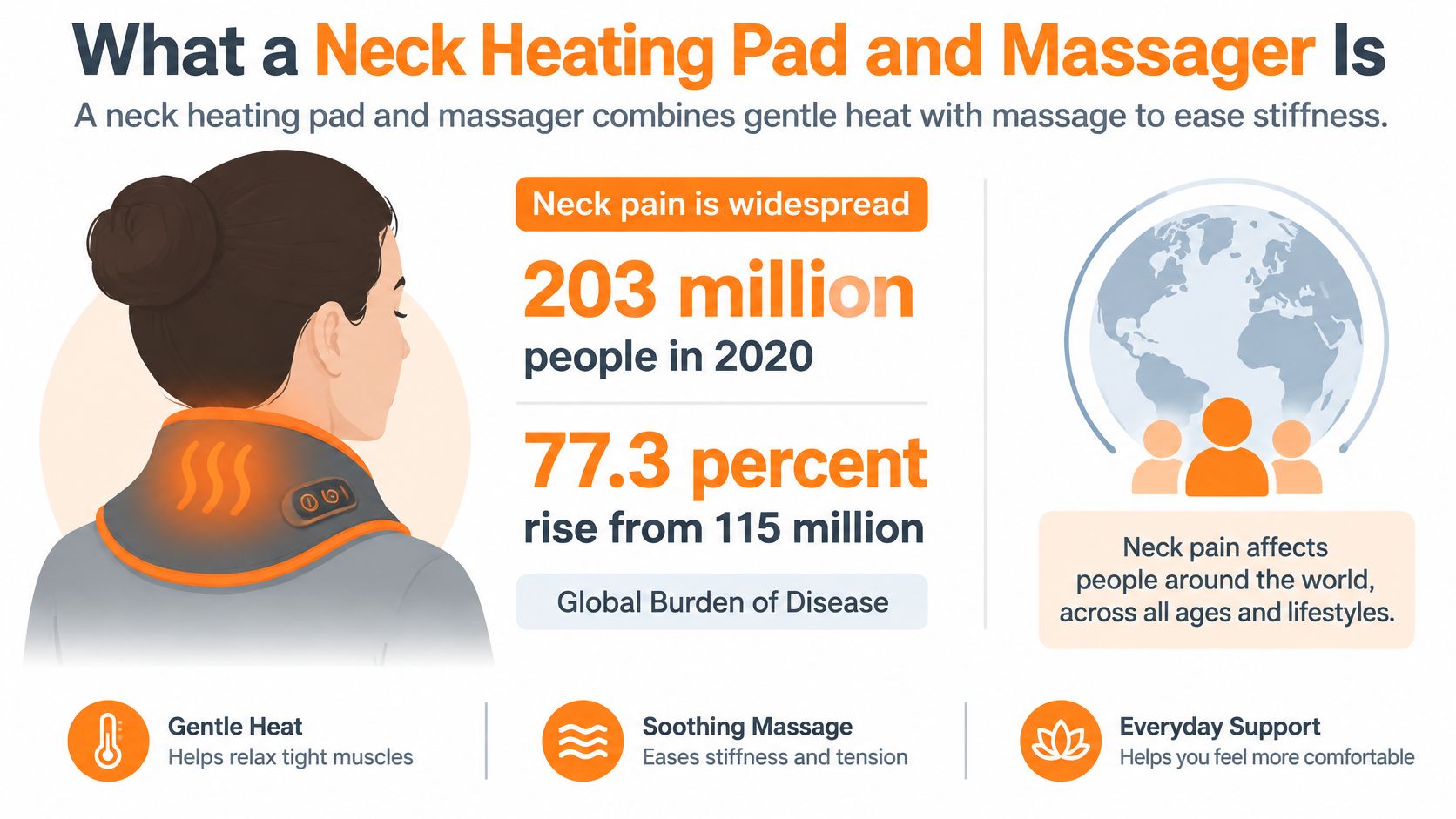
The Global Burden of Disease Study estimated that 203 million people worldwide experienced neck pain in 2020, a 77.3% increase from the estimated 115 million cases in 1990, with population growth and aging contributing to that increase. A stiff neck is common, not evidence that you've somehow failed at sitting correctly.
A neck heating pad and massager is any setup that combines localized warmth with pressure, kneading, or vibration. It might be an electric collar with heated massage nodes, or a microwavable wrap followed by a separate manual tool.
This visual puts the scale of neck discomfort alongside the basic purpose of the product.
A comfort tool, not a diagnosis
Say you finish an afternoon of laptop work with a tight band across your shoulders. A wrap can provide soothing warmth while you step away from the screen; afterward, gentle pressure may make that area feel less guarded.
That doesn't tell you why your neck hurts. A pad can't distinguish ordinary muscular tension from an irritated nerve, a disc problem, or an injury.
Think of heat as a warm-up lap, not the whole workout. The useful outcome is being ready to move comfortably, rather than needing stronger stimulation to keep discomfort out of awareness.
Separate the treatment from the furniture
You don't need a large powered device to try this approach. A reusable wrap and a simple tool can offer more control over where you apply warmth and pressure; this guide to massage tools for home can help distinguish handheld options.
If you're also choosing supportive seating, you can compare heated massage recliners through Indian River Furniture to understand how chair-based features differ from a targeted neck wrap. Treat those features as comfort options, not a reason to remain seated longer.
A useful setup lets you relax your shoulders and remove the device easily. It shouldn't require you to brace, pull, or hold your neck in an awkward position.
Formats and Session Times to Start With
Neck heat and massage formats and first sessions
| Format | Heat source | Massage | First session | Best for |
|---|---|---|---|---|
| Microwavable neck wrap | Microwave-heated fill such as flax seed or lava sand | None, or a separate tool afterward | Use the labeled heating cycle and wear limit; check for uneven warmth before applying | Desk tension and hands-free home use |
| Electric shiatsu neck massager | Built-in heat on a controlled low setting | Kneading nodes | Start with the lowest heat and gentlest pressure; stay within the device timer | Localized shoulder tension when kneading feels comfortable |
| Travel neck pillow or light pad | Microwave-heated fill or an air-activated warmer, depending on the product | Minimal or none | Use only while awake and able to inspect and remove it; follow its wear limit | Passenger travel and outdoor breaks |
| Heat pad then separate massager | A pad used before a separate massage tool | Handheld or manual pressure | Finish a brief, label-limited warming session, remove the pad, then try gentle pressure | People who want independent control of heat and massage |
Choose the format before choosing the intensity
For broad stiffness across the neck and shoulders, start with a wrap that drapes without pulling your head forward. Microwave it according to its own instructions, redistribute the fill if permitted, and check the entire contact surface before putting it on.
Don't copy heating instructions from a different wrap. Fill, moisture, fabric, and microwave output all affect how a pack warms, so a cycle that suits one product can scorch another.
An electric shiatsu collar suits someone who prefers repeated kneading without holding a manual tool. Position it over the muscular upper shoulders rather than letting hard nodes press against the front of the neck or directly onto the spine.
A travel pad solves an access problem, not a treatment-duration problem. Choose a microwave product only when you'll have a suitable microwave available; an air-activated warmer has different placement and clothing requirements.
The separate-pad approach offers the clearest control. You can remove the heat completely, assess how your neck feels, and decide whether massage adds anything useful.
What temperature and time actually mean
A review of heat for nonspecific neck pain describes continuous-heat interventions using approximately 41 ± 0.5 °C at the neck, but it doesn't establish a definitive optimal session duration, frequency, or delivery method. That's a studied treatment condition, not an instruction to make every home pad reach that temperature.
A household device's setting also isn't necessarily the temperature at your skin. Fabric layers, pressure, folds, and the way a wrap sits can change the heat you receive.
Use these practical checks:
- Warm the whole contact area evenly: Don't accept a hot lump surrounded by cool fabric.
- Use the product's session limit: A timer is a ceiling, not a target you must reach.
- Separate unfamiliar functions: Try warmth and massage independently before combining them.
- End on comfort: Stop when the area feels easier to move, rather than continuing until it feels intensely heated.
Practical rule: If you can only tolerate a pad by repeatedly shifting it away from a hot spot, remove it. Don't try to sit through the session.
How Warmth Prepares Muscle for Massage
You close your laptop and notice that turning toward the doorway feels stiff. Instead of digging into the sore spot immediately, you settle a comfortably warm wrap across your upper shoulders and let your arms rest.
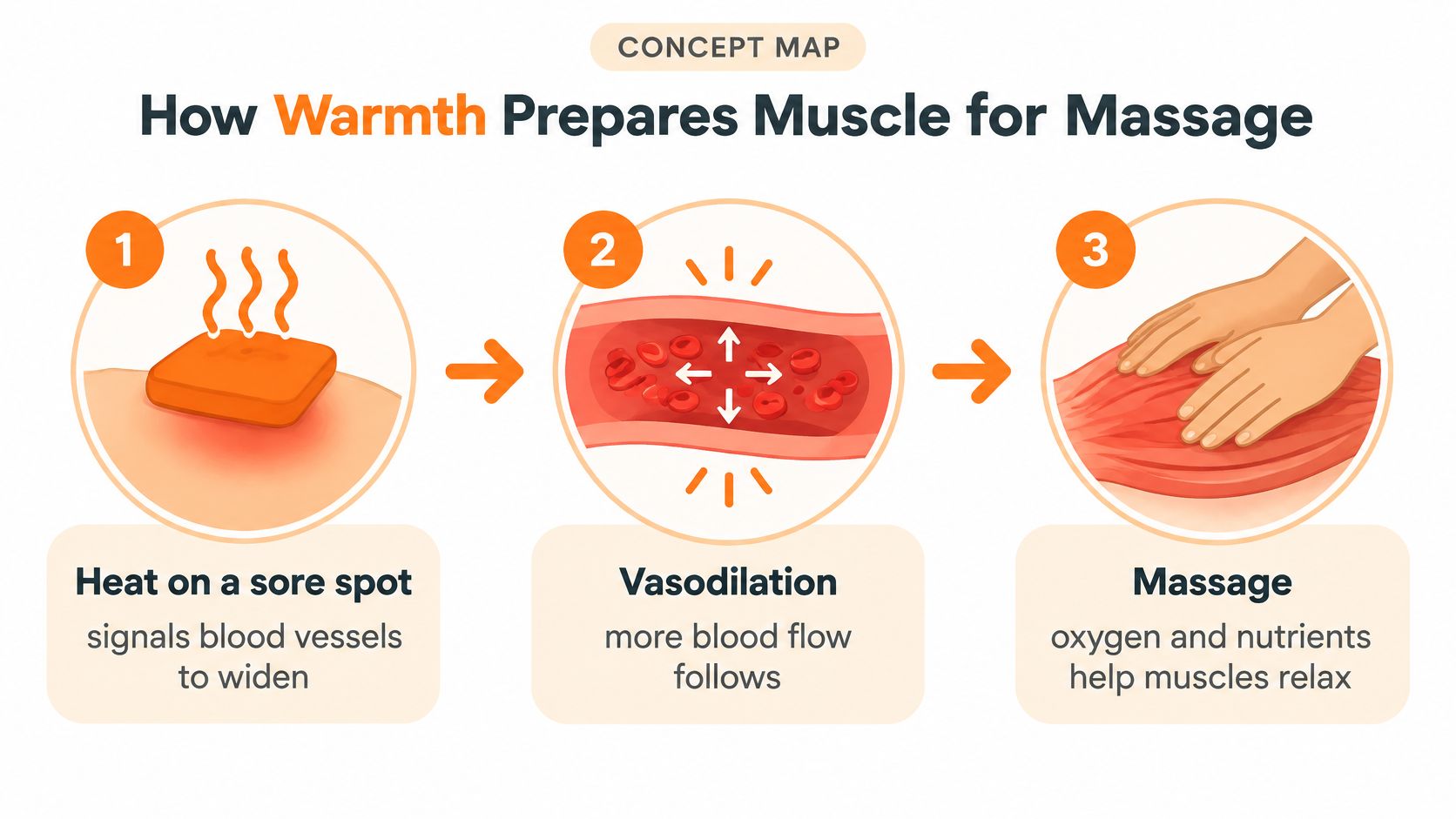
Heat can widen small blood vessels near the warmed area, a process called vasodilation. It also changes sensory input from the skin, which can make discomfort feel less prominent without repairing an underlying structural problem.
The diagram shows the broad relationship between local warmth, circulation, and preparation for massage.
Less force, not deeper force
Think of dryer-warm fabric compared with fabric that feels cold and stiff. That's a useful analogy for the sensation of moving after warmth, although muscle is not fabric being softened.
When you feel less guarded, you may accept gentle contact more comfortably. That's the opportunity massage offers: a tolerable, controlled sensation, not permission to push harder.
A tender spot doesn't need to be crushed to become less bothersome. If you hold your breath, clench your jaw, or lift your shoulder away from the tool, reduce the pressure or stop.
- Keep contact on muscle: Work over the upper shoulder rather than pressing into the throat or bony spine.
- Support your arm: Rest your elbow when using a manual tool so you don't create another strained position.
- Let the sensation settle: Pause instead of repeatedly grinding the most sensitive spot.
Turn comfort into movement
After removing the wrap, gently turn your head within a comfortable range. Let your shoulders rise and settle, then stand and walk away from the workstation.
The point isn't to achieve your largest possible stretch. It's to see whether ordinary movement feels less restricted without provoking symptoms.
Nor should you interpret warmth as flushing out a day's accumulated lactic acid. Desk-related soreness isn't waste trapped in a muscle, and a stronger massage doesn't clear it out.
For a visual companion to gentle neck movement, use comfortable range rather than trying to match someone else's motion.
Finish with an everyday action: walk to refill your water, change workstations, or do a light household task. If warmth makes movement more tolerable, that's a useful result even when you don't use massage afterward.
Relief You Can Expect and Its Limits
The placebo-controlled difference is modest: a 2024 Cochrane review found that, across eight studies involving 403 participants, massage improved pain by 3.43 points on a 0–100 scale compared with placebo, with low-certainty evidence. Some comparisons against no treatment looked more favorable, including a short-term pain reduction of roughly 22.59 points.
Those comparisons answer different questions. Feeling better after receiving attention and hands-on care isn't the same as demonstrating a large benefit beyond a credible placebo treatment.
They also don't establish what a particular heated collar will do. Therapeutic massage, a handheld device, and a microwavable wrap aren't interchangeable interventions.
Look for changes in daily function
A controlled trial of therapeutic massage for chronic neck pain found clinically meaningful improvement on the Neck Disability Index after 10 weeks in 39% of massage participants, compared with 14% of participants given a self-care book. That supports cautious interest in massage as an adjunct, not a promise that a home device reproduces a therapist-delivered treatment.
Judge your own response through ordinary tasks:
- Turning comfortably: Can you look toward a nearby screen without bracing?
- Returning to activity: Can you resume a manageable task without immediately needing the device again?
- Tolerating movement: Does gentle mobility feel easier afterward, without a later increase in soreness?
A pleasant sensation alone isn't proof that the cause has improved. If relief lasts only while the device is running, reconsider the activity, posture, or condition that's provoking symptoms.
Don't let comfort postpone care
Pain following a fall or collision, pain shooting into an arm, progressive weakness, persistent numbness, fever, or symptoms that keep worsening deserve clinical assessment. Sudden or rapidly progressing neurological symptoms call for urgent care rather than another home session.
For familiar muscular aching, the guide to heat therapy for neck pain offers additional context for using warmth alongside activity. Don't use a reassuring article or a soothing device to explain away a new symptom pattern.
Sleep positioning is another practical consideration when discomfort is strongest on waking. Miller Waldrop Furniture & Decor's overview of cervical pillow options for better sleep can help you compare shapes, but choose support that keeps your neck comfortable in your usual sleeping position rather than assuming a particular contour treats the cause.
Measure success by what you can comfortably do afterward, not by how intense the session felt.
Fills Fabrics and a Hands-Free Fit
Design features that change neck heat and massage
| Feature | Why it matters | Look for |
|---|---|---|
| Fill | Fill distribution affects the contact surface and where warmth collects | Flax seed or lava sand in a microwave-rated wrap; cold use only when the product permits it |
| Heat retention | A cooling wrap and a continuously powered pad need different monitoring | Clear wear instructions; don't keep reheating simply to maintain the strongest sensation |
| Heat control | Uneven heat and pressure can create uncomfortable contact points | Adjustable electric warmth, a timer, and a pad that lies flat |
| Cover fabric | Texture, seams, and cleaning affect regular use | Soft fleece or cotton, with a removable washable cover where offered |
| Hands-free fit | A slipping wrap makes you brace or repeatedly reposition it | A shoulder-draping shape or easy-release fastening that stays put without throat pressure |
| Massage style | Pressure should be adjustable without pulling hard on the device | Gentle kneading, accessible controls, and nodes that don't press onto bone |
Compare construction, not promises
A natural-fill wrap offers a simple setup without a power cord during wear. Its warmth gradually fades, but that doesn't make it automatically safer than an electric pad: overheated fill can still burn, and a thick outer cover can conceal an excessively hot interior.
Check whether the manufacturer allows the fill to be redistributed. If the contents collect at one end, the wrap may sit unevenly and put more weight on an already tender area.
Electric collars provide ongoing powered warmth and mechanical movement. Look for controls you can reach without twisting, and check that stopping the massage doesn't require navigating an unfamiliar sequence of buttons.
Don't assume a collar's weight makes it more therapeutic. If it slides forward and you must pull backward to hold it in place, the fit is working against relaxation.
Test the fit before heating
Drape the unheated wrap across your shoulders while seated in your usual chair. Your head should remain upright without effort, and the wrap shouldn't force your chin forward or crowd your throat.
Then check removal and cleaning:
- Easy release: You should be able to remove it promptly without untangling cords or reaching behind your head.
- Stable placement: Turn gently and stand up. Reject a fit that immediately slips or needs constant support.
- Clear care instructions: A washable cover doesn't mean the filled insert or electrical unit can go into the washing machine.
- Sound condition: Stop using a product with damaged wiring, leaking fill, scorched fabric, or a burnt smell.
SunnyBay's reusable microwavable neck wraps are one option in this category, with flax-seed or lava-sand fills and fleece-and-cotton fabric designs; compare the individual model's fastening, cover care, and heating instructions with other reusable wraps.
“Chemical-free” isn't a meaningful safety guarantee. A more useful distinction is whether the product uses microwave-stored heat, electrical power, or an air-activated warming reaction.
Choose colors and patterns because you like them. Choose the shape, controls, and contact surface because you can use them without strain.
Safety Rules Before You Add Heat
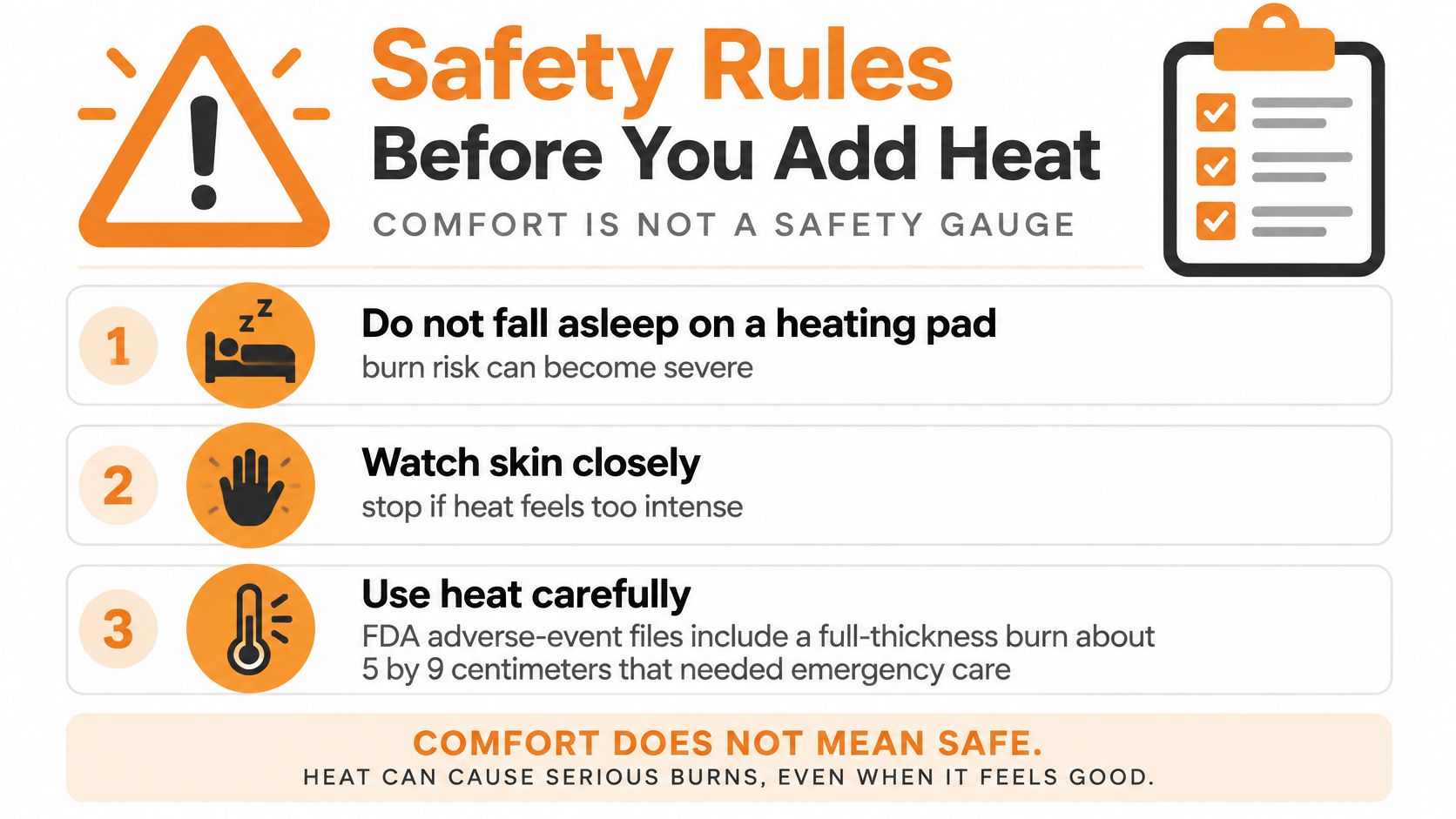
Comfort isn't a reliable safety gauge. An FDA adverse-event report describes a person who fell asleep on a heating pad and sustained a full-thickness burn measuring 5 × 9 cm, requiring emergency treatment and surgical consultation.
An individual report can't tell us how often this happens. It does demonstrate why sleeping on active heat is an unacceptable shortcut, even if the pad initially feels soothing.
Keep the key precautions visible wherever you store your wrap.
Check your risk before switching it on
Ask a clinician before use if you have diabetes, neuropathy, poor circulation, fragile skin, impaired alertness, or difficulty removing the device independently. Reduced sensation can prevent you from noticing excessive heat early.
Don't lie on a pad, trap it beneath tight clothing, or operate it while drowsy. Don't use a neck massager while driving, and don't start unfamiliar heat and massage functions at maximum intensity.
Heat and massage also have different hazards. Heat can burn skin; mechanical pressure can aggravate an acutely injured area even when the warmth feels pleasant.
Use a repeatable safety check
- Start low: Choose the lowest effective warmth rather than chasing a hotter sensation.
- Respect the label: Follow the heating cycle, placement instructions, and session limit for that exact product.
- Use the appropriate barrier: Add the specified cover or fabric layer without improvising heavy insulation.
- Inspect your skin: Check during and after use, especially beneath the hottest contact area.
- Stop promptly: Remove the device for burning, pain, rash, numbness, dizziness, unusual redness, or worsening symptoms.
The heating pad safety guide can help you turn those precautions into a regular routine.
Recurring work-related discomfort also needs more than safer heating. A systematic review of office-worker neck and shoulder risk factors identified associations involving low task variation, keyboard position, and perceived muscular tension; these are reasons to examine how you work, not proof that moving a keyboard alone prevents pain.
Match the Session to the Workday
Choose a session around the activity you want to do more comfortably. A wrap shouldn't become something you need to tolerate an unchanged workday.
Before work
If familiar morning stiffness makes getting started difficult, use a brief warming session while you're awake and unhurried. Follow it with comfortable neck turns and normal shoulder movement before opening the laptop.
Don't use the temporary improvement as a cue to sit rigidly until lunch. Set up the day so you can alternate between tasks rather than treating any single posture as the correct position to hold indefinitely.
During a flare
Step away from the screen before reaching for heat. Check whether you're squinting at small text, holding a phone between your ear and shoulder, or reaching awkwardly for the mouse.
- Change the demand: Enlarge text, bring the work into view, or switch from typing to a different task.
- Make the break real: Remove your hands from the keyboard and leave the working position.
- Keep warmth bounded: Finish the session rather than wearing active heat through successive meetings.
After work
Use gentle massage only if it feels helpful, then choose an activity that gets you moving. For persistent muscular symptoms, a physiotherapist can help select neck and shoulder strengthening that matches your capacity instead of adding another passive treatment.
If the same ache repeatedly returns, change a specific driver and observe the result. Reposition the mouse so you aren't reaching, adjust the keyboard so your elbows rest comfortably, or alternate concentrated screen work with another task.
Don't move equipment farther away just because you've heard that a close keyboard is risky. Fit the workstation to your body and task, and avoid replacing one cramped position with prolonged reaching.
The sensible next purchase may be a simple reusable wrap, not a stronger massager. Add tools only when they help you return to comfortable activity rather than spend more time treating the same sore spot.
SunnyBay offers reusable microwavable neck wraps, heating pads, and massage tools for targeted home comfort. Visit SunnyBay to compare a hands-free wrap with a separate massage tool, and choose a setup you can use briefly before returning to movement.


