


Muscle Recovery Tools Explained and How to Choose
-
You finish a workout feeling accomplished, then wake up with stiff thighs, tight shoulders, or a back that complains when you stand. The same thing can happen after a long drive or a full day at a desk. A heating wrap, foam roller, massage gun, compression sleeve, or cold pack may make you feel better, but those tools don't all do the same job, and feeling better isn't always the same as healing faster.
The useful way to think about muscle recovery tools is by function. Some warm tissue, some cool a painful area, some apply pressure, some support a limb, and others help you move through a comfortable range. This guide connects each tool to a specific goal, explains sensible timing and dosing, and shows how to build a small routine without buying every device on the shelf.
Table of Contents
- Introduction to Muscle Recovery Tools and What They Can Do
- How Muscle Recovery Actually Works in Simple Terms
- The Main Types of Muscle Recovery Tools and How They Work
- Heat and Cold Therapy for Soreness and Stiffness
- Massage Foam Rolling and Percussion Tools in Practice
- How to Choose the Right Muscle Recovery Tools for You
- Building a Simple Recovery Routine You Will Actually Use
Introduction to Muscle Recovery Tools and What They Can Do
A sore morning usually creates a simple question: should you stretch, use heat, reach for ice, or roll the area until it loosens? The answer depends on what you're trying to change. A tool might reduce the sensation of soreness, improve movement for a while, or help you tolerate an activity. That can be useful even when it doesn't alter the underlying repair process.
Think of recovery as having two lanes. The first is short-term relief, where the priority is reducing discomfort or stiffness enough to walk, work, or train comfortably. The second is biological recovery, where the body restores function, adapts to training, and repairs stressed tissue. Current evidence doesn't always show that a device producing quick relief also shortens recovery time. A 2025 editorial highlights the continuing lack of basic research that properly validates many popular recovery interventions, while a review of massage guns found their clearest benefits in short-term range of motion, flexibility, and perceived soreness rather than strength, balance, agility, or explosive performance (editorial on recovery research and evidence gaps).
The practical mindset: choose a tool for the result you want today, then judge it separately for its effect on longer-term recovery.
For example, warmth may help a tight neck feel easier to turn, while a foam roller may improve temporary mobility before movement. Cold can provide a useful numbing effect around a freshly irritated area. Compression may feel supportive after demanding activity. None of these replaces appropriate rest, gradual loading, or medical assessment when pain is severe or persistent.
The sections ahead start with a simple model of recovery, then compare the main tool families. From there, you'll find evidence-informed guidance for temperature therapy, massage tools, choosing equipment, and creating a routine you can repeat. The aim isn't to find one magical product. It's to match the tool, the body area, the timing, and the dose to the problem in front of you.
How Muscle Recovery Actually Works in Simple Terms
Your muscles don't recover through one switch turning on. They respond to several overlapping processes, and different tools influence different parts of that response.
Four moving parts shape the recovery experience
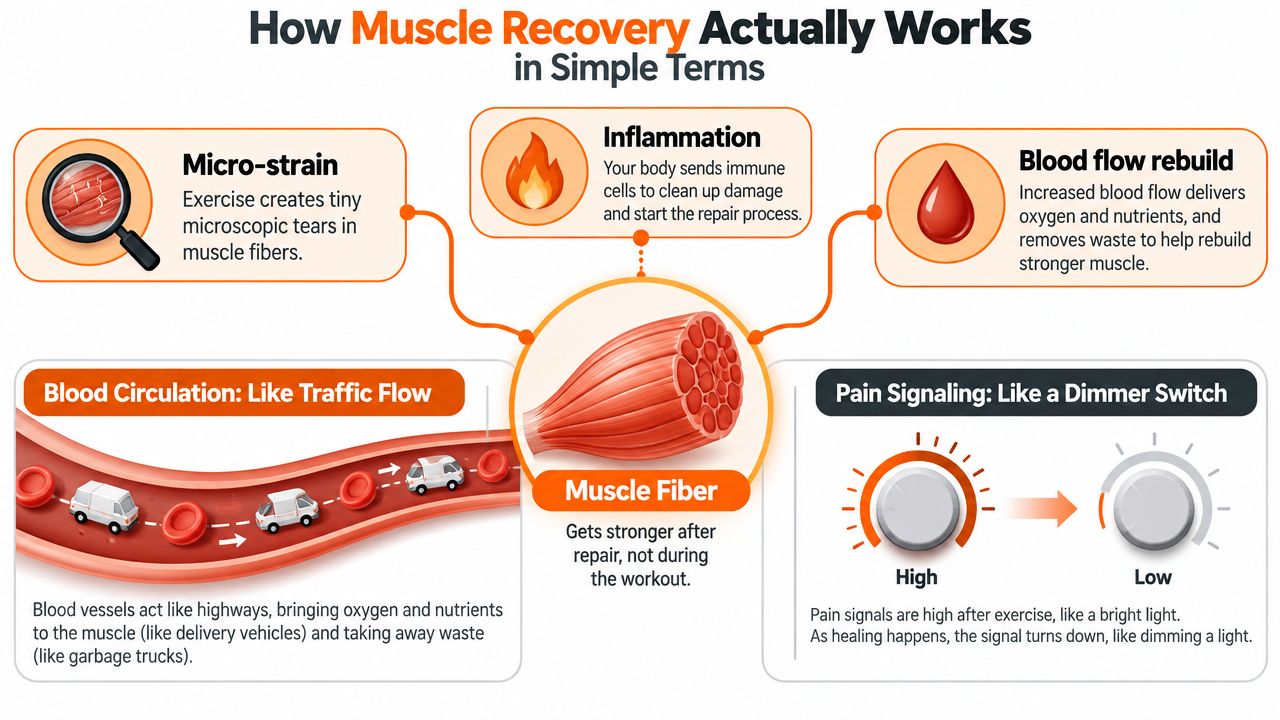
Micro-strain is the small amount of stress created when muscles handle work they aren't fully accustomed to. You may notice this later as soreness, reduced force, or reluctance to move. The body then manages the local response through repair and adaptation.
Inflammation is part of that response, not automatically a sign that something has gone wrong. It can contribute to tenderness and warmth, which is why a painful area may feel different from ordinary stiffness.
Blood flow acts like traffic moving through a road system. Exercise changes demand in the tissue, and recovery requires the delivery and removal systems to keep working. Local heat may improve circulation, while movement and compression can alter how an area feels during the recovery window.
Pain signaling behaves more like a dimmer switch than a simple alarm. The nervous system constantly weighs tissue input, threat, fatigue, attention, and movement. A tool can lower the intensity of the signal without removing every underlying reason for it.
Timing changes the question
Immediately after exercise, you may care about calming a hot, uncomfortable area or restoring a comfortable range of motion. Later the same day, gentle warmth or light movement may suit stiffness better. The next morning, the priority may be making ordinary movement easier rather than chasing a dramatic physiological effect.
Heat has mechanistic and human evidence as a recovery aid. Review-level research reports that local heat can accelerate glycogen resynthesis after exhaustive exercise, restore contractile function and endurance after eccentric muscle damage, and support processes involving blood flow, vascular changes, and muscle protein synthesis. The same review describes less soreness and better function with pre-exercise heating, while post-exercise findings are more variable (review of heat therapy and exercise recovery).
That variation explains why one device can't solve every recovery problem. A massage gun may change how your legs feel and move, but it won't automatically address weakness. A cold pack may reduce discomfort, but it won't restore capacity by itself. Use the tool as one input in a broader plan, not as a substitute for the process your body still needs to complete.
The Main Types of Muscle Recovery Tools and How They Work
The easiest way to compare recovery equipment is to ask what it does to your immediate experience and where its limits begin.
Heat tools
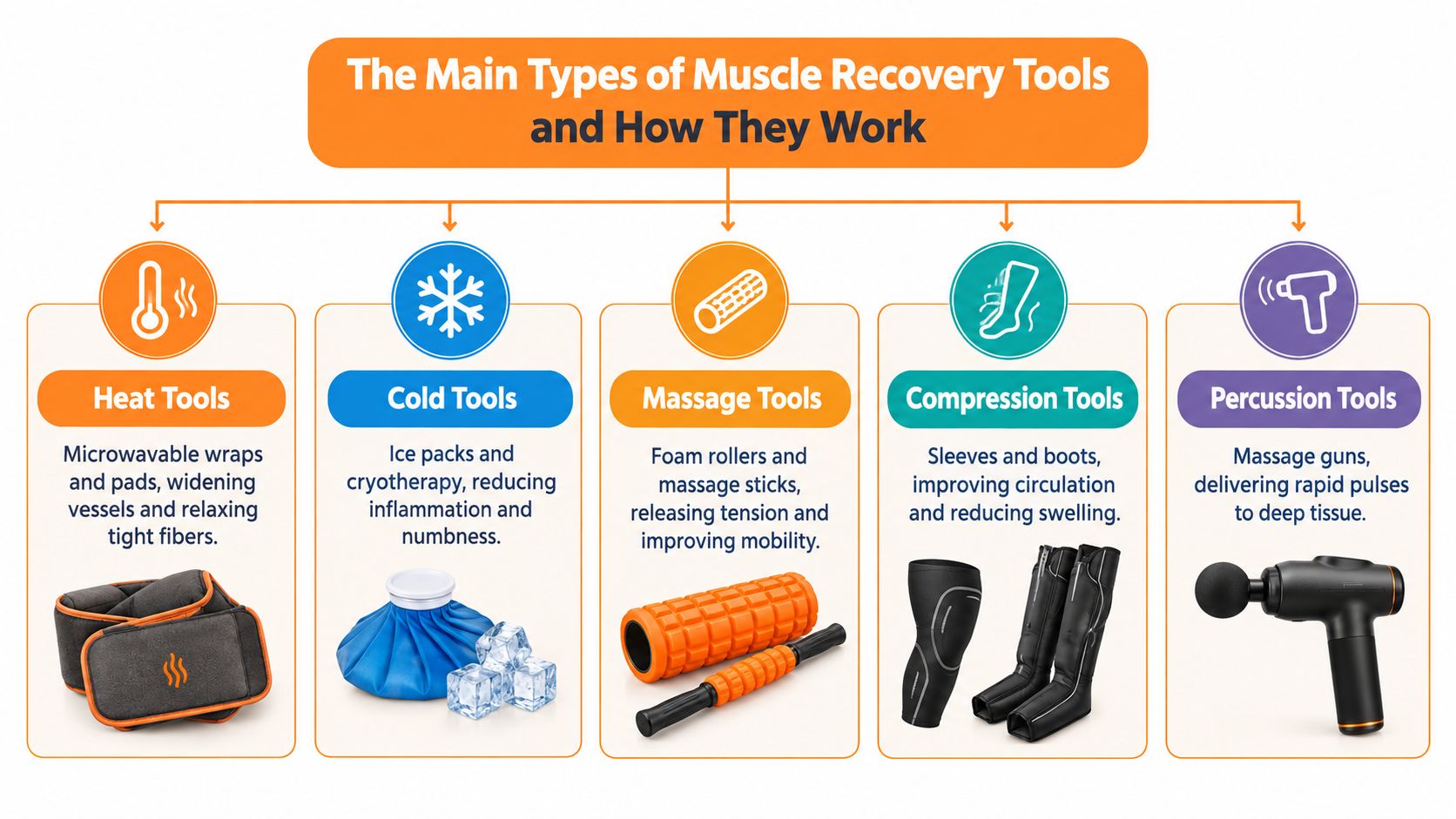
Microwavable wraps, electric heating pads, and targeted heat patches raise local temperature and can make tight muscles feel more relaxed. They're often practical for lingering stiffness, neck tension after screen work, or a back that feels restricted after sitting. A hands-free wrap can keep warmth against the shoulders while you read or work.
The trade-off is that warmth can make an area feel ready before the tissue has regained full capacity. Use it to support comfortable movement, not to ignore worsening pain.
Cold tools
Ice bags and cold packs are commonly chosen when an area feels freshly irritated, hot, or swollen. Cooling can reduce sensation and make a painful region easier to tolerate. Adjustable straps help keep a cold pack in place without requiring you to hold it.
Cold is a symptom-management tool. Numbness can hide useful feedback, so don't use it as permission to push through an injury.
Massage tools
Foam rollers, massage sticks, and handheld rollers apply pressure while you move across or around a muscle. People commonly use them for perceived tightness and temporary mobility changes. The experience ranges from broad pressure with a roller to more targeted contact from a stick.
Pressing harder isn't automatically better. Excessive pressure can turn a calming routine into another stressful input.
Compression tools
Compression sleeves, wraps, and pneumatic boots hug a limb or body area. Users often choose them for a supported feeling, leg fatigue, or swelling management. Their usefulness depends on fit and context, and they shouldn't create pain, tingling, discoloration, or loss of sensation.
Stretching aids and percussion devices
Straps help you control a stretch without forcing a joint, while foam rollers can also assist with positioning and mobility drills. Percussion guns deliver rapid pulses to larger muscle groups and are more intense than a simple roller. That intensity may feel satisfying, but the current evidence is stronger for short-term movement and soreness outcomes than for lasting performance changes.
| Tool family | Best fit | Main sensation | Important limit |
|---|---|---|---|
| Heat | Stiffness and tightness | Warmth and relaxation | Comfort doesn't prove faster repair |
| Cold | Fresh irritation or swelling | Cooling and numbing | Numbness can mask feedback |
| Massage | Perceived tightness and mobility | Pressure and release | Harder pressure isn't better |
| Compression | Support and limb fatigue | Hugging or squeezing | Poor fit can irritate |
| Stretching aids | Controlled mobility work | Lengthening and tension | Forcing range can aggravate symptoms |
A tool's category matters less than the match. Choose warmth for a stiff area that responds well to heat, cooling for a fresh flare-up, gentle pressure for mobility, and a strap when you need controlled movement rather than passive treatment.
Heat and Cold Therapy for Soreness and Stiffness
After a hard session, a stiff muscle can make the first few steps feel guarded, while a recently irritated area may feel hot or swollen. Heat and cold address those sensations differently, but neither should be treated as proof that tissue has repaired faster. A 2021 systematic review and network meta-analysis examined 32 randomized controlled trials and found that heat reduced delayed-onset muscle soreness compared with control at 24 hours or less and at more than 24 hours. Pain scores favored heat beyond 24 hours, with p=0.004, while heat and cold did not differ significantly at either follow-up window (systematic review of heat and cold for delayed-onset muscle soreness).
The practical choice depends on the current signal from the area. Warmth often helps stiffness and cautious movement feel easier. Cooling may suit a fresh flare-up, heat, or swelling. Relief is the immediate target. True recovery still depends on time, sleep, nutrition, and an appropriate return to activity.
Heat at home
Reusable wraps work well around the neck, shoulders, back, or hands. Many use a flexible fill that warms in a microwave and can be shaped around the body. Some designs include a washable cover or hands-free fit, which helps keep the wrap in place during quiet activities.
Follow the heating instructions supplied with the device, and place a layer between very warm material and sensitive skin when needed. Check your skin during use. Avoid sleeping with an actively heated device unless its instructions specifically permit it and explain the safety precautions.
Cold with control
A large ice bag or gel pack with an adjustable strap can sit around a knee, shoulder, or back without requiring you to hold it. Aim for a tolerable cooling sensation rather than maximum cold. Stop if the skin becomes painful, unusually pale, or numb for too long. Numbing can reduce the feedback that would otherwise tell you to stop, so feeling less pain does not mean the underlying issue is resolved.
Warmth around the eyes follows a more specific routine. Guidance commonly places eyelid-surface temperature around 40 to 45°C, held for at least 4 minutes, with 8 to 10 minutes more often used for moderate meibomian gland dysfunction. A 2024 evidence review recommends a moist-heat device, including microwavable or self-heating masks, for 10 minutes once per day (warm-compress guidance for dry eye).
Heat vs Cold at a Glance
| Factor | Heat Therapy | Cold Therapy |
|---|---|---|
| Typical goal | Ease stiffness and guarded movement | Calm sensation and acute irritation |
| Useful feeling | Relaxed, more mobile | Numbed, less sensitive |
| Common tools | Wraps, pads, warm compress masks | Ice bags, gel packs |
| Main caution | Excessive heat or prolonged contact | Skin irritation and masked pain |
| Soreness evidence | Reduces pain versus control in reviewed windows | No significant advantage over heat in the reviewed windows |
Use the symptom, timing, and safety instructions to guide the choice. For a broader practical comparison, see this heat therapy versus cold therapy guide.
Massage Foam Rolling and Percussion Tools in Practice
After training, a foam roller may make tight legs feel easier to move, while a percussion gun can briefly soften the sensation of soreness. That immediate change is useful, but it is not proof that damaged tissue has healed. These tools work mainly as mobility and comfort aids. Reviews find their clearest benefits in range of motion, pain, and short-term performance. Lasting gains in strength or injury prevention remain uncertain (research on foam rolling and recovery dosing).
A practical dose
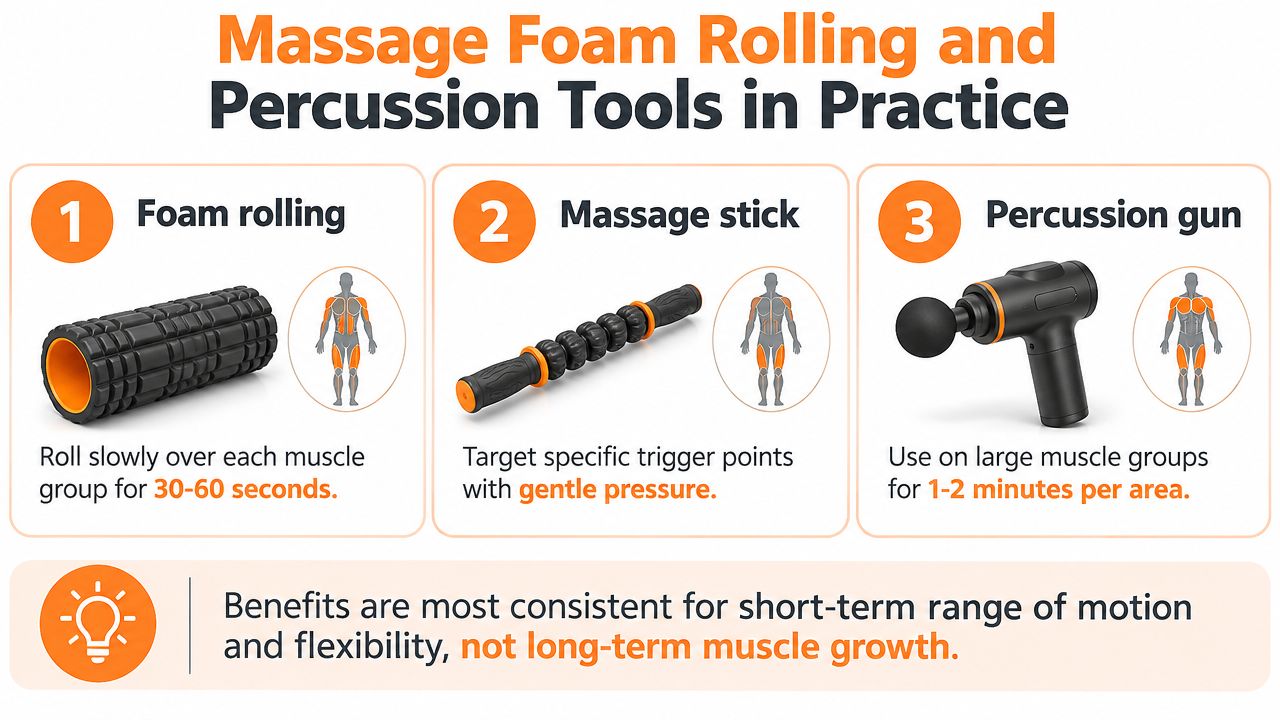
Start with 90 to 120 seconds per muscle group. Use the shorter duration while learning how your body responds, then adjust based on comfort and movement afterward. A 2024 trial found that at least 120 seconds of rolling produced significantly better immediate and prolonged post-exertional recovery. Treat this as a tested starting point, not a guarantee that your body will respond the same way.
A separate clinical study reported pain reductions of 22.8% at 24 hours, 39.2% at 48 hours, and 59.7% at 72 hours, alongside improved agility and strength compared with passive recovery (foam-rolling trial and clinical findings). The figures describe that study's participants and protocol, not a promised result for every user.
Move slowly, breathe normally, and stay on the muscle. Avoid grinding directly over joints, bones, or sharp, focal pain.
- Foam roller: Use controlled passes across a large muscle group. You can pause briefly on a sensitive spot, but severe pain does not show that the technique is working.
- Massage stick: Apply gentle, targeted pressure to areas such as the calf or thigh. Since you control the force, ease off before the tissue becomes guarded.
- Percussion gun: Begin on a low setting over broad muscle areas. Keep the device moving, and avoid bony regions, the front of the neck, unexplained swelling, and acute injuries.
A 2024 paper found insufficient evidence that short-term massage-gun use after strenuous exercise is better than rest, with effects limited to very short periods. A 2025 review also described weak methods, small samples, short observation periods, and heavy representation of young, healthy men (review of post-exercise massage-gun use). Use extra care if you are older, managing chronic pain, or applying a tool outside an athletic setting.
Pressure check: If you brace, hold your breath, or feel sharp pain, lower the intensity. Recovery work should leave movement more comfortable, not make you feel battered.
For home-based options, browse these massage tools for home.
How to Choose the Right Muscle Recovery Tools for You
Start with the outcome, not the product category. If your goal is immediate comfort, choose the tool that makes the area feel manageable without hiding warning signs. If your goal is next-day mobility, prioritize something that helps you move easily. If you're trying to support repeated training, select a tool you can apply consistently and combine with sensible loading, sleep, hydration, and movement.
Match the tool to real life
A reusable microwavable wrap makes sense at home when you have access to a microwave and want warmth around the neck, shoulders, back, or hands. An air-activated heat patch may suit travel, outdoor work, or sport when you don't have power nearby. A simple strap takes little space and lets you control stretching, while a powered percussion device requires charging, storage, and a willingness to learn safe technique.
Your body area also matters. A broad roller suits large muscle groups, a stick offers more targeted pressure, and a shaped wrap may stay in place better around the neck or shoulder. For people tracking body composition or changes in lean mass as part of a wider health plan, a Telomyx DEXA scan service in Manchester can provide a separate assessment resource. It isn't a replacement for judging how a recovery tool feels or functions.
| Decision factor | Lower-complexity option | More involved option |
|---|---|---|
| Cost | Strap, roller, reusable wrap | Percussion device or compression system |
| Ease of use | Passive heat or basic rolling | Powered tools requiring technique |
| Portability | Heat patch, strap, massage stick | Large pad, boot, or charging device |
| Best evidence focus | Heat for soreness, rolling for mobility | Short-term comfort and movement effects |
| Consistency | Works when simple enough to repeat | Useful only if you use it safely and regularly |
Evidence remains uneven for older adults and people with chronic pain, because many studies focus on young, healthy men. That uncertainty doesn't make the tools useless. It means you should evaluate them by repeatable outcomes: Can you move more comfortably? Can you complete normal activities? Does the benefit last beyond the immediate session? Or do you only enjoy the sensation while using the device?
Use this recovery tools guide for athletes as a further comparison, but keep your own goal central. A smaller, familiar kit often beats a crowded drawer of devices you rarely use.
Building a Simple Recovery Routine You Will Actually Use
A useful routine starts with what you can repeat. Begin with light movement that feels comfortable, drink fluids normally, and protect your sleep. Add one tool that fits the day's problem, rather than stacking heat, rolling, compression, and percussion because they're available.
For a practical starter kit, choose a versatile heat wrap plus either a foam roller or a stretching strap. Use warmth when stiffness is the main barrier, rolling or stretching when movement feels restricted, and cooling when a fresh irritated area responds better to reduced sensation. Keep the session gentle enough that you can judge the result clearly.
Track the outcome for a week. Write down the tool, when you used it, how long you used it, and whether you could move or function more easily afterward. Also note whether the improvement lasted or disappeared as soon as the session ended. That simple record helps you separate useful relief from a pleasant ritual.
Consistency beats collection: one tool used safely at the right time is more valuable than several devices chosen by hype.
Adjust timing and dose before buying something new. If pain keeps returning, limits ordinary activity, or comes with concerning symptoms, seek an assessment rather than trying to cover it with another recovery gadget.
SunnyBay offers reusable microwavable heat wraps, hot and cold therapy accessories, air-activated patches, and massage tools for targeted comfort at home or while traveling. Visit SunnyBay to compare options and choose a recovery aid that matches your body area, routine, and comfort goal.


