


Microwavable Heating Pads with Lavender: What Works
-
Product pages love one tidy line: lavender plus heat equals pain relief. That line blends two different jobs. Heat can loosen stiff muscles and ease tightness for a short while. Lavender scent is a separate sensory feature, and the clinical picture for it is mixed. If you're shopping for microwavable heating pads with lavender, treat warmth as the working part and fragrance as optional comfort. Check a few figures on the label before you ever press start.
Table of Contents
- Heat, Scent and Limits at a Glance
- Does Lavender Add Pain Relief or Only Relaxation
- Lavender Scent Sensitivity and Who Should Be Careful
- Fill and Cover Choices That Change the Experience
- How to Warm and Use the Pad Safely
- When Heat Is the Wrong Choice and What to Do
- Pick a Lavender Pad You Can Use Safely
Heat, Scent and Limits at a Glance
Buy a lavender microwavable heating pad for controlled warmth and a short calming ritual, not as a proven pain treatment. The scent may make the session pleasanter. It doesn't do the job of the heat, and it doesn't turn the pad into medicine.
Match these figures to any label before the first heating.
| Check | Target or figure | Why it matters |
|---|---|---|
| Surface temperature | About 40 °C | Balances effect and safety for muscle and joint heat |
| Pain-causing heat threshold | Above roughly 45 °C | Heat in this range can damage tissue |
| Single session length | 15 to 30 minutes with a fabric barrier | Limits skin exposure in one session |
| Heat retention claim | Up to 30 minutes, if the label states it | Shows how long a fully heated pad stays useful |
| Microwave time | Printed on the label, start at the low end | Helps prevent scorching and hot spots |
About 40 °C is the contact warmth to aim for, enough to ease stiffness without chasing a hotter pack. Above roughly 45 °C is where heat can hurt tissue, so a pad that feels sharply hot has already left a comfortable range. 15 to 30 minutes with cloth between pad and skin caps how long skin stays exposed in one sitting. A retention line of up to 30 minutes only describes how long a fully heated pad may stay useful, and only if the label states it. The printed microwave time is your start point, and the low end of that range is the safer first try.
Three items to confirm on the label
- Printed microwave time: A time range, not a vague "heat until warm," so you aren't guessing with a hot fill.
- Removable fabric cover: Cloth you can put between the pad and your skin, and wash without soaking the filling.
- Stated maximum session length: A clear stop, so a comfortable pad doesn't stay on for an hour.
Compare the label with the table before you buy. If the time, the cover, or the session limit is missing, that pad is harder to use safely.
Does Lavender Add Pain Relief or Only Relaxation
A warm pad and a lavender smell are doing two different jobs. Product pages often treat them as one. Heat is the part that changes the tissue: a warmer muscle can feel less stiff for a while, the way a warm cloth loosens a stiff hinge. The smell is the room around that hinge. It may help you settle. It does not supply the warmth, and an unscented pad can still do the physical job.
What the pain reviews actually mixed together
A systematic review and meta-analysis examined 18 studies published between 2000 and 2018 among surgical patients, mothers after childbirth, people with arthritis, and dialysis patients. It reported a statistically significant overall effect on pain, with a Hedges' g of approximately −1.06 and a 95% confidence interval of −1.40 to −0.72, in that systematic review and meta-analysis. Those interventions included inhalation, massage, topical application, hot packs, and oral administration. A mixed result like that cannot be pinned on a microwavable heating pad with lavender in the cover.
Pooled trials of lavender aromatherapy in burn care did not reach statistical significance. That pool is aromatherapy during burn care, not a fabric pad on a sofa. The gap is easy to miss: a calmer mood and a lower pain score are not the same measurement.
Inhaled oil is still not a filled pad
In a 2023 randomized, double-blind trial, 100 women after cesarean delivery reported lower pain with inhaled lavender essential oil than with a distilled-water placebo at rest (23.84 ± 18.01 versus 38.76 ± 22.90), in a Springer Nature journal article. That trial tested inhaled oil. A cloth pad warmed in a microwave is a different exposure, with heat on the body and only whatever scent the fill or cover releases.
Practical rule: Keep heat as the reason for the pad. Test lavender as relaxation, not as proof it treats arthritis, injury, or chronic pain.
A calming essential oil for relaxation is a different product from a heated cloth pad, and it carries its own limits. For scent on a pad, start with the soothing side of lavender.
Alternate a scented night with an unscented warm night. Write down pain, how relaxed you felt, and how you slept. If the scented nights are not clearly better, the lavender is not earning its place for you. The heat still can.
Lavender Scent Sensitivity and Who Should Be Careful
The U.S. National Center for Complementary and Integrative Health reports that evidence remains unclear for lavender aromatherapy's benefits in pain, anxiety, sleep, and related conditions. It also notes that inhaled lavender may cause headache or coughing in some people. A pleasant smell isn't a proven effect, and it isn't harmless for every nose.
Heat changes the scent. A warm pad releases more fragrance in the first minutes after the microwave, so the smell is strongest when the pad is hottest. If a room-temperature sniff is already strong, the heated pad will be stronger.
People who should go slowly
- Fragrance sensitivity: Start with a short session in a ventilated room, not under a blanket with the pad near your face.
- Asthma: Keep the pad farther from your airway. A cough is a stop signal, not something to push through.
- Frequent headaches: Lavender can trigger headache for some users, including people who already notice smell as a migraine cue.
- Plant allergies: Dried lavender is still plant material. A sealed insert is safer than loose buds against the skin.
A sealed sachet or a low-volatility insert is the safer build. Don't put concentrated oil on the fabric or on your skin. Heated oil can intensify fumes, and it can irritate skin if it transfers.
Say you have mild asthma. Ten minutes in, with the pad near your collar, you notice a cough. Move the pad across the room, air the space, and switch to an unscented pad next time. If coughing, headache, rash, or eye irritation shows up, stop. If it doesn't settle, get medical advice.
People who already react to odors can try tracking scent triggers with Relief before they commit to a scented pad.
Fill and Cover Choices That Change the Experience
The fill decides how the heat behaves and how the pad feels in your hands. Natural fills such as flaxseed tend toward long, even warmth and a chemical-free feel. Lava sand and rice are common alternatives, and they don't behave the same way.
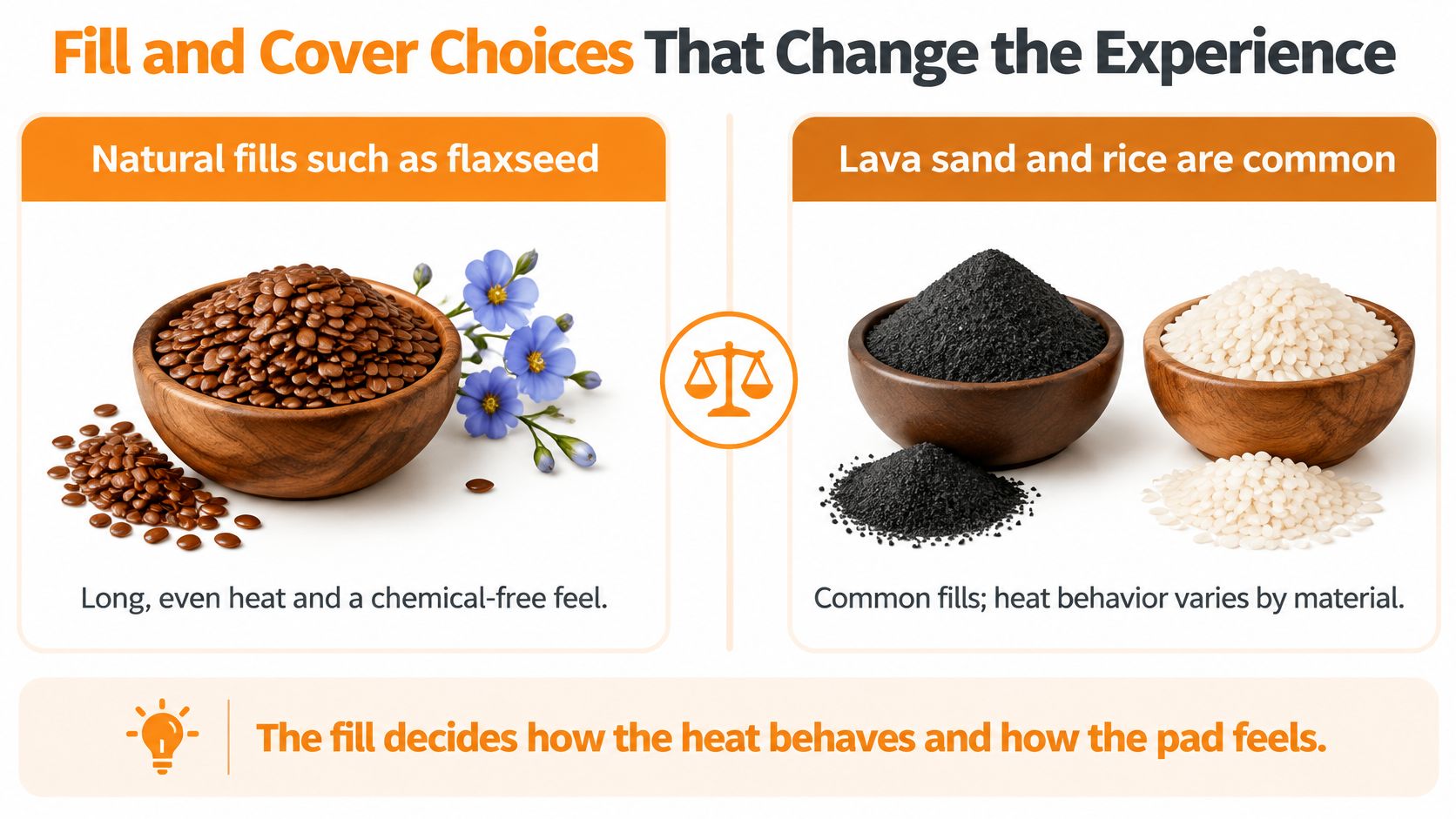
| Fill | Heat behavior | Scent carry | Watch for |
|---|---|---|---|
| Flaxseed | Long, even heat hold; natural | Not documented; use a sealed sachet | Overheating or uneven hydration can cause hot spots |
| Lava sand | Dense, steady heat; heavier | Not documented | Weight may be tiring for neck use |
| Rice | Heats quickly; dries out with use | Not documented | Scorching and clumping over time |
Flaxseed is the fill to prefer when you want steady warmth you can shape around a shoulder. Lava sand holds heat in a denser, heavier pack. That can feel grounding on a large muscle and tiring around the neck. Rice warms fast and shows up in many homemade packs, then dries, clumps, and scorches if it stays too long in the microwave. None of these fills is documented as a scent carrier, so the lavender should live in its own sachet.
Cover, size, and where the scent lives
- Soft fleece: Feels warmer and plusher, and it holds the sensation against the skin.
- Cotton: Breathes more, so the same fill can feel less trapped.
- A thicker cover: Slows the heat that reaches the skin. That can be kinder on sensitive skin and slower to ease a tight muscle.
Match the shape to the sore spot. A long, narrow neck wrap with elastic bands suits a desk worker's neck and shoulders. A larger body pad suits lower-back soreness. A small eye pad suits a mild warm compress, never pressed hard on the eyes.
If you want scent without handling loose oil, choose a pad with a sealed lavender sachet. Skip any pad that tells you to spray fragrance on the fabric.
Confirm fill type, cover fabric, whether the cover is removable and washable, and a size that matches the sore area. Wash the cover if the label allows it. Don't wash the filling unless the label says that's safe.
How to Warm and Use the Pad Safely
The goal is controlled warmth, not the hottest pad you can make. The hottest contact point can sit well above the average temperature, so "the middle feels fine" isn't a full check.
An international multidisciplinary consensus identified approximately 40 °C as the preferred surface-temperature target for balancing efficacy and safety in musculoskeletal heat therapy. Physiotherapy guidance places tissue-damaging thermal pain above roughly 45 °C. Aim for a stable contact near that milder level, for about 15 to 30 minutes, with a fabric barrier when you need one. People with diabetes, reduced sensation, fragile skin, or impaired circulation need extra caution, because they may not notice excess heat in time.
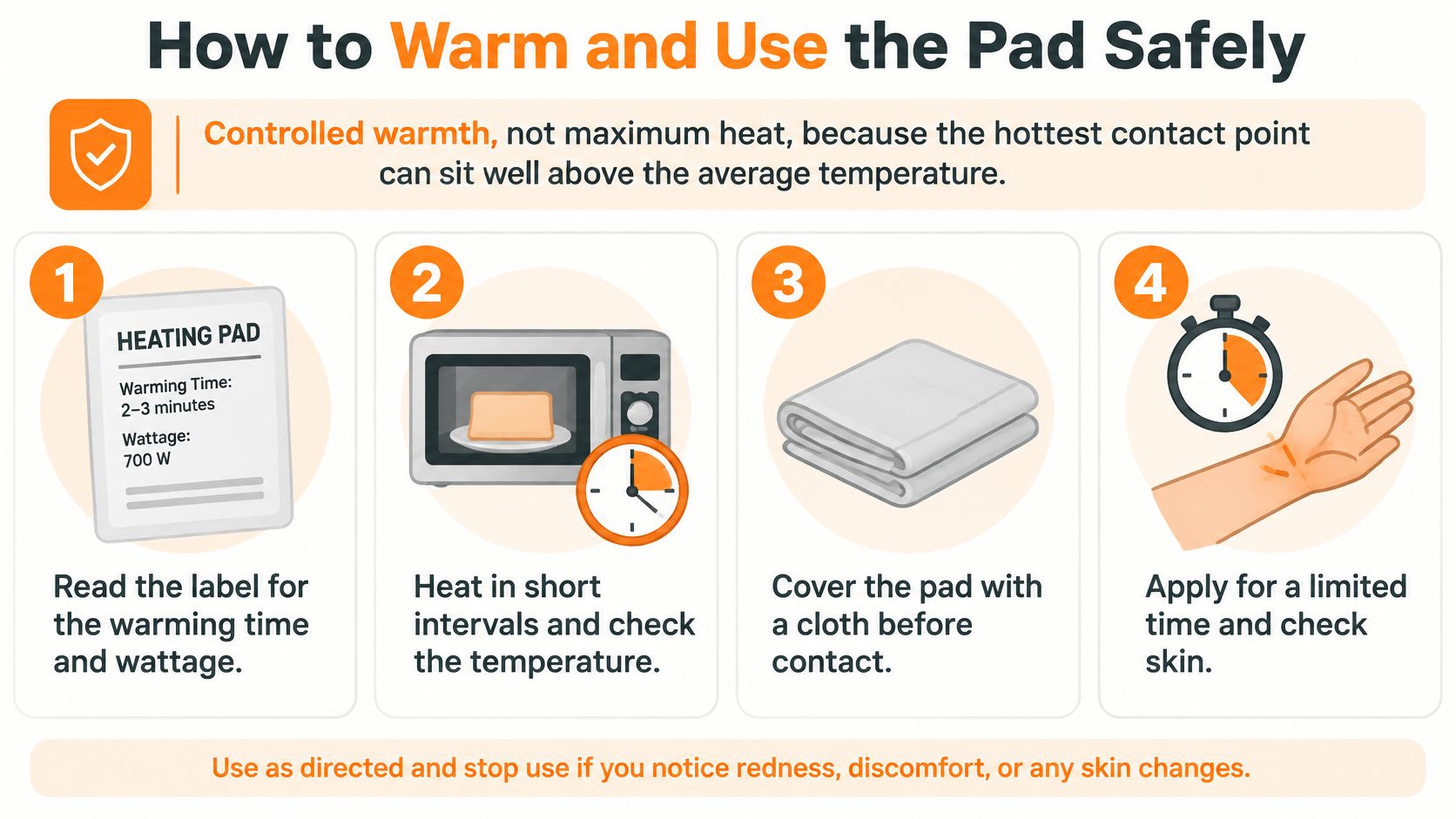
The warm-up sequence
- Read the label first. Find the microwave time and the maximum session length before the first use. Without those numbers, you're guessing, and guessing is how fills scorch.
- Heat in short increments. Start at the low end of the printed time. A second short burst beats one long blast. Natural fills such as flaxseed get less predictable when they're overheated or unevenly dry.
- Let it stand. Give the pad a minute or two so heat can move out of hot clumps. Standing time is what keeps one seed pocket from becoming a hot spot.
- Test the inside of your wrist. It should feel warm, not hot. If you pull your wrist away, it isn't ready for a shoulder or a back.
- Add cloth and watch the clock. Keep fabric between the pad and your skin, and stay inside the session window. More on those limits is in this note on whether microwave heating is safe.
- Inspect after every use. Look for moisture loss, scorch marks, and clumps. A lumpy fill won't heat evenly next time.
- Cool it fully before any reheat. Never reheat a pad that smells burnt. That smell means the fill is already damaged.
A correctly warmed pad feels evenly warm across the middle. There's no single sharp hot point, and there's no burning once it's on covered skin. Redness or pain means take it off.
When Heat Is the Wrong Choice and What to Do
Heat fits chronic or non-specific aches, and later rehabilitation once swelling has gone down. It doesn't fit every new injury. A hot pad on a fresh sprain, because "warmth heals," is the habit that causes the most trouble.
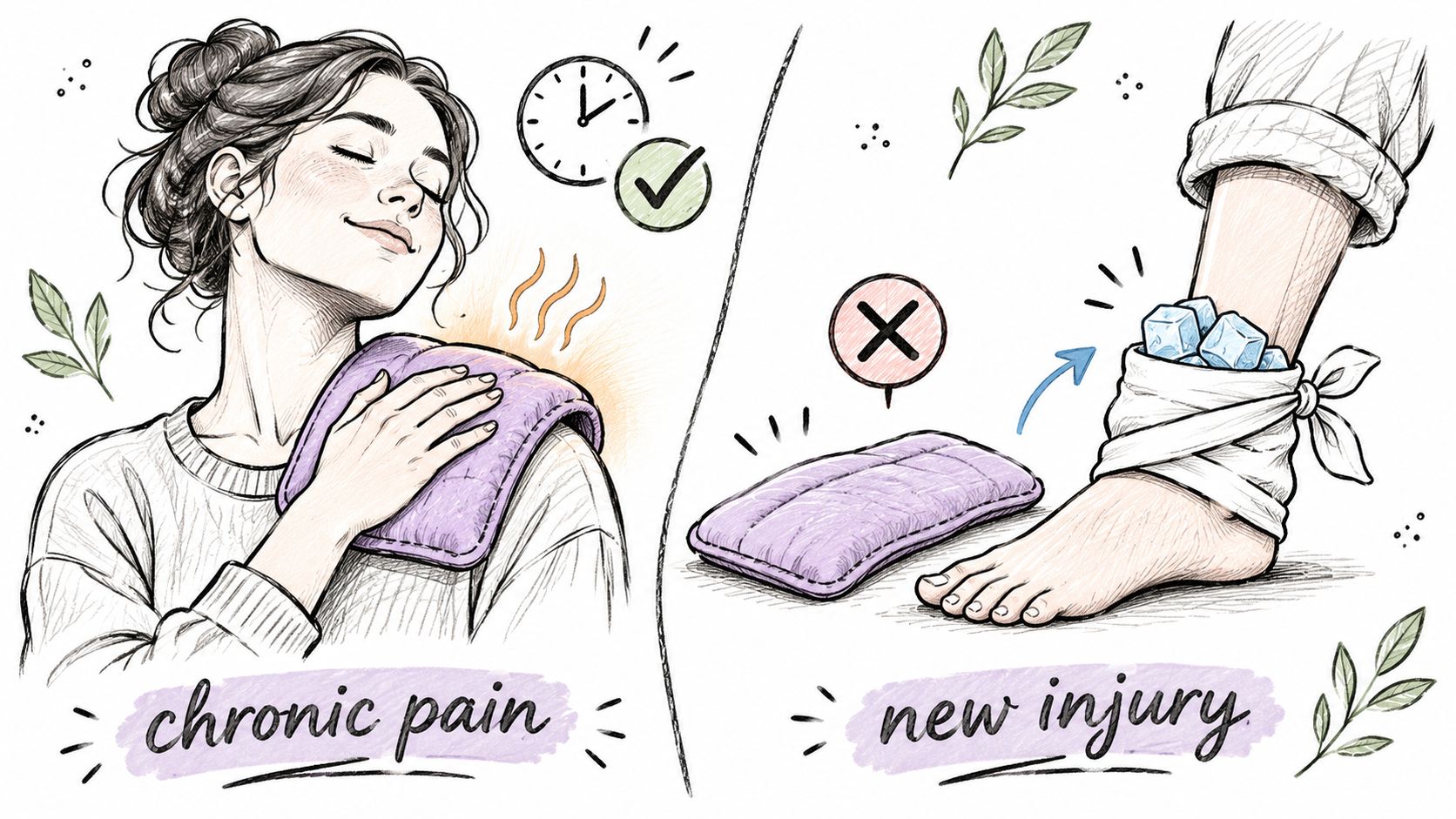
A clinical chronic-pain guideline supports self-applied, low-tech heat for some patients, and it notes possible adverse events including irritation, allergy, increased pain, and burns. Relief is often temporary. For some people, reaching for heat at every twinge can reinforce unhelpful pain habits. Musculoskeletal guidance points to heat for chronic or non-specific pain and for later-stage rehab, after swelling has subsided.
Where a hot pad doesn't belong
Skip the pad over numb skin, open wounds, acute swelling, or any spot where you can't reliably feel temperature. Diabetes and impaired circulation belong in that careful group, because a burn can start before it feels wrong. A lavender filling adds a second question: whether fragrance or plant contact is part of the irritation. A scented filling isn't the same exposure as oil rubbed on skin, and it still isn't neutral for everyone.
The split between a stiff back and a new ankle is spelled out in this comparison of heat therapy versus cold therapy.
| Symptom | Likely cause | Action |
|---|---|---|
| Pad too hot to hold | Overheated core or too long in the microwave | Let it stand, shorten the next heating time and add a cover |
| Redness or burn marks on skin | Direct contact, numb skin or too long a session | Stop, remove the pad, check the skin and see a clinician if it persists |
| Pain increases after heating | Heat used on acute injury or swelling | Stop heat and seek medical evaluation |
| Lumpy or scorched filling | Uneven hydration or repeated overheating | Retire the pad and stop using it |
If pain worsens, swelling appears, or symptoms last beyond a short spell, stop the heat and get a medical evaluation. More heating won't fix an injury that heat is aggravating.
A short clinic walk-through is worth watching before you pick heat or cold for today.
Pick a Lavender Pad You Can Use Safely
Choose a microwavable pad for the body area you want to warm, and treat lavender as a scent that may help create a relaxing ritual, not as a proven pain treatment.
Before buying, check three things:
- Time, session, and cover: Follow the pad's printed microwave instructions and use its cover as directed. SunnyBay says its portable heat pads can retain warmth for up to 30 minutes, though the experience may vary with your microwave and use.
- Fill and size: A neck wrap is shaped for the neck and shoulders, while a larger pad can cover more of the back. SunnyBay's Microwavable Extra Large Body Heating Pad for Back Soreness Relief measures 10" x 24" and is made in the USA. Check how lavender is included, and avoid adding loose oil to a pad.
- Printed stop rules: Look for clear instructions on heating and when to remove the pad. If they are missing, choose a product with directions you can follow.
For your first session, use the low end of the label's heating time, test the pad on your wrist, and keep the session short. Notice whether the scent bothers you; stop using the pad or scent if you develop burning, redness, worsening pain, coughing, or a headache. Seek medical advice if symptoms persist.
SunnyBay offers reusable microwavable heating pads, including a lavender-scented extra-large body pad. Choose a size and fill suited to the area you want to warm, and review the product details at SunnyBay before use.


