


Massage Recovery Tools That Support Real Recovery
-
You've been at a screen for hours, your neck feels like a tight rope, and the massage gun in a drawer promises instant relief. Or you've just finished a run and your calves are heavy and stiff. Those two moments look similar, both involve discomfort, but they don't call for the same tool, pressure, or expectations. Massage recovery tools work best when you match them to a clear job first.
Table of Contents
- Choosing Massage Recovery Tools With Clear Goals
- How Massage Recovery Tools Support the Body
- Comparing the Main Massage Tool Categories
- Matching Tools to Body Areas and Recovery Goals
- Using Recovery Tools After Work and Exercise
- Setting Realistic Pressure Duration and Frequency Goals
- Screening Body Areas and Avoiding Common Risks
Choosing Massage Recovery Tools With Clear Goals
Marta closes her laptop and rolls her shoulders. The tension sits high, near her neck, after a day of leaning toward a monitor. She doesn't need deep, pounding pressure. She needs targeted warmth, something hands-free, and a sensation that helps her unwind while she cooks dinner.
Across town, a recreational runner finishes intervals and feels his quads tighten as he cools down. His goal is different. He wants brief, comfortable input on large leg muscles before mobility work, not a long session meant to erase fatigue. A third person, an older adult with recurring shoulder tightness and a weak grip, needs a lightweight tool she can hold and position without strain.
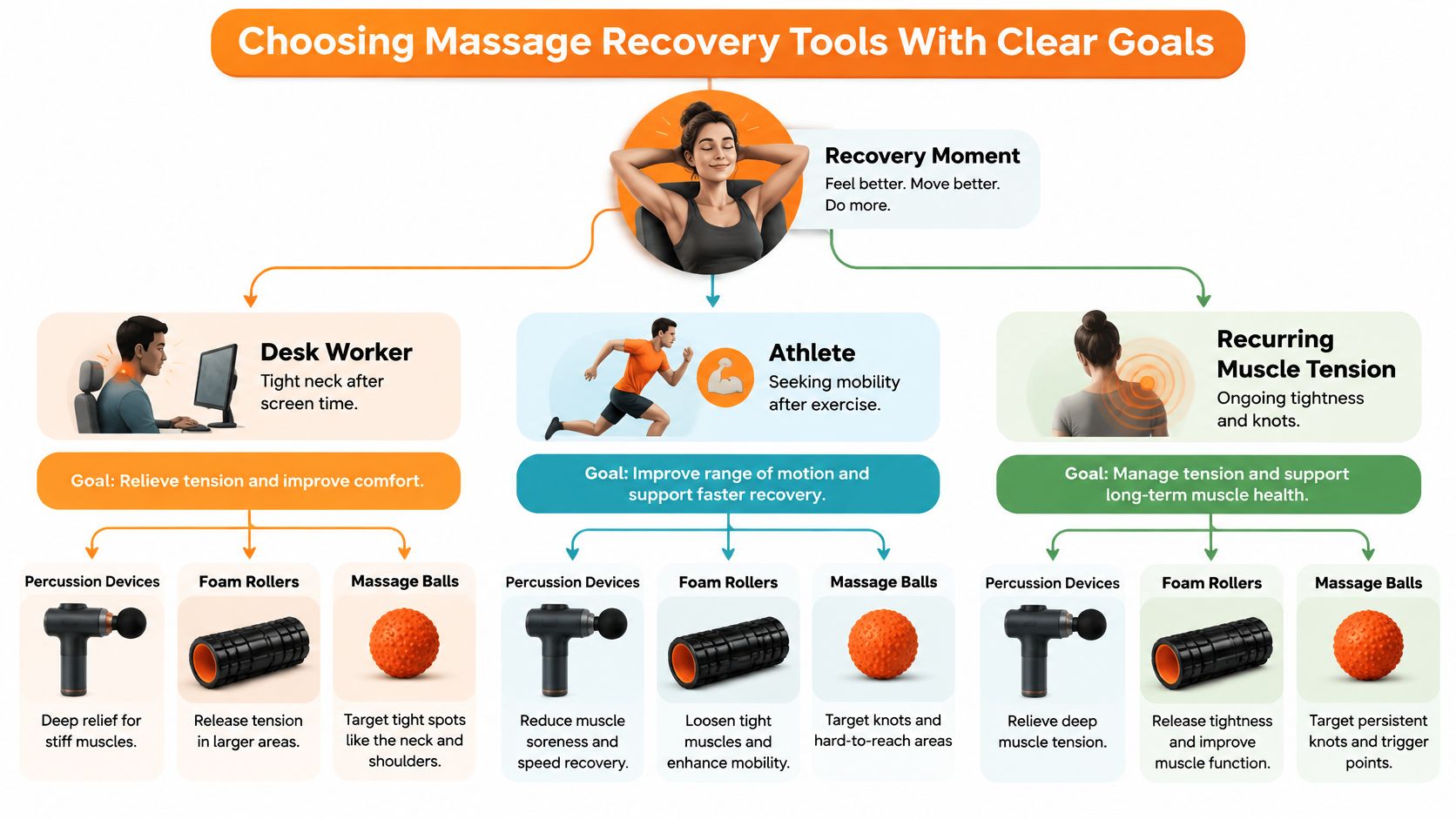
Start With the Moment, Not the Device
Massage recovery tools include percussive devices, rollers, balls, sticks, cushions, heat wraps, cold packs, and compression products. They support temporary muscle comfort and recovery routines. They don't replace training, rehabilitation, or medical care, and a stronger setting doesn't make a tool more appropriate for every body.
Use this order before you compare features:
- Name the goal: Do you want warmth, brief mobility support, slow pressure, or relaxation after activity?
- Pick the body area: Is it a broad muscle like the thigh, or a smaller, sensitive area like the neck?
- Check your constraints: Consider grip strength, sensation, medications, recent injury, and how much control you need.
- Compare tools last: Look at intensity, shape, portability, and ease of use only after the first three answers are clear.
Practical rule: If you can't state the goal and body area in one sentence, you're not ready to choose a setting or attachment.
That simple pause prevents the most common mistake, treating every tight spot as a reason for maximum pressure.
How Massage Recovery Tools Support the Body
Think of recovery like traffic on a highway. A tool can change how the road feels for a while, help you notice where traffic is bunched up, and make the next stretch more comfortable. It doesn't rebuild the road by itself. That distinction keeps expectations honest.
Percussive tools deliver repeated mechanical taps. Rollers and balls provide slower pressure you control with body weight or hand force. Heat products add warmth to a targeted area, while compression tools squeeze a broader region. Each input creates sensation, and sensation can influence how stiff or guarded a muscle feels during movement.
Four Outcomes People Often Blur Together
- Temporary range of motion: You may reach or squat a little more easily right after use.
- Perceived relaxation: The area feels looser or calmer, even if fatigue remains.
- Biochemical markers: Blood measures linked to muscle stress can shift without you feeling a dramatic change.
- Treatment of a condition: Diagnosing or fixing an injury, joint problem, or disease is outside what a home tool can promise.
A 2023 systematic literature review of percussive therapy from massage guns found that a single application was associated with acute improvements in muscle strength, explosive strength, and flexibility, while repeated treatments were associated with reduced musculoskeletal pain. A separate review in that same source screened 281 records and included only 11 studies, reporting flexibility gains on the Thomas test, the 90–90 hamstring test, and the ankle-lunge test at p ≤ 0.001, but no consistent improvements in strength, balance, acceleration, agility, or explosive activities.
Broader massage research points in a similar, measured direction. A systematic review and meta-analysis of massage covering 47 studies and 3,284 participants found reduced pain versus control conditions, with a standardized mean difference of −0.87 and p < 0.001, plus improved range of motion at 0.64 and p < 0.001. It also reported lower serum creatine kinase at −0.64 and p = 0.001.
Those numbers support massage as a recovery aid, not a guarantee. If you're sorting ordinary post-exercise discomfort from other causes, a guide to understanding muscle soreness and relief options can help you frame the problem before you reach for a device. Clinicians in other recovery settings face the same need for structured decisions, which is why resources such as a clinician guide to HBOT workflows emphasize screening and sequencing rather than equipment alone.
Comparing the Main Massage Tool Categories
No category wins across every desk, gym bag, and living room. A roller gives you slow feedback through your own body weight. A percussive device does the repetitive work for you, but it also makes it easier to apply too much input to a small area. A heat wrap asks almost nothing from your hands, which matters when your shoulders are the problem.
For a focused side by side look at two popular options, a recovery gear comparison guide can help you weigh percussion against rolling before you buy. Use the table below to place that choice within the broader context.
Massage Recovery Tool Categories at a Glance
| Tool category | Primary mechanism | User control | Portability | Best-fit role |
|---|---|---|---|---|
| Percussive device | Repeated rapid taps | Speed, head, hand pressure | Moderate to high | Brief input on larger, healthy muscles |
| Foam roller | Body-weight pressure while rolling | Position and weight shift | Moderate, bulky shape | Broad passes on legs and upper back |
| Massage ball or peanut | Focused static or rolling pressure | Precise placement | High | Small spots in hips, feet, or upper back |
| Massage stick or cushion | Hand-guided rolling or kneading | Direct hand force or settings | High to moderate | Calves, thighs, seated back comfort |
| Heat wrap or pad | Sustained warmth | Temperature and placement | Moderate, power or microwave dependent | Hands-free neck, shoulder, or back comfort |
| Compression product | Broad squeeze | Fit, straps, or pressure setting | Varies | Even pressure around limbs after activity |
| Hands-on massage | Human touch and adaptation | Feedback during session | Requires another person | Assessment, varied pressure, hard to reach areas |
Control is the trade off people underestimate. With a ball against a wall, you can ease off in a second. With a powered device, you choose a speed before contact, then manage angle and pressure while it keeps moving. Neither is automatically better, but the powered option demands more attention on sensitive tissue.
Portability also changes behavior. A ball lives in a coat pocket and gets used. A large roller stays home but covers the thigh in fewer passes. A contoured heat wrap suits a chair based routine, while air-activated heat patches suit travel or outdoor work where you can't use a microwave.
Hands-on care deserves its own row for a reason. A therapist can notice guarding, ask about symptoms, and change technique mid session. A device can't interview you. If localized tender spots are your main concern, learning how trigger point therapy is described and applied can help you decide whether a small ball, a stick, or a person fits better.
A tool that matches your routine and gets used gently will serve you better than a powerful device you avoid or misuse.
Matching Tools to Body Areas and Recovery Goals
Start with a map, not a shopping list. Broad, thick muscles tolerate broader contact. The front of the thigh, glutes, and calves usually suit a large roller pass, a massage stick, or a wide percussive head used lightly. You have room to move and adjust.
Smaller or more complex areas need a different approach. The neck, shoulder joint, and spots near bone call for lower intensity, closer control, and often a non percussive option. A contoured wrap that sits on the shoulders can provide warmth without asking you to aim a moving head at a sensitive area.
The visual below shows how body area and intended result narrow the choice before brand or speed enters the discussion.
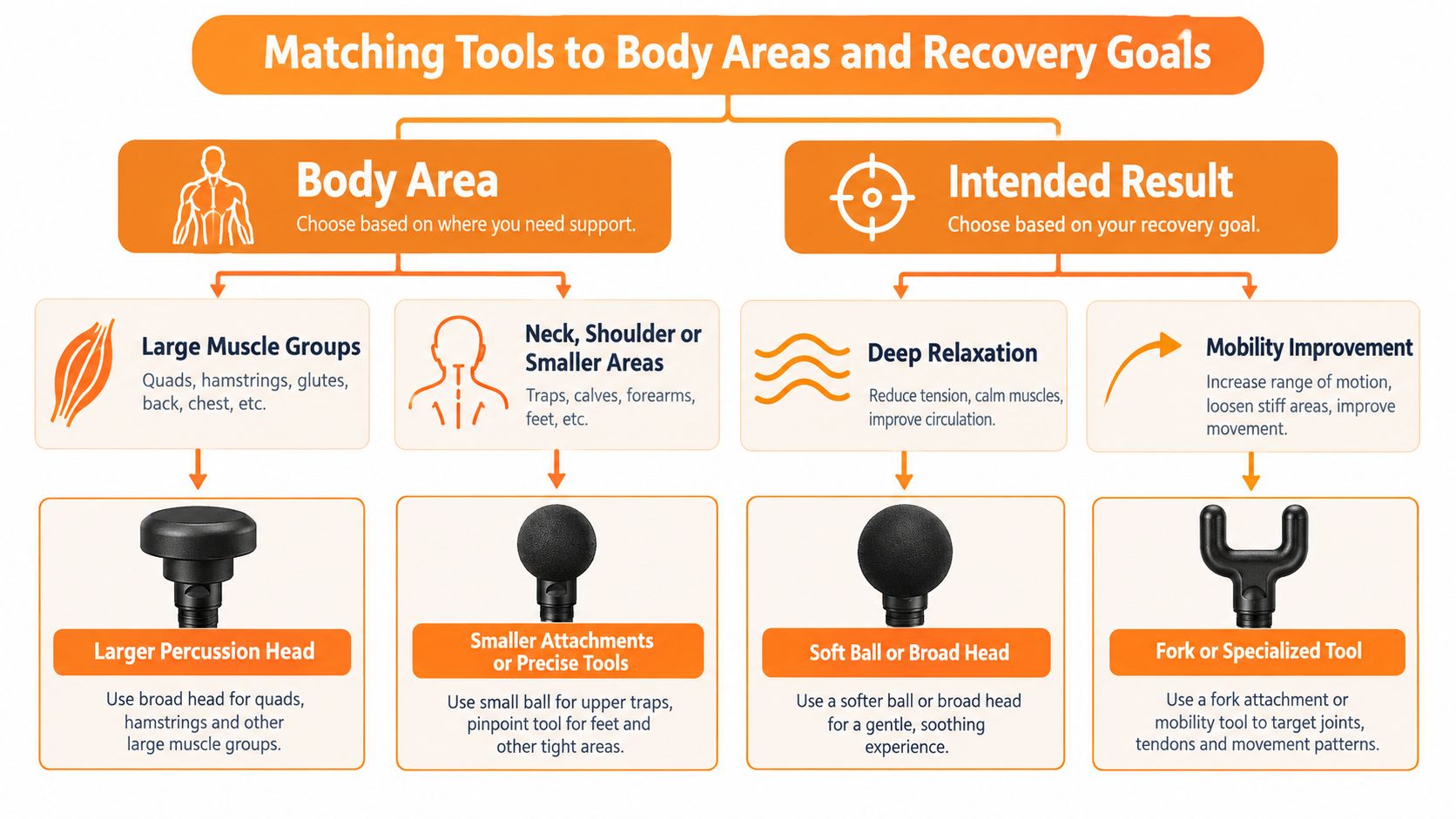
A Four Step Selection Method
- Locate the area: Broad muscle, small muscle, joint-adjacent area, or a spot you can't reach well.
- State the sensation you want: Warmth, slow pressure, rhythmic tapping, broad squeeze, or cold.
- Add your setting: Desk chair, gym floor, travel bag, clinic table, or bed.
- Filter by your body: Grip strength, balance on the floor, skin sensitivity, sensation changes, and health history.
A screen worker who wants warmth at a desk may choose a shoulder-shaped wrap and keep working. A lifter preparing for mobility drills may choose brief, low-pressure percussion on the quads, then move. A traveler may pack a massage ball because it works against a hotel wall and needs no charging. An older adult who can't get down to a roller safely may do better with a seated cushion, a stick, or a wrap.
Fit explains why shape matters as much as mechanism. SunnyBay, for example, sells contoured neck and shoulder wraps, larger body pads, and reusable hot and cold accessories designed to stay on a specific area hands-free. That category illustrates a useful principle, even if you choose another brand. When a product matches the curve of the body, you need less hand force to keep it in place.
Watching a tool being positioned can clarify size and reach in a way a product photo can't, especially for the upper back and shoulders.
Before you buy, mimic the motion without the tool. Can you reach the spot, hold the position, and stop quickly? If not, change the category, not just the model.
Using Recovery Tools After Work and Exercise
After a tempo run, Jon sits on a mat and uses a percussive device lightly on his quads. He keeps it moving, checks how his knees bend, then does his mobility work. He isn't trying to erase the workout. He's using brief input as a bridge into movement, which is a realistic role for massage recovery tools.
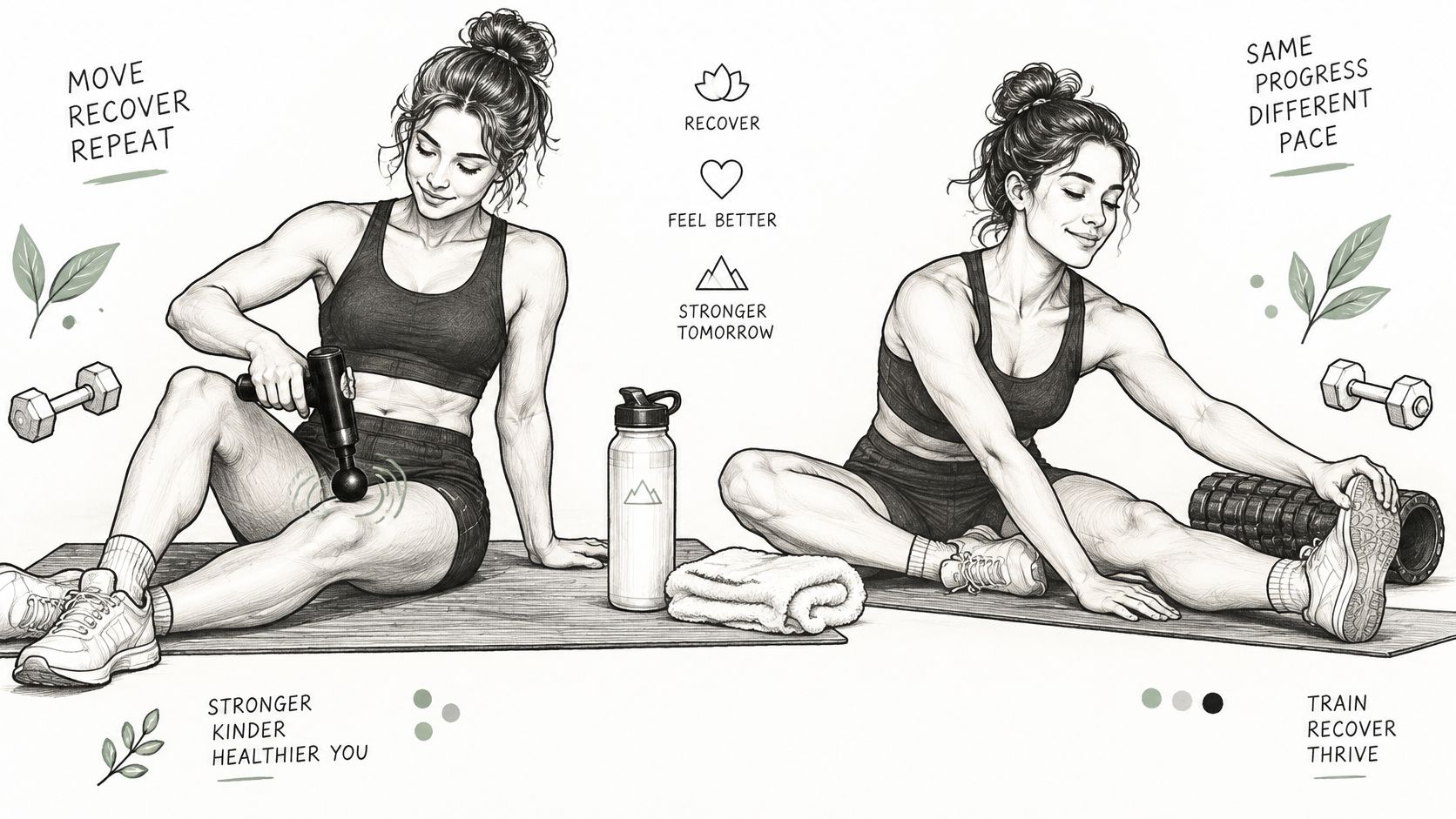
At home that evening, his partner has a different problem. Her upper back feels tight from a laptop on a kitchen table. She places a ball between her shoulder blade area and a wall, leans in slowly, and breathes while she controls the pressure. The wall setup gives her an easy exit, she just steps away.
Match the Routine to the Setting
- After exercise: Use comfortable, brief input on large worked muscles, then walk, stretch gently, or do mobility drills.
- After screen work: Choose warmth or gentle pressure for the neck and shoulders while seated, and change posture or take a walk.
- In a clinic or spa: A therapist may use a handheld tool to support manual work, but assessment and hands-on feedback still guide the session.
- At home for someone else: Ask where it feels helpful, start lighter than you think, and stop if they tense up or report sharp pain.
Runners who prefer a roller can build from structured foam rolling routines to prevent injuries, adapting pressure and positions to their own comfort and balance. The routine matters more than copying every move exactly. Slow passes, steady breathing, and a clear stop point beat rushed digging.
Heat fits a separate niche. Microwavable wraps and pads can rest on the neck, shoulders, or back while you sit, read, or do light tasks, and reusable designs may also be chilled for cold use when the manufacturer allows it. In a full recovery plan, that hands-free comfort sits alongside sleep, food, fluids, and gradual training loads. A broader checklist of post-workout recovery habits for fitness enthusiasts can help you place any single tool in that wider system.
Notice what each scenario shares. The tool supports the next sensible action, movement, rest, or a posture break. It isn't the whole plan.
Setting Realistic Pressure Duration and Frequency Goals
More pressure doesn't mean more recovery. It's like turning up a shower. Warm water can feel soothing, but hotter and longer eventually becomes the problem. Your tissue gives feedback the same way, through comfort, guarding, bruising, or next-day tenderness.
Separate two common sessions. A pre-mobility session is brief and light, aimed at making the next movement feel easier. A comfort session after activity is slower and relaxation focused. Mixing them up leads people to use heavy pressure before training or to expect a short session to resolve lingering pain.
Why There's No Universal Setting
A recent systematic review and meta-analysis of percussive therapy dose and recovery outcomes reported possible benefits for explosive-performance recovery and early creatine-kinase reduction, but no clear benefit for maximum-strength recovery or delayed-onset muscle-soreness relief. In that same review, treatment longer than five minutes per muscle group may favor countermovement-jump recovery, while shorter 2.5 to 5 minute sessions at higher frequencies may affect creatine kinase.
Those are preliminary, endpoint-specific findings, not a prescription for your shoulder on a Tuesday. Duration that relates to one lab measure may do nothing for soreness. That's why promising that percussion reliably eliminates soreness goes beyond the evidence.
Start conservatively:
- Begin at the lowest comfortable setting: You should be able to breathe and relax into it.
- Keep the first pass brief: Reassess movement and comfort before adding time.
- Increase only one variable: Change duration or pressure, not both at once.
- Stop on worsening symptoms: Sharp pain, numbness, dizziness, or increasing swelling ends the session.
Comfort during the session and how you feel later that day tell you more than the number on a speed dial.
Sleep, passive rest, graded movement, hydration, and rehabilitation when needed can matter more than device intensity or price. Treat the tool as an adjunct you can adjust, not a test of toughness.
Screening Body Areas and Avoiding Common Risks
Safety screening isn't fine print. It's the first decision, especially for older adults and people with chronic pain who may have several risk factors at once. The same device that's reasonable on a healthy thigh may be inappropriate over bone, an acute injury, numb skin, or unexplained pain.
Use a simple check before use. Ask what changed, where exactly it hurts, whether sensation is normal, and whether there's bruising, swelling, infection, recent surgery, or a new medication. If you can't answer confidently, choose rest, gentle positioning, or professional assessment.
The triage visual below turns that pause into a repeatable decision process.
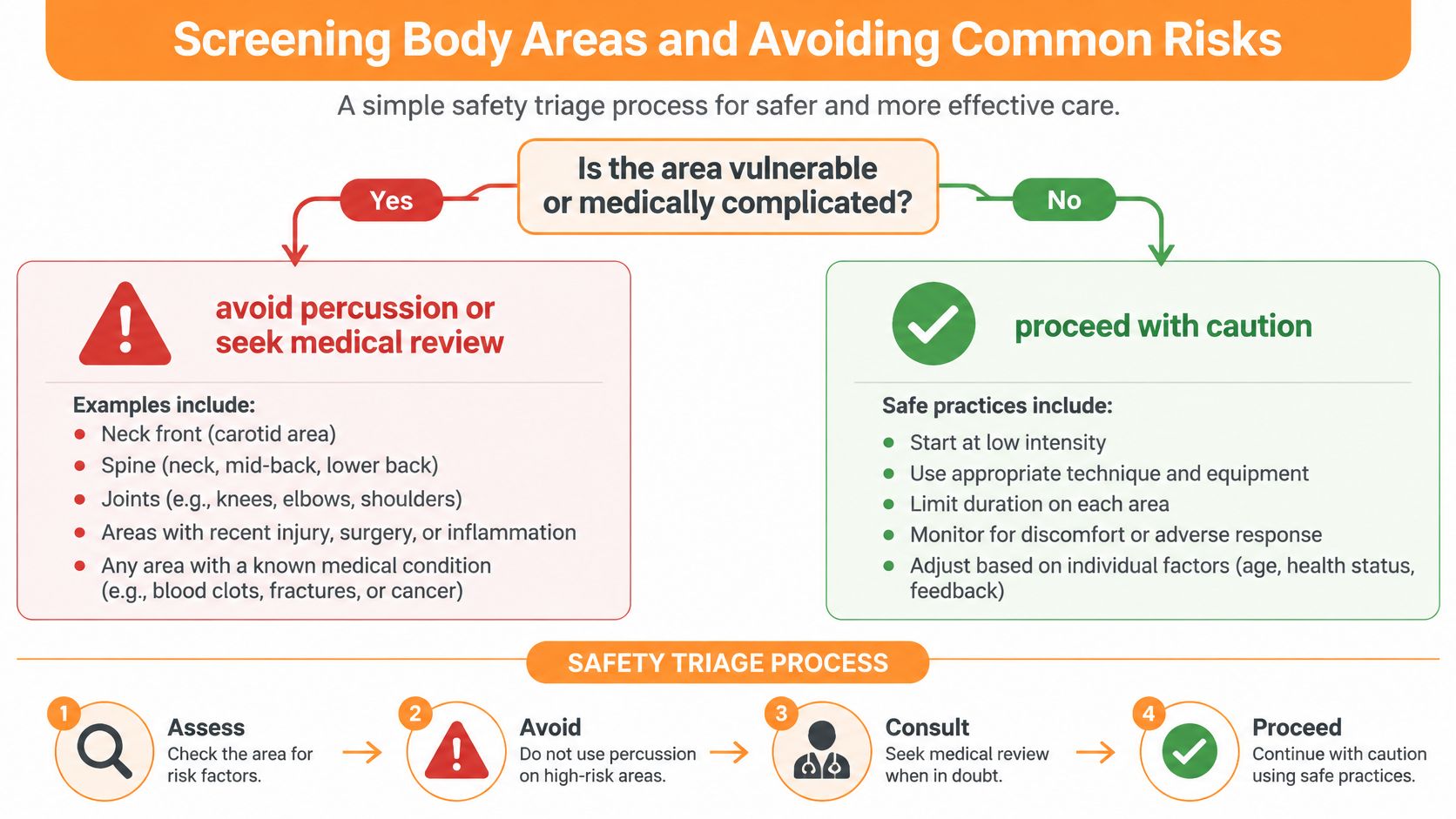
Situations That Need Avoidance or Medical Review
Clinical education on percussion lists severe osteoporosis, metastatic bone cancer, rib fractures, recent thoracic fusion, pneumothorax, and bleeding risk as reasons to avoid percussion or seek medical review, as set out in a clinical manual on percussion contraindications and precautions. Apply extra caution with recent surgery, bruising, infection, anticoagulant use, numbness, and possible vascular or cardiopulmonary problems.
- Bone and recent procedures: Avoid direct percussion over fractures, fused areas, surgical sites, and prominent bone unless a clinician advises otherwise.
- Bleeding and skin concerns: Don't use pressure or heat over broken skin, active infection, unexplained bruising, or areas where you can't feel temperature or pain normally.
- Neck and chest caution: Avoid the front of the neck and be conservative around the ribs and chest, where sensitive structures sit close to the surface.
- Medication and sensation: Anticoagulant use, numbness, or reduced sensation raises the risk that you'll apply too much without noticing.
Ordinary post-exercise soreness usually follows a known workout, affects worked muscles, and eases as you move gently. Unexplained chest pain, significant swelling, unusual weakness, breathlessness, or symptoms that raise concern for pulmonary embolism are different. Don't massage through them or use heat to mask them. Seek medical care.
Safeguards for Every Session
Read the manufacturer's instructions for temperature, session limits, cleaning, and charging. Check skin before and after, especially with heat or cold. Keep pressure off joints, the spine itself, and areas that feel sharp, electric, or numb. If a tool is questionable, gentle heat when appropriate, comfortable positioning, rest, or a professional assessment may be the better choice.
When in doubt, downgrade the intervention. A smaller, gentler step you can monitor is safer than a strong session you talked yourself into.
If your main goal is hands-free warmth for neck, shoulder, or back tension after work or activity, explore the reusable microwavable wraps, body pads, and hot and cold accessories at SunnyBay and choose a shape that matches the area you want to cover. Start gently, follow the product instructions, and build the rest of your recovery routine around movement, rest, and sleep.


