


Ice Pack for Wrist Pain: Safe Use, Timing, and Packs
-
You're answering emails with a bag of frozen peas balanced against your wrist, hoping the ache will settle before your next task. It may help, but the fit, timing, and reason for the pain matter. A cold pack should feel comfortable, not painfully cold, and it shouldn't keep you from noticing changes in your skin.
Wrist pain isn't limited to athletes or people who've had a fall. A systematic review of 32 cross-sectional studies found median wrist-pain prevalence in the preceding week was 6% in the general population and 4.2% among non-manual workers; among people exposed to physically demanding work or sports, median short-term prevalence reached 10% (systematic review of wrist-pain prevalence). That range matters: a recent sprain, a swollen wrist after activity, and a stiff wrist that's been aching for weeks don't call for one universal icing rule.
A useful routine starts with the cause and the skin. Choose a pack that can sit comfortably against the wrist, use a cloth barrier, and check how your skin and symptoms respond. Below, you'll find a practical way to choose a pack, time cold therapy, compare ice with heat, and recognize when home care isn't enough.
Table of Contents
- Why Wrist Pain Is Worth Treating Carefully
- Choosing the Right Pack for Your Wrist
- How Long and How Often to Ice
- Ice or Heat and How to Tell
- Wrapping, Immobilization and Positioning
- Safety Who Should Be Cautious and Why
- When Home Icing Stops Being Enough
Why Wrist Pain Is Worth Treating Carefully
Someone nursing a sore wrist at a desk might reach for whatever's in the freezer. If the pain followed a small twist or a demanding day of hand use, a cold pack may offer temporary comfort. But the same approach isn't automatically right for a chronic ache, a wrist that feels numb, or pain after a hard fall.
That's why the details matter more than a blanket instruction to “ice it.” The wrist is a small area with bony contours, so a rigid pack can press unevenly or leave gaps. And pain can have different causes: a recent sprain, irritation after activity, ongoing tendon symptoms, or a nerve-related problem. Cold may ease symptoms for a while, but it doesn't diagnose or fix the underlying cause.
Wrist pain is common across everyday life, work, and sport. The review cited earlier found a median prevalence of 10% across populations in the preceding week and 19.1% in the preceding year, with substantial variation between studies (wrist-pain prevalence review). In other words, knowing how to use a cold pack safely is useful well beyond the sports field.
The practical aim is simple: match the pack to your wrist and the symptoms, keep the cold controlled, and stop if your skin reacts badly. A frozen bag of peas can be a quick stand-in, but a thin cloth barrier and a timer turn an improvised fix into a more careful routine. Persistent or severe symptoms need assessment, not repeated icing.
Choosing the Right Pack for Your Wrist
A good wrist cold pack should conform without squeezing. The wrist has curves and prominent bones, so a stiff rectangular pack may touch only part of the sore area. Flexible gel packs, sleeves, or small ice pieces wrapped in cloth can make closer contact. Whichever you choose, don't put it directly on bare skin.
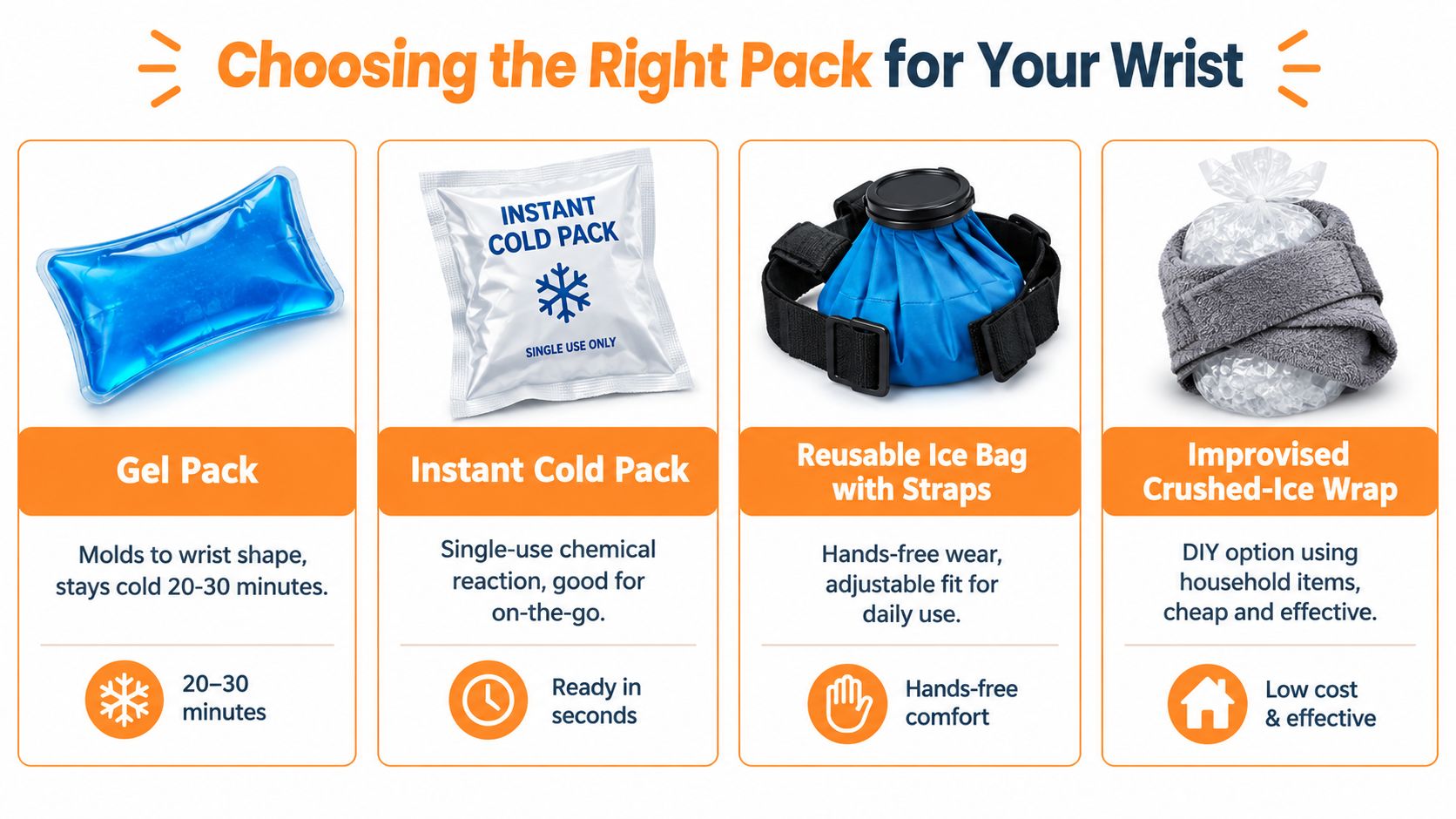
Compare fit, convenience, and reuse
- Gel pack: Reusable and easy to shape if it stays flexible when chilled. A soft cover can reduce condensation and make it more comfortable to hold against the wrist.
- Instant cold pack: Useful when you don't have freezer access, such as away from home. It's generally a single-use option, so check its instructions and use a cloth barrier.
- Reusable ice bag with a strap: An adjustable strap can keep the bag in place and free your hands. SunnyBay offers a reusable hot/cold ice bag with an adjustable strap, one option for hands-free application. Fit it loosely enough that the strap doesn't affect circulation.
- Crushed ice in a thin, damp towel: A low-cost household option. Small ice pieces can shape around the wrist, but check for concentrated cold spots and keep the towel between the ice and skin.
| Pack type | Best for | Wrist fit | Reusability | Notes |
|---|---|---|---|---|
| Gel pack | Repeated home use | Often flexible | Reusable | Look for a cover or use a cloth barrier |
| Instant cold pack | A quick option away from a freezer | Depends on pack shape | Usually single-use | Follow the product instructions |
| Reusable ice bag with straps | Hands-free application | Adjustable | Reusable | Keep the strap comfortably loose |
| Crushed-ice wrap | A simple household alternative | Conforms well | Reusable with fresh ice | Check for sharp or unusually cold spots |
Pick based on where you'll use it, not just what's available. At a desk, a small flexible pack may be easier to position than a bulky sleeve. If you need both hands free, a strap can help, while a gel pack may be easier to reuse at home. No pack type is automatically right for every wrist or every cause of pain.
How Long and How Often to Ice
For a minor recent sprain, start with a short, controlled application rather than leaving a pack on while you work. Place a thin, damp towel or cloth between the cold source and your skin, apply it for about 10–15 minutes, then remove it and let the skin return toward normal before considering another round. An NHS wrist-pain protocol suggests 10–15 minutes, 3–4 times daily (cold-therapy guidance for wrist pain).
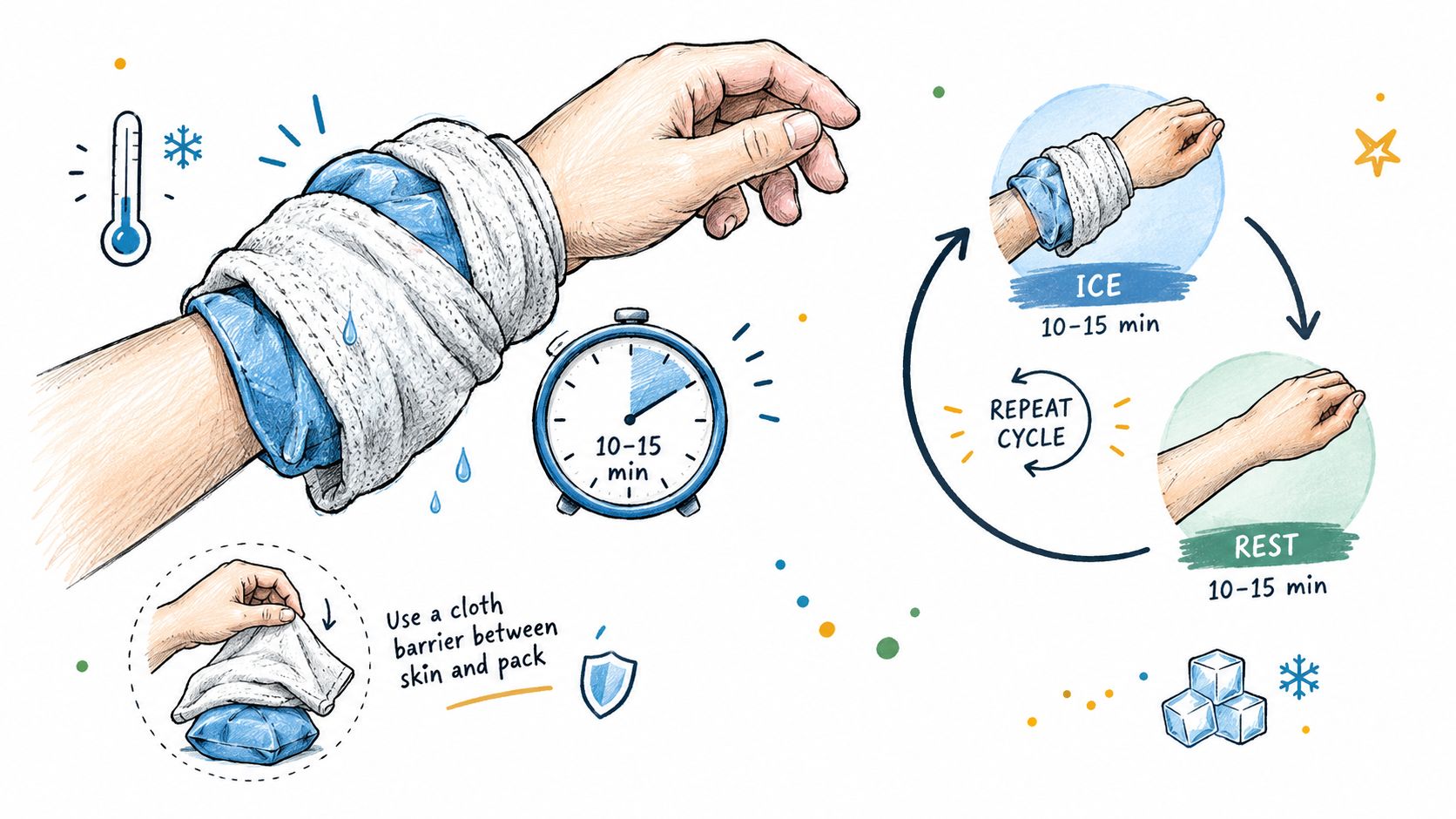
A repeatable routine
- Protect the wrist. Stop or modify the activity that aggravates it. If the wrist is swollen, rest it and raise it on a pillow.
- Add a barrier. Put a towel or cloth between your skin and the pack.
- Apply and check. Keep the pack in place for roughly 10 minutes, checking your skin and sensation regularly.
- Remove and reassess. Let the skin warm back toward normal. Repeat only if the first application felt comfortable and the skin looks intact.
Cold can numb pain, but longer isn't always better. The wrist's relatively superficial tissues can cool quickly, and prolonged cooling may temporarily reduce muscle power. Avoid icing just before gripping, lifting, driving, sport, or exercises that rely on wrist strength. If you need more detail about using an ice bag after an injury, see SunnyBay's guide to ice bags for injuries.
For a mild sprain, the American Academy of Orthopaedic Surgeons advises applying cold for 20 minutes at a time, several times daily, with a towel or cloth barrier (AAOS guidance for sprains). Guidance differs on exact timing, so use a cautious, skin-protected routine and follow any instructions from your clinician. A short application that eases discomfort is more useful than pushing through pain or numbness.
For a visual walkthrough of safe application, watch the demonstration below.
Ice or Heat and How to Tell
Start with a quick question: Is the wrist newly injured or swollen, or is it mainly stiff and achy? Cold is usually the more sensible choice for a recent injury, visible swelling, or an inflammatory flare-up. Heat may be more comfortable for ongoing stiffness or chronic tendon discomfort when there's no active swelling.
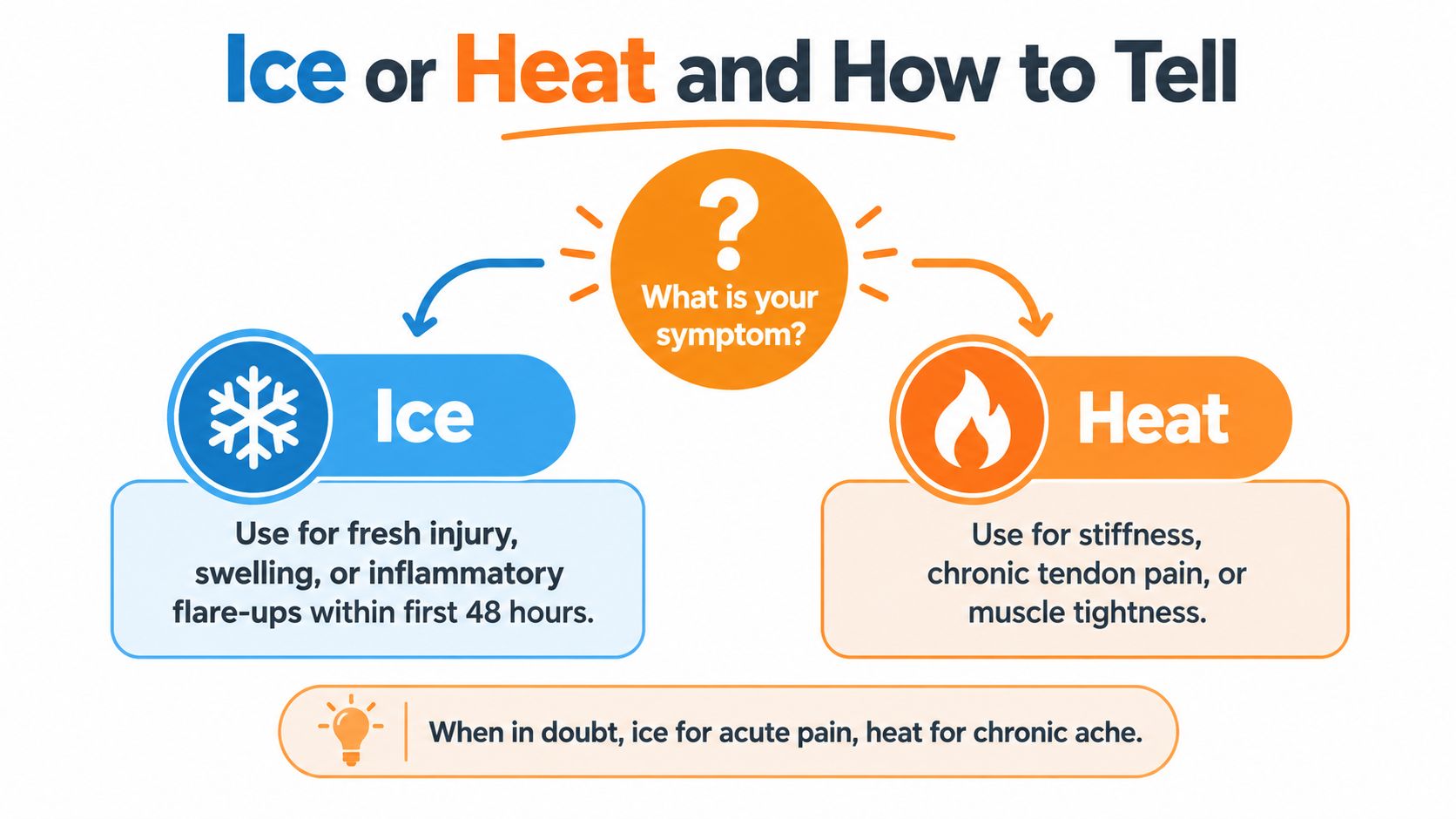
Match the choice to the symptoms
A gardener who feels new swelling after a long session of pruning might try protected cold therapy and rest. A desk worker with a dull, persistent tendon ache and no swelling may find gentle warmth more comfortable, while someone with arthritis and morning stiffness may prefer warmth to help the wrist feel easier to move. These are starting points, not diagnoses.
For an injury, NHS guidance recommends ice and advises avoiding heat during the first 2–3 days (NHS wrist-pain advice). Mayo Clinic distinguishes a sudden tendon injury from chronic tendinopathy, where heat may be more helpful (Mayo Clinic guidance on tendinopathy). If you're weighing the options more broadly, this overview of hot and cold therapy basics can help clarify how each approach is commonly used.
| What you notice | A reasonable starting point |
|---|---|
| Recent injury or new swelling | Protected cold, followed by rest and reassessment |
| Stiffness without swelling | Gentle warmth may feel more comfortable |
| Ongoing tendon pain | Consider warmth if there's no fresh injury or swelling |
| Unclear cause or worsening symptoms | Don't keep switching treatments; seek medical advice |
Some people consider alternating cold and warmth once the acute phase has passed, but it isn't necessary for everyone. Don't use a contrast routine to mask worsening pain or delay an assessment. For a broader comparison, see SunnyBay's guide to heat therapy versus cold therapy. The useful question isn't “Which temperature is always best?” It's “What do my symptoms look and feel like right now?”
Wrapping, Immobilization and Positioning
A wrap should hold the cold pack in place, not clamp the wrist. Put a thin cloth between skin and pack, then use a light elastic bandage or adjustable strap to secure it. If your fingers change color, feel increasingly numb or tingly, or become more painful, loosen or remove the wrap.
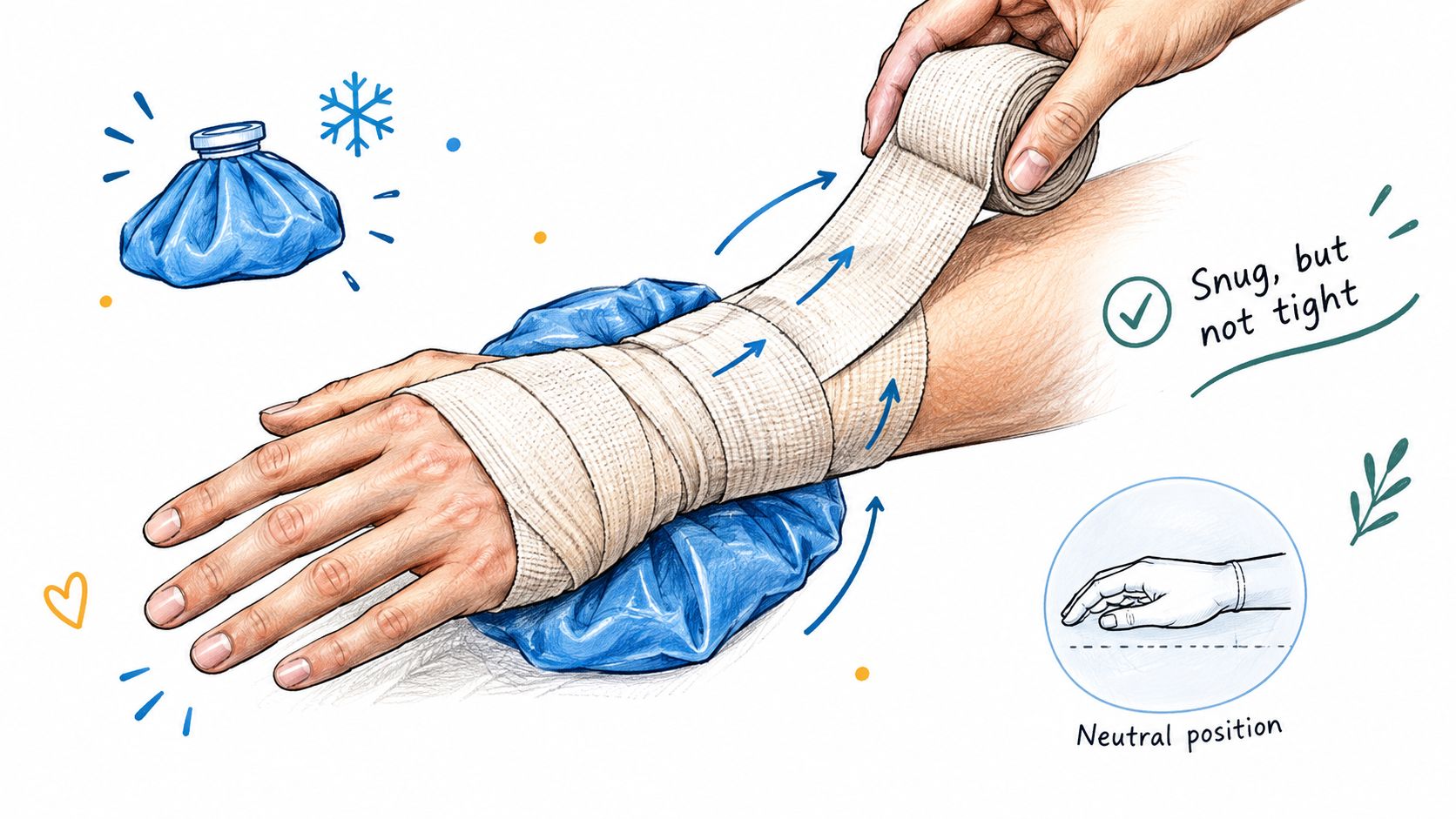
Place the pack over the area that hurts. Pain on the back of the wrist may call for positioning the pack dorsally; pain on the palm side may call for a palmar placement. Don't force the wrist into a bent position to make a pack fit. Rest it in a comfortable, neutral position and prop it on a pillow or chair arm if that eases throbbing.
At a desk, a small gel pack secured with a loose strap can stay put while you pause from typing. While watching TV, a hands-free wrap may be convenient. At rest, a pillow can support the forearm and wrist so you're not holding the limb up yourself.
A splint can complicate cooling. A bulky splint may prevent the pack from reaching the skin, while removing or shifting the splint may interfere with treatment after a fracture or surgery. Follow the clinician's instructions rather than trying to fit a pack under or around immobilization. If you need help comparing support options for activities that load the wrist, Bowling Gear Reviews' wrist support picks offer a separate look at supports, not a substitute for advice about an injury.
Safety Who Should Be Cautious and Why
Don't place ice directly on your skin, and don't apply it to an area that's numb or has reduced sensation. If you can't feel the cold properly, you may not notice early tissue irritation. Check your skin during the application, and remove the pack if you see whitening, blue or blotchy discoloration, blistering, or worsening pain.
Use extra caution if you have Raynaud disease, peripheral vascular disease, cold urticaria, sickle-cell disease, diabetic neuropathy, or another condition affecting circulation or sensation. Ask a clinician before using cold therapy if any of these apply. Reduced sensation can make it difficult to detect a cold injury early, so discomfort isn't a dependable safety signal for everyone.
After wrist surgery, follow the surgical team's directions rather than improvising with a freezer pack. A systematic review of non-knee joint surgery included 22 studies and 1,424 patients; results for wrist procedures were mixed (systematic review of cryotherapy after non-knee joint surgery00072-9/fulltext)). Controlled postoperative cryotherapy is a clinically managed treatment, not permission to use colder packs or longer sessions at home. A splint, bandage, wound, or altered sensation can also change what's safe.
Stop immediately if the skin turns white, becomes blotchy or unusually red, blisters, or grows more painful. Let the skin return toward normal and get medical advice if the changes persist or you're unsure what you're seeing.
When Home Icing Stops Being Enough
Home icing isn't the right response to every wrist problem. Seek medical advice if pain follows a fall, the wrist looks deformed or is markedly swollen, you can't move it, you have persistent numbness or tingling, or your grip has weakened. The AAOS advises medical evaluation if pain or swelling persists beyond 48 hours after a mild sprain (AAOS sprain guidance).
Quick answers: A reusable ice bag can be a practical alternative to a dedicated wrist sleeve if it fits comfortably and stays in place; neither design is proven to work the same for every person or condition. Don't expect a fixed number of minutes to solve the cause of the pain. Cold may provide temporary relief, but prolonged or poorly protected use can injure skin and shouldn't replace assessment or treatment. If typing seems to be aggravating your symptoms, use SunnyBay's advice for wrist pain from typing alongside a plan to reduce the strain.
Build a simple, skin-protected routine, watch for red flags, and trust a clinician when your symptoms don't follow the expected pattern.
For a hands-free option at home, SunnyBay offers reusable hot/cold accessories, including an ice bag with an adjustable strap. Visit SunnyBay to explore options for wrist icing and other comfort needs.


