


Ice Knee Pads: How to Pick, Use, and Stay Safe
-
You finish a run, climb out of bed with a stiff knee, or come home after surgery and reach for the cold pack because that's what people do. The question is whether the thing in your freezer helps, or whether you're just following a habit that sounds right. Ice knee pads can be useful, but only when you match the pad, the timing, and the safety checks to the situation.
Cold therapy sits inside a broader clinical category called cryotherapy, which includes ice massage, cold packs, and continuous-cooling devices. The practical takeaway is simple, use ice as a supportive tool, not a cure-all, and choose it when pain, swelling, or inflammation are part of the picture. If you're unsure whether cold or heat makes more sense for your knee today, a quick reference like this ice-versus-heat guide helps frame the decision.
Table of Contents
- Why Ice Knee Pads Matter and When to Reach for One
- How to Choose the Right Ice Knee Pad
- Applying Ice Knee Pads the Right Way
- Timing and Intensity for Common Situations
- Safety Rules Most Users Skip
- Combining Ice Knee Pads with Other Therapy
- Care, Cleaning, and Storage for Reusable Pads
Why Ice Knee Pads Matter and When to Reach for One
A sore knee often shows up at the worst possible time. You finish a workout, the joint feels hot and swollen, and the only thing you want is something that takes the edge off without making you think too hard. That's where ice knee pads earn their place, they're a simple way to apply localized cold around the knee without needing a clinic visit.
The older evidence matters because it shows why people still use cold for knee problems. A Cochrane review found three randomized trials in 179 people with knee osteoarthritis, and one trial reported a 29% relative improvement in quadriceps strength after repeated ice massage over three weeks, compared with a control treatment (Cochrane review). That doesn't mean every pad works the same way, and it doesn't turn ice into a standalone fix. It does give you a real benchmark for why cold around the knee is still taken seriously.
Practical rule: use cold when your knee needs calm, not when it needs warmth or movement. If the joint is visibly swollen, sore after surgery, or irritated after activity, cold is usually the more defensible first choice.
Where the logic comes from
Modern knee-surgery research supports the same basic idea. A 2023 review of total-knee-arthroplasty trials found that traditional cryotherapy remained recommended because more complex continuous systems were not cost-effective, and a larger 2024 meta-analysis found cryotherapy reduced postoperative pain compared with no cryotherapy (Frontiers review). A separate Cochrane review on knee replacement surgery also found that cryotherapy may slightly improve pain at 48 hours, while longer-term benefits stayed uncertain (Cochrane knee replacement review).
That's the right mental model for this product category. Ice knee pads are most useful as part of a recovery routine, especially when swelling and pain are driving the problem. They're not a promise that you'll heal faster on their own.
How to Choose the Right Ice Knee Pad
Choosing a knee pad sounds simple until you try to fit one to an actual knee. Knees bend, swell, shift shape, and need different kinds of coverage depending on whether you're walking, sitting, or recovering after a procedure. The right pad is the one that stays in place, covers the painful area, and applies cold without making circulation problems worse.
The features that actually matter
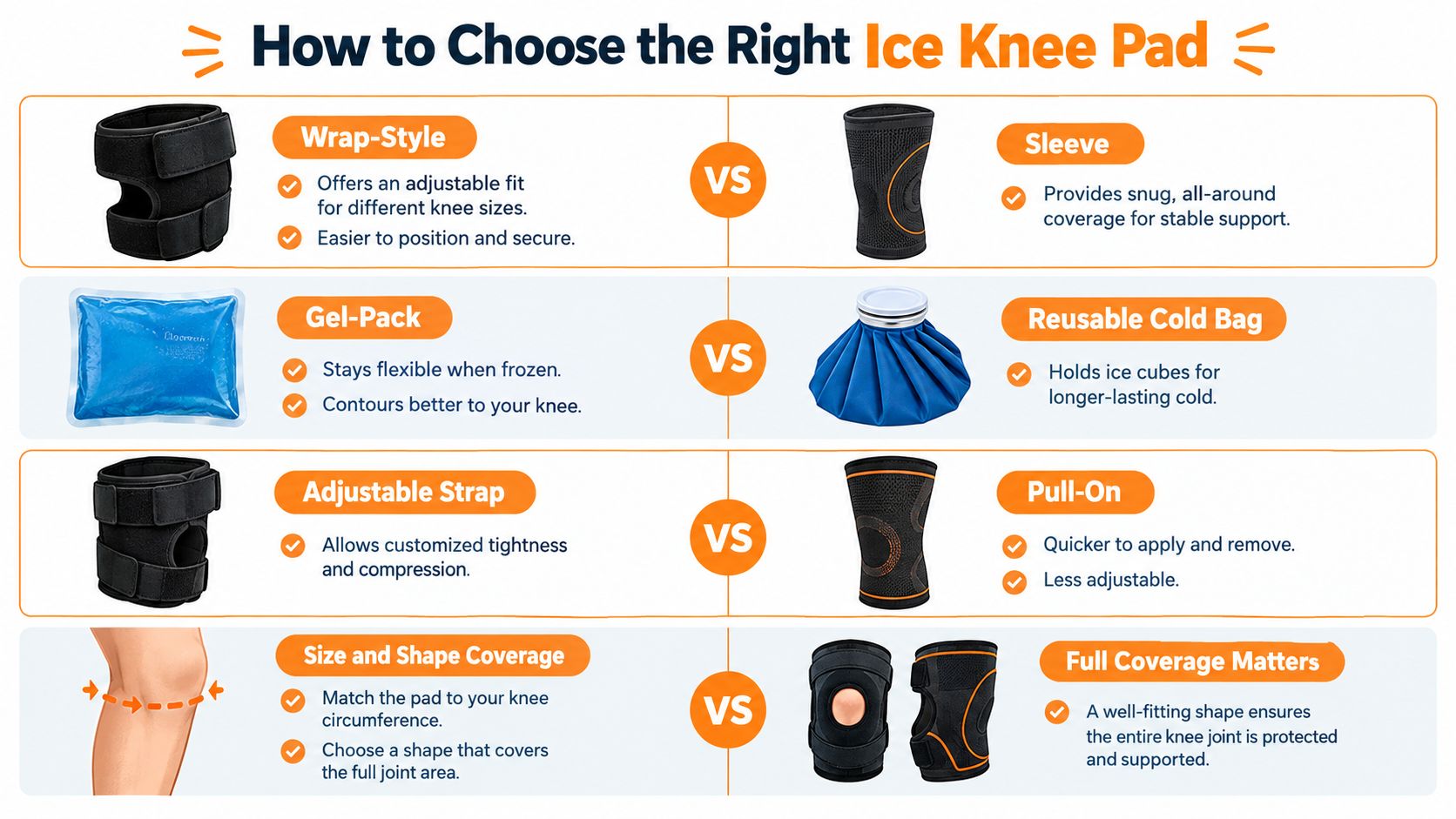
Fit comes first. Wrap-style pads usually give you a more adjustable fit, while sleeves can feel snug all around but are harder to fine-tune. If your knee swells during the day or your kneecap sits differently from one side to the other, adjustability matters more than a marketing claim about “universal comfort.”
Material matters too. Flexible gel packs tend to conform better when frozen, which helps the cold contact the joint more evenly. A reusable cold bag can be a smart alternative when you want a form that fills with ice and water, especially if you need broader coverage or already know you want strap-based support.
A good rule is to match the pad to your use case:
- Athletes: pick a pad that stays put during light movement and doesn't force you to stop everything the moment you sit down.
- Arthritis users: look for a soft wrap that feels comfortable while seated, since long wear time is less important than easy positioning.
- Post-surgical users: choose wrap-around coverage with gentle compression, because the knee may be swollen and tender in a way that rewards easy on, easy off use.
A pad that compresses too tightly can make the knee feel worse instead of better. Moderate pressure can help, but squeezing harder is not a shortcut to better results.
| Ice Knee Pad Styles Compared | Best for | Strength | Watch out for |
|---|---|---|---|
| Wrap style | Variable swelling, post-surgical use, easier repositioning | Adjustable fit and better placement | Can shift if straps are too loose |
| Sleeve | Seated use, light daily support | Snug all-around coverage | Less adjustable for changing swelling |
| Gel pack | Curved coverage and flexible contact | Conforms well when frozen | May lose flexibility in very cold freezers |
| Reusable cold bag | Broader cold coverage with ice and water | Easy to refill and strap on | Can feel bulky if overfilled |
The marketing you can ignore is anything that promises a one-size-fits-all solution. Knees don't behave like that, and the best pad is usually the one with the simplest combination of fit, shape, and controllable pressure. If you only filter on two features, make them coverage and adjustability.
Applying Ice Knee Pads the Right Way
Cold works best when it's placed well, kept on for the right amount of time, and given enough room for the skin to recover. The temptation is to think tighter and colder must be better, but that's exactly how people end up with numb skin, irritation, or a pad that's uncomfortable enough to abandon after two uses. The safer approach is controlled, not aggressive.
Positioning and skin protection
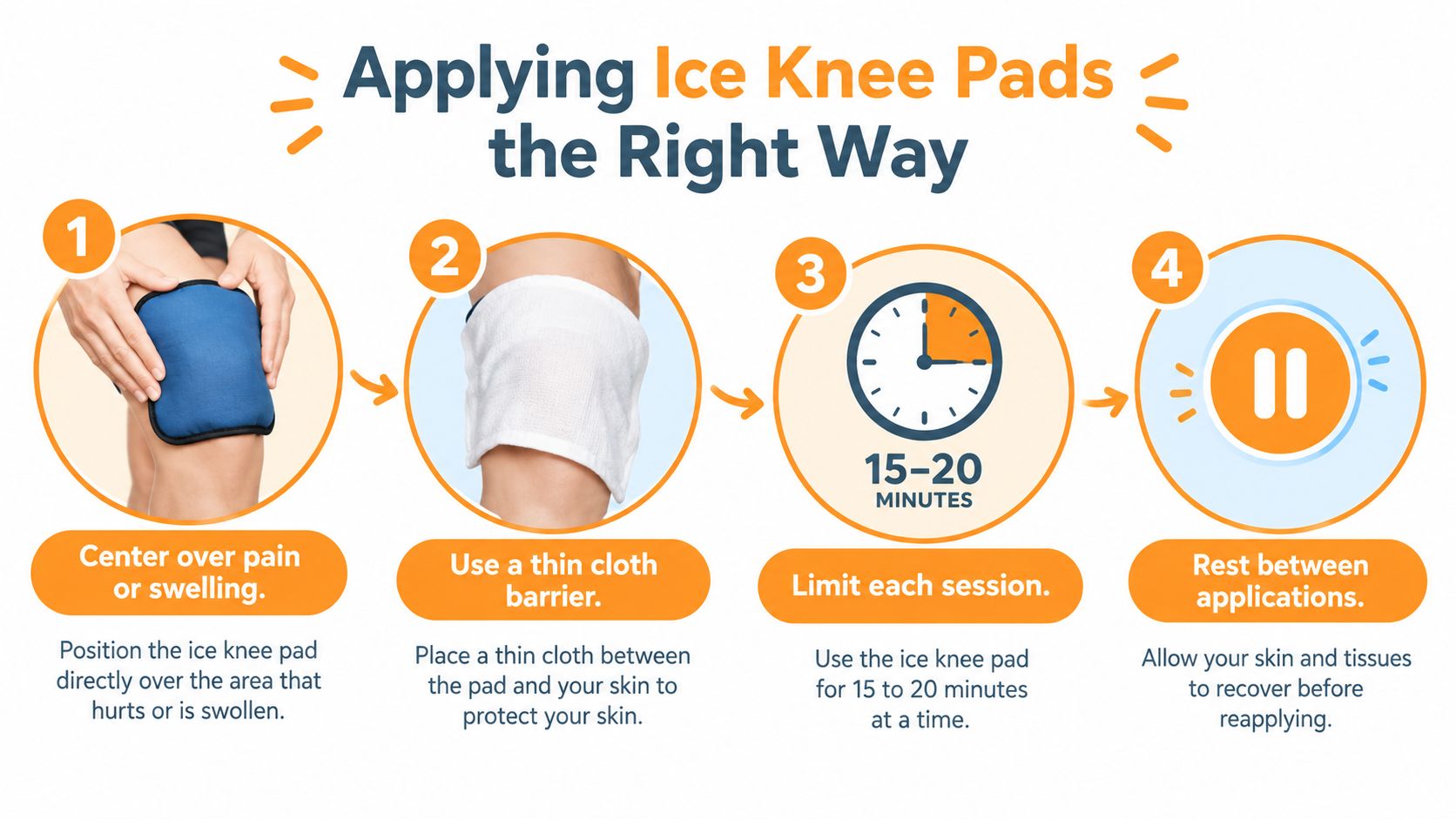
Start by centering the pad over the area that hurts or swells. If the pain sits along the kneecap, the side of the joint, or the back of the knee, the pad should follow that map instead of sitting randomly over the front of the leg. A thin cloth barrier between the cold source and the skin is the practical safeguard that prevents frostbite and makes the session tolerable.
A clinical review recommends 20-minute ice-pack applications at one-hour intervals for treatment benefit and tissue safety, while other rehabilitation guidance notes that intermittent icing, such as 10 minutes on followed by 10 minutes off, can control acute inflammation more effectively than one uninterrupted exposure (Cleveland Clinic Journal of Medicine review). For a reusable ice knee pad, the most defensible everyday protocol is still the same shape of advice, use it for about 15 to 20 minutes, then let the knee rewarm before repeating.
The simplest positions are often the best:
- Seated: place the leg supported, with the knee relaxed and the pad centered.
- Lying down: keep the knee comfortable and let the pad sit flat without tightening the straps excessively.
- Raised-leg recovery: raise the leg enough to help swelling move down while the cold does its job.
Practical checkpoint: stop the session if the skin looks mottled, the pain rises instead of settling, or the knee goes numb in a way that doesn't quickly clear after removal.
What the rewarming window is doing
The pause between sessions is not optional. Skin and soft tissue need time to return toward normal temperature, and that break is part of what keeps cold therapy safe. A good rule is to wait at least 40 minutes before repeating, especially if you're using the pad repeatedly in one day.
The first 48 to 72 hours after an acute injury is the most defensible window for this approach, because pain and swelling are the main targets then. If your goal is only analgesia, you usually don't need an intense freeze, you need enough cooling to calm the area without crossing into skin injury territory.
A short video can also help you visualize the fit and placement:
For a more general injury-cooling reference, this ice bag guide fits well with the same placement logic.
Timing and Intensity for Common Situations
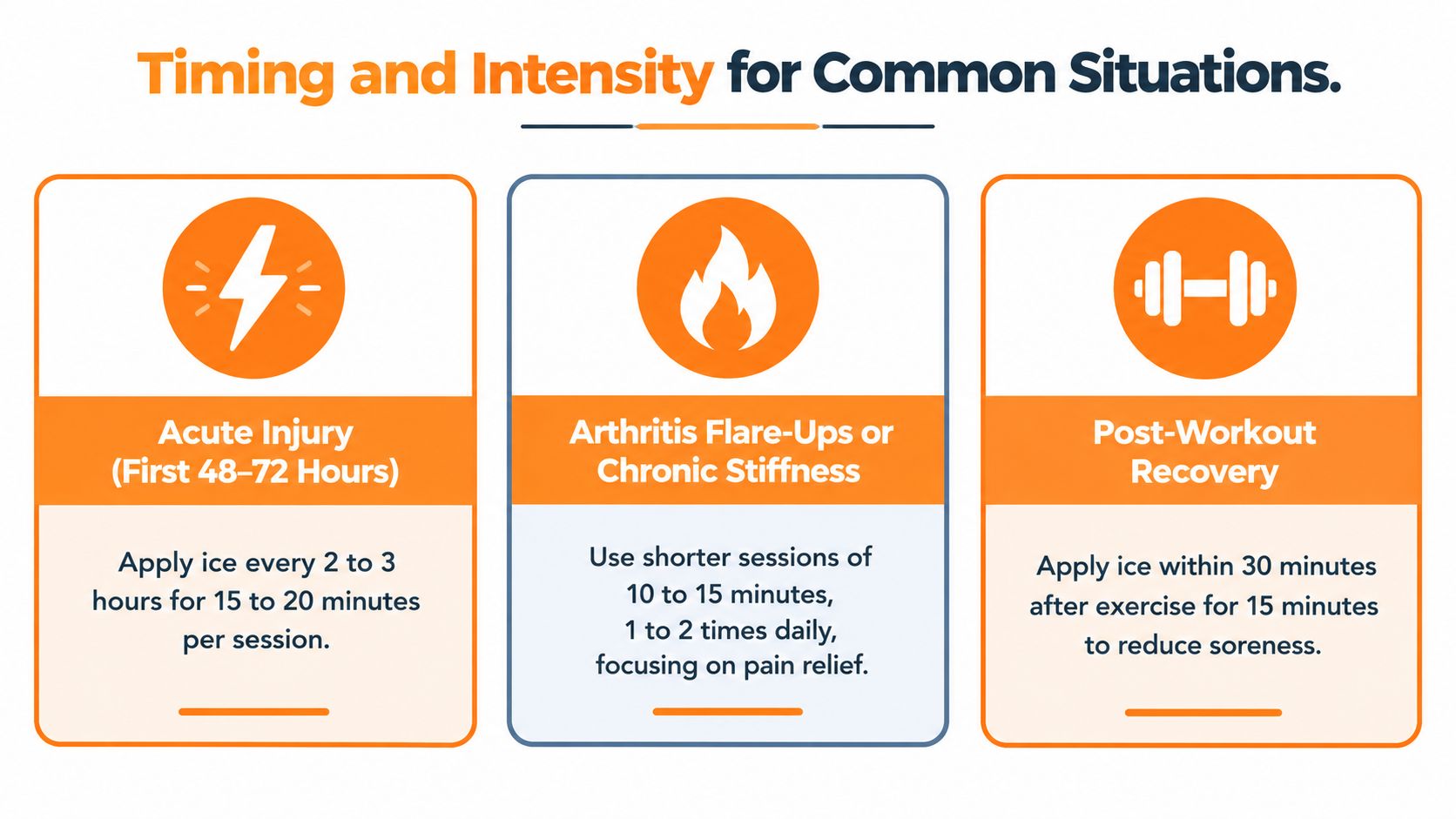
A knee does not need the same cold session every time it flares. A fresh twist, an arthritis flare, and post-workout soreness are different situations, so the timing and intensity should change with the goal. If you use one timer for everything, some sessions will be too aggressive and others too mild.
Acute injury is about control, not comfort
In the first 48 to 72 hours after a new injury, the main aim is to settle swelling and pain while the tissue is still reactive. Cold is usually the first option because it helps quiet the area while you watch for signs that the injury is improving or needs medical attention. Heat usually makes more sense later, after the acute phase has passed.
Arthritis is more variable than product ads suggest
Arthritis is where the protocol needs more judgment. Some people feel better with cold, while others get cold hyperalgesia, which means the knee feels worse when chilled. A 2025 systematic review found a pain benefit for cryotherapy in osteoarthritis, but function and muscle strength still remained uncertain, so the benefit appears to be mainly symptom relief.
If the joint feels sharper, more painful, or stiffer after cooling, stop and reassess. Two runners with the same diagnosis can still need different protocols. One with baseline swelling and daily analgesic use may do better with shorter, more frequent sessions than someone who only ices after long runs.
Post-workout recovery depends on what you actually did
After exercise, not every sore knee is reacting in the same way. A short cooling session can help when the joint feels irritated or puffy, but a lot of post-workout soreness is ordinary muscle fatigue that may settle with gentle movement, rest, or later-stage heat. The same pad can be useful after one training block and unnecessary after another.
Use cold when the knee feels reactive. If the soreness is mild and movement feels normal, you may not need intense cooling at all. The result depends on diagnosis, baseline swelling, analgesic use, and adherence, not on the pad alone.
Safety Rules Most Users Skip
A runner straps on an ice knee pad after training, answers a call, and realizes much later that the pad is still on. The mistake is not just the clock. Risk starts with who is wearing the pad, what the skin is like that day, and whether normal sensation and circulation are intact.
That is why the same pad can be low risk for one person and a poor choice for another.
Older adults, people with diabetes, neuropathy, vascular disease, recent surgery, or limited ability to explain what they feel need more supervision. Thinner skin can react faster. Reduced sensation can hide early warning signs. A simple barrier cloth, shorter sessions, and quick skin checks are not product extras. They are the basic safety steps that lower the chance of cold injury.
The warning signs are usually easy to spot if you look for them early:
- Excessive numbness: if the knee feels dead or hard to sense, remove the pad.
- Burning or escalating pain: cooling should not become sharper pain.
- Mottling or discoloration: take the pad off right away.
- Excessive redness: if redness keeps building instead of fading, the skin needs a break.
Compression needs the same caution. Gentle support can help, but a strap pulled tight can leave the lower leg throbbing, tingling, or pale. Sleeping with the pad on creates a different problem. You lose the feedback that would normally tell you to stop.
The evidence behind this is more useful than a generic timer rule. Reported or considered complications include local skin reactions, discomfort, superficial infection, cold injury, and thrombotic events, although serious adverse-event evidence remains limited (source). That is why a risk-based approach matters more than treating every knee the same way.
If you train in contact sports or grappling, the principle is familiar. Good recovery habits use the same mindset as prevention. This guide on how to prevent injuries in BJJ makes a similar point. Notice problems early, respond while they are still small, and do not push through warning signs just because the gear is easy to wear.
If swelling keeps returning, the skin reacts badly, or sensation or circulation is already impaired, stop self-treating and ask a clinician.
Combining Ice Knee Pads with Other Therapy
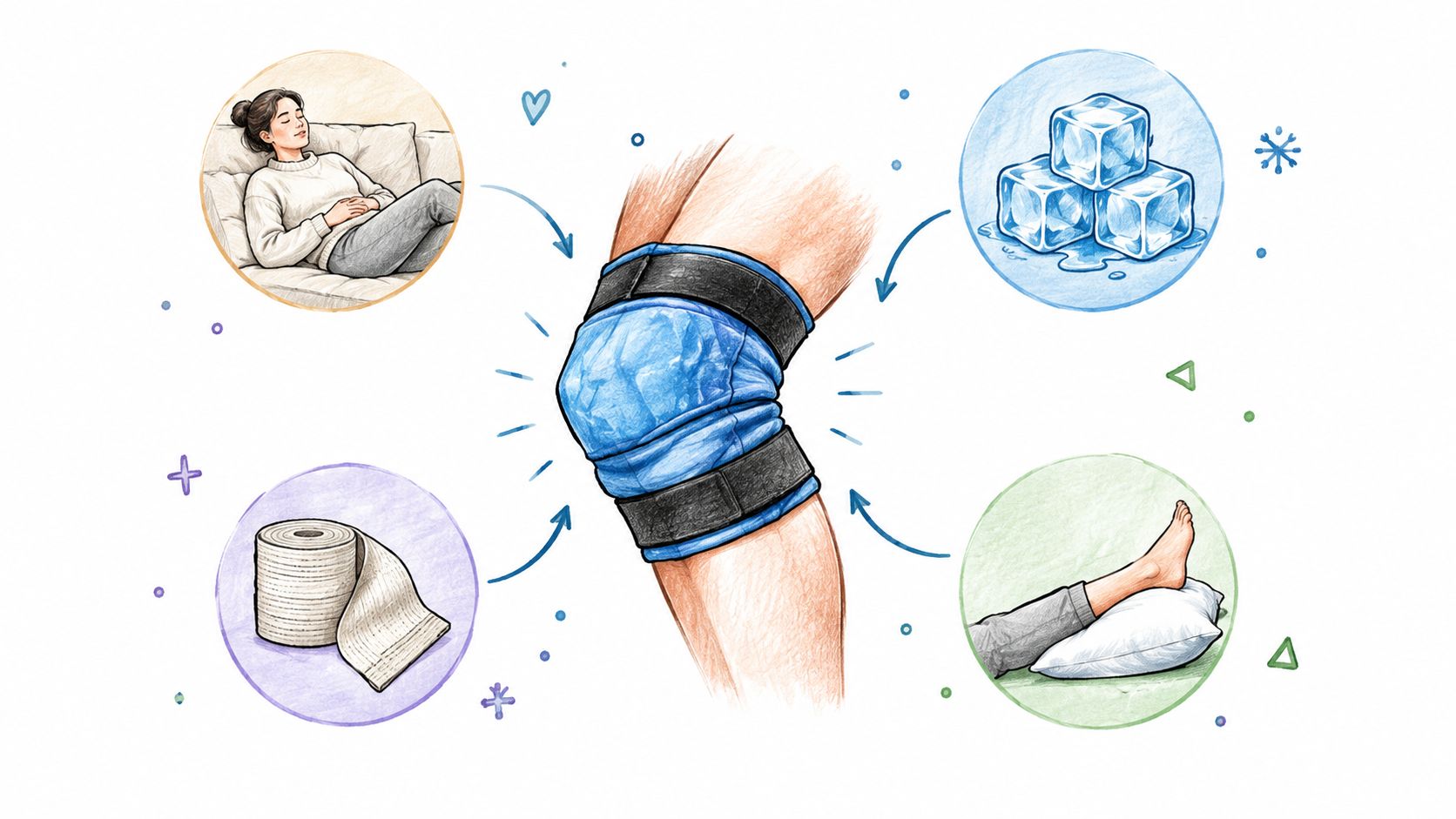
Cold works best as one piece of a plan. The classic RICE approach, rest, ice, compression, and elevation, makes sense because each part solves a different problem at the same time. Ice handles temperature and pain, compression manages fluid, elevation helps drainage, and rest keeps the tissue from getting re-irritated.
What to pair with cold
Compression can be part of the pad itself, or it can come from a separate gentle wrap layered over the cold source. The key is moderation. The pad should feel supportive, not tight enough to make the lower leg tingle or throb.
Cold also pairs well with movement, but not the same kind of movement at every stage. Early on, that means gentle walking, short range-of-motion work, and letting the swelling settle enough that the joint can move more naturally. Later, it means progressive loading and rehab exercises that rebuild function instead of just calming symptoms.
That's where heat enters later. Once the knee is no longer acutely inflamed and stiffness becomes the bigger complaint, gentle warmth can be more helpful than cold for loosening guarded movement. If you're deciding between the two after a workout or after a rough day, this safer exercise-with-joint-issues guide fits naturally with the idea of pacing yourself.
A simple mental model helps:
- Acute inflammation: cold first.
- Stiffness without swelling: heat often becomes more useful.
- Rehabilitation: movement does the rebuilding, cold just helps the knee tolerate it.
Ice knee pads don't replace the rest of the recovery sequence. They make the sequence easier to follow.
Care, Cleaning, and Storage for Reusable Pads
A reusable pad only stays useful if you treat it like equipment, not like a disposable ice bag. The most common failures are boring ones, weak seams, worn straps, cloudy gel, and covers that hold sweat or skin residue. Those aren't glamorous problems, but they're the ones that decide whether the pad still fits and cools evenly after months of use.
Refreezing a gel pack is usually fine as long as the pad remains intact and still holds temperature properly. If it no longer stays cold long enough to be useful, leaks, or feels lumpy because the gel has shifted, it's time to replace it. Flat storage in the freezer helps the pad keep an even shape, which matters because uneven shapes create uneven skin contact.
Clean the cover and straps regularly so they don't irritate the skin or collect bacteria. Washable covers are useful because they let you keep the contact surface fresh without damaging the cold element itself. Before each use, do a quick inspection:
- Check the seams: look for cracks, leaks, or weak spots.
- Check the gel distribution: the pad should still lay evenly.
- Check strap elasticity: the wrap should hold without over-tightening.
- Check the surface: no sticky residue, odors, or visible wear.
Sleeping while iced is unsafe, so the replacement habit is simple, use the pad before bed if you need it, then take it off before you fall asleep. A reusable pad can be used straight from the freezer, but it should still go on with a cloth barrier and with a timer in mind. Icing is generally most useful before or after activity when swelling or irritation is the issue, not as a random all-day background habit.
If the knee pain keeps returning, the swelling doesn't settle, or the skin can't tolerate cold comfortably, stop trying to force the routine. That's the point where a clinician should guide the next step instead of another freezer cycle.
SunnyBay offers reusable hot and cold therapy products, including strap-based ice bags that can be used around the knee, along with other support tools for targeted relief. If you want a reusable option that fits into the kind of cold therapy routine described here, visit SunnyBay and look at the products that match your recovery setup.


