


Large Gel Ice Packs for Back Pain: A Practical Guide
-
You're sitting on the edge of the bed after a long day, one hand pressed into a tight lower back while the other searches the freezer. The only option is a small gel pack meant for a knee or lunchbox. You place it over the sorest spot, but much of the painful area remains uncovered, and the pack shifts every time you move.
That frustrating result usually isn't a failure of cold therapy. It's a coverage problem. Large gel ice packs are designed to spread cooling across broad muscle regions, but they still need the right size, freezing routine, barrier, and application timing to work safely.
Table of Contents
- Why Big Muscle Groups Need a Different Kind of Cold Pack
- How to Choose the Right Size and Shape
- Freezing, Storage, and the Refreeze Trap
- Safe Application Times and How to Wrap One On
- Large Gel Packs vs Reusable Microwaveable Options
- Reading Pack Specs Without Getting Misled
- Putting It All Together and Common Questions
Why Big Muscle Groups Need a Different Kind of Cold Pack
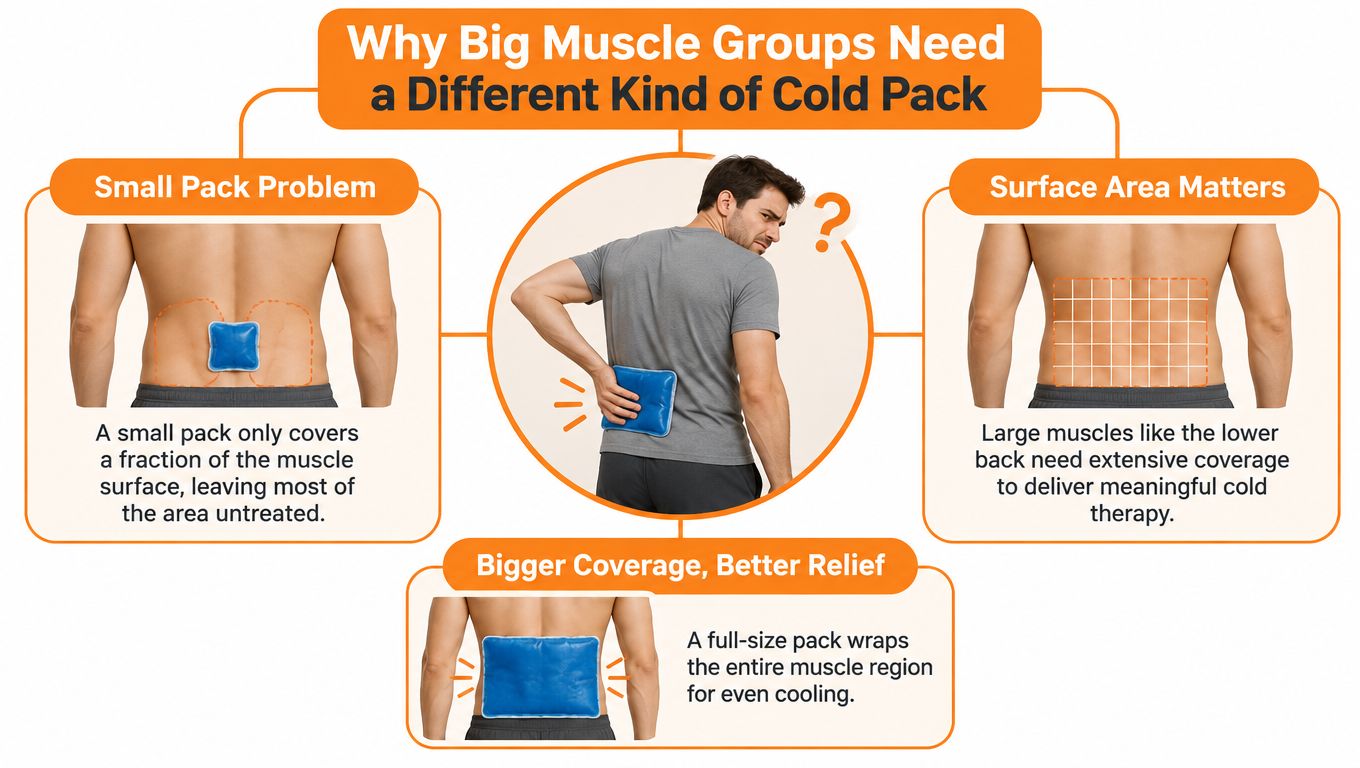
A small pack can be useful when the problem is highly localized. It works well over a kneecap, ankle, wrist, or one distinct tender point. Lower-back discomfort is often less precise. The erector spinae, gluteal muscles, and surrounding tissues can form a broad painful region, so a small rectangle leaves much of the area untreated.
That's why someone with a back flare-up may keep repositioning a compact pack without feeling much benefit. The pack may be cold, but it isn't contacting enough of the region that feels tense or irritated. A larger surface can distribute cooling more evenly and reduce the need to hold the pack in place.
Coverage matters more than maximum cold
The useful question isn't, “Which pack gets coldest?” It's, “Which pack covers the painful region without creating a cold-injury risk?” A large pack can be more practical for a lower back, shoulder girdle, thigh, or hip because it makes consistent contact across a wider area.
The FDA's AccessGUDID classification for reusable hot and cold packs places these products in a recognized category of non-powered devices for non-invasive application to the body surface. The classification describes reusable packs filled with thermally retentive material, including gel, for musculoskeletal pain and discomfort. That doesn't prove that every pack will work for every condition, but it confirms that reusable thermal packs are established therapeutic devices rather than merely novelty accessories.
Practical rule: If the painful region is larger than the pack, the first improvement usually comes from increasing coverage, not from choosing a colder formula.
For office-related stiffness, cold therapy should sit alongside movement, posture changes, and professional assessment when symptoms persist. This osteopathic guidance for office workers offers useful context on reducing the mechanical triggers that can keep back discomfort returning. A broader back pain relief guide can also help you decide when cold therapy fits into a wider self-care routine.
How to Choose the Right Size and Shape
Start with the body region, not the freezer shelf. A pack intended for a knee doesn't become a back pack because it's cold, and an oversized pack may be awkward if you need to strap it around a shoulder.
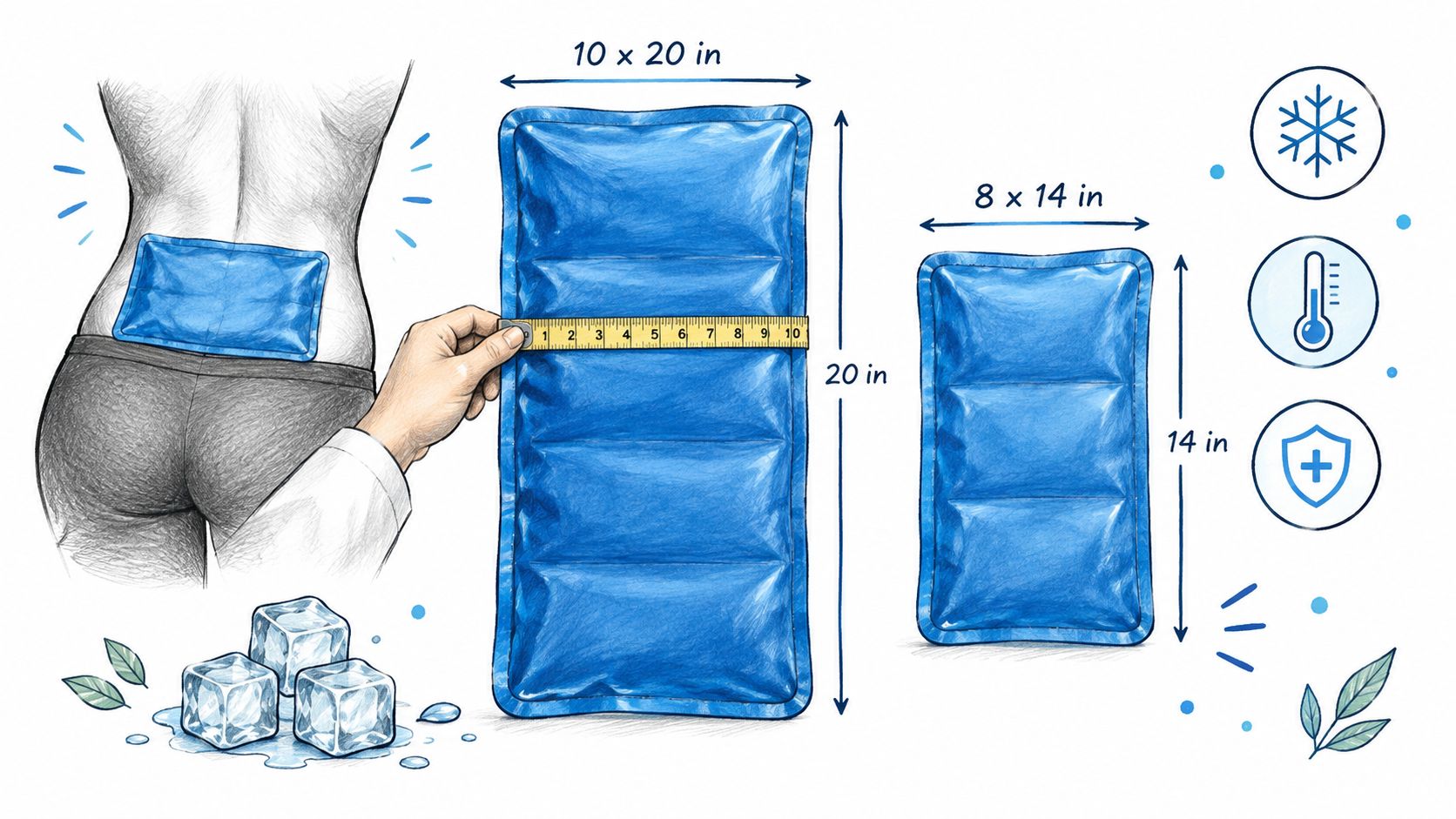
For a full lower back, a practical target is approximately 10 by 20 inches. For a shoulder or upper-back area, approximately 8 by 14 inches may offer useful coverage without becoming unnecessarily heavy. These dimensions are buying guides, not universal medical requirements. Your height, body shape, and exact pain pattern still matter.
Match the shape to the job
Contoured packs curve around the waist, shoulder, or neck and tend to shift less. They're useful when you want hands-free positioning or need the pack to follow a rounded body area. Their drawback is that the curved design may leave small gaps over a flat region.
Flat rectangular packs provide broad, predictable coverage. They're easier to fold into a wrap, place beneath the lower back, or position across a thigh. They can shift more easily, especially when you're walking or sitting upright, so an elastic sleeve or adjustable strap becomes important.
A frozen full-size pack can also become heavy. Weight matters if you're lying on it, but it matters even more if you're trying to wear it around the waist or hold it against a shoulder. A pack that covers everything but forces you into an uncomfortable posture may be less useful than a slightly smaller pack that stays in place.
Inspect the filling and outer layer
Gel formulas vary. Some use silicate-based gel, others use polymer beads or blends designed to remain flexible after freezing. Don't judge quality by the word “gel” alone. Look for a pack that bends enough to maintain contact, has sealed seams, and distributes its filling rather than forming one hard lump.
The outer layer deserves equal attention. A fabric cover can make positioning more comfortable and helps reduce direct exposure to a frozen surface. If the pack doesn't include one, plan to use a thin towel or fabric sleeve. A bare pack against skin isn't a performance upgrade. It's a safety risk.
Freezing, Storage, and the Refreeze Trap
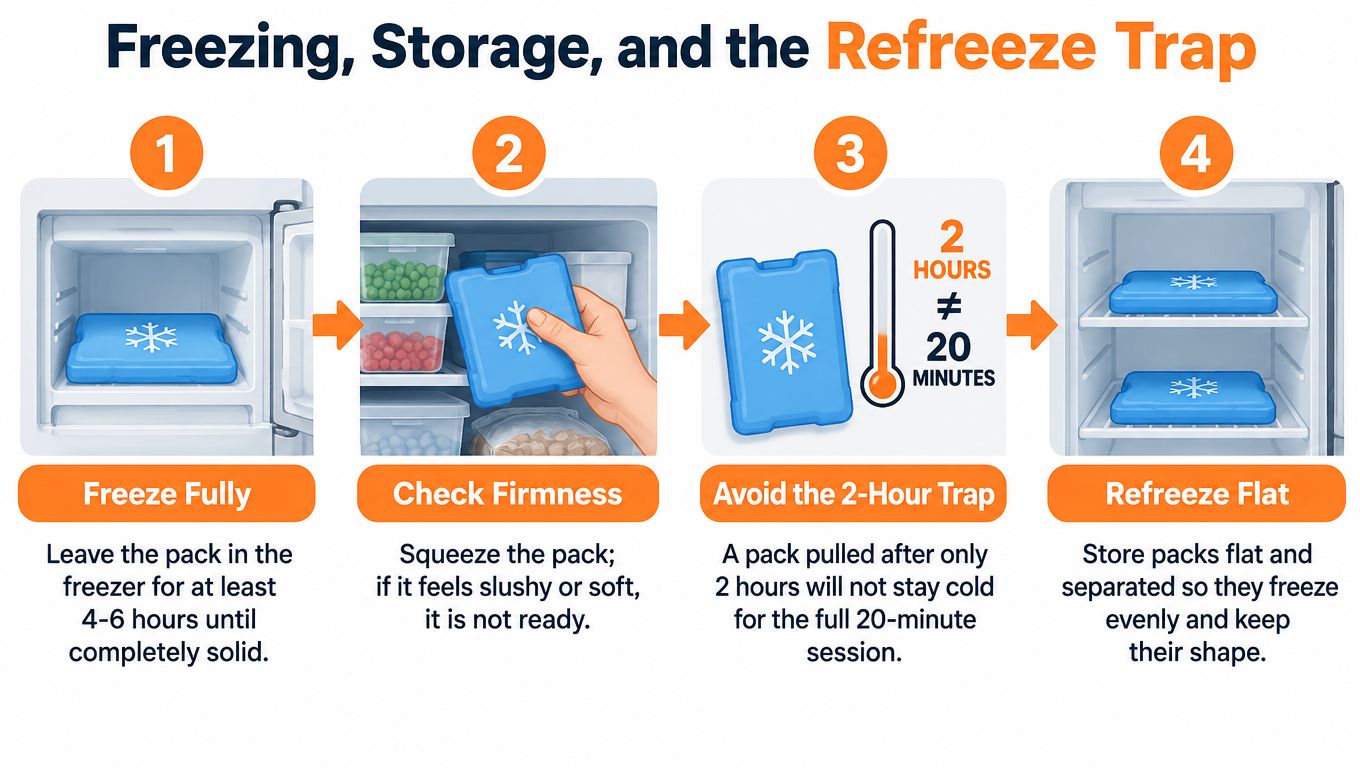
A large gel pack can feel frozen on the outside while its center remains soft. More filling means cold takes longer to reach the middle, so a short return to the freezer may not restore the cooling performance you expect.
The UC Davis cryotherapy study shows why freezer time matters. Packs frozen overnight at approximately −20°C reached a surface temperature of −14.2 ± 2.3°C. After 10 minutes, that surface temperature had risen to 7.65 ± 2.6°C. After a two-hour refreezing interval, the packs reached only −6.7 ± 0.9°C, substantially warmer than after overnight freezing.
Build a dependable freezer routine
Use a consistent routine rather than judging readiness by the outer surface:
- Freeze fully: Keep the pack in a freezer near −20°C when possible. The study froze packs for at least 36 hours before repeated testing, while the reported UC Davis testing used overnight freezing. Thickness and filling affect the time required.
- Store it flat: A flat position spreads the gel more evenly and helps preserve the pack's shape. Avoid sharply folding it while frozen.
- Leave space around it: Warm groceries or frost-covered bags can slow and unevenly affect freezing. Allow cold air to circulate around the pack.
- Plan for recovery: For repeated sessions, rotate in a second pack. A brief refreeze does not provide the same preparation as a full freeze.
Freezer performance depends more on its actual temperature and the time available than on the brand. If the pack feels soft, slushy, or unevenly frozen, wait longer before using it for consistent cooling. A thermometer can confirm freezer temperature, but firmness alone cannot confirm that the center is fully frozen.
Safe Application Times and How to Wrap One On
A large gel pack can cover a sore region quickly, but its convenience makes timing easy to ignore. For a clinical-style application, use 20 minutes, then remove the pack and let the skin return to its normal color and temperature before another session. Evidence-based nursing guidance recommends at least 40 minutes of recovery between intermittent cold applications. Treat that interval as a practical safety rule, not permission to extend the first application.
Use a thin towel, fabric sleeve, or foam barrier between the pack and your skin. This matters especially when a frozen surface may be below 0°C. The barrier slows heat transfer while preserving useful cooling, and it also reduces the chance of an uncomfortable cold spot from a stiff, uneven pack.
Position the pack without compressing yourself
For lower-back use, lie on your side or back and place the pack across the broadest part of the sore area. Keep the barrier between the pack and your skin. Let the pack rest evenly instead of forcing its edge into one painful point. A large pack should spread contact, not add pressure.
For a shoulder, position it over the upper trapezius or shoulder region. Use an elastic wrap only to hold it in place, and keep the tension light enough for normal breathing, circulation, and arm movement. Check the skin during the session rather than relying on the timer alone.
Remove the pack immediately for intense burning, marked numbness, blotchy white skin, or increasing pain. Inspect the area and allow it to warm naturally. People with impaired circulation, altered sensation, or conditions affected by cold should consult a healthcare professional before using cold therapy.
Cold application also appears in care routines outside large-muscle recovery. The guidance on TMJ care from Pain and Sleep Therapy illustrates why placement, comfort, and timing matter around a sensitive area. For injury-related use, this ice bag guide offers further practical wrapping context.
Large Gel Packs vs Reusable Microwaveable Options
A large gel ice pack and a reusable microwaveable pack solve different problems. Choosing between them starts with the symptom pattern, not with a claim that one product is universally superior.
Cold is generally the better fit for a recent injury, visible swelling, or a post-activity area that feels hot and irritated. Heat is usually more comfortable for stiffness, muscle guarding, and a chronically tight region that needs relaxation before movement. Those are broad decision rules, not a diagnosis.
| Criterion | Large Gel Ice Pack | Reusable Microwaveable Pack |
|---|---|---|
| Primary role | Cooling and temporary numbing | Warming and easing stiffness |
| Best fit | Acute soreness, swelling, post-activity irritation | Muscle tension, chronic stiffness, warm-up |
| Application feel | Cold, firm, and potentially heavy | Warm, pliable, and usually more relaxing |
| Main setup | Freeze fully and use a barrier | Heat according to the manufacturer's instructions |
| Key risk | Excessive cold exposure or direct skin contact | Overheating or uneven heating |
| Main trade-off | Strong initial cooling can be uncomfortable | Heat may be unsuitable for a fresh, swollen injury |
When each option wins
Large gel packs are often more useful immediately after an activity that leaves a region irritated. They can also cover a broad area without producing the wet mess associated with loose crushed ice. Their weakness is that they require freezer space, planning, and careful timing.
Microwaveable packs are more practical when the main limitation is stiffness. Warmth can make gentle movement feel easier, especially before mobility work. They're less appropriate when the area is freshly swollen or feels unusually hot.
Hybrid hot/cold packs offer flexibility, but that convenience involves compromises. A pack designed for both jobs may not be as cold as a dedicated frozen gel pack or as comfortable and evenly heated as a purpose-built warming wrap. If you're considering microwaveable products, review microwave heating safety guidance before using any pack.
Reading Pack Specs Without Getting Misled
“Stays cold for 24 to 48 hours” sounds impressive, but it rarely means that the pack can safely remain against your skin for that period. It may describe storage in a freezer, time spent inside an insulated container, or a product's ability to remain cool in a particular test environment.
For therapeutic use, the relevant window is much shorter. Ordinary frozen gel can feel intensely cold at first, then warm quickly as it exchanges heat with the body and surrounding air. A longer-lasting claim doesn't remove the need for a timer or a fabric barrier.
Ask what the test actually measured
A useful specification should tell you more than the pack's dimensions. Look for:
- Freezer conditions: The freezer temperature and the duration of freezing.
- Recovery conditions: How long the pack was refrozen between applications.
- Starting temperature: The surface temperature immediately after removal.
- Application setup: Whether testing used a towel, fabric, foam, or direct contact.
- Measurement target: Whether the test recorded pack temperature, simulated skin temperature, load temperature, or the time until the pack felt cool.
A controlled test should use a consistent load and ambient environment, then record both pack-surface and load temperatures at fixed intervals. It should also check for leakage, seam failure, loss of flexibility, and uneven filling after repeated use.
Understand the difference between gel and PCM
Phase-change material, or PCM, is a separate thermal approach. A neutral review reports that a 15°C PCM can maintain cooling for approximately 3 hours and has been used for 3 to 6-hour applications in exercise-recovery settings, while ordinary cryotherapy commonly remains limited to about 30 minutes because lower temperatures and prolonged exposure can create discomfort or safety concerns. The comparison appears in this review of phase-change materials and cooling applications.
That doesn't make PCM automatically better. It means the cooling behavior is different. Frozen gel generally prioritizes strong initial cooling, while PCM products aim for a more controlled temperature range. For skin-contact use, the application protocol still matters more than an impressive duration printed on the box.
Putting It All Together and Common Questions
Choose the pack by body region first. Freeze it fully, ideally overnight in a freezer near −20°C, place a fabric barrier between the surface and your skin, use it for 20 minutes, then allow at least 40 minutes of recovery before an intermittent repeat. Re-evaluate the symptoms rather than automatically continuing, especially if pain is worsening, spreading, or accompanied by unusual weakness or altered sensation.
A large pack becomes useful when these habits are consistent. The right dimensions improve contact, full freezing makes the cooling more predictable, and a timer prevents a short recovery tool from becoming an extended cold exposure.
How can I remove a chemical smell?
Wipe the exterior with a mild vinegar solution, then clean away any residue according to the manufacturer's instructions. Leave the pack open to the air until the smell fades before returning it to the freezer.
Don't puncture the outer shell or attempt to drain the filling. If the odor comes from a leak rather than the surface material, stop using the pack and inspect the seams.
Is daily use safe?
Daily use can fit into a recovery routine when you use a barrier, follow the timed application, and allow the skin to recover between sessions. Don't sleep with a frozen pack, strap it tightly enough to impair circulation, or continue through numbness and burning.
If you have poor circulation, reduced sensation, or a condition that affects your response to cold, get individualized medical advice first. Cold therapy can reduce discomfort without addressing the reason the pain is present.
When should I replace the pack?
Replace it when you see visible leakage, a cracked seam, a damaged outer shell, or gel that no longer distributes evenly. A pack that has become stiff in one area and empty in another won't make reliable contact, even if it still freezes.
Reusable doesn't mean permanent. Treat the pack as a recovery aid, not a substitute for assessment, progressive movement, or rehabilitation when symptoms persist.
If you're comparing reusable options for cold and heat routines, visit SunnyBay to explore wraps, large therapy accessories, and other products designed for targeted home recovery. Choose the format that matches your body region and whether you need controlled cooling, warming, or hands-free support.