


What Does Heat Wrap Do and Why It Works
-
A heat wrap delivers gentle, localized warmth that temporarily loosens tight muscles, eases soreness, and helps you move more easily. It doesn't fix the underlying cause of pain, but it can make stiff tissue feel more comfortable while you work, stretch, or rest.
If you've ever reached for warmth after a long day and wondered what does heat wrap do beyond feeling cozy, you're asking the right question. The answer depends on timing, body area, and how you use it.
Table of Contents
- When a Heat Wrap Becomes the Right Tool for the Moment
- How Heat Wraps Work Inside Your Muscles
- Microwavable Wraps Versus Air-Activated Patches
- What the Research Says About Pain Relief
- Matching the Right Wrap to the Right Body Area
- When Heat Is the Wrong Choice and What to Watch For
- Practical Routines, Sensible Limits, and Clear Takeaways
When a Heat Wrap Becomes the Right Tool for the Moment
You finish a day of desk work and your neck feels locked. Or you spend a Saturday raking, lifting boxes, or weeding, and by evening your lower back won't loosen up no matter how you shift in your chair. That's the moment many reach for a heat wrap, and it's often a sensible instinct.
A heat wrap is a reusable or disposable form of thermotherapy that lays controlled warmth over one sore spot. Think of it as borrowing your body's own warming response. Instead of heating your whole body like a bath does, you place warmth exactly where tissue feels tight, so you can keep typing, cooking, or walking around the house.
Three jobs heat handles well
Heat tends to help most in a few familiar situations, and naming them keeps expectations honest.
- Muscle tightness: Your shoulders creep up during a stressful meeting and stay there. Warmth can ease that guarded, clenched feeling for a while.
- Chronic stiffness: A back or neck that feels rusty first thing in the morning often moves better after gentle warming.
- Mobility prep: You're about to do light stretches or a home exercise routine. Warm tissue first, then move, rather than forcing cold, stiff tissue to stretch.
That short list matters because warmth isn't the right tool for every ache. A fresh twist, a swollen joint you can't explain, or skin that's broken or numb calls for a different decision. If you're torn between options, a guide to when to ice and when to heat can help you sort the timing before you commit to either one.
Use heat to loosen and prepare tissue, not to push through a new injury.
A useful mental model is conditional. Warmth supports comfort and movement in the short term, especially for tight, stiff muscles during daily activities. It doesn't replace medical assessment when pain is persistent, severe, or paired with numbness, weakness, or other neurological symptoms. The sections ahead walk through the physiology, the product formats, the research, and the safety checks, in that order, so you can match the tool to the moment instead of guessing.
How Heat Wraps Work Inside Your Muscles
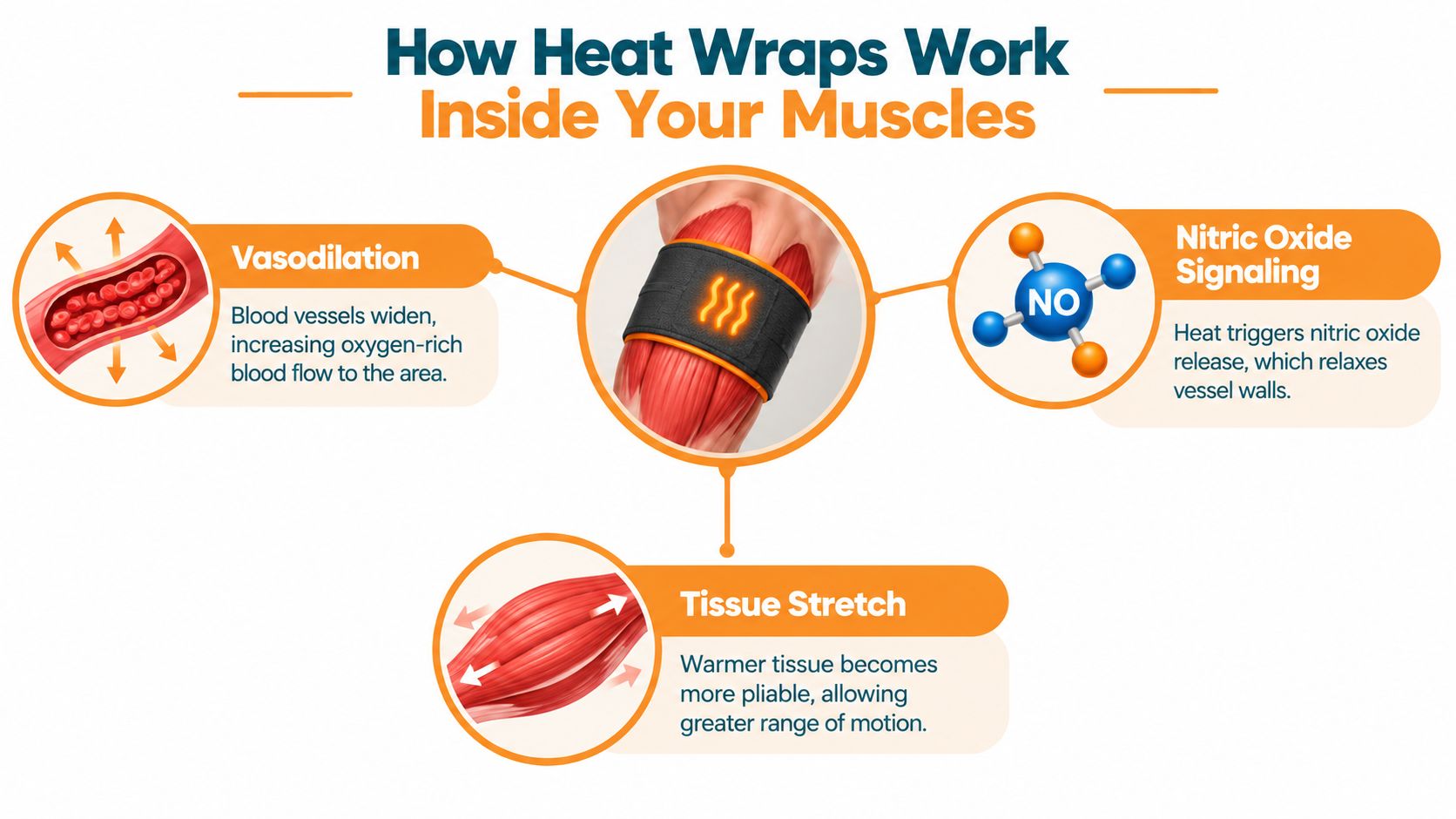
Warmth feels good, but feeling cozy isn't the mechanism. When you lay a wrap over skin, you create localized superficial heating. That heating triggers changes in blood vessels, nerves, and the tissue itself, and those changes explain why a stiff back feels looser after a session.
The diagram below maps the three pathways that work together during a typical session.
Step one blood vessels widen
Heat causes vasodilation, which means nearby blood vessels relax and widen. Part of that response runs through nitric oxide signaling in the skin, a chemical message that tells vessel walls to let go. Wider vessels carry more blood to the warmed area, bringing oxygen and nutrients and helping clear local metabolic by-products that build up in tight tissue.
This response is graded, not all or nothing. Measurements in the trapezius muscle found that tissue temperatures of 38°C, 40°C, and 42°C corresponded to approximately 27%, 77%, and 144% increases in local blood flow, respectively, according to research on local heating and muscle blood flow published in the Journal of Applied Physiology. More warmth produced more flow, which is why steady, comfortable heat does more than a brief warm touch.
Step two tissue stretches and nerves respond differently
Warm tissue is more pliable. Heat increases tissue viscoelasticity, so muscle and connective tissue stretch with less resistance, a bit like taffy that pulls easier when it's warm than when it's cold. Heat also increases nerve conduction velocity and alters sensory input, which can lower how strongly pain signals register for a while.
Put those steps together and you get the practical payoff. You're not numbing the area. You're making tissue temporarily more flexible and better perfused, so gentle stretching, massage, or movement feels easier and range of motion improves. That's why warming before you stretch beats aggressive stretching on cold tissue.
One caution follows from the same physiology. The goal is controlled warmth, with approximately 40°C tissue temperature identified as an appropriate safe target for superficial heat therapy when skin is intact, as noted in the physiology source linked above in this section. Hotter isn't better, and you shouldn't place a wrap over damaged or insensitive skin, because you may not feel excessive heating until a burn has started.
Microwavable Wraps Versus Air-Activated Patches
Heat wrap is a category, not a single product. The two formats you'll meet most often work differently, last for different lengths of time, and suit different parts of your day. Choosing between them is mostly about matching the format to your routine.
Microwavable wraps are fabric wraps filled with materials such as flax seed or lava sand. You warm them in a microwave, drape or strap them in place, and reuse them session after session. SunnyBay offers microwavable neck and body wraps in this style, designed for hands-free use at home or at a desk. They give you moist-feeling, conforming warmth, and many can also go in the freezer for cold use.
Air-activated patches work without a microwave or outlet. You open the packet, exposure to air starts a warming reaction, and you wear the thin patch under clothing or in a belt. They're disposable, portable, and built for longer, lower-profile wear while you travel, work outdoors, or sit through a long drive. If you're comparing adhesive and belt styles, an overview of pain relief patches and how they're worn shows the main variations.
| Feature | Microwavable Wrap | Air-Activated Patch |
|---|---|---|
| Heat source | Microwave-warmed natural fill | Air-activated warming ingredients |
| Recharge method | Reheat in microwave, reusable | Single use, open a new packet |
| Typical session feel | Warm, weighted, conforms to curves | Thin, discreet under clothing |
| Best setting | Home, desk, couch, bedtime routine while awake | Travel, workday, car, outdoor activity |
| Cold use | Often yes, after freezing | No |
| What to plan for | Access to a microwave | Keeping spares in a bag or drawer |
Matching format to your day
Keep a microwavable wrap where you unwind, near the couch or your desk chair, for a focused session followed by stretching. Keep air-activated patches in a gym bag, glove compartment, or desk drawer for days when you can't stop to reheat anything. Neither format is better in the abstract. The right one is the one you'll use correctly, for a sensible length of time, with skin checks built in.
What the Research Says About Pain Relief
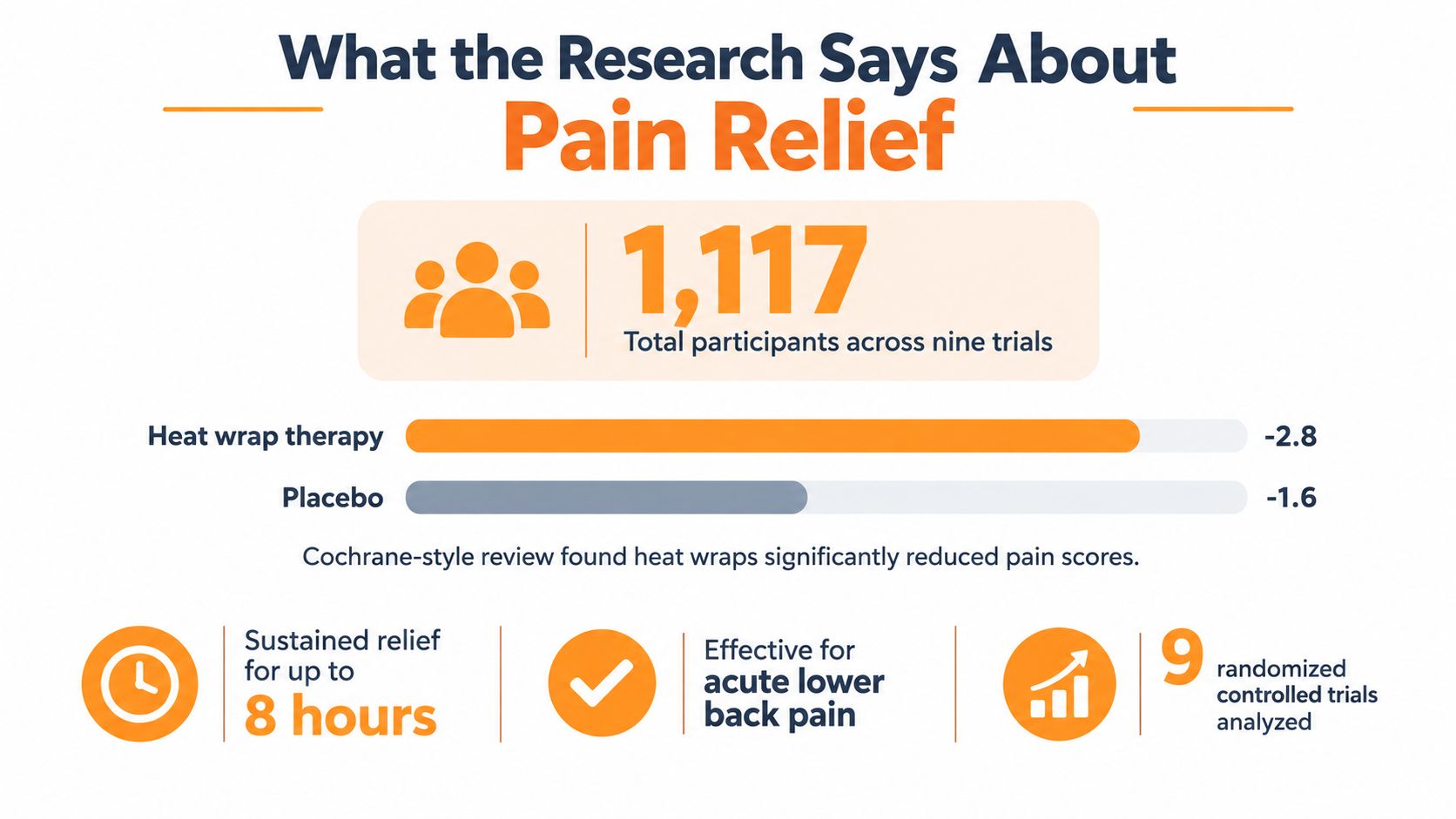
It's reasonable to ask whether the relief is real or just comfort. For low-back pain, the most cited summary is a Cochrane review of 9 clinical trials involving 1,117 participants, which found that heat wraps deliver superficial warmth that can temporarily reduce pain and disability, particularly in acute or subacute low-back pain, as summarized in the Cochrane review record hosted by Australian Catholic University.
The graphic below puts that participant total and the placebo comparison in visual form.
What the numbers mean in plain language
In 2 trials including 258 people, heat-wrap therapy produced a statistically significant pain reduction after 5 days compared with an oral placebo, with a weighted mean difference of 1.06 points on a 0 to 5 pain scale and a 95% confidence interval of 0.68 to 1.45, according to the review record linked above. That's a modest, real shift, not a cure. In everyday terms, pain that dominates your attention may step back enough that you can move, work, and sleep more normally.
Another trial of 90 participants found that a heated blanket reduced pain immediately after application by 32.20 points on a 0 to 100 scale, with a 95% confidence interval from 25.71 to 38.69 points, as reported in that same review record. Immediate relief and relief after several days are different claims, and both appear in the evidence.
The video below walks through how heat therapy is typically applied in practice, which helps connect trial protocols to home use.
Two qualifications keep this honest. The review characterized the evidence as moderate but limited, because trials were relatively few and varied in design. And adding exercise to heat-wrap treatment reduced pain after 7 days more than heat-wrap therapy alone, per the review record linked above. Heat works best as a partner to movement, not a substitute for rehabilitation or for medical evaluation when pain persists.
Matching the Right Wrap to the Right Body Area
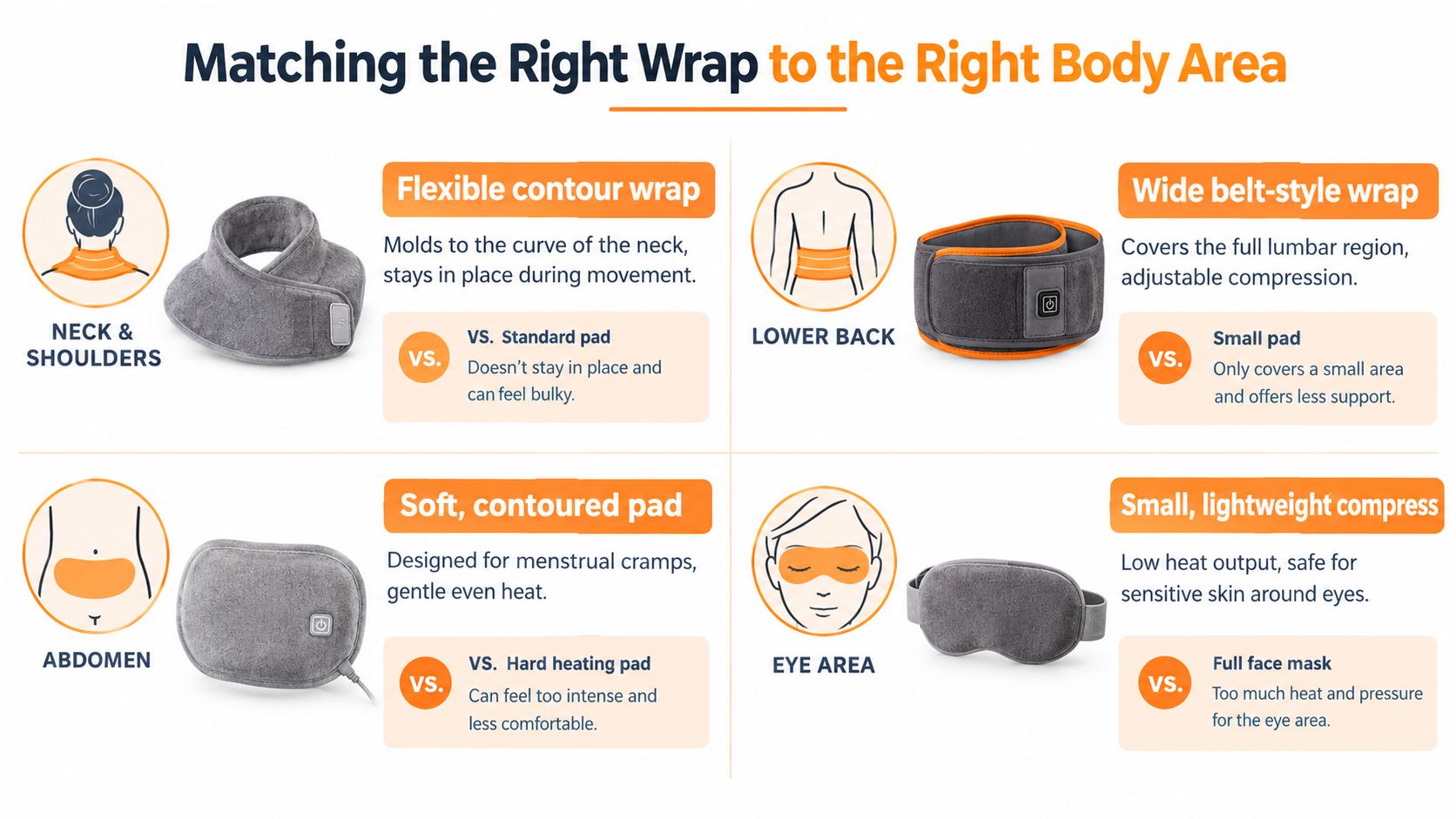
A wrap that works beautifully on your neck can be the wrong shape, weight, or temperature for your eyes. Anatomy drives design, so it helps to think area by area rather than buying one wrap and using it everywhere.
The comparison below shows how wrap shapes change to fit four common target areas.
Neck, shoulders, and lower back
For the neck and shoulders, look for a flexible contour wrap that drapes over the curve where your neck meets your shoulders and stays put while you type or read. Desk workers feel tension here because the trapezius holds your head up all day, and a wrap that slides off breaks the session. For the lower back, a wide belt-style wrap covers the full lumbar region and lets you walk around, which matters because gentle movement after warming is part of the benefit.
Some people layer other topical approaches into a shoulder routine. If you're curious about complementary options people use on tight muscles, learning what magnesium oil spray does can help you decide what belongs in your routine and what doesn't. Keep any topical product off skin that's about to go under a hot wrap unless the product directions say otherwise.
Abdomen for menstrual pain
Abdominal warmth for menstrual cramps is a separate use case with its own evidence. A 2025 systematic review included 57 randomized trials involving 5,359 participants and found that heat reduced pain compared with no treatment for primary dysmenorrhea, while versus NSAIDs pain differences were small and adverse events were probably less frequent with heat, according to the systematic review published in Frontiers in Medicine. That supports heat as a non-drug option worth trying, not as a reason to skip evaluation for severe, new, or changing pelvic pain. A soft, contoured pad that spreads gentle, even heat suits this area better than a heavy neck wrap pressed into service.
Eyes need a specialized mask
Dry eye masks aren't small pain wraps. They're warm compress tools meant to soften thickened oils in your meibomian glands so those oils flow into the tear film and slow evaporation. A 2022 review of 58 human clinical studies found eyelid-warming devices were generally safe, and among 9 studies of heated eye coverings, 7 of 9, or 78%, reported symptom improvement, while 5 of 9, or 56%, reported improvement in tear quality and 4 of 9, or 44%, reported improvement in meibomian gland measures, according to the review of eyelid warming therapies in PMC.
Fit rule: Pick the wrap shape from the body area first, then compare fabrics and fills.
Because eyelid skin is thin and the target is gland function, an eye mask must deliver controlled, even warmth without heavy pressure. Don't substitute a body wrap. Seek professional care for persistent eye pain, vision changes, or worsening irritation.
When Heat Is the Wrong Choice and What to Watch For
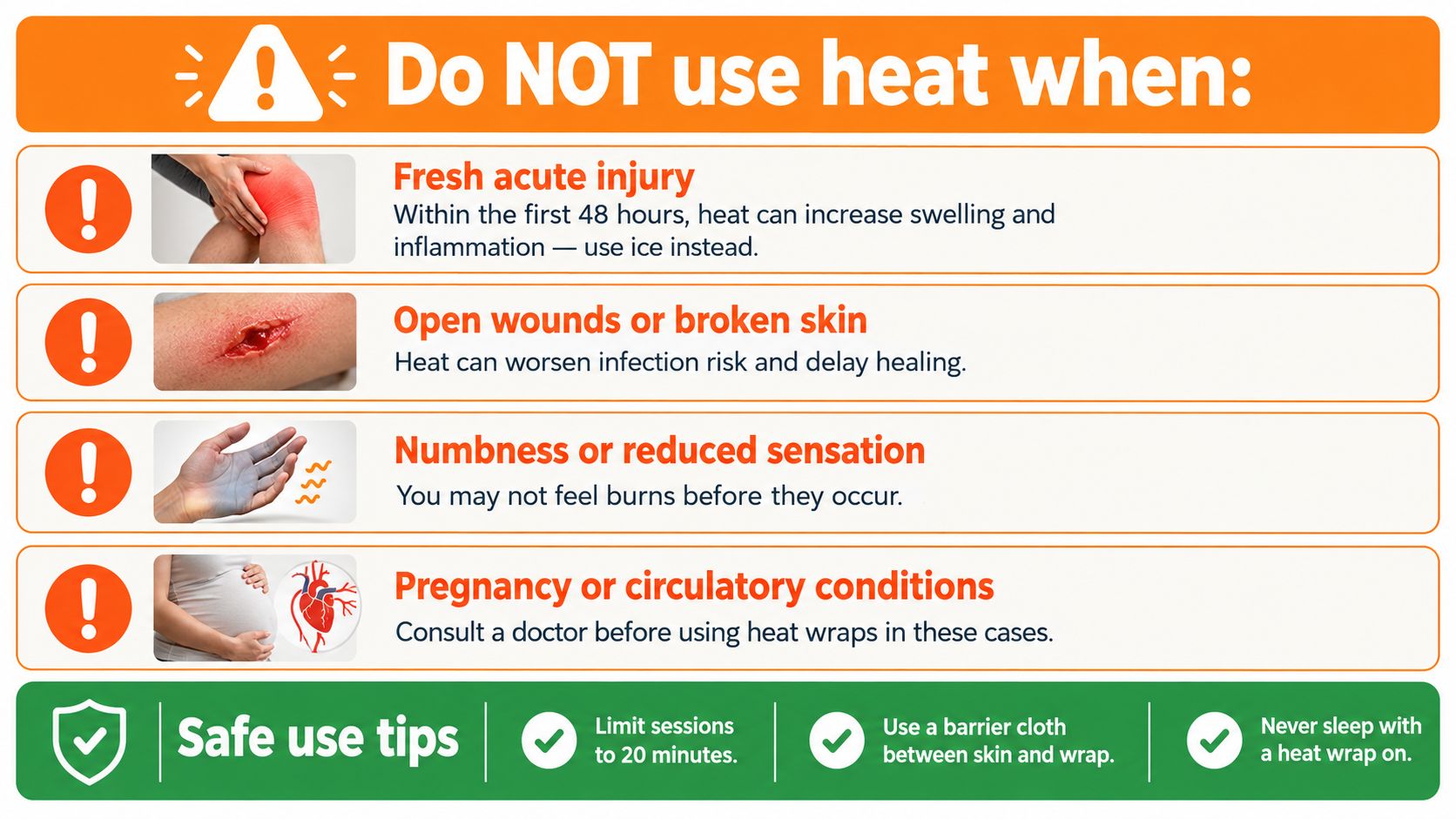
Warmth feels soothing, so it's tempting to assume it's always safe. It isn't. Heat increases blood flow, and in some situations more flow and more heat make the problem worse.
The checklist below flags the situations where you should pause and choose something else.
Situations that call for a different decision
Avoid heat, or get clinical guidance first, in these scenarios.
- Fresh acute injury: A new sprain or strain with swelling in the first 48 to 72 hours can worsen with heat.
- Suspected infection or unexplained swelling: Warm, red, swollen tissue you can't explain needs assessment, not more warmth.
- Open wounds or broken skin: Heat over damaged skin raises burn and infection concerns.
- Reduced sensation: Diabetes, neuropathy, poor circulation, multiple sclerosis, spinal cord injury, or rheumatoid arthritis can blunt temperature feedback, raising burn and ulceration risk, as outlined in professional guidance on heat and cold therapy from the International Pharmaceutical Federation.
Older adults deserve specific attention here. That guidance advises against nighttime use of self-heating products in people over 55, and geriatric recommendations emphasize timers and making sure the person can remove the wrap independently, per the professional guidance linked above. If you can't feel heat well or can't take the wrap off quickly, don't wear it unsupervised.
Warning signs during a session
Stop and remove the wrap if skin becomes persistently red, painful, numb, or blistered. Brief pinkness that fades is common, but pain, numbness, or blistering means the temperature or duration was too much. For a fuller pre-use check, heating pad safety guidance on barriers, timing, and skin checks is worth reading before your next session.
Seek clinical assessment when pain persists, worsens, follows trauma, or comes with fever, unexplained swelling, weakness, or numbness. Heat is for stiffness and tightness. Warning signs belong to a clinician.
Practical Routines, Sensible Limits, and Clear Takeaways
You don't need a complicated protocol. You need a short, repeatable routine you can do correctly on a tired evening, with limits that protect your skin.
A simple session you can use tonight
Start with 15 to 30 minutes of warmth with a thin cloth barrier between the wrap and your skin, following your product's heating-time instructions. Check your skin partway through, especially during the first few uses. When you remove the wrap, use the window of improved flexibility for gentle movement, a short walk, or light stretching, rather than sitting still until stiffness returns.
Scheduled use beats indefinite wear. One reviewed trial applied heat for 20 minutes twice daily over three weeks and reported a significant pain reduction from 4.1 to 1.6 on a 10-point visual analog scale versus 4.6 to 3.5 with placebo, alongside better adherence to home exercise, according to a review of continuous low-level heat therapy in the International Journal of Hyperthermia. Notice the pattern in that result. Short sessions, repeated, paired with exercise.
Three common questions answered quickly
Can you sleep in a heat wrap? Don't. You can't monitor your skin or adjust temperature while asleep, and prolonged exposure raises burn risk. Warm up before bed, then remove the wrap.
Can you use heat on a fresh injury? Not in the first 48 to 72 hours when swelling is active. Reassess once the acute phase passes and stiffness, not swelling, is the main complaint.
Can you wear a wrap while working? Often yes, if it's a hands-free or belt style, you're awake and checking your skin, and the session stays time-limited. Set a timer so a busy afternoon doesn't turn into hours of unnoticed heat.
Heat plus gentle movement outperforms heat alone. Warm the tissue, then use it.
Check with a clinician before regular use if you have diabetes, poor circulation, reduced sensation, or fragile skin, or if you're caring for an older adult who may not sense or report overheating. The durable takeaway is conditional, and that's a strength. Heat wraps temporarily loosen tight tissue, ease soreness, and support movement when you match the format to the body area, keep sessions short, and skip heat when warning signs are present.
If you're ready to match a wrap to your neck, back, abdomen, or eyes, SunnyBay offers microwavable wraps, air-activated patches, and dry eye masks built for those specific areas and routines. Browse the shapes, fills, and session guidance to find the format that fits your day, and start with a short, skin-checked session tonight by visiting SunnyBay.


