


Hot Cold Therapy Wraps: A Practical Guide to Lasting Relief
-
You've finished a long day at your desk, and your neck feels tight when you turn your head. Or you've just come home from practice with sore legs and a tender spot that wasn't bothering you yesterday. A reusable hot cold therapy wrap can help in either situation, but the right choice depends on what your body is telling you and when the discomfort began.
Heat and cold aren't interchangeable comfort settings. One is generally more useful for stiffness and tight muscles; the other often suits a fresh injury or active swelling. The goal is to choose the mode that fits the problem, apply it safely, and recognize when a wrap isn't enough.
Table of Contents
- Why One Wrap Can Solve Two Different Problems
- How Hot and Cold Actually Change What You Feel
- The Main Types of Hot and Cold Wraps
- When to Choose Heat and When to Choose Cold
- Features That Actually Matter When You Choose a Wrap
- Safe Use and Care That Keeps a Wrap Working
- Real Scenarios and How to Use a Wrap for Each
- Wrapping Up and Answering Common Questions
Why One Wrap Can Solve Two Different Problems
A neck wrap warmed in the microwave can feel soothing after hours spent leaning toward a laptop. The warmth may help a tight shoulder relax, making it easier to turn your head or settle into a comfortable position. The next day, if you twist an ankle or notice a newly swollen knee after activity, that same wrap, if it's designed for cold use, may be chilled and used to cool the area.
That flexibility is useful, but it doesn't mean you should reach for either setting at random. A wrap is a simple way to apply temperature to a particular area. It doesn't diagnose what's causing the pain, repair an injury by itself, or replace a care plan when one is needed.
A helpful starting point is to ask two questions: What does the area feel like, and when did the problem start? A new injury with swelling calls for a different approach than familiar stiffness that builds after sitting. Soreness after exercise can be more nuanced, since the best-feeling option may depend on whether pain or tightness is the main complaint.
A tool, not a treatment plan
Think of the wrap as one adjustable tool in a home-care kit. You can use it to manage symptoms while you rest, move gently, or follow professional advice. Some reusable wraps switch between warm and cool modes; others are designed for one kind of temperature or for a particular body area.
You don't need medical training to use one, but you do need to pay attention to comfort, timing, and skin response. The aim isn't to make the area as hot or as cold as possible. It's to apply a tolerable temperature for a limited session and stop if the sensation becomes uncomfortable.
The practical framework is straightforward: cold is commonly used for fresh swelling and acute irritation, while heat is often chosen for stiffness and muscle tightness. The sections below explain why that distinction makes sense and how to apply it to everyday situations.
How Hot and Cold Actually Change What You Feel
Temperature changes how the body responds near the skin and how sensations reach your attention. You don't need to memorize medical terms to make a sensible choice, but a simple picture of what's happening can make the options easier to understand.
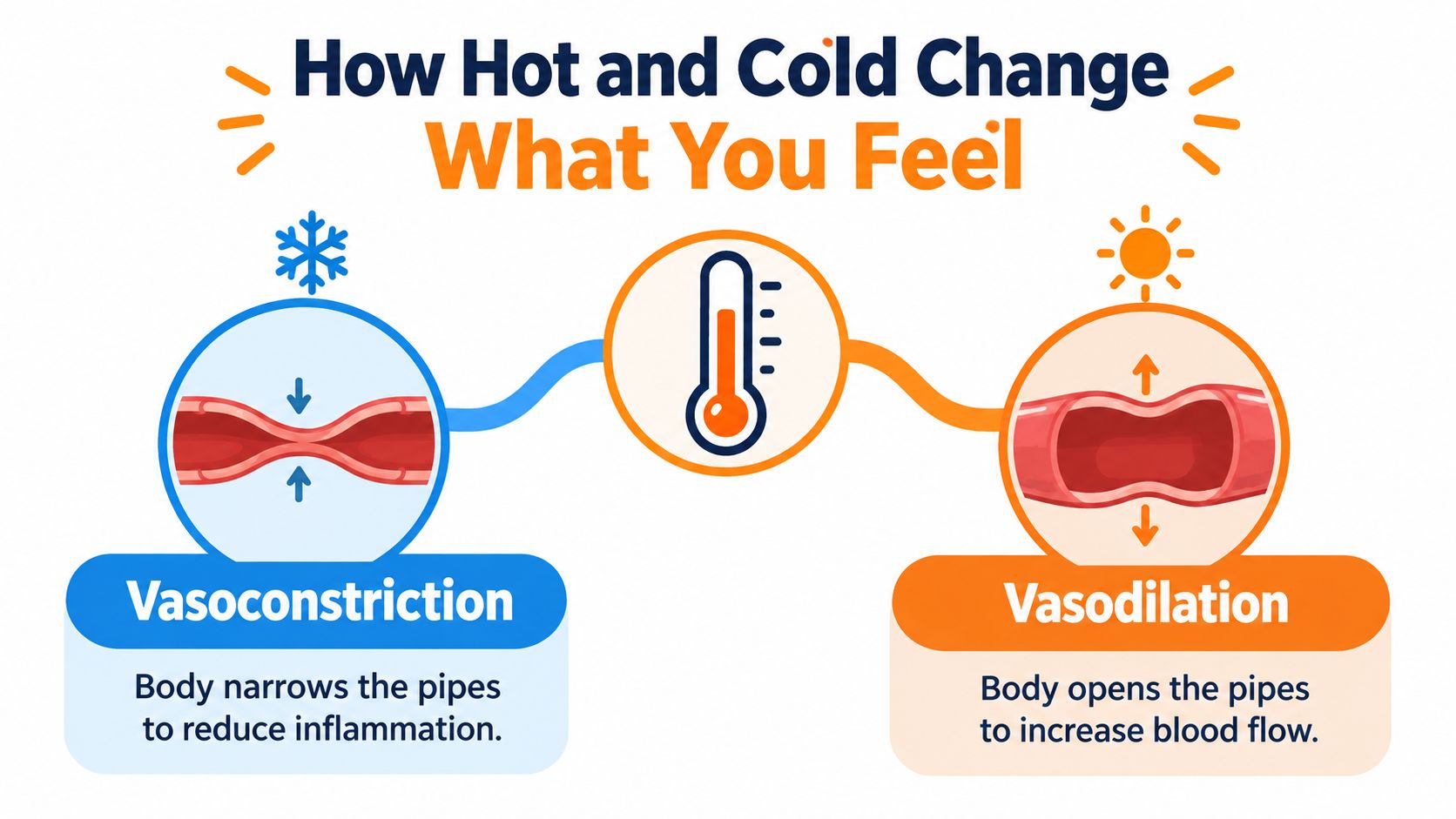
Cold narrows the pipes
When cold is applied to the skin, nearby blood vessels narrow. This response is called vasoconstriction. Picture a pipe becoming narrower: less blood flows through that local area for a time, which can help limit swelling and make pain feel less prominent.
That can be useful when an injury is fresh and the area feels warm, swollen, or tender. Cold can also temporarily dull sensation, which is one reason an ice pack may feel helpful after a bump or strain. It shouldn't be so cold that it burns, causes persistent numbness, or irritates the skin.
Heat opens the highway
Warmth encourages nearby blood vessels to widen, a response called vasodilation. Imagine opening a highway so traffic can move more freely. Increased local blood flow can support comfort in tight, stiff muscles, and the skin's warmth can also compete with pain signals as they travel toward the brain.
That effect helps explain why a warm wrap may feel good on a tense neck but unpleasant on a newly swollen injury. The body's needs have changed, so the same temperature may not suit both situations.
Temperature, duration, and the layer between wrap and skin all matter. Clinical guidance places superficial heat near 40–45 °C (104–113 °F), generally applied for 5–30 minutes, with a cloth barrier to help reduce burn and irritation risk (guidance on heat and cold for pain). Moisture can increase heat transfer, so a damp interface may feel more intense than a dry wrap at a similar surface temperature.
A systematic review of 32 randomized trials involving 1,098 participants found that cold applied soon after exercise reduced delayed-onset muscle soreness during the following day, while heat showed pain benefits both within and beyond that period. The review measured pain outcomes, not proof that either temperature heals injured tissue (systematic review of hot and cold therapy after exercise).
The Main Types of Hot and Cold Wraps
Wraps differ in how they hold temperature, conform to the body, and stay in place. Recognizing the main categories helps you compare options without assuming that one design suits every situation.
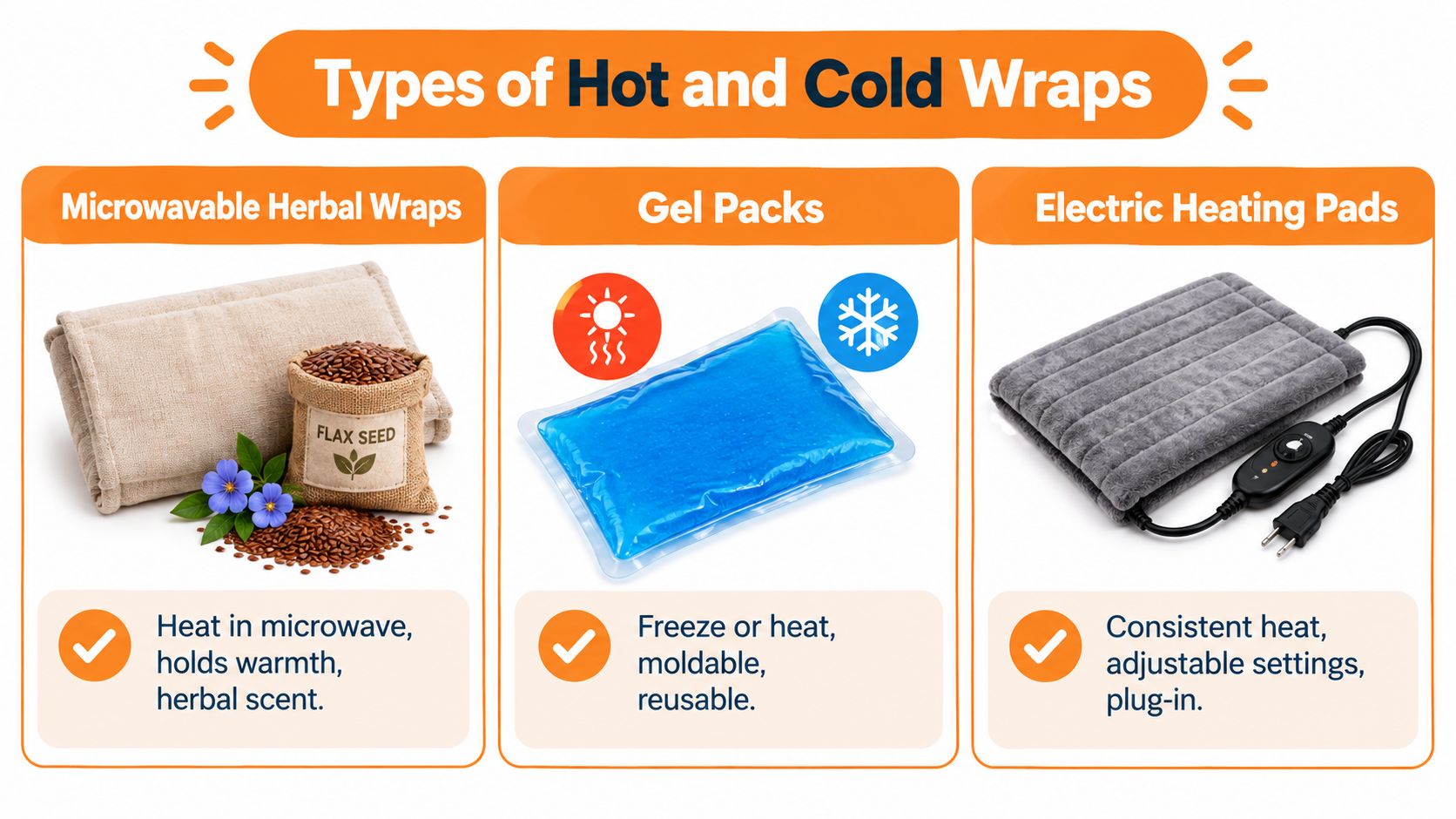
Microwavable and weighted wraps
Microwavable herbal wraps use a fabric pouch filled with materials such as flax seed or other weighted fills. They're convenient for a short break at home or work, and their flexible shape can drape across the neck or shoulders. Their limitation is that temperature can vary across the pouch, and heating instructions matter.
A weighted version may settle naturally over a joint or around the neck, which can feel more secure than a flat pad. The trade-off is that weight isn't right for everyone, especially if pressure on the area is uncomfortable.
Gel packs and portable options
Reusable gel packs can often be chilled or warmed, depending on the product's instructions. Their flexible shape can cover a focused area, such as a knee or elbow. They're less useful if they become too rigid when chilled or don't come with a comfortable cover.
Disposable air-activated patches provide portable warmth without a microwave or plug. They can suit an outdoor shift or a commute, but they're generally heat-only and should be used according to their individual directions.
Support and coverage
Compression sleeves and wrap-style holders combine a way to keep a pack in place with gentle support. They can be practical for an active routine, although a tight fit may be uncomfortable or unsuitable for some users. Check that the design doesn't press painfully or restrict movement.
Large body pads cover broader areas, such as the lower back or abdomen. They make sense when discomfort spans a wide region, but they're less targeted than a small pack.
SunnyBay's product range includes reusable microwavable wraps and gel-based accessories, alongside other targeted warming products. That's one example of how a product line may span different shapes and temperature uses, not a reason to assume every design will suit every person. Choose by body area, temperature mode, and fit.
When to Choose Heat and When to Choose Cold
A rolled ankle on a Saturday hike and a stiff neck after a week at a desk can end with the same question: heat or cold? Both feel like "something hurts," yet they call for opposite starting moves. The reliable way to decide is to read the timeline first, then check what the area is doing.
For a fresh injury with swelling, warmth, or sharp tenderness, cold is generally favored during the first 24 to 72 hours. For stiffness, tightness, or soreness that has settled in, gentle heat tends to be the more comfortable choice (clinical guidance on pain and inflammation).
An analogy can make this stick. Cold works like turning down the volume on an alarm, quieting the signals around a new injury. Heat works like warming a stiff hinge, loosening tissue so movement feels easier again.
| What you notice | A common starting choice | Why it may fit |
|---|---|---|
| New swelling after a twist or bump | Cold | Helps calm the sensation around an acute injury |
| Tight muscles after sitting | Heat | May ease stiffness and support comfortable movement |
| Soreness after exercise | Either, based on symptoms | Cold may suit early soreness; heat may help when tightness dominates |
| Long-standing stiffness | Heat | Often more comfortable when the main issue is restricted, tight movement |
Post-exercise soreness deserves a little nuance. As discussed earlier, cold applied soon after exercise reduced pain over the following day, while heat showed pain reduction both early and later. Those findings concern soreness and pain perception, not a promise that either mode speeds tissue healing.
For injury self-care in an athletic setting, Vitals Healthcare Doctor On Call offers this guide for Dubai fitness enthusiasts. And if a new injury has you reaching for cold first, SunnyBay's ice-bag guidance for injuries walks through practical application.
One common confusion is whether to alternate hot and cold in a single session. You usually don't need to. Pick the mode that matches the current symptoms, use it for a limited period, then reassess how the area feels. If pain lasts more than a week, persists despite self-care, or worsens, arrange a clinical evaluation rather than extending home treatment indefinitely (guidance on when to seek evaluation).
Decision cue: New swelling points toward cold. Familiar stiffness points toward heat.
Features That Actually Matter When You Choose a Wrap
A wrap doesn't need the boldest claim on the package. What matters most is whether it sits comfortably on the area and provides a stable, tolerable temperature while you use it. A wrap that slides away from a sore shoulder or heats unevenly is less useful than a simpler design that stays put and feels comfortable.
Fit and temperature control
Start with shape and coverage. A neck wrap should rest securely over the shoulders without squeezing the throat. A broad pad may suit lower-back soreness, while a smaller pack can be easier to place over a forearm or knee.
Next, look for clear heating or cooling instructions and a cover that feels comfortable against the skin. A soft inner layer can make direct contact more pleasant, while a well-constructed outer fabric can help distribute the fill. Weighted materials such as flax seed or lava sand may drape over curves, but added weight can also feel too heavy on a sensitive area.
Hands-free designs can be convenient when you want to sit upright or move gently during a short session. A loose pad may work well while resting, but it can shift if you change position. Neither style is automatically superior; the right one depends on whether you need secure placement or simpler coverage.
Match the design to the body area
Use this table as a starting point, then check the product's instructions and fit for yourself.
| Body area | Wrap style | Key feature to prioritize |
|---|---|---|
| Neck and shoulders | Contoured or hands-free neck wrap | Secure placement without pressure on the throat |
| Shoulder joint | Shaped shoulder wrap | Coverage that stays over the joint |
| Lower back | Broad body pad or wrap | Wide, even contact with the sore area |
| Hands and fingers | Hand warmer or glove-style wrap | Comfortable finger access and easy removal |
| Eyes | Warm eye mask or compress | Stable, gentle warmth and a comfortable fit |
A size that feels excessive on an arm may be useful across the back or shoulder. Instead of asking whether a wrap is “large” or “small,” ask whether its dimensions and closure match the area you want to treat.
For dry-eye discomfort, temperature consistency and ease of use matter more than choosing the most elaborate device. A recent review found benefits from eyelid-warming devices compared with controls, but didn't establish a clear overall advantage over ordinary warm towels or other warming devices; more well-designed trials are needed (review of eyelid-warming devices). Warm compresses may be more relevant for some meibomian-gland problems than for every cause of dry eye, so persistent or changing eye symptoms deserve professional advice.
Safe Use and Care That Keeps a Wrap Working
A wrap that feels only "a bit too warm" can keep injuring skin after you stop noticing it. Skin sheds heat the way a car radiator does, steadily and at a limited rate. Once incoming heat outruns what skin can release, a burn builds. That is why a protective layer, a comfortable temperature, and a firm stopping point belong inside the routine itself rather than as afterthoughts.
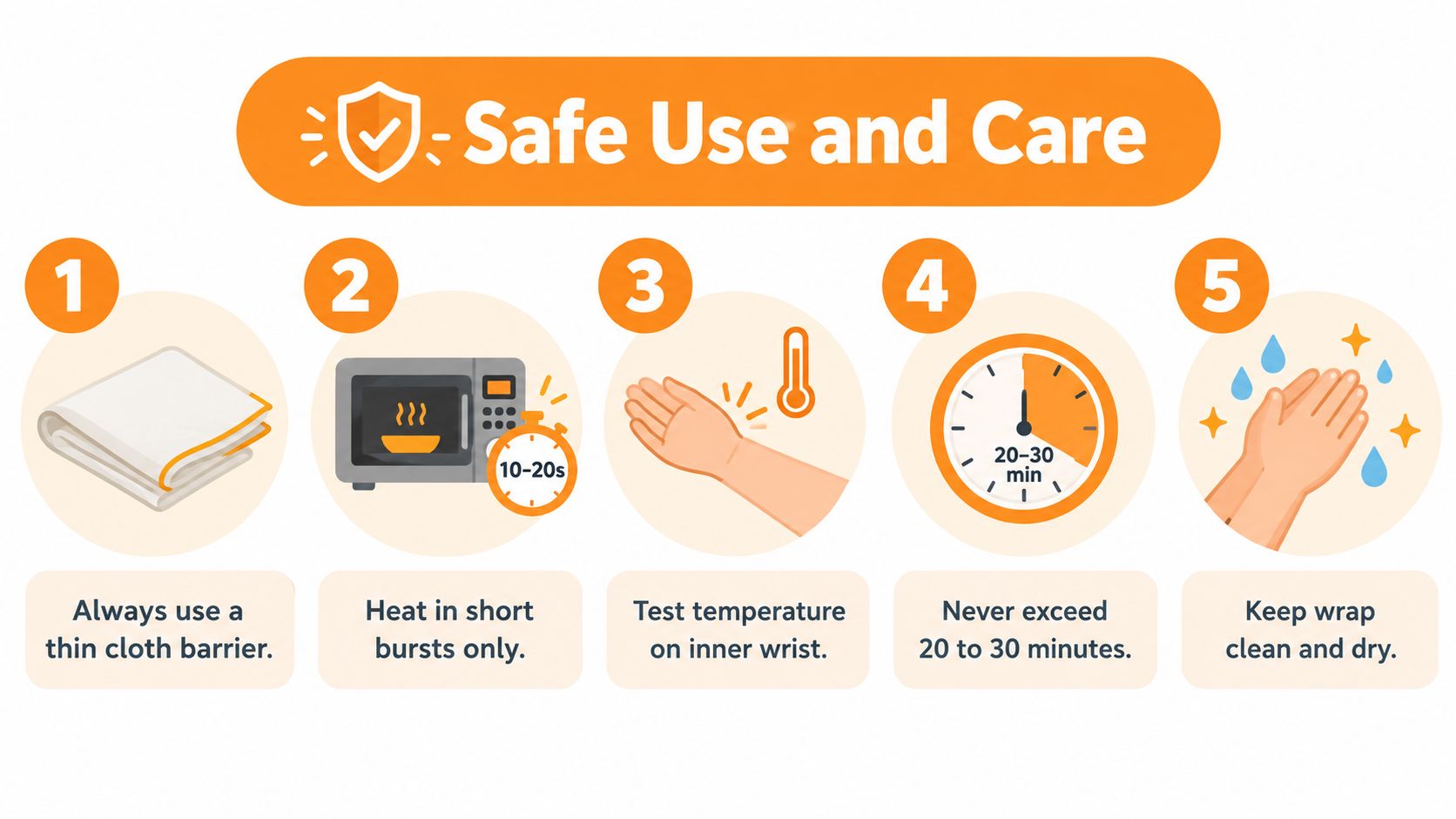
Before and during a session
- Use a barrier. Place a thin cloth between the wrap and your skin. The cloth slows heat transfer the same way a mug sleeve does, lowering the risk of burns, irritation, or cold-related skin injury.
- Follow the product's heating instructions. For a microwavable wrap, heat in short bursts if the instructions allow, then test the warmth on your inner wrist before applying. If your wrist reads "hot" rather than "warm," the wrap is still too intense for a resting arm, back, or leg.
- Keep sessions limited. Stay within the short, supervised session lengths covered earlier in this article, and let skin return to its normal color and temperature between uses. Never fall asleep with a wrap in place, because a sleeping person cannot catch early warning signs.
People with reduced sensation, impaired circulation, diabetes-related neuropathy, or fragile skin need extra caution, since they may not feel an injury developing. If you cannot reliably judge whether a wrap is too hot or too cold, ask a clinician before using it. Young children should not use superficial heat therapy unless they can remove the wrap themselves when it becomes uncomfortable.
Avoid applying heat over pain rubs, medicated lotions, creams, or ointments, which can change how skin absorbs or senses warmth. Skip broken or irritated skin entirely. Remove the wrap promptly if you feel burning or unusual numbness, notice discoloration, or find that pain is worsening.
Keep it clean and usable
Follow the maker's care instructions. Spot-clean fabric covers as directed, let them dry completely, and store reusable wraps away from sharp objects and heat sources. A wrap that leaks, splits, or develops uneven clumps has reached the end of its safe life. Replace it rather than patching it, because clumped filling heats unevenly and creates hot spots.
For more detail about handling a microwavable product safely, see SunnyBay's microwave-heating safety guide. Product designs vary, so the manufacturer's instructions take priority over any general routine.
Real Scenarios and How to Use a Wrap for Each
A wrap is easiest to use well when you match the temperature to the specific complaint, not just the body part. A shoulder can feel stiff one day and newly irritated the next, so check whether the main issue is tightness or fresh swelling before choosing a mode.
Everyday examples
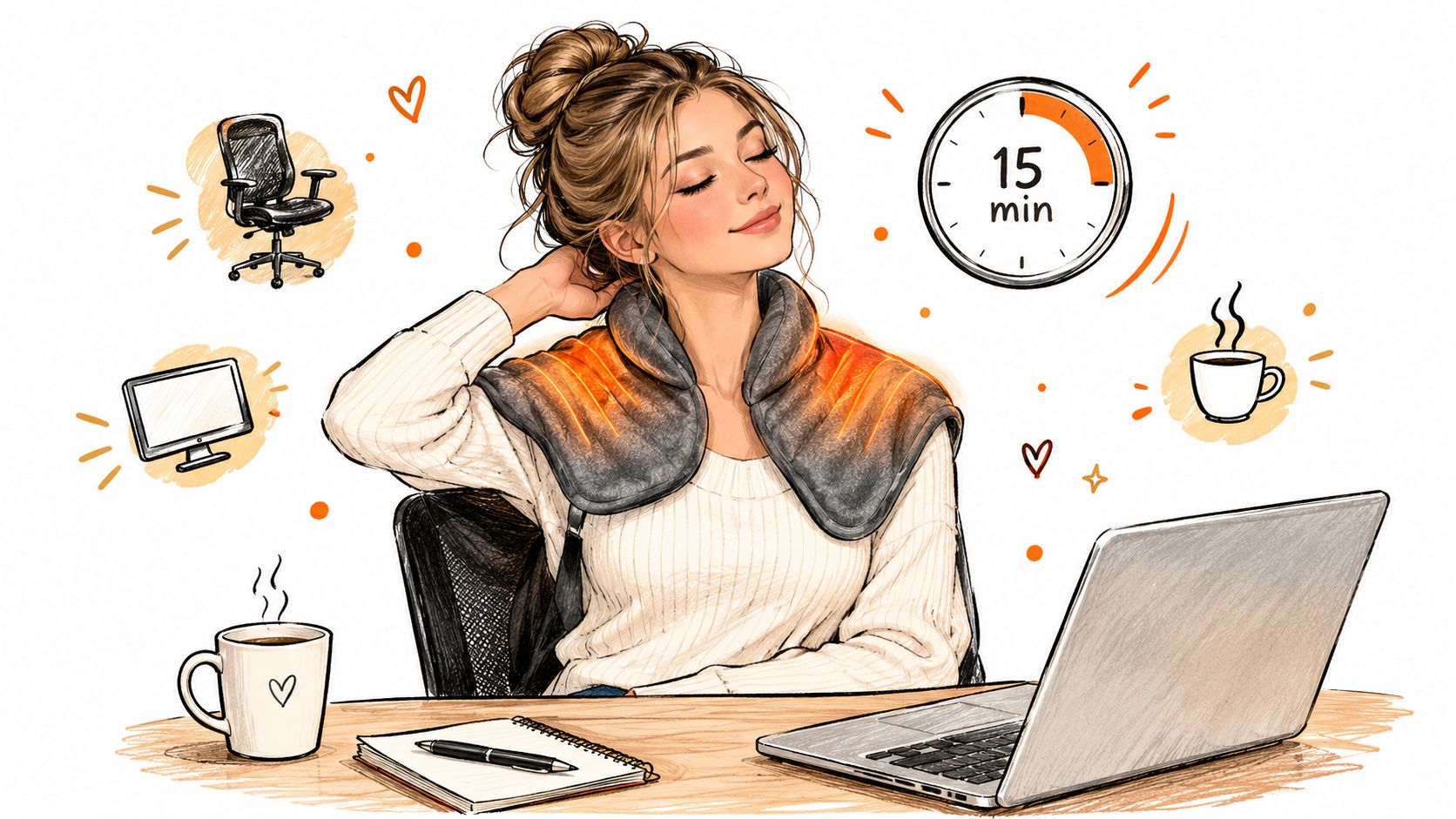
- Neck tension after desk work: Try gentle heat across the upper shoulders and base of the skull for a short, supervised session. Stop if the warmth causes burning, a headache, or more discomfort.
- Lower-back soreness after yard work: If there's no fresh swelling or injury, superficial heat may feel soothing. A Cochrane review found heat wraps reduced acute low-back pain after five days compared with an oral placebo, although the evidence was limited and varied in quality; evidence for cold in low-back pain was too weak for firm conclusions (Cochrane review of heat or cold for low-back pain). Stop if pain worsens or begins to spread.
- Dry, tired eyes after screen use: A comfortably warm eye compress may provide temporary comfort. Keep the temperature gentle and stop if you feel burning, pain, or worsening redness. Vision changes need professional assessment.
- Rotator-cuff or frozen-shoulder stiffness: If stiffness is the main complaint, gentle warmth before comfortable movement may help you get started. A new flare with swelling or sharp pain is a different situation; stop and seek appropriate advice if symptoms increase. For condition-specific context, see SunnyBay's rotator-cuff recovery guide.
- Post-exercise soreness in the legs: Cold may suit early soreness, especially if the area feels tender or warm. If tightness becomes the main issue later, gentle heat may feel better. Stop either treatment if numbness lingers or the skin changes color.
The video below offers an additional visual reference for applying temperature therapy. Use it alongside the product's instructions, since designs and safe-use directions can differ.
A wrap should leave the area feeling comfortable, not worse. If a symptom is severe, unusual, or not improving, don't keep experimenting with temperature in place of assessment.
Wrapping Up and Answering Common Questions
A wrap works like a thermostat you hold against one spot: it changes local conditions for a short window, and nothing more. Keep that in mind and the routine stays simple. Match the mode to the problem's phase, use a comfortable temperature for a limited session, place a cloth barrier between the wrap and skin, and stop if something feels wrong. When pain persists, the wrap has done what it can, and assessment takes over.
Questions people commonly ask
Can I fall asleep with a wrap on? No. Remove it when the session ends. Falling asleep makes it harder to notice excessive heat, cold, or pressure, so a session that felt fine at first can turn into a skin problem by morning.
Can a microwavable herbal wrap also be frozen? Only if the manufacturer says it's safe for freezing. Some fills may lose moisture or clump, so don't assume that a heat-only wrap can switch modes.
Does heat help arthritis? Warmth may feel helpful when stiffness is the main symptom. If a joint is newly swollen or hot, cold may be more comfortable. If symptoms change or don't settle, ask a clinician what's appropriate for your condition.
Can a wrap replace physical therapy? No. It supports comfort between sessions, but persistent pain needs a diagnosis and a movement plan. The decision section above explains how to tell when home treatment has run long enough and it's time to book an evaluation.
Hot and cold wraps are simple tools. Used with the right timing, a comfortable fit, and sensible limits, they support everyday care without asking them to do more than they can.
SunnyBay offers reusable microwavable wraps and hot/cold accessories for targeted comfort around areas such as the neck, shoulders, and back. Visit SunnyBay to explore options and choose a style that fits your body area and routine.


