


Head Cooling Wrap Guide: Types, Uses and Safe Use
-
Your forehead feels hot, your temples ache, and the cold pack you've grabbed won't stay in place. A head cooling wrap can make that moment more manageable, but choosing the coldest option isn't necessarily the best move.
The useful distinction is comfort cooling versus clinical temperature control. A wrap you wear at home may feel soothing without meaningfully changing your core temperature. Choosing the right design, checking its fit, and knowing when to take it off matter more than chasing maximum cold.
Table of Contents
- Head Cooling Wrap Types Compared Side by Side
- Conditions Where a Head Cooling Wrap Helps
- How Head Cooling Works and Safe Fit Limits
- Heat Load During Work and Exercise
- How to Use a Head Cooling Wrap Step by Step
- Pre-Use Checklist Before Your First Session
Head Cooling Wrap Types Compared Side by Side
Head cooling wrap designs and where each fits
| Design | How It Cools | Best For | Main Limitation |
|---|---|---|---|
| Gel pack wrap | Stored cold gel draws heat from the scalp | Headache or fever comfort at home | Warms during use; needs chilling or freezer space |
| Phase-change wrap | Material changes state near a set temperature | Steady comfort when a defined temperature band matters | Temperature band is product-specific; check the label |
| Ice-pack wrap | Frozen cubes or a frozen pack sit in a fabric sleeve | Clinician-approved cooling for acute swelling | Cold can be intense; requires close skin checks |
| Reusable frozen fabric wrap | Chilled fabric or contained filling absorbs heat | Portable use at the office, during activity breaks, or while traveling | Needs access to re-cooling |
| Liquid-cooled stationary system | A pump circulates chilled water through a cap or wrap | Clinical or supervised temperature-management settings | Requires equipment and setup; not a simple portable wrap |
A head cooling wrap is a flexible cooling product positioned across the forehead, temples, or back of the head. Its cooling medium determines how you prepare it, while its shape determines whether it stays comfortable against the intended area.
Portable packs and fabric wraps
Gel wraps are a practical starting point for occasional comfort. Check whether the product is meant for refrigeration, freezing, or both, because gel formulations don't all behave alike. A pack that remains flexible is easier to position than one that freezes into a rigid lump.
Phase-change wraps use material designed to change state around a specified temperature. That can make them useful when you want a defined cooling band rather than the initial intensity of frozen ice. Don't assume every phase-change product provides the same temperature or wear time.
Ice-pack wraps need particular care. If you're considering one for swelling after an injury or procedure, confirm that cooling is appropriate for that location before using it. A sleeve helps hold the pack, but it doesn't eliminate the need to monitor the skin.
Reusable fabric wraps suit people who want something easy to carry and reposition. Check what's inside: a water-wetted textile, a gel insert, and a filled fabric pack require different preparation and cleaning. An ordinary fabric wrap shouldn't go into a freezer unless its instructions permit it.
When equipment changes the decision
A liquid-cooled system adds a pump, tubing, and a controlled cooling supply. That's a different category from placing a chilled pack against your forehead. Clinical equipment belongs within an appropriate treatment protocol, not an improvised home routine.
For a broader explanation of choosing between warmth and cold, use this guide to hot and cold therapy wraps.
Selection rule: Choose for the setting and the cooling task, not for the strongest initial chill.
Before buying, answer these questions: How long do you need access to cooling? Where will you wear it? Can you refrigerate or freeze it there? A portable wrap is only convenient if you can prepare and safely reuse it.
Conditions Where a Head Cooling Wrap Helps
For a headache, placing something cool across the forehead and temples may feel soothing. That's a comfort choice, not proof that the wrap treats migraine or resolves the cause of a tension headache. Direct evidence for ordinary consumer wraps is limited, and pain that changes or worsens deserves attention.
For familiar tension-type discomfort, natural approaches to relieving tension headaches can help you think beyond the pack itself. If headaches occur alongside jaw discomfort or sleep concerns, discussing assessment and care at Pain and Sleep Therapy Center may be more useful than repeatedly cooling the painful area.
Match the claim to the condition
Head cooling by condition: evidence and practical note
| Condition | What the Evidence Shows | Practical Note |
|---|---|---|
| Migraine or tension headache | Consumer use is primarily for subjective comfort, not an established treatment outcome | Stop if pain spreads, changes, or becomes worse |
| Fever | A comfort measure, not treatment for the underlying illness or reliable fever control | Maintain appropriate fluids and rest; seek advice for high or persistent fever |
| Post-operative care in cardiac surgery | A 2023 randomized pediatric trial found lower core temperatures with a wrap plus forced-air warming than with warming alone, with p < 0.0001 | A specialized clinical application, under the care team's instructions |
| Concussion symptoms in teens | An Akron Children's Hospital study reported by Ideastream involved 167 patients aged 12–19 and reported symptom improvements of 14% after one treatment and 25% after two, versus standard care | A research setting, not instructions for treating concussion at home |
| Exercise in relapsing-remitting multiple sclerosis | A study described by The Neurology Hub found average exercise duration of 28.4 minutes with cooling versus 20.8 minutes without, in 10 adults | A small study; discuss an exercise-cooling plan with a neurologist |
| Heat exposure during work or exercise | Head cooling can contribute to heat removal under controlled conditions | Use alongside rest, shade, and hydration, never as sole protection |
The cardiac-surgery finding concerns limiting core-temperature elevation during forced-air warming. It doesn't establish that a home wrap reduces postoperative swelling, treats headaches, or controls fever.
Likewise, feeling cooler during fever doesn't tell you whether the illness is improving. Don't use a comfortable forehead as a substitute for checking the person's overall condition.
A wrap may change how symptoms feel without changing why they're happening.
Confusion, fainting, loss of coordination, or steadily worsening symptoms require medical attention, not another cooling session. A suspected concussion also needs clinical assessment even if cooling seems to help.
How Head Cooling Works and Safe Fit Limits
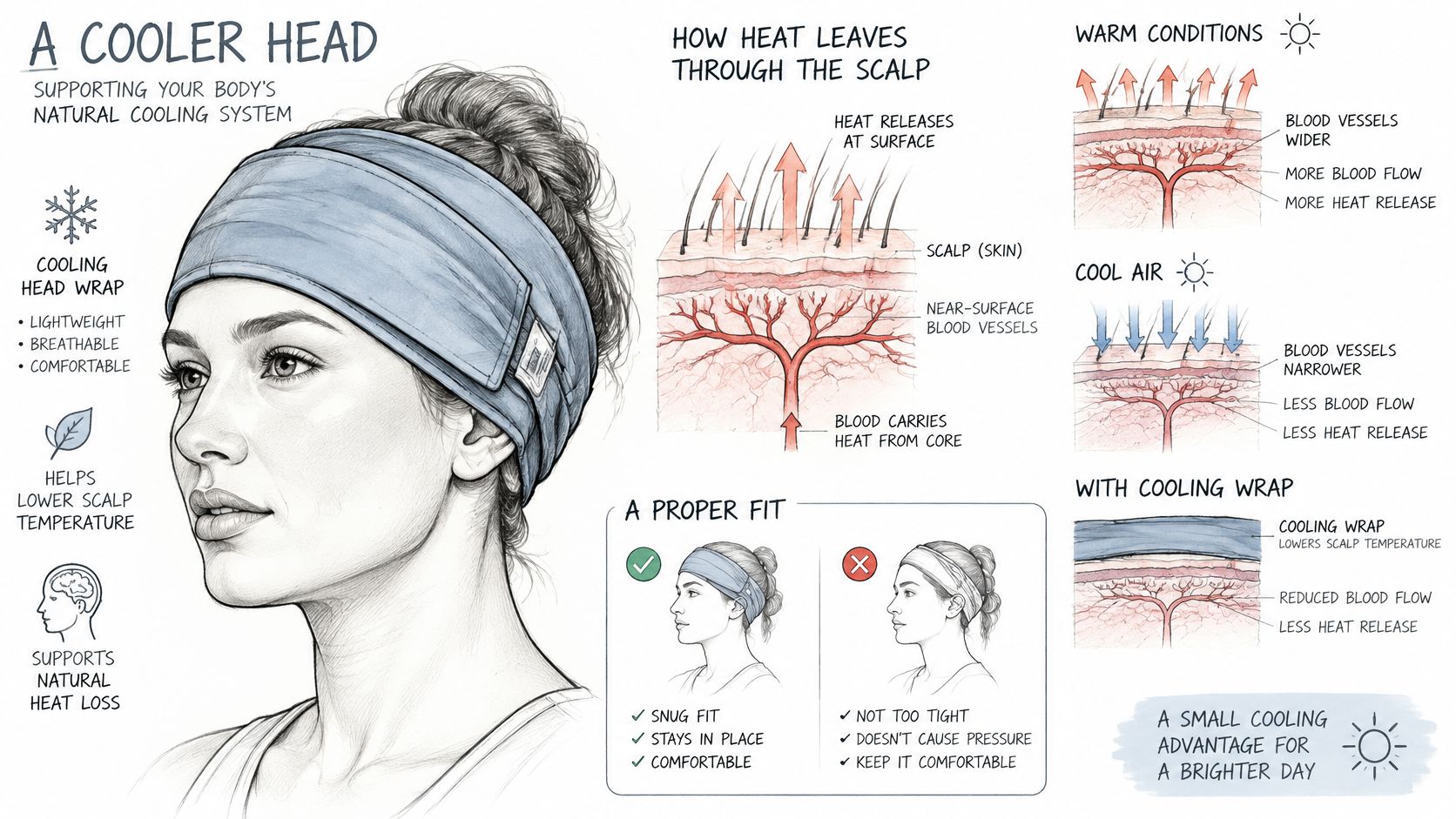
Think of the scalp as part of a radiator: blood carries heat toward vessels near the surface, where heat can pass into something cooler. But unlike a household radiator, those vessels can narrow in response to cold. That means the scalp's temperature and blood flow change together.
The illustration shows the surface-level cooling pathway.
Why colder isn't automatically better
In a controlled NASA study, 24 healthy adults used a liquid-cooled head-and-neck system for 30 minutes at approximately 21 °C ambient temperature; oral temperature fell by about 0.2–0.6 °C and continued declining by roughly 0.1–0.2 °C for around 10 minutes after removal, while intracranial blood flow decreased significantly during the first 10 minutes.
That was an instrumented cooling system, not a freezer-chilled consumer wrap. An oral-temperature change also isn't a direct measurement of whole-brain temperature. The important practical lesson is that cooling can have physiological effects beyond the immediate cold sensation.
A local-hypothermia and scalp-perfusion paper describes scalp temperature reaching approximately 26 °C within 5 minutes in a device study, while a separate experiment found that the first 10 °C reduction in scalp temperature lowered skin perfusion to below 40%.
Those findings help explain the tradeoff. Skin can become very cold while deeper cooling remains limited, and narrowing blood vessels can restrict further heat transfer. Numbness isn't a useful target, even if you're hoping for stronger relief.
Fit the wrap without chasing pressure
Say you take a wrap from the freezer and find that it feels sharp or painful against your forehead. Don't tighten it to improve contact. Let it moderate, add an appropriate barrier, and reassess whether it's suitable to wear.
Use this fit checklist:
- Protect the skin. Place a thin, dry cloth or the product's specified temperature-moderating layer between the cooling medium and skin.
- Spread the contact. Position the wrap over its intended areas without concentrating a frozen edge against a small spot.
- Keep pressure comfortable. It should stay in place without pressing on the eyes, folding the ears, or causing a pressure headache.
- Keep bare ice off skin. A strap or sleeve doesn't make direct ice contact safe.
- Use a timer. Follow the product's wear limit, remain awake, and remove it sooner if discomfort develops.
This video offers an additional visual reference; your product's instructions and clinician's advice remain the controlling guidance.
Who needs medical advice first
Children, older adults, and people with reduced sensation may need help recognizing excessive cold or removing a wrap promptly. Seek advice before use if you have circulation problems, cold sensitivity, injured skin, or difficulty judging temperature.
Clinical scalp-cooling literature in Scientific Reports describes exclusions involving migraine, cold sensitivity, cold-agglutinin disease, cryoglobulinemia, cryofibrinogenemia, certain thyroid disorders, and scalp or brain metastases.
Those exclusions don't establish that every consumer wrap is unsafe for everyone with migraine. They do show why eligibility for medical scalp cooling can't be reduced to whether someone tolerates an ice pack. People with these conditions should get individualized advice rather than borrow a clinical protocol.
Remove the wrap immediately for numbness, burning, unusual pain, discoloration, blisters, or welts. Don't reapply it to test whether the reaction happens again. Seek medical advice if symptoms persist after removal, and obtain prompt care for blistering, marked discoloration, or suspected cold injury.
Heat Load During Work and Exercise
A report in Aviation, Space, and Environmental Medicine found that head cooling removed approximately 30% of resting metabolic heat and 19% of the available heat generated during work. These are controlled-research benchmarks, not performance promises for a wrap worn while gardening or running.
The cooling temperature, contact area, session length, airflow, humidity, clothing, workload, and the wearer's condition all affect the result. A cold forehead doesn't establish that the rest of your body is shedding heat fast enough.
Build a layered heat plan
The head is an accessible place to apply targeted cooling when whole-body cooling is impractical. That can make a wrap useful during a shaded recovery break, provided it doesn't interfere with required protective equipment.
Use it within a broader plan:
- Prepare your fluids. Have drinking water available before starting and during activity; follow any clinician-directed fluid restrictions.
- Arrange shade and breaks. Choose a noticeably cooler recovery area rather than relying on a brief pause in direct sun.
- Use cooling during recovery. Apply the wrap in a timed session when you can monitor your skin and how you feel.
- Reduce or stop activity when necessary. Don't extend the job or workout just because your forehead feels better.
Say you're doing yard work in heavy clothing. A chilled wrap during a seated break may improve comfort, but returning immediately to the same workload doesn't address the continuing heat exposure. Adjust the task, pace, clothing where safe, or timing of the work.
Heat-safety rule: Feeling refreshed isn't permission to ignore worsening symptoms.
Know when the plan has failed
Confusion, faintness, loss of coordination, or symptoms that keep worsening mean stop and seek help immediately. Move out of the heat if you can do so safely, and don't leave a symptomatic person alone. Confusion, collapse, or impaired coordination warrants emergency assistance.
A wrap cannot independently prevent heat illness. Treat it as an optional cooling tool, not a safety guarantee or a replacement for environmental controls.
How to Use a Head Cooling Wrap Step by Step
- Check the wrap and your skin. Look for torn seams, damaged fasteners, or escaping filling, and don't apply it to numb, broken, or irritated skin without medical advice.
- Prepare it by its cooling method. Refrigerate, freeze, or wet it only as the product permits; don't assume every fabric wrap or gel insert is freezer-safe.
- Add the barrier and position the wrap. Use a dry cloth or the supplied protective layer, then place the wrap on its intended contact area without covering your airway or forcing a tight fit.
- Set a conservative session limit. Use the manufacturer's consumer wear instructions, check early rather than waiting for discomfort, and remove the wrap immediately if a stop sign appears.
- Remove it and allow recovery. Inspect the skin and wait until normal warmth, color, and sensation have returned before considering another session; don't rotate frozen packs continuously to prolong exposure.
- Clean and store it correctly. Wipe the wrap with a damp cloth after use, let it dry before storage, and follow its preparation instructions before chilling again; for a dual-use heating wrap, let it fully cool before reheating.
- Retire damaged components. Stop using a wrap with leaking gel or fill, torn fabric, or unreliable fasteners; if cooling performance changes, check preparation and storage before deciding it needs replacement.
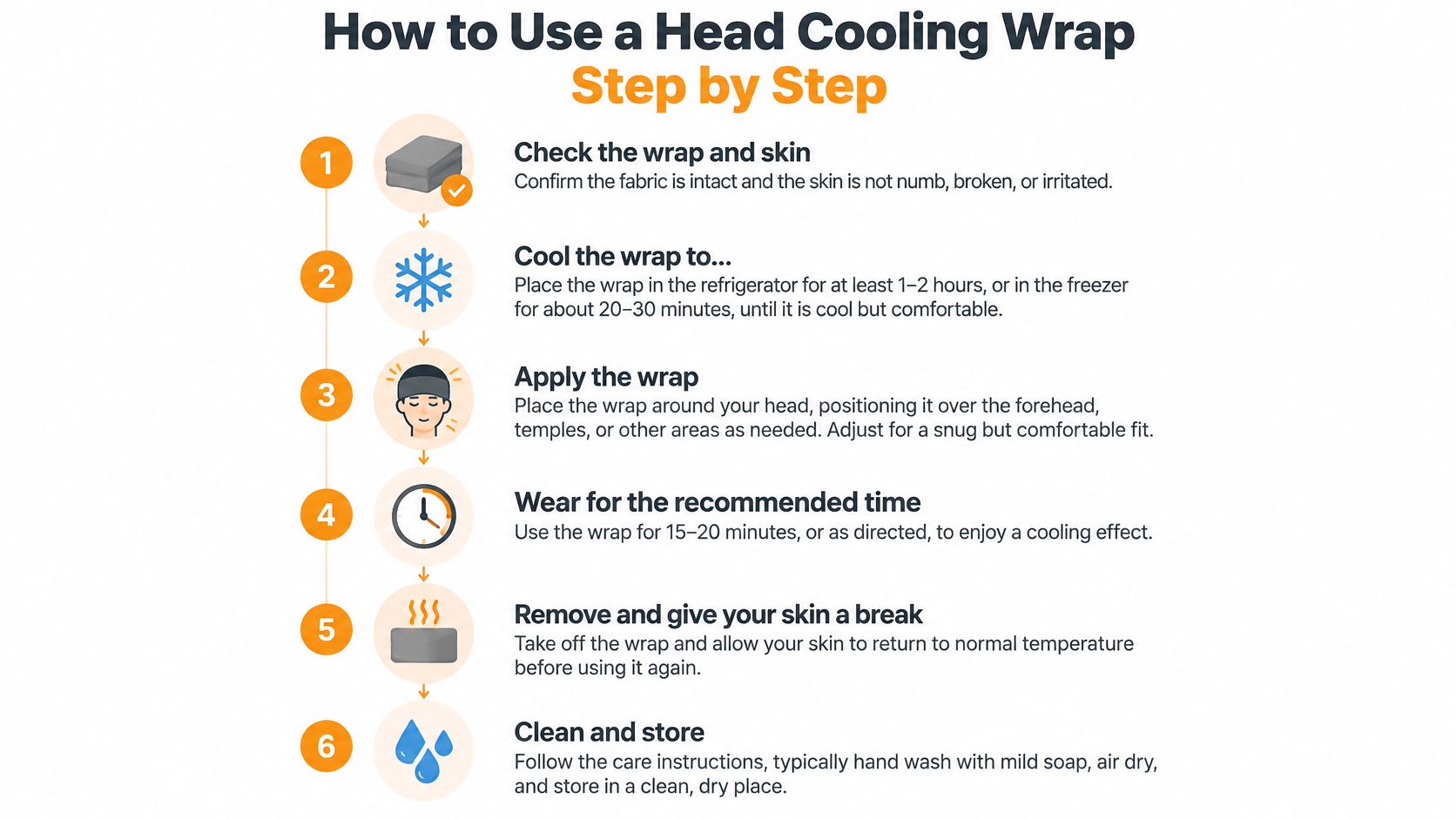
The visual guide provides a quick reminder of preparation, placement, and care.
Don't borrow a hospital wear schedule
Chemotherapy scalp-cooling literature describes pre-cooling commonly lasting 5–30 minutes and post-cooling lasting 15 minutes to 4 hours. Those are treatment-protocol intervals, not suggested wear times for consumer wraps.
There's no universal home-use duration supported by those protocols. Hair thickness, room temperature, insulation, fit, and the pack's starting temperature affect how a consumer product performs. Refreezing restores stored cold, but it doesn't make longer skin exposure safer.
For repeat use, note what you experienced: comfortable contact, an uneven cold spot, pressure, or irritation. Change the fit or stop using the product rather than trying to overcome discomfort through longer wear.
Subjective relief and clinical outcomes are different measurements. A wrap can feel pleasant without reliably controlling scalp temperature, lowering core temperature, or treating the condition causing your symptoms.
Pre-Use Checklist Before Your First Session
Before preparing the wrap, finish this sentence: I'm using cooling for… A clear purpose helps you avoid turning an ordinary comfort product into an improvised medical treatment.
Use the checklist as a final preparation check, not permission to proceed despite concerning symptoms.
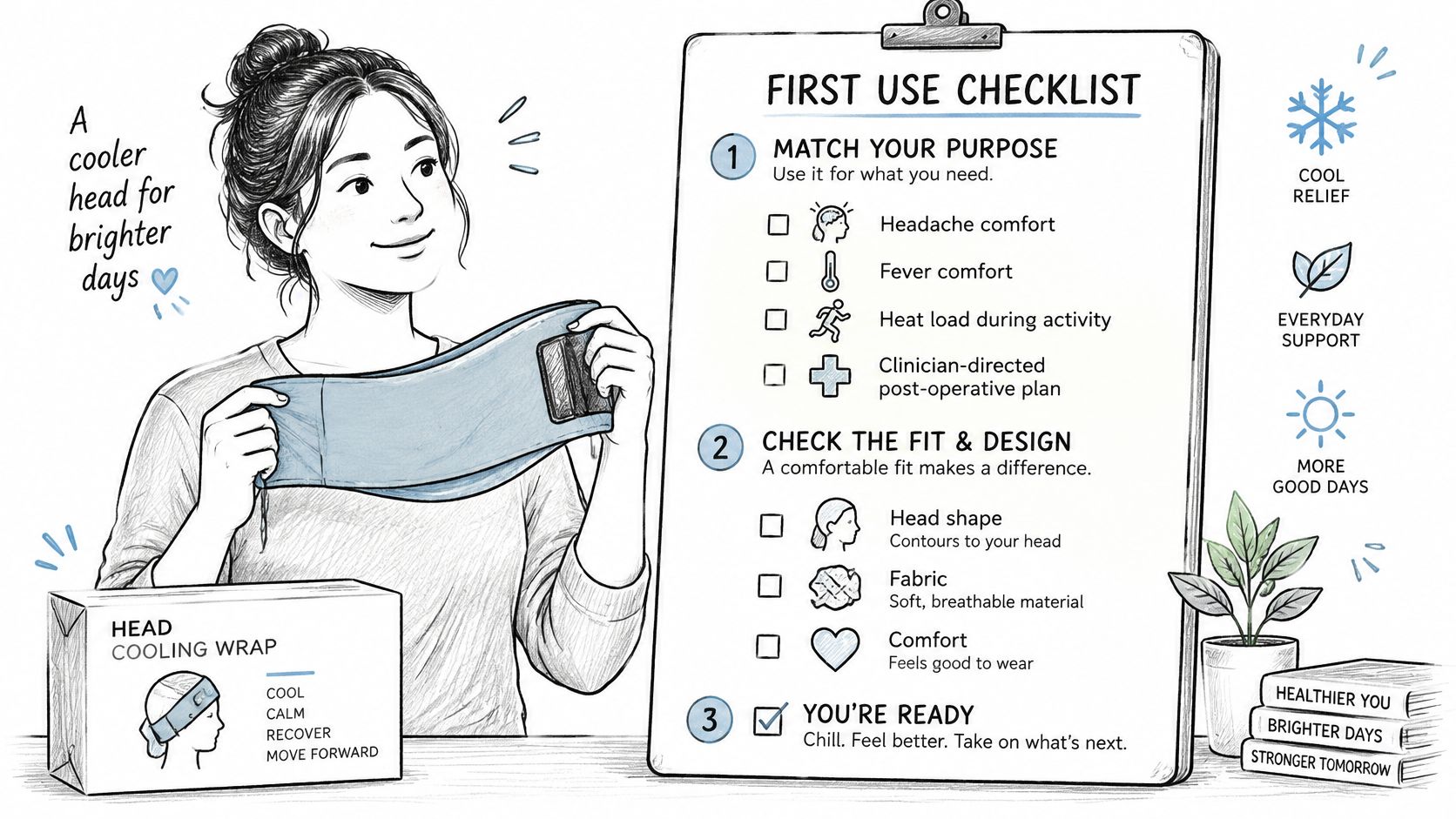
Make the decision before chilling
- Purpose confirmed. You're seeking comfort for a familiar symptom, supporting an activity-recovery plan, or following specific clinical instructions.
- Design matched. You've chosen a cooling medium you can prepare and monitor, rather than selecting ice because it feels strongest.
- Fit checked. The product is intended for the area where you'll place it and won't require excessive tightening or improvised straps.
- Preparation understood. You know whether the item permits freezing, refrigeration, or warming; dual-use capability shouldn't be assumed.
- Limits ready. The barrier and timer are within reach, and you can remove the wrap without assistance or have someone available to help.
- Medical questions resolved. Severe, sudden, unexplained, or postoperative symptoms have been discussed with an appropriate clinician before home cooling.
If you're choosing cooling for a new injury, this explanation of using an ice bag for injuries can help you assess the format. It doesn't replace assessment of a head injury.
The best first session is one you can monitor comfortably and stop easily.
Our SunnyBay reusable neck and body wraps are another format, not head-specific medical devices. The wrap can be microwaved for heat or frozen for cooling relief, and our heated wraps contain fresh flax seeds rather than gels or chemicals. Those material choices don't remove the need for temperature checks, appropriate placement, and the same stop rules.
SunnyBay offers reusable hot/cold neck wraps and body pads for targeted comfort, rather than clinical head-temperature control. Visit SunnyBay to compare the intended body areas, preparation instructions, and wrap formats before choosing an option for your routine.


