


Frozen Shoulder vs Rotator Cuff: How to Tell Them Apart
-
The most repeated shortcut for frozen shoulder vs rotator cuff is tidy and often wrong. If a helper can lift the arm, people say it's a cuff problem. If the arm stays stuck, they say it's frozen shoulder. That test is useful, but it isn't a verdict. The two problems start in different tissues, they limit motion in different ways, and they can sit in the same shoulder at once. Pain at night, trouble dressing, and a weak overhead reach show up in both. What changes the next step is the pattern of active motion (what you do yourself) and passive motion (what someone else can do while you relax), plus a clear reason for any scan.
Table of Contents
- Frozen Shoulder and Rotator Cuff Injury Side by Side
- What Frozen Shoulder Is and How It Progresses
- What a Rotator Cuff Injury Does to the Shoulder
- The Movement Test That Separates the Two
- How Clinicians Confirm Each Condition
- Heat, Therapy and Recovery Timelines Compared
- Real Scenarios and Which Condition Fits
- Decide Your Next Step and When to Seek Care
Frozen Shoulder and Rotator Cuff Injury Side by Side
Frozen shoulder is a painful, progressively tight joint capsule. A rotator cuff injury is damage to the tendons and muscles that stabilize and lift the arm. One locks the joint lining. The other weakens the machinery that moves the ball in the socket.
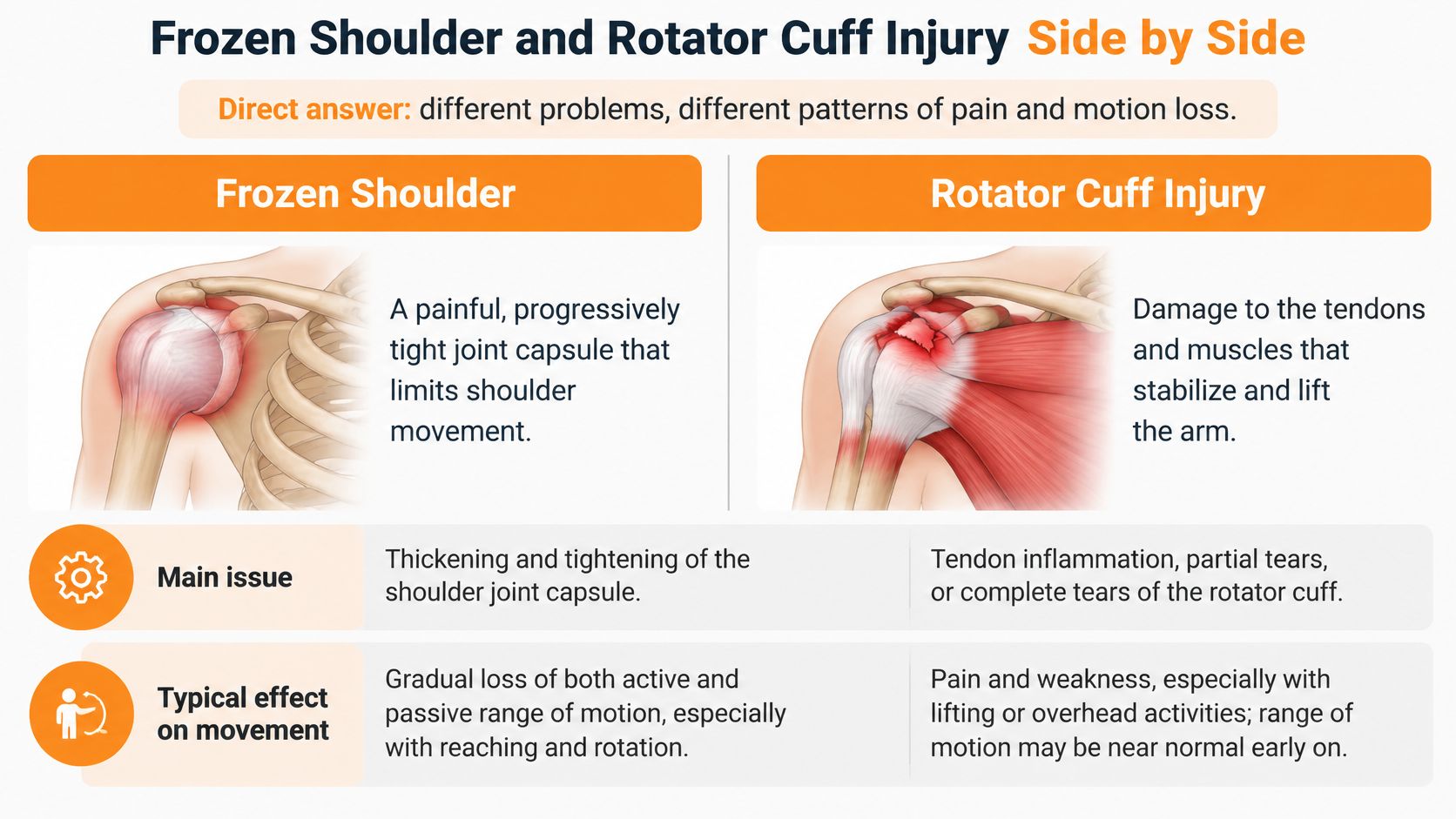
| Feature | Frozen shoulder | Rotator cuff injury |
|---|---|---|
| Medical name | Adhesive capsulitis | Rotator cuff tendinopathy or tear |
| Core problem | Capsule around the joint becomes painful and tight | Tendons or muscles that stabilize and lift the arm are damaged |
| Motion pattern | Active and passive motion both restricted | Passive motion often preserved; active lifting painful or weak |
| Typical age | Most often 40 to 70 | Rises with age and repetitive overhead use |
| Strongest associated condition | Diabetes | Overuse, repetitive reaching or trauma |
| Usual course | Freezing, frozen and thawing phases | Varies with lesion size; partial tears may improve with therapy |
| Key bedside test | Passive external rotation severely limited | Weakness on resisted movement |
Read the rows as clues, not labels. Adhesive capsulitis means the capsule, the sleeve around the ball-and-socket joint, has thickened and contracted. Tendinopathy means an irritated or worn tendon. A tear means fibers have split, partly or all the way through.
The motion row is the one that changes care. Global stiffness points toward the capsule. Painful or weak lifting with a freer passive range points toward the cuff. Age and diabetes raise suspicion for capsular stiffness. Overhead work, a fall, or a heavy lift raises suspicion for the cuff. Even then, a cuff problem can produce protective stiffness, and a stiff capsule can hide a tendon defect.
Practical rule: Match your limits to a column, then test whether someone else can move the arm farther than you can. The column is a starting map, not the diagnosis.
What Frozen Shoulder Is and How It Progresses
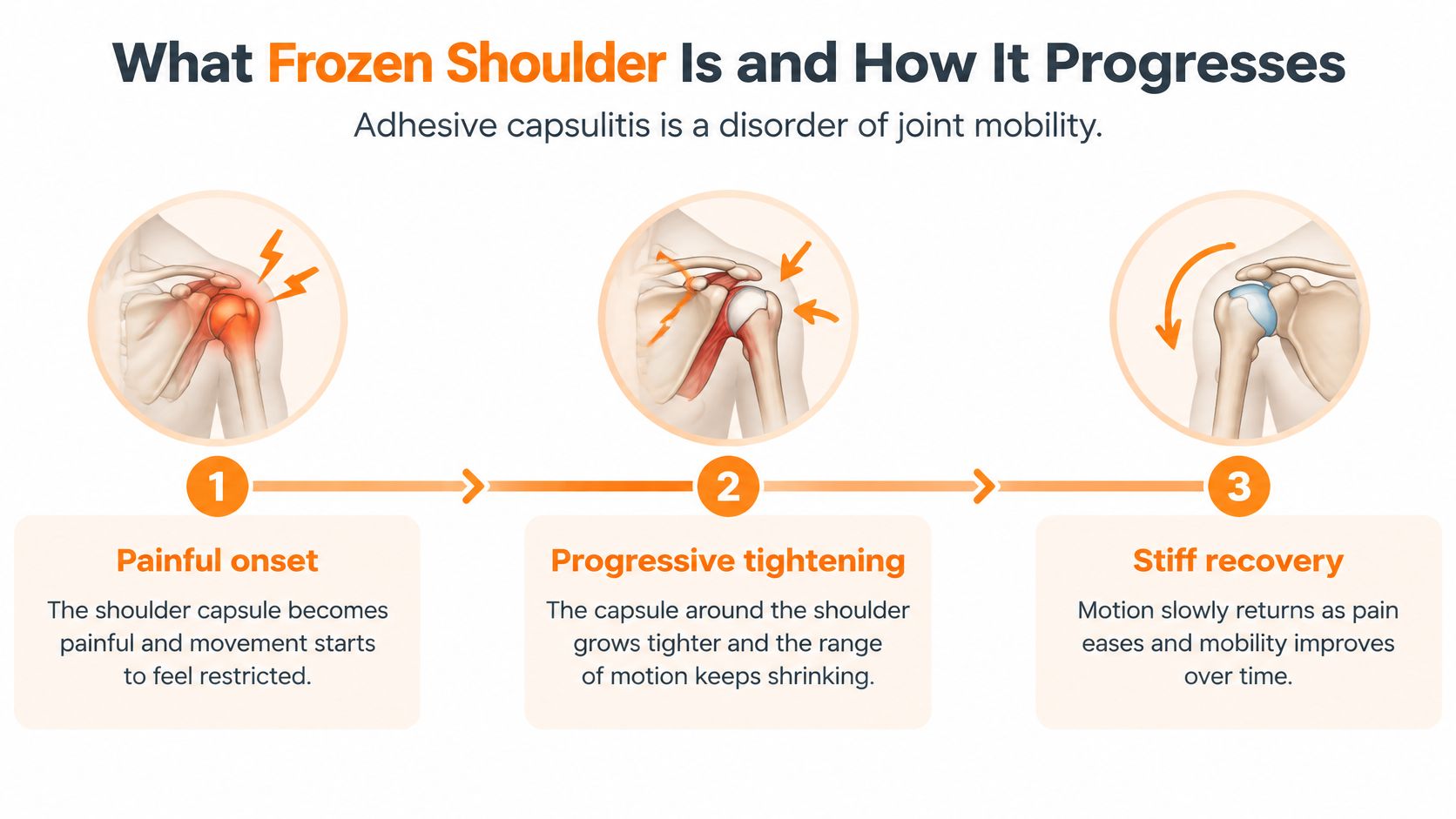
Adhesive capsulitis is a disorder of joint mobility. The capsule becomes painful and progressively tight, so both the movement you make and the movement someone else applies get smaller.
Cambridge University Hospitals patient information puts usual prevalence at 2%–5% of the general population, with published estimates from 0.5% to 10% depending on how the condition is defined. The same guidance notes diagnosis most often between ages 40 and 70, with diabetes an important associated condition. A large U.S. Medicare analysis identified 92,437 people older than 65 with adhesive capsulitis, an estimated one-year prevalence of 0.35% (92,437 of 26,756,183 beneficiaries over 65).
The three phases people live through
You don't jump from normal to locked overnight.
- Freezing: Pain builds, often worse at night, and reach starts to shrink. Reaching a seatbelt or a high shelf hurts more each week.
- Frozen: Stiffness takes over. Pain may ease a little, yet the shoulder feels mechanically stuck, especially turning the palm outward with the elbow at your side.
- Thawing: Motion returns gradually. Gains are uneven. A better week doesn't mean the capsule is finished changing.
Heat can feel soothing during any phase. Worsening stiffness still needs a clinician, because care centers on pain control, carefully dosed mobility work, physiotherapy, and, in selected cases, a corticosteroid injection or another procedure.
A timeline you can write down
Before any self-label, note three things.
- Which phase fits now: rising pain, dominant stiffness, or slow return of motion.
- How long it has lasted: weeks, or many months.
- The direction of change: night pain and lost motion getting worse, flat, or better.
That log is for the exam. It isn't a diagnosis.
What a Rotator Cuff Injury Does to the Shoulder
The rotator cuff is a group of muscles and tendons that helps keep the upper-arm bone centered in the shoulder and powers lifting, reaching, and rotation. When a tendon is irritated or torn, everyday tasks can expose the problem: carrying a grocery bag may hurt, lying on that side may wake you, and raising the arm overhead may feel weak or unreliable. The joint may still move when someone else supports the arm.
Frimley Health guidance on rotator cuff repair describes a common pattern: cuff problems cause weakness or painful active motion, while passive range is relatively better. After rotator cuff repair, postoperative stiffness or frozen shoulder occurs in about 3%–5% of people. A cuff problem and frozen shoulder can therefore coexist, so one symptom alone does not settle the diagnosis.
Partial tear versus full-thickness tear
A partial-thickness tear affects some tendon fibers. It may cause aching, mild weakness, or guarding, where pain makes you limit movement. A full-thickness tear extends through the tendon and may make it harder to lift or hold the arm up. Pain itself can also reduce effort, so a home strength check cannot reliably distinguish a tear from pain-related weakness.
Clicking or popping during an overhead reach may occur with cuff problems, but a noise alone does not prove there is a tear. This overview of common causes of rotator cuff popping explains why shoulder sounds can have more than one cause.
Two checks before you decide it's "just the muscle"
- What dominates: painful lifting and weakness, or stiffness that limits movement in many directions.
- Who moves the arm: whether it travels farther when relaxed and assisted, or reaches a similar limit either way.
Pain on the outer shoulder cannot identify the cause by itself. Warmth may soothe nearby muscles, but it cannot repair a tendon or distinguish a tear from capsulitis, arthritis, or another problem. Sudden injury, marked weakness, deformity, or inability to raise the arm calls for timely clinical review. Many cuff problems are managed with activity changes, pain relief, physiotherapy, and later strengthening. When a tear follows an injury or weakness continues to limit function, clinicians may consider imaging and discuss whether surgery is appropriate.
The Movement Test That Separates the Two
The separating principle is simple. Frozen shoulder restricts passive motion as well as active motion. When someone else moves the arm, it hits the same wall. Cuff disease usually leaves that passive range in place while active elevation and rotation hurt or fail.
American Family Physician describes adhesive capsulitis as a global restriction of glenohumeral motion, classically with external rotation most limited, because the capsule contracts and the axillary recess and rotator interval thicken. Cuff tendinopathy or a tear usually preserves passive motion. A painful arc and positive Hawkins or Neer tests support cuff-related pathology.
| Movement or test | Frozen shoulder | Rotator cuff tear |
|---|---|---|
| Passive external rotation | Markedly limited | Usually preserved |
| Active elevation | Limited and painful | Painful or lost, especially with full-thickness tears |
| Resisted abduction or external rotation | Pain, limited by stiffness | Weak, a key sign of cuff pathology |
| Painful arc during raising | Less typical | Common in cuff disease |
| Hawkins or Neer test | Not the typical pattern | Positive result supports cuff pathology |
How a clinician runs the key moves
Passive external rotation is the headline. Elbow tucked at the side, forearm turned outward by the examiner, you stay relaxed. Marked loss points to the capsule.
Active elevation is what you can lift forward or out to the side. Limited and painful fits capsular stiffness. Painful or absent elevation, especially after trauma, fits a larger tear.
Resisted abduction and external rotation ask the tendon to work. Weakness here, with passive motion still available, is the cuff sign. Stiffness-limited pain is a different story.
Hawkins and Neer tests position the shoulder so irritated cuff tissue gets pinched. A positive result supports cuff pathology. It doesn't prove a full tear, and it isn't the classic frozen-shoulder pattern.
Why a kitchen self-test still fails
Partial-thickness defects can restrict motion too. Pain alone can stop you from trying. A partner who pushes too hard can hurt you without learning anything reliable. You can also have both problems. Capsular contracture plus a cuff tear won't match one clean column.
If passive external rotation is nearly as limited as active motion, prioritize capsular stiffness. Don't treat weakness alone as proof of a tear. If passive motion is preserved and resisted movement is weak, ultrasound or MRI is the more relevant next look at cuff integrity.
Noncontrast MRI can support adhesive capsulitis when it shows coracohumeral-ligament thickening, rotator-interval fat infiltration, or axillary-recess thickening. Guidelines still treat frozen shoulder as primarily a clinical diagnosis and use imaging mainly to check for other pathology.
Write down, for the visit, how far you lift alone, how far a gentle helper gets, which resisted move feels weak, and whether pain sits in one arc or in every direction. Bring the notes. Don't treat them as a label.
How Clinicians Confirm Each Condition
Confirmation starts with the exam, not a picture. Frozen shoulder is defined by restricted passive and active glenohumeral motion. A major full-thickness cuff tear more often keeps passive motion and loses active elevation through weakness. University of Washington Orthopaedics is direct that the two can coexist, so "frozen shoulder versus tear" is an oversimplification. A person may have capsular stiffness plus a cuff tear, or a cuff problem that produces protective stiffness.
| Test | Best used for | Main limit |
|---|---|---|
| Clinical examination | Classic stiffness pattern and the first step in assessment | Depends on the examiner and on how much pain limits effort |
| X-ray | Excluding arthritis, fracture or calcific disease | Does not confirm adhesive capsulitis |
| Ultrasound | Suspected full-thickness cuff tear where skilled examiners are available | Operator-dependent; sensitivity 0.95 and specificity 0.96 for full-thickness tears |
| MRI or MR arthrography | Persistent, complex or surgical cases needing structural detail | Not always indicated; capsule findings are specific but not fully sensitive |
What each picture is allowed to decide
Plain radiographs generally exclude arthritis, fracture, or calcific disease. They don't confirm adhesive capsulitis. A normal-looking X-ray leaves both diagnoses open. Imaging is often unnecessary when the clinical pattern is classic.
Ultrasound is the practical cuff check when a skilled examiner is available. A shoulder-guideline summary reports pooled sensitivity of 0.95 and specificity of 0.96 for full-thickness tears, so about 95% of true full-thickness tears are detected and 96% of people without that tear are classified correctly, and ultrasound is described as nearly as effective as MRI for partial tears in the Washington State shoulder guideline. Skill still matters. A 2025 rotator-cuff guideline notes that sonography can support initial diagnosis and follow-up when expertise is present, while MRI is favored for acute injuries, symptoms lasting more than 3–6 months, or planned surgery, and that ultrasound depends on the examiner, as set out in the 2025 rotator cuff guideline.
MRI, or MR arthrography, earns its place when symptoms fail to improve after roughly 6 weeks to 3 months, or when weakness, trauma, or atypical findings raise concern for a tear. Capsule and ligament changes can support adhesive capsulitis. They aren't fully sensitive, and routine imaging isn't always indicated. No single scan has proven itself the superior frozen-shoulder test across every technique and confounder.
The question to ask before you book a scan
What decision will this result change? If the pattern is classic capsular stiffness and red flags are absent, more images may not change the plan of pain control and guided mobility. If passive motion is preserved and resisted strength is poor, a cuff-focused scan can change whether you stay with strengthening or discuss repair. Temporary warmth that eases ache doesn't prove the problem is "muscular." Our notes on the most common rotator cuff discomfort and how it's diagnosed walk through that diagnostic fork in plain language. Acute traumatic weakness, or an arm you can't actively raise, shouldn't wait on a comfort experiment.
Heat, Therapy and Recovery Timelines Compared
Heat is comfort support, not repair. It can relax muscle around a stiff or sore shoulder before gentle movement. It doesn't free a contracted capsule by itself, and it doesn't reattach tendon.
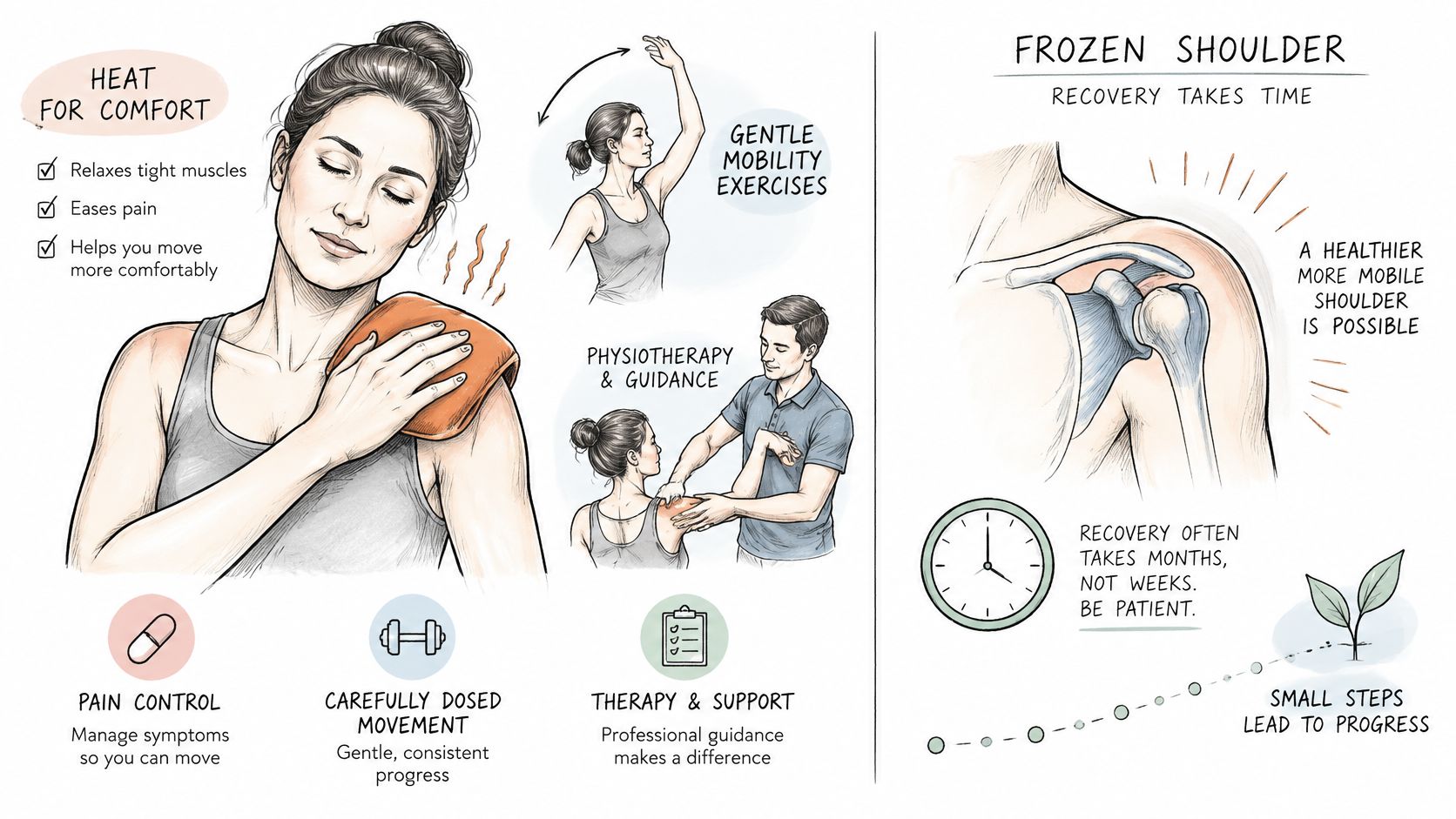
| Condition | Main conservative approach | Role of heat or ice | Typical timeline |
|---|---|---|---|
| Frozen shoulder | Pain control, dosed mobility exercises, physiotherapy, injection in selected cases | Comfort and muscle relief; does not free the capsule alone | Often one to three years overall, across three phases |
| Rotator cuff injury | Activity change, analgesia, progressive strengthening | Comfort and muscle relief; cannot repair a tendon | Partial tears often improve over several months; acute or persistent weakness may need surgical review |
For capsular stiffness, the dose of stretching matters. Aggressive pulling in a highly painful phase often flares the shoulder. Short, comfortable mobility, pain control, and physiotherapy lead. A corticosteroid injection is a selected add-on, not a first reflex for every stiff shoulder. Surgery such as capsular release is for stiffness that stays disabling after a real course of care.
For cuff injury, the early job is to change the load. Stop the overhead repetition that provokes the tendon, use analgesia, then rebuild strength in a graded way. Acute traumatic loss of lift, or weakness that doesn't recover, is when imaging and surgical review enter. A clear overview of non-surgical care for injured shoulders is worth reading beside your therapy plan so strengthening stays matched to the tendon, not copied from a generic workout.
Where warmth and cold actually fit
Use heat before easy motion, when muscle guarding is the barrier. Use cold after a flare or a harder session, when the shoulder feels hot and irritable. Our short guide on when to ice and when to heat spells out that timing. The Shoulder Joint Heat Wrap for Rotator Cuff and Frozen Shoulder, Royal Blue is $29.99 on sale if you want hands-free warmth over the joint before those mobility minutes. A Large Ice Bag with Strap can be filled with ice or hot water, so one bag covers both sides of a flare.
A short walk-through of comfortable shoulder motion makes the "don't force it" point easier to picture.
Track the same three things each week, the same way. Measure one reach (hand behind the back, or palm-up rotation with the elbow in). Note night waking. Note one strength task, such as lifting a light mug to shoulder height. Bring the log if the line is flat. Comfort that lasts twenty minutes isn't the same as tendon healing or capsule recovery.
Real Scenarios and Which Condition Fits
Say you're 54, you have diabetes, and stiffness crept in over several weeks. You can't tuck in a shirt. A partner can't turn your forearm outward any farther than you can. That is the classic capsular pattern. First action: book a clinical review and start a dosed mobility plan rather than heavy strengthening.
Say you fell on an outstretched arm yesterday. Pain is sudden, the shoulder looks different, and you can't lift the arm. That pattern treats a cuff tear as the leading concern until a clinician says otherwise. First action: prompt assessment, and imaging if weakness or loss of elevation is clear.
Say you throw or paint overhead. Passive motion is nearly full. Resisted outward rotation is the weak, painful spot. That's a tendinopathy pattern more than a locked capsule. First action: load management and progressive cuff strengthening, not aggressive end-range stretching.
Say you already had a cuff repair and the shoulder has tightened since. Postoperative stiffness is a known follow-on, not proof the repair "failed" and not proof you only have adhesive capsulitis. First action: mobility work coordinated with the surgical team, on their timeline.
Say both columns fit. Passive rotation is clearly down, and resisted lifting is weak out of proportion to pain. You may need the capsule and the tendon addressed, in an order a clinician sets. First action: an exam that tests passive range and strength separately, then a scan only if the result would change treatment.
These sketches are recognition tools. Overlapping night pain is exactly why a clinic visit still confirms the pattern.
Decide Your Next Step and When to Seek Care
Book a clinical assessment for any shoulder pain that limits daily life, and ask what each test would change before you agree to it.
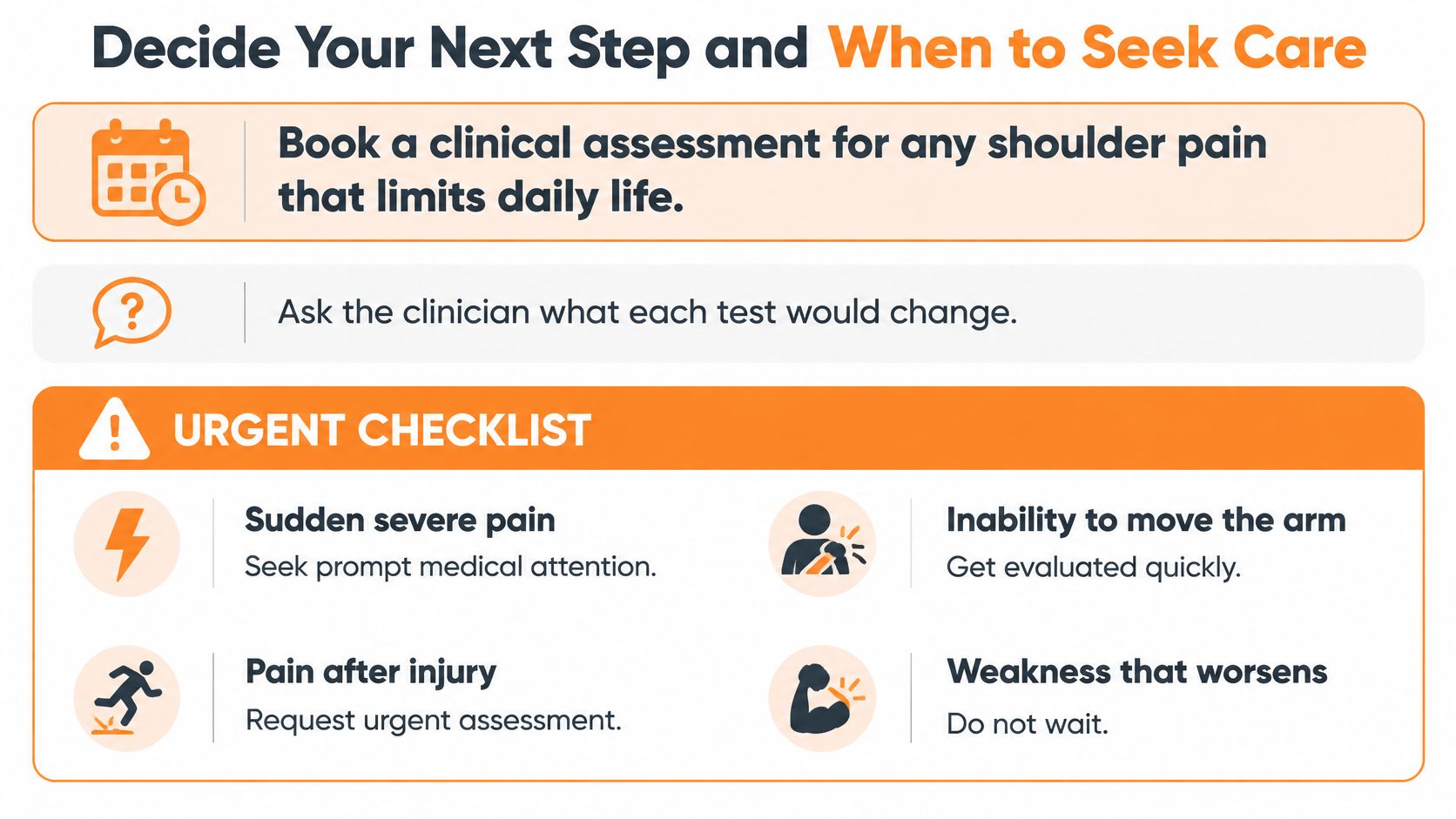
See an orthopedic shoulder specialist, or a physiotherapist experienced with shoulders, sooner when any of these show up.
- Sudden severe pain after an injury. Don't wait to see if it settles overnight.
- Inability to lift the arm. Active elevation that's gone is a different problem from gradual stiffness.
- Visible deformity. A changed contour needs same-day eyes on it.
- Marked or new weakness. Strength loss out of proportion to ache raises concern for a significant tear.
- Numbness or loss of function. That can mean more than the capsule or the cuff.
For stubborn frozen shoulder that hasn't responded to therapy, arthroscopic capsular release is one option clinicians discuss. A 2025 systematic review indexed by PubMed covered 45 studies and 1,921 patients and reported three postoperative rotator-cuff tears, 0.16%. That figure is about one surgical risk, not a promise of who should have surgery.
Bring a one-page log. When pain starts, which movements hurt, night symptoms, diabetes or thyroid history, and any fall or repair. While you wait, keep motion inside a comfortable range and don't crank a stiff joint. Our notes on how to treat frozen shoulder at home stay in that gentle lane. Today, write the passive-versus-active result, circle any urgent trigger above, and book the visit if daily tasks are already shrinking.
SunnyBay makes reusable hot and cold wraps for shoulders, including designs meant to sit on the joint before gentle mobility work for frozen shoulder or rotator cuff soreness. Warmth is there to make movement more comfortable, not to diagnose the capsule or repair a tendon. If you're sorting frozen shoulder vs rotator cuff and want practical heat-and-ice tools to use alongside clinical care, visit SunnyBay.


