


Ankle Heating Pad: When Heat Helps and When It Hurts
-
The familiar advice to put heat on a sore ankle leaves out the most important question: is it stiff, or is it newly injured and swollen? An ankle heating pad may make a settled, tight ankle more comfortable, but warmth can worsen swelling after a fresh sprain. Feeling soothing isn't proof that a treatment suits the injury.
There's another catch. Someone with a cold, numb ankle may want warmth most urgently, yet reduced sensation can make a heating pad particularly risky. Choose heat by the ankle's condition and your ability to feel temperature, not only by whether warmth sounds appealing.
Table of Contents
- When an Ankle Needs Heat or Cold
- Wrap Designs and Ankle Sizing
- How to Apply Ankle Heat Safely
- Stiffness Sessions After Sprains and Arthritis
- Fills Covers and Everyday Care
- Choose a Pad That Stays Put
When an Ankle Needs Heat or Cold
| Situation | Use | Why | Window | Stop if |
|---|---|---|---|---|
| Fresh sprain, swollen or bruised | Cold, plus protection and elevation | Heat can aggravate swelling during acute injury | Brief applications through cloth, following clinical advice | Skin becomes numb, pain worsens, or swelling grows |
| Still puffy several days later | Cold, not heat | Ongoing puffiness means the ankle hasn't necessarily moved beyond the inflammatory phase | Short cold sessions while swelling is being assessed | Swelling isn't settling |
| Chronic arthritis or morning stiffness, no new swelling | Heat may be appropriate | Gentle warmth can help with settled tightness | A short, awake session within the product's instructions | Persistent redness, mottling, or blistering appears |
| Muscle tightness after activity, swelling gone | Heat may be appropriate | Local warmth can make tight tissue feel more comfortable | Brief seated use before gentle movement | Pain or puffiness returns |
| Numbness, diabetic neuropathy, poor circulation, or drowsiness | Neither temperature treatment without clinical guidance | Impaired sensation or circulation changes the safety decision | Use loose clothing or comfortable room warmth instead | Any concerning skin change appears |
| Later rehabilitation after a clinician clears the acute phase | Heat as comfort support, not a cure | Superficial warmth has a place after acute inflammation | A clinician-approved session with skin checks | Instability, fracture concern, or new swelling develops |
Why swelling changes the answer
Think of small blood vessels as delivery roads through the ankle. Heat widens those roads, a response called vasodilation, allowing more blood into the warmed area. That can suit a settled, stiff ankle, but an injured area already dealing with leaking fluid and swelling doesn't necessarily need more incoming traffic.
The National Athletic Trainers' Association position statement advises against thermotherapy during acute and subacute ankle injury because warming can worsen swelling. The important distinction is the tissue's condition, not whether a certain number of days has passed.
A small trial summarized in the ankle-sprain guidance hosted by the National Athletic Trainers' Association illustrates the problem: among 30 young adults treated three to five days after injury, mean ankle-volume increases were 3.3 mL with cold, 25.3 mL with heat, and 26.5 mL with contrast therapy. Those findings don't establish every person's response, but they challenge the idea that alternating hot and cold automatically makes a swollen ankle better.
Bruising isn't a countdown timer, either. Bruising may remain after the initial injury, while swelling, tenderness, and difficulty bearing weight still need attention. Don't use a change in bruise color as permission to start heating.
For practical context on choosing between the treatments, MedAmerica Rehab Center's ankle sprain recovery guidance for active adults is a useful companion to individualized advice. For cold-pack placement and barriers, see this guide to an ice pack for feet and ankle.
Where warmth belongs
An international multidisciplinary Delphi consensus published in 2022 found 86% agreement that superficial heat may be indicated for strains and sprains during chronic rehabilitation or after the acute phase has ended. That supports a limited role for heat, not a blanket recommendation for any ankle pain.
A heating pad applies superficial warmth, primarily to skin and nearby tissue. It may make gentle movement more comfortable, but it doesn't knit a torn ligament, stabilize a loose joint, or establish that you're ready to return to sport. Don't mistake temporary relief for restored strength or balance.
Practical rule: Choose by swelling and function, not by the calendar. An ankle that remains puffy isn't automatically ready for heat.
Cold also has limits. It's a symptom-management tool, not permission to keep walking on a potentially serious injury, and it shouldn't be applied directly to skin or continued until the area becomes numb. People with reduced sensation or circulation problems need individualized advice about cold as well as heat.
Seek assessment rather than experimenting with temperature if you can't bear weight, the ankle looks deformed, swelling is rapidly increasing, or the joint repeatedly gives way. A newly red, hot, unusually painful ankle also deserves attention, especially when you don't know what caused it.
Wrap Designs and Ankle Sizing
An ankle isn't a flat surface. The malleoli, the bony bumps on either side, interrupt contact with a pad, while the heel and Achilles tendon create awkward edges. A pack that sits comfortably across your back may bunch, slide, or press against bone when wrapped around your ankle.
Fit should distribute warmth without creating pressure points. A wrap's ability to stay attached matters less than whether you can remove it easily and inspect the skin.
| Design | Best for | Fit check | Main miss |
|---|---|---|---|
| Open wrap with adjustable straps | Changing ankle size or an initial fit trial, once heat is appropriate | Straps rest lightly; ankle bones aren't pinched | Tightened aggressively to stay on while walking |
| Soft sleeve | Chronic stiffness with stable ankle size | Even contact without toe color changes or constriction | A tight cuff creates a tourniquet-like effect |
| Small pack plus light strap | A localized stiff area near the ankle | Pack rests against soft tissue rather than pressing only on bone | Slides sideways or bunches near the heel |
| Seated electric pad with a cover | Stationary home use | Covered pad rests lightly against the ankle | Used in bed, folded, or trapped under bedding |
Measure for contact, not compression
Use a flexible measuring tape around the narrow area just above the ankle bones, then compare that measurement with the product's sizing instructions. If the design passes under the foot or around the heel, check those dimensions too. An ankle-circumference measurement alone won't tell you whether a foot loop fits.
Fasten the wrap lightly and slide your fingertips beneath the strap. You should be able to lift the strap without pulling hard or leaving a deep groove. Check that your toes remain their usual color and temperature, and loosen or remove the wrap if you feel tingling.
Length and width both matter. Excess fabric can fold at the shoe line, while a narrow pack may roll off the outer ankle bone and concentrate its weight along an edge.
Hands-free doesn't mean walking-ready
A heating wrap is a seated comfort tool, not a medical ankle brace. Don't tighten it until it survives a walk around the house, and don't use a shoe or boot to hold it against your skin. Both approaches can introduce pressure you didn't intend.
Adjustable beats compressive when ankle size is unpredictable.
Before buying, check whether you can open the fastening without twisting your ankle or bending awkwardly. Easy removal is a meaningful safety feature, particularly if your hands are stiff or your reach is limited.
How to Apply Ankle Heat Safely
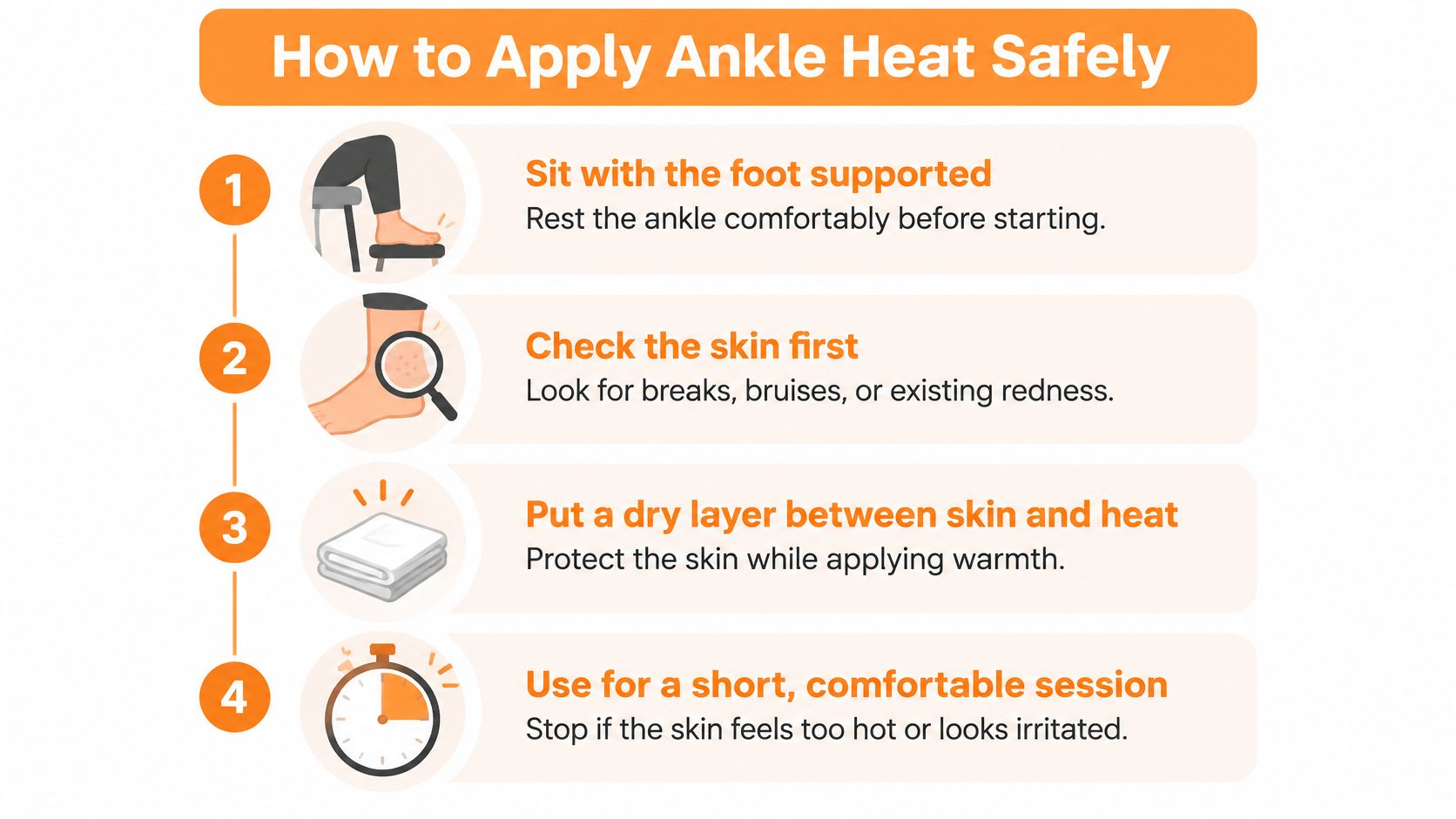
Use this routine only when the ankle's condition makes heat appropriate. Gather the pad, its cover or a dry cloth, and a timer before sitting down, so you don't have to walk with the pack attached.
A seated routine with checks built in
- Support the foot and inspect the skin. Sit securely with your ankle comfortably supported. Look for broken skin, existing redness, irritation, or unexpected swelling so you won't mistake a pre-existing problem for a reaction to the pad.
- Add a dry protective layer. Put the supplied cover or a suitable dry cloth between the pad and your skin. Don't begin with bare-skin contact and add protection only after it feels too hot.
- Prepare gentle, even warmth. For a microwavable pack, use the manufacturer's heating directions, including any instructions about redistributing the fill. For an electric pad, start at the lowest suitable setting; test the covered surface with normally sensitive skin before placing it on the ankle.
- Position without squeezing. Rest the pack against the stiff area and secure it lightly if it has straps. Avoid wedging a heavy pack against the ankle bones or tightening a fastening to force full contact.
- Set a timer within the permitted session length. Use the shorter limit if your clinician and the product instructions differ. Don't extend the session because the pad feels mild, and don't pile blankets over an electric pad.
- Lift the pad during use. Look directly at the skin rather than judging safety only by comfort. Stop promptly if the skin becomes increasingly red, blotchy, painful, or unusually swollen.
- Remove the heat for warning signs. Persistent redness, mottling, blistering, or worsening pain isn't a normal target response. Don't immediately reapply the pad; seek medical advice for a suspected burn, particularly if blistering or skin breakdown occurs.
- Finish before you become sleepy. Remove the pack, inspect the skin again, and let it return to normal before considering another session. Never sleep with a heating pad attached.
Reduced sensation changes the routine
A numb ankle shouldn't be warmed by trial and error. A clinical report on severe burns in people with diabetic neuropathy documents injuries associated with heat sources, illustrating why unreliable temperature sensation makes home warming hazardous.
If you have diabetes-related neuropathy, nerve injury, vascular disease, or numb feet, ask a clinician before applying heat. Age alone doesn't establish loss of sensation, but an older adult who can't reliably distinguish warm from hot shouldn't rely on comfort as a safety check.
Loose socks and a comfortably warmed room are preferable to pressing a heat source against an ankle you can't feel. Gentle movement may also be an option when your clinician says it's suitable. The broader heating pad safety guide can help you review equipment and habits, but it doesn't replace that individual assessment.
Stiffness Sessions After Sprains and Arthritis
Ankle injuries are common enough that many people eventually face the home-care decision. A pooled analysis published in Bone & Joint Research in 2022 reported ankle-sprain incidence of 429.4 cases per 100,000 person-years and summarized evidence that chronic ankle instability affected approximately 40% of people one year after a first-time lateral ankle sprain. Persistent symptoms therefore deserve more thought than just finding a warmer pack.
These everyday scenarios show the difference between using warmth for comfort and asking it to do a rehabilitation job it can't perform.
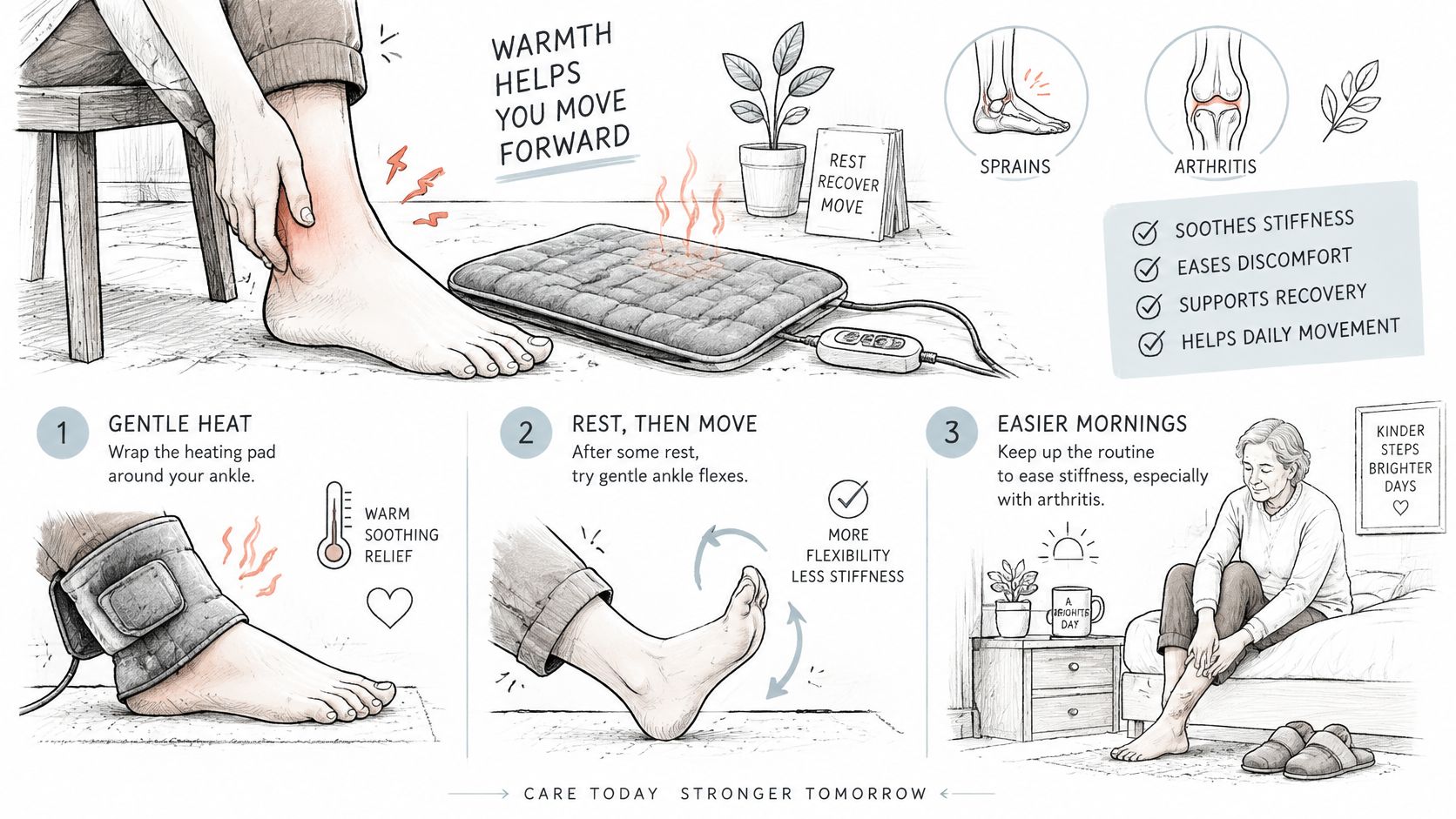
Morning arthritis stiffness
Say your ankle feels predictably stiff when you get out of bed, without new swelling, redness, or unusual pain. If heat is suitable for your condition, a brief seated session before putting on shoes may make the first gentle movements more comfortable. Remove the wrap before standing, then ease into your usual activity.
The pad isn't treating every cause of arthritis pain or protecting the joint from overload. If the morning pattern changes, don't assume the same routine still fits. A broader plan for managing arthritis pain should include activity choices and clinical guidance, not just temperature therapy.
A runner returning to rehabilitation
Consider a runner whose swelling has resolved and whose clinician has cleared gentle movement. Warmth may serve as a comfortable lead-in to the prescribed exercises, but the runner still needs to perform the balance, mobility, and strengthening work. Feeling looser doesn't justify adding an unplanned run.
If puffiness returns that evening, the runner should reduce the provoking load and follow the clinician's symptom-management advice. The useful question is what the ankle tolerated, not whether another heating session can hide the discomfort.
A gardener winding down
A gardener with a chronically tight ankle might use a supported, seated session after removing muddy footwear. The pack stays outside the boot, where it can be lifted easily, rather than becoming a hidden source of heat and pressure during outdoor work.
Warmth can make a rehabilitation routine more comfortable. It can't supply the stability that the routine is meant to rebuild.
Heat continues to be investigated in rehabilitation settings. A controlled laboratory study published in 2024 included 20 male participants undergoing lower-leg immobilization and rehabilitation with heat or sham treatment, but that study design alone isn't a promise of faster recovery from a home ankle wrap.
If your ankle still gives way, arrange an assessment. Repeated instability calls for evaluation and a rehabilitation plan, even when warmth temporarily reduces the ache.
Fills Covers and Everyday Care
The material inside a pack affects how it settles around your ankle and how you maintain it. Choose a fill you can prepare predictably, rather than one that promises intense heat.
Flax seed and similar grain fills can shift around the ankle's contours. Redistribute the contents as the manufacturer directs so the pack doesn't collect into a heavy pocket against a bony edge. A scorched smell is a reason to stop using the pack, not an invitation to mask it with fragrance.
Gel packs may support both hot and cold use, but only when their labeling permits it. Check that the outer pouch is intact and use the specified barrier. Don't assume a pack designed for freezing can also go in the microwave.
Match care to the construction
| Component | Do | Stop using it if |
|---|---|---|
| Natural-fill insert | Keep dry and heat only as directed | It smells burnt, leaks fill, or develops persistent hot spots |
| Gel pouch | Inspect seams and follow temperature instructions | It leaks, bulges unexpectedly, or has damaged seams |
| Removable cover | Launder separately according to its care label | Damage leaves the insert exposed or disrupts fit |
| Electric pad | Inspect the cord and clean only as permitted | The cord frays, controls malfunction, or heating becomes uneven |
An electric pad offers ongoing powered warmth, but its electrical components change the cleaning rules. Don't soak it or assume the entire assembly is washable because the fabric feels like a blanket. Disconnect it before inspection and follow its specific care instructions.
Keep storage simple and dry
Remove a washable cover before cleaning rather than putting the filled pack in the washing machine. Spot-clean straps if permitted, and let all components dry completely before reassembly or storage. Natural fill that remains damp shouldn't be sealed away.
If a dual-purpose pack allows freezing, store it in a protective bag as directed. Don't transfer a frozen or damp pack straight into the microwave unless its instructions explicitly allow that sequence.
Store the pack in a clean, dry drawer away from direct sun and accidental spills. Wash the cover when it smells of sweat, inspect the pack before use, and retire damaged equipment rather than attempting an improvised repair.
Good care keeps the tool predictable. It doesn't change which ankle conditions qualify for heat.
Choose a Pad That Stays Put
Buy an ankle heating pad for controlled contact, not maximum temperature. The useful design rests against the ankle without hard pressure, has a protective cover, and comes off easily when you want to inspect your skin. A wrap that needs constant tightening or repositioning isn't a good fit, however comfortable its fabric feels.
Use a short buying check before choosing:
- Shape and weight. Look for a pack that drapes without folding into a thick ridge near the heel.
- Accessible fastening. Make sure you can release it while seated without twisting the ankle.
- Clear instructions. Heating, cooling, cleaning, and session guidance should be easy to find and follow.
- Suitable coverage. Favor contact with the intended stiff area rather than a bulky pack that surrounds the whole foot unnecessarily.
Choose for the routine you'll actually follow
Reusable packs can make sense for recurring stiffness, especially if you prefer a tool that doesn't require a fresh patch each time. A hot-and-cold design is useful only if you prepare and apply each mode correctly. More functions don't compensate for poor ankle fit.
At SunnyBay, our portable pain relief pads offer hot and cold therapy, a natural flax-seed filling, even, balanced heat, and a soft fleece and cotton cover. They use chemical-free materials and retain heat for up to 30 minutes, but that retention time isn't a recommended ankle-session length. Our neck and body designs also aren't medical ankle braces, so evaluate their size and placement rather than assuming every shape suits this joint.
If your ankle is newly swollen, postpone the heat purchase and get appropriate injury advice. If settled stiffness is your usual pattern and heat has been cleared, choose a manageable wrap and test its fit during calm, seated use. Check the applicable return terms before ordering so you're not committed to keeping a pack that slides or bunches.
SunnyBay offers reusable hot-and-cold pads for targeted comfort, including natural flax-seed options. Visit SunnyBay to compare shapes and covers, and choose an ankle-compatible fit only when warmth suits your symptoms and clinical guidance.


