


Ice Pack for Feet and Ankle: Best Relief in 2026
-
Your ankle is throbbing, the outside of the joint looks puffier by the minute, and someone nearby says, “Just put ice on it for 20 minutes.” That advice isn't wrong, but it's also incomplete. You aren't told what icing helps with, what it doesn't do, how to position the pack for a foot versus an ankle problem, or why certain people need to be much more careful.
I tell patients to think of an ice pack for feet and ankle injuries as a tool, not a cure. Used well, it can calm pain, make walking less miserable, and help manage early swelling. Used poorly, it can irritate the skin, miss the injured tissue, or create a false sense that the injury is “handled” when it still needs support, protection, or a medical exam.
Table of Contents
- Why Cold Therapy Works for Feet and Ankles
- Anatomical Fit and Sizing for Foot and Ankle Ice Packs
- Reusable vs Disposable Cold Therapy Options
- How to Apply an Ice Pack the Right Way
- RICE, PEACE, and What the Evidence Actually Shows
- When Icing Helps and When It Does Not
- Care, Maintenance, and Safe Use for High-Risk Users
Why Cold Therapy Works for Feet and Ankles
You roll an ankle, pull your shoe off, and the area feels hot, tight, and harder to move within minutes. That is the point where cold therapy can help, but the reason matters. If you know what cold is doing, you can use it more intelligently than the usual “20 minutes of ice” advice.
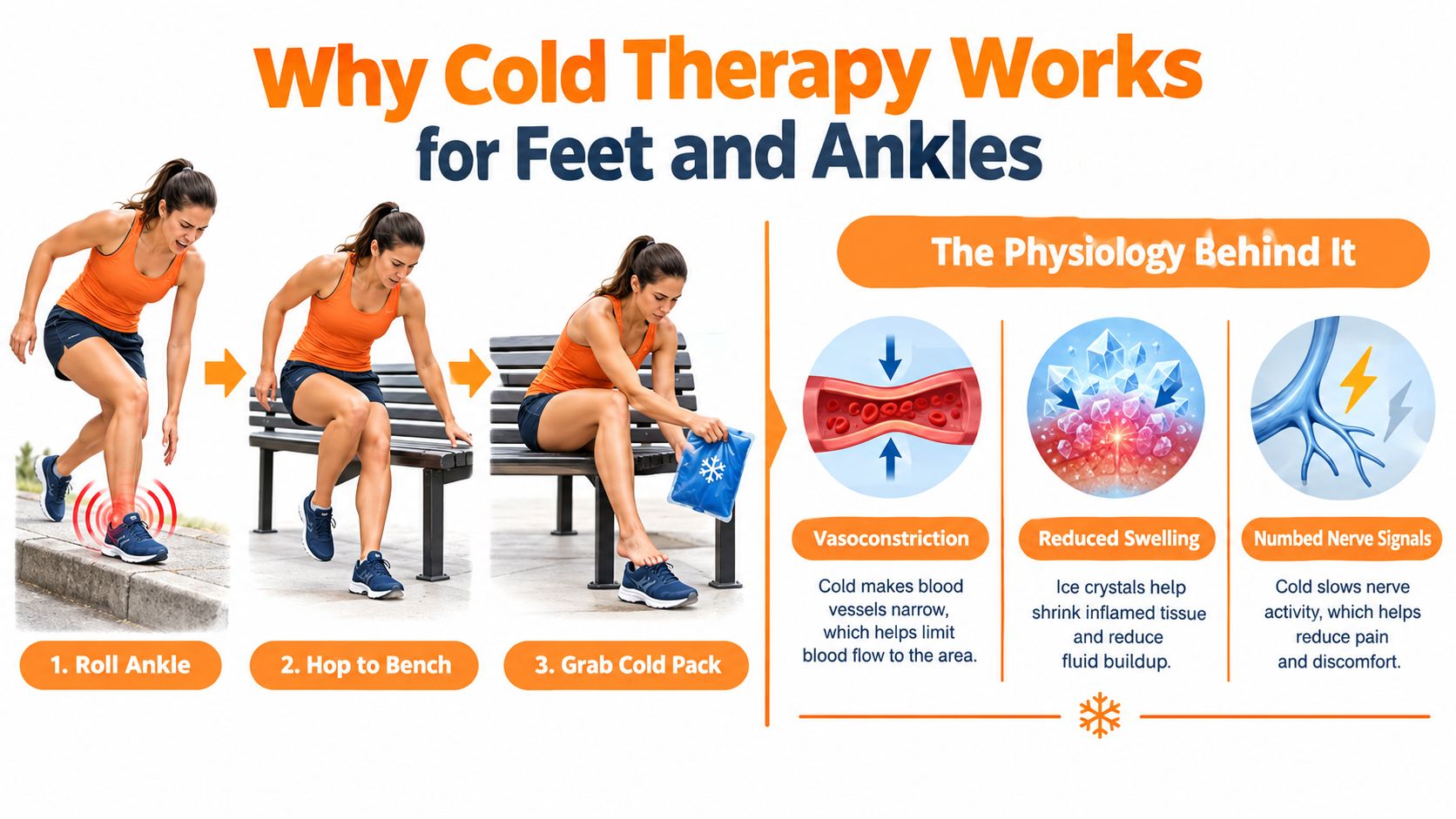
Cold therapy is mainly a short-term symptom tool for acute foot and ankle injuries. It can reduce pain, calm that strong throbbing feeling, and help limit early swelling in some cases. First-aid guidance summarized by WebMD's overview of the RICE method still supports brief, repeated icing sessions early after a sprain, with a cloth barrier between the pack and the skin.
The easiest way to understand it is to compare the first phase of an ankle sprain to a faucet turned on too fast. Blood flow and inflammatory chemicals rush into the area because the body is reacting to injury. Cold slows that local activity for a while. It does not repair the ligament. It lowers the volume on the pain and heat so the ankle feels less angry.
That trade-off is important.
Less pain can make walking easier, but comfort is not the same as healing. Some swelling control may help the joint feel less tight, yet icing harder or longer does not guarantee a better recovery. For many people, short intermittent sessions work better than one long session because you get symptom relief without exposing the skin and superficial nerves to as much cold stress.
Feet and ankles often respond quickly because the injured structures sit close to the surface. On the outside of the ankle, the ligaments are not buried under thick muscle. The same is true over the top of the foot, around the heel, and along the Achilles. If the pack contacts the sore area, the cold reaches it more efficiently than it would at the hip or thigh.
Contact matters more than people expect.
A cold pack draped loosely over the front of the ankle may feel chilly, but it may miss the irritated ligament on the outer side. A well-placed pack works more like a fitted compress than a bag of cold sitting nearby. That is one reason patients sometimes say, “Ice did nothing,” when the issue was poor coverage, not lack of effect.
Swelling is where the advice often gets oversimplified. Early icing may help with edema control, especially right after injury, but it is only one part of the picture. Position, compression, and how much you keep loading the foot also change how puffy the area gets. If you stand and limp around all afternoon, an ice pack later may not fully offset that.
Some people should be more cautious from the start. Older adults, people with diabetes, and anyone with reduced sensation or circulation problems may not feel excessive cold normally. For them, the goal is gentle cooling, not intense numbness. A towel layer, shorter sessions, and frequent skin checks are safer choices.
If you are curious about cold exposure more broadly, not just ankle icing, Swift Running explains cold plunge duration in a useful way that reinforces the same idea. More time is not automatically better.
Anatomical Fit and Sizing for Foot and Ankle Ice Packs
A flat rectangular gel pack often sounds fine until you try to wrap it around a real ankle. Then you notice the problem. The ankle curves, the heel sticks out, the arch dips inward, and the outside ankle bone creates a little peak that leaves air gaps under a stiff pack.
Those gaps matter because cold only helps where it touches.
Why generic packs miss the target
A lateral ankle sprain usually hurts along the outside of the ankle, not across the whole foot. Plantar heel pain sits under the heel and often into the arch. Achilles irritation runs up the back of the ankle in a narrow strip. One shape won't fit all three well.
A better way to choose an ice pack for feet and ankle problems is to match the pack to the injury zone:
| Injury Site | Pack Size | Shape | Best Wrap Style |
|---|---|---|---|
| Lateral ankle sprain | Smaller or medium | Narrow, flexible wrap | Figure-eight or strap wrap around the ankle |
| Top of foot soreness | Medium | Broad, pliable panel | Loose compression wrap over the dorsum |
| Plantar heel and arch pain | Medium | Curved or draped pack | Seated contact with towel hold or elastic wrap |
| Achilles irritation | Narrow | Slim strip or tube-like profile | Vertical wrap behind the ankle |
| Combined ankle and heel swelling | Larger | Contoured wrap | Strap system that anchors under heel and around ankle |
The most useful features are usually simple:
- Flexibility in the freezer: A pliable pack molds around the malleoli and heel better than a stiff plastic slab.
- Targeted width: Narrower designs fit the Achilles or outer ankle more cleanly than oversized body packs.
- Hands-free support: Straps help keep the cold source on the sore tissue instead of sliding toward the floor.
Fit matters more than people expect
If the sore spot is the outer ankle, the pack should wrap the outside corner of the joint. If the problem is under the foot, a top-down ankle wrap may miss the painful area almost completely. This is why some people say icing “doesn't work” when the issue is poor contact.
A strapped ice bag can be useful for this. One example is the SunnyBay large ice bag with strap, which is designed to secure around areas like the foot or ankle rather than forcing you to hold a loose pack in place.
The right size isn't the biggest pack you own. It's the one that stays in contact with the tissue you're trying to calm down.
A quick home test
Before you even start a session, place the cold pack over the sore area without tightening anything. If you can slide two or three fingers into obvious empty spaces between the pack and your skin, that fit probably isn't doing much for you. In clinic, I'd rather see a smaller flexible pack with full contact than a larger one touching only the high points of the foot.
Reusable vs Disposable Cold Therapy Options
People often ask which cold option is best. The more useful question is best for what situation. The right answer changes if you're at home after work, on a sideline, in a hotel room, or trying to manage repeated swelling after a long day on your feet.
The trade-offs side by side
| Option | Cost per Use | Duration | Fit | Convenience |
|---|---|---|---|---|
| Reusable gel pack | Lower over time | Moderate | Good if flexible | Good at home, needs freezer |
| Instant cold pack | Higher over time | Brief | Fair | Very convenient away from home |
| Traditional ice bag with crushed ice | Varies | Moderate | Excellent contour | Messier, needs ice access |
| DIY frozen peas or similar | Low upfront | Variable | Good contour | Convenient but inconsistent |
Reusable gel packs are common because they're clean, simple, and easy to keep in a home freezer. The downside is that some become rigid when very cold, which reduces contact around the ankle's curves.
Instant cold packs solve the prep problem. If you're at a game, in the car, or traveling, they're practical because you can activate them on the spot. They don't tend to be the option people rely on for repeated daily care.
Why old-school ice bags still hold up
Crushed ice in a soft bag still conforms extremely well to the foot and ankle. For awkward areas like the Achilles or the outside of a swollen ankle, that contour can beat many pre-shaped products. The trade-off is cleanup. Melted ice, condensation, and refilling aren't fun when you're using it several times a day.
If you use bagged ice regularly, simple packing tricks help. HYDAWAY's guide to maximizing a bag of ice is useful for thinking through storage and handling, especially when you're trying to make one bag last through multiple sessions.
Matching the option to the person
- For office workers: A reusable gel pack usually makes sense because it's easy to keep ready at home.
- For athletes or parents on the go: Instant cold packs or a soft ice bag are easier to deploy immediately after an injury.
- For people who need exact placement: Crushed ice bags often fit the ankle's shape better than broad freezer packs.
- For occasional home use: DIY options can work, but they're less predictable and should still be wrapped in cloth.
No single format wins every category. The smartest setup is often a combination, such as a travel option for the first hour after injury and a reusable pack for the rest of the week.
How to Apply an Ice Pack the Right Way
You twist your ankle stepping off a curb, sit down, and grab the coldest pack in the freezer. The common advice is simple: ice it for 20 minutes. The part that often gets missed is how you place it, how tightly you secure it, and whether one solid block of time is the best choice for your situation.
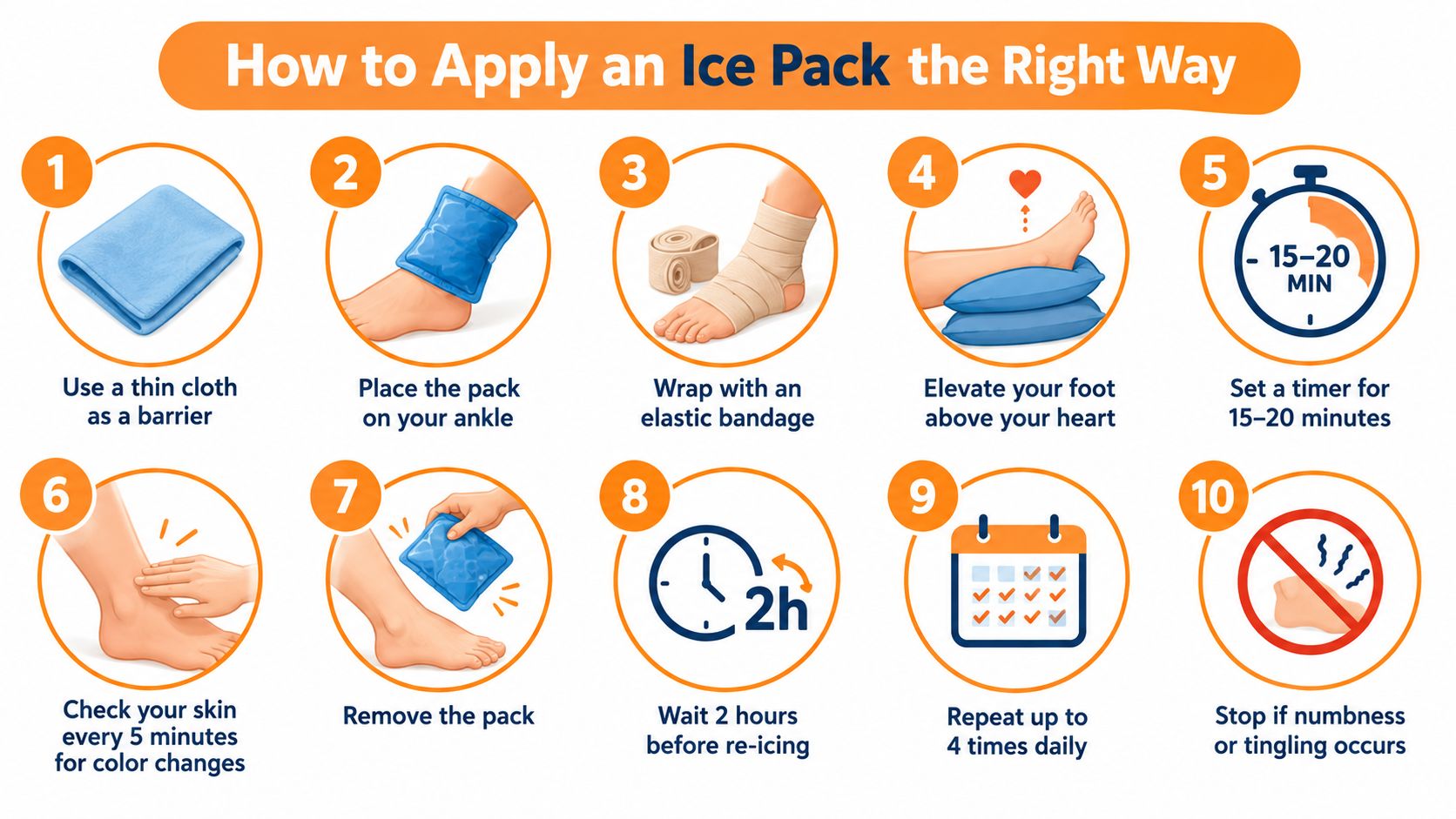
Cold works best when it reaches the sore area without irritating the skin. The ankle is full of curves, tendons, and bony edges, so contact matters. A pack sitting on the top of the foot while the swollen outer ankle stays uncovered is like putting a heating vent in the wrong room. You are using the tool, but not aiming it where it can help most.
A simple icing routine
- Use a barrier. Place a thin towel, sock, or pillowcase between your skin and the cold pack.
- Cover the actual injured area. Put the pack over the outer ankle, heel, arch, or Achilles based on where symptoms are.
- Mold the pack to the shape. Gentle contact around the ankle works better than a flat pack resting loosely on top.
- Secure it lightly. A light wrap or strap can keep the pack in place, but it should not leave deep marks or add pressure pain.
- Raise the foot if swelling is present. A couple of pillows can help limit dependent swelling while you rest.
- Set a timer. Short, planned sessions are safer than guessing.
- Check the skin partway through. Stop if you see whitening, blotchy color change, or feel sharp burning.
- Remove the pack on time.
- Let the skin return to normal temperature before another session.
- Repeat during the early phase if it still helps pain and swelling.
General first aid guidance commonly limits icing to short sessions, often about 10 to 20 minutes at a time, especially early after a foot or ankle injury. The exact best dose is less precise than many people expect, which is why the details above matter. If you have a pack that shifts around easily, a practical ice bag for injuries guide can help you see how to position and secure it around a joint.
Standard timing versus intermittent timing
A single 15 to 20 minute session is the format many people know. It is simple and easy to remember. For mild soreness after activity, that may be enough.
An acutely swollen ankle can be different. Some clinicians use intermittent icing, where you apply cold for a shorter stretch, remove it, then repeat after a break. A randomized trial on acute ankle sprain found that an intermittent cryotherapy approach improved pain on activity after one week more than one continuous 20 minute application, though it did not show clear differences in swelling, function, or pain at rest, according to the study in PMC.
That result helps explain a trade-off patients run into all the time. A longer session sounds stronger, but more time is not always more useful. If the area becomes numb quickly, the extra minutes may add skin risk without adding much comfort. Intermittent sessions can give you cooling, then a reset, then cooling again.
Positioning changes by injury
Placement should match the tissue that hurts.
- Outer ankle sprain: Wrap or drape the pack around the outside of the ankle bone where swelling often collects.
- Achilles irritation: Run the cold source along the back of the ankle and lower tendon.
- Plantar heel or arch pain: Place the pack under the heel and arch while seated so it stays in contact.
- Top of foot soreness: Center the pack over the tender area, but avoid excessive pressure from tight straps.
NHS-style patient guidance also stresses using a cloth barrier, keeping sessions limited, and stopping if the skin becomes very pale or discolored, as described in Milton Keynes University Hospital's ankle injury leaflet.
One group needs extra caution. Older adults, people with diabetes, and anyone with reduced sensation or poor circulation may not feel early warning signs from cold. For them, shorter sessions, thicker barriers, and frequent skin checks are the safer choice. If you cannot reliably tell whether the pack feels cold versus painful, ask a clinician before using routine icing at home.
Short, well-placed sessions usually work better than long sessions with poor contact.
RICE, PEACE, and What the Evidence Actually Shows
For years, many people learned one automatic response to a sprain: RICE, meaning rest, ice, compression, and elevation. That approach became embedded in sports medicine, urgent care, school athletics, and family medicine advice for stable ankle sprains.
The modern discussion is more careful. Ice hasn't disappeared, but its role has changed.
Why the old message became less certain
A British Journal of Sports Medicine guideline update from 2018 stated that there is no evidence that RICE alone, cryotherapy alone, or compression alone has a positive influence on pain, swelling, or function in acute lateral ankle sprain, and therefore there is no role for RICE alone, according to the published guideline update in BJSM.
That statement surprised a lot of clinicians and patients because it challenged a habit that felt almost universal. But it didn't mean ice was useless. It meant ice, by itself, shouldn't be treated as a full recovery plan.
Where cold therapy still fits
A later review discussed in that same evidence arc found that cryotherapy remained highly recommended in several high-quality guidelines for the acute phase because it can reduce pain and swelling, especially early after injury. That's the practical middle ground many of us use now.
Here's the cleaner way to approach it:
| Acronym | Component | Cold Therapy Role |
|---|---|---|
| RICE | Ice | Traditional first-line measure for early symptom relief |
| RICE | Rest, compression, elevation | Supportive measures often paired with icing |
| PEACE | Protection and education | Cold is no longer the centerpiece |
| PEACE and LOVE | Loading and exercise-focused recovery | Cold may help comfort, but doesn't replace rehab |
The important shift is this. Ice is mainly a symptom-management tool, not a stand-alone healing accelerator.
What that means for real decisions
If your ankle hurts enough that every step is guarding and limping, icing may help settle things enough for you to tolerate movement, compression, and sensible activity changes. That's valuable. It just isn't the same as saying the ligaments are repairing faster because you used a frozen pack.
Patients often feel relieved when they hear that distinction. It gives them permission to use cold when it helps, and to stop expecting it to solve the whole problem.
When Icing Helps and When It Does Not
Some people ice everything. Others stop icing because they tried it once on the wrong condition and saw no benefit. Both approaches miss the question: What problem are you trying to solve right now?
Situations where icing usually makes sense
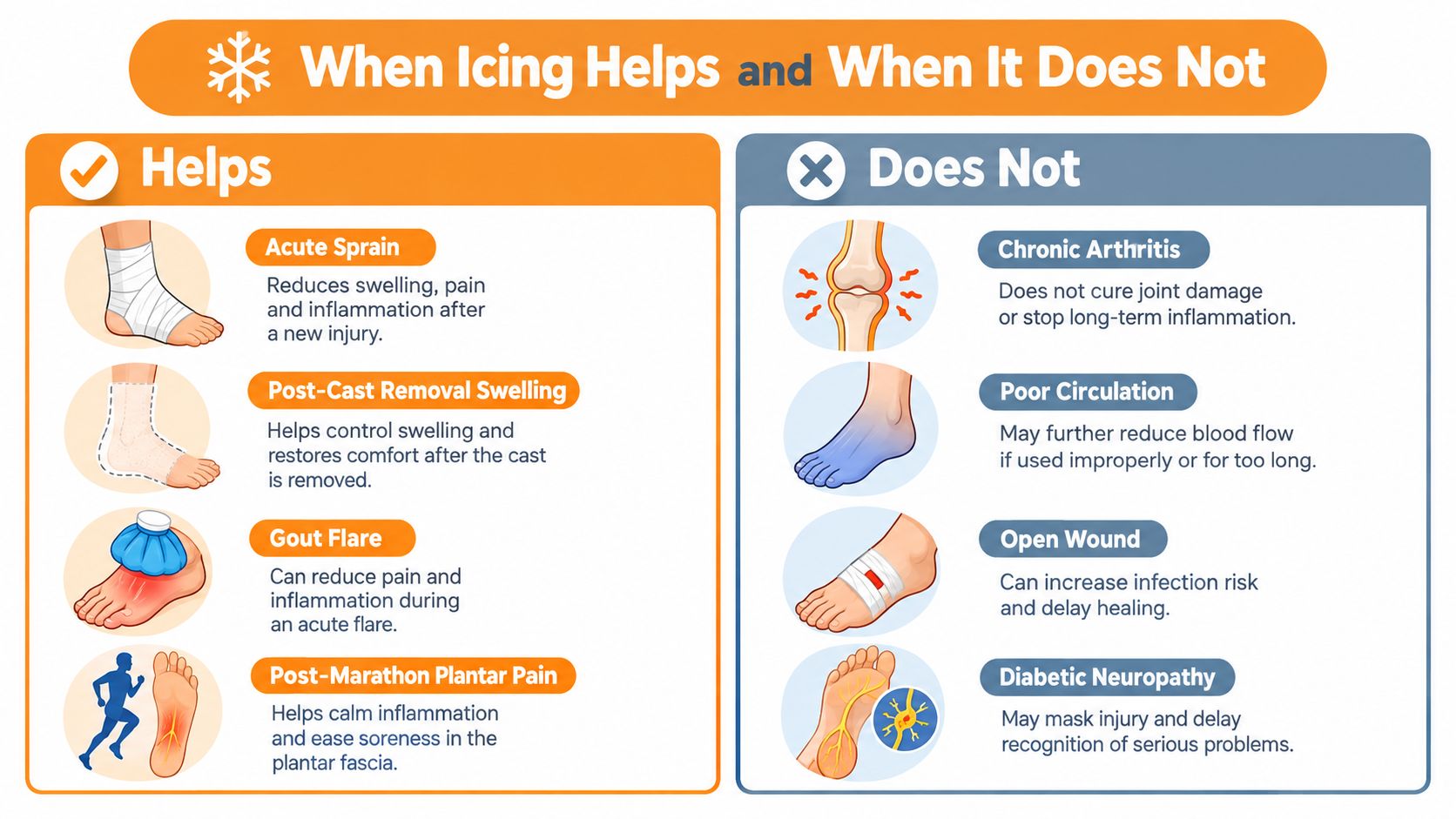
Cold therapy has its clearest role in a fresh injury or a flare with obvious swelling and tenderness. For post-injury ankle edema, comparative clinical evidence has shown that cold can outperform heat and contrast bath during the subacute phase. One study concluded cold produced the least edema on days 3 to 5 after first- and second-degree sprains, and another review cited ankle cold immersion at 50°F to 60°F (10°C to 16°C) for 20 minutes, three times over five days as producing less edema than heat, as summarized in Physical Therapy research.
That's useful when someone says, “My ankle isn't just painful. It feels full and puffy by the end of the day.” In that setting, cold can be a sensible choice.
Examples where icing may help:
- Acute ankle sprain: Early pain and swelling control.
- Post-activity flare: The foot aches and puffs up after a long walk or run.
- Swollen ankle after recent immobilization: The joint feels congested and irritated with return to movement.
Situations where icing may disappoint
Cold often does less for stubborn, load-related problems that aren't primarily about fresh swelling. A chronic Achilles issue, for example, may calm briefly with ice but still needs gradual tendon loading and activity management. The same can happen with ongoing plantar pain that's been brewing for weeks.
There are also times to skip self-treatment and get examined first:
- You can't bear weight
- The foot or ankle looks deformed
- Your toes change color
- You notice numbness
- Pain is severe or keeps worsening
If the foot looks wrong, feels unstable, or you can't trust it to hold you, don't let home icing delay an evaluation.
If you're trying to decide between cold and heat for a non-emergency flare, this guide on when to ice and when to heat can help you sort out the goal before you reach for a pack.
Care, Maintenance, and Safe Use for High-Risk Users
A cold pack isn't just something you toss in the freezer and forget. If you use it often, maintenance affects both comfort and safety. This matters even more for older adults and anyone who may not feel cold accurately.
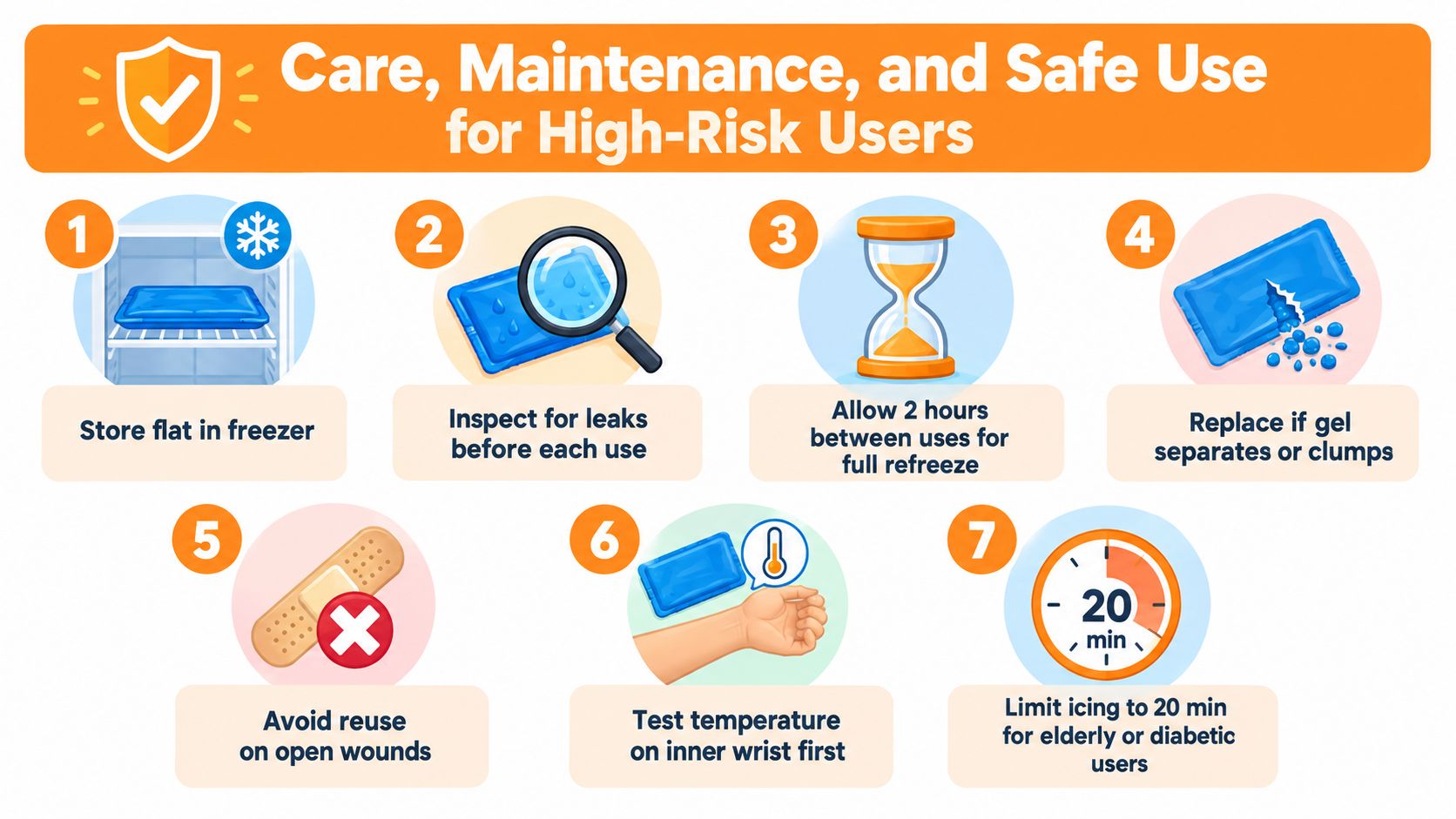
Basic care habits that help
- Store it flat: A flatter pack usually wraps better when you take it out.
- Inspect before use: If the outer layer is punctured, sticky, or separating, replace it.
- Use a cover or cloth: This protects both the skin and the pack.
- Let it refreeze fully: A half-frozen pack often warms too quickly or cools unevenly.
- Clean the surface regularly: Especially if it's used around bare feet or gym bags.
A worn-out pack often tells on itself. It may become lumpy, lose flexibility, or stay stiff in a way that prevents good contact around the ankle.
Who needs extra caution
Several clinical leaflets warn against placing ice directly on the skin and advise avoiding use on broken skin or areas with poor sensation. They also say to stop if the skin becomes blotchy or painful, as noted in Gloucestershire Hospitals' foot and ankle soft tissue injury leaflet.
That warning matters for:
- People with diabetes
- Older adults with fragile skin
- Anyone with reduced sensation or neuropathy
- People with poor circulation
- Anyone with open wounds or irritated skin in the area
For these users, cold can be risky because the normal warning signals aren't reliable. They may not notice that the skin is getting too cold until there's already irritation.
A safer routine for vulnerable users
Use shorter, cautious sessions. Keep a cloth barrier in place every time. Check the skin frequently, and if you're helping a parent or family member, don't assume they'll tell you when it's too cold. Look.
The best habit is simple: treat icing as a deliberate routine, not an afterthought. Set it up, monitor it, stop on time, and reassess.
If you're looking for a practical hot or cold option for home use, SunnyBay offers reusable therapy products and accessories that fit real-life recovery routines, including options designed for targeted joint use. To see what might work for your foot or ankle setup, visit SunnyBay.


