


How to Treat Frozen Shoulder at Home A Practical Guide
-
Dealing with a stiff, painful shoulder is beyond frustrating. It turns simple things we take for granted, like reaching into a high cabinet or even just getting dressed, into a major ordeal. The key to successfully managing frozen shoulder at home is knowing where you are in the journey.
You have to first understand which of the three stages you're in—freezing, frozen, or thawing—and then tailor your approach. This is crucial because it means focusing on gentle mobility in the early, painful phase and knowing when to avoid aggressive stretches that can actually make things worse.
Your First Steps in Understanding Frozen Shoulder
When your shoulder starts to ache and lock up, it’s easy to feel a bit lost. The pain and stiffness, which doctors call adhesive capsulitis, can feel like it came out of nowhere and completely disrupt your life. If this is you, know you're not alone. It’s a surprisingly common condition, affecting about 2% to 5% of adults.
Think about Sarah, a 52-year-old who works at a desk all day. For her, it started as a dull ache she brushed off as a simple strain. But over a few weeks, that ache became a sharp, persistent pain, especially at night. Soon, she couldn't even reach behind her back to fasten her bra. That progression—from a nagging pain to significant, limiting stiffness—is the classic start of frozen shoulder.

Identifying the Three Stages of Frozen Shoulder
Figuring out your current stage is the most important thing you can do right now. Why? Because what works in one phase can be counterproductive in another. Pushing too hard, too soon can easily set you back, but being too cautious in the later stages can drag out your recovery.
The condition almost always unfolds in a predictable, three-part timeline.
To help you pinpoint where you are, here’s a quick breakdown of what to expect in each stage.
The Three Stages of Frozen Shoulder What to Expect
| Stage | Typical Duration | Key Symptoms | Primary Home Goal |
|---|---|---|---|
| Stage 1: Freezing | 2 to 9 months | Increasing pain, especially at night. Range of motion starts to decrease. | Pain relief and preserving current mobility with very gentle movements. |
| Stage 2: Frozen | 4 to 12 months | Pain may lessen, but stiffness becomes the main issue. Significant loss of motion. | Gently and gradually improve range of motion without causing pain. |
| Stage 3: Thawing | 6 months to 2+ years | Stiffness slowly eases, and range of motion gradually returns to normal. | Regain full strength and flexibility through consistent stretching and exercise. |
As you can see, matching your home care strategy to what your shoulder needs at that exact moment is the smartest way to a smoother, less frustrating recovery.
Key Takeaway: Correctly identifying your stage allows you to work with your body, not against it. This simple step can dramatically improve your recovery time and reduce unnecessary pain.
The Power of a Consistent Home Program
Treating frozen shoulder at home is a marathon, not a sprint. It takes patience and consistency, but the payoff is huge. A dedicated home care plan isn't just a side-task; for most people, it's the absolute foundation of a successful recovery.
And there's good science to back this up. While things like corticosteroid injections can offer fast, short-term relief, research consistently shows that pairing them with a home exercise program is what drives real, long-term improvement.
In fact, over 90% of patients manage to get their full mobility back within 6-12 months just by sticking to a dedicated home plan, often avoiding surgery altogether. You can discover more insights from the full research about how these treatments work together.
Soothe Your Shoulder with Heat and Massage
Before you even think about stretching a frozen shoulder, you need to prepare the area. Just jumping into exercises when the joint is cold, stiff, and angry is a recipe for more pain. Imagine trying to stretch a frozen rubber band—it won’t bend, it will just snap. Your shoulder capsule works the same way.
This is where heat and massage therapy become your indispensable allies. They don’t just soothe; they actively prepare your shoulder for healing and movement, making your stretches safer and far more effective.
The Incredible Benefits of Heat Therapy
Applying warmth to your shoulder does more than just feel comforting; it triggers powerful physiological changes. Heat signals the blood vessels to expand, dramatically increasing circulation. This fresh, oxygen-rich blood floods the tight joint capsule and surrounding muscles, delivering nutrients that promote healing and flushing out pain-inducing waste products. The result is a significant decrease in pain and a shoulder that is more pliable and ready for gentle movement.
Think of it like warming up clay before you sculpt it. Cold clay is hard and brittle, but with a little warmth, it becomes soft and malleable. Applying a warm compress for 15-20 minutes before you stretch can make the difference between a painful, frustrating exercise session and a productive one that leads to real progress. This simple step can boost blood flow by up to 20-30%, transforming your stiff tissues.
For example, Mark, a weekend golfer sidelined by a frozen shoulder, started using a contoured heat pack every morning. He found that it not only cut his pain but, more importantly, allowed him to push his range of motion a little further each day with much less resistance. That’s how you make real progress.
Figuring out when to use cold versus heat can be tricky. But for the chronic stiffness of a frozen shoulder, heat is almost always your go-to. If you want to dive deeper, check out our guide on when to use ice versus heat.
Unlock Relief with Self-Massage
While heat works deep inside the joint, self-massage addresses the overworked muscles that are adding to your pain. Your deltoids, upper traps, and chest muscles have been compensating for your stiff shoulder, leading to knots and tightness. Releasing this tension is a critical step.
Gentle massage doesn't just feel good; it tells your nervous system to relax its grip on these tight muscles, further improving blood flow and reducing your overall pain level. By combining heat and massage, you are creating the perfect healing environment.
Here’s a simple routine to try after applying heat:
- Upper Trap Squeeze: Use your good hand to gently squeeze the thick muscle between your neck and shoulder. Hold for 10 seconds, release, and repeat. This helps relieve the neck tension that often accompanies shoulder pain.
- Deltoid Rub: With your fingertips, make slow, circular motions all around your shoulder muscle. This brings awareness and blood flow directly to the area.
- Chest Muscle Release: Press your fingers or a massage ball into the area just below your collarbone. This spot gets incredibly tight from hunching over to protect your shoulder. Releasing it helps your shoulder sit in a more natural, relaxed position.
By taking just five extra minutes for massage after your heat therapy, you’re not just easing pain—you’re telling your body it’s safe to move again, setting the stage for a successful stretching session.
Your Essential Home Exercise Program
Alright, now that you’ve warmed up your shoulder with some soothing heat, you’re ready for the most critical part of your home recovery plan. This is where the real work begins—and where you start to win back your mobility. The mantra here is gentle persistence, not gritting your teeth through sharp pain. Think of it as coaxing the stiff joint capsule to let go, not forcing it into submission.
The secret to success is matching the right exercises to where you are in your recovery. In the early, painful 'freezing' stage, we’ll focus on simple movements that get the joint moving without flaring it up. As you move into the 'frozen' and 'thawing' stages, we'll introduce more active stretches to really start reclaiming your range of motion.
To get the most out of every session, it helps to follow a simple prep routine.
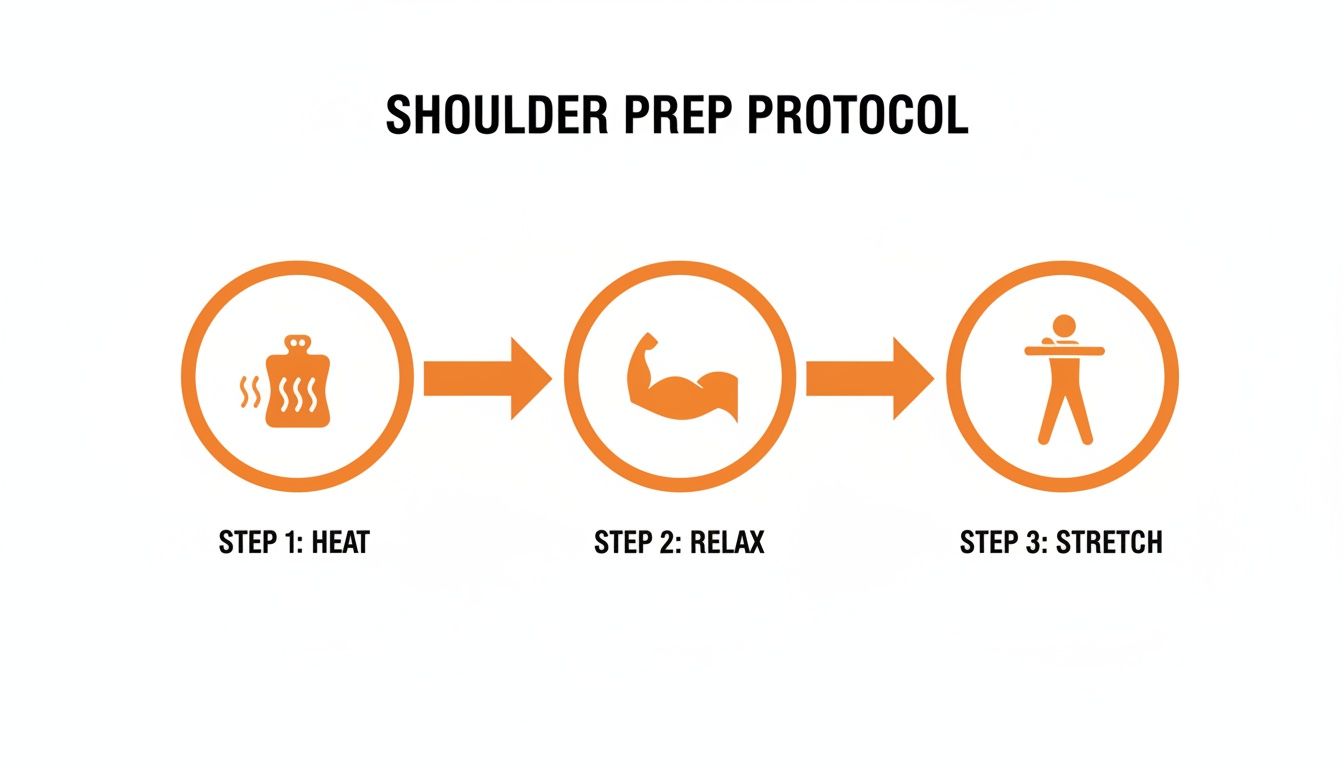
This little sequence—heat, relax, then stretch—creates the perfect environment for your shoulder to respond safely and effectively to the exercises.
Foundational Movements for the Early Stages
When your shoulder is at its most angry and sensitive, the main goal is just to keep it moving. If you stop moving it completely, it will only get stiffer. These first two exercises are incredibly gentle and use gravity as a helper.
Pendulum Swings
This is almost always the first exercise anyone with a frozen shoulder learns, and for good reason—it’s that gentle. Lean over and support your good arm on a table or the back of a chair. Let your sore arm hang straight down toward the floor like a rope.
Now, completely relax your shoulder. Use a slight rocking motion from your body to get the arm swinging in a small circle. Don’t use your shoulder muscles to do the work. Imagine you're gently stirring a pot. Start with tiny circles and slowly make them bigger as your comfort allows.
Wall Crawls (or Finger Walks)
Face a wall, standing about an arm’s length away. Put the fingertips of your affected hand on the wall, maybe around waist level. Very slowly, use your fingers to "walk" up the wall, going as high as you can without significant pain.
Pause at the top for a moment, then slowly walk your fingers back down. You’re not trying to break any records here; the goal is just to reach a tiny bit higher each day.
Progressing to Active Stretches
Once that initial, intense pain starts to back off and stiffness becomes the main enemy, it's time to bring in some more active stretches. These are designed to specifically target the directions of movement that a frozen shoulder loves to steal.
Doorway Stretch
This is a fantastic stretch for opening up the front of your shoulder and chest, which get incredibly tight with this condition. Stand in an open doorway. Bend your affected arm to a 90-degree angle (like you're about to give a high-five) and place your forearm on the doorframe.
Gently step forward with the leg on the same side, leaning in until you feel a nice, mild stretch across your chest and the front of your shoulder. Hold it for 30 seconds while breathing deeply. A key tip: keep your shoulders pulled down and back, away from your ears.
A consistent home exercise routine is the absolute cornerstone of recovery. In fact, clinical trials have shown that a dedicated program can improve shoulder function by 25-39 points on standardized medical scales. You can read more about the research behind these exercise findings to see just how effective it can be.
Behind-the-Back Towel Stretch
This stretch tackles internal rotation—the motion of reaching behind your back—which is often the last and most stubborn movement to come back. Grab a small towel with your good hand and drape it over your good shoulder so it hangs down your back.
With your affected arm, reach behind your back and grab the bottom end of the towel. Now, use your good arm to gently pull the towel up, which will slide your sore arm further up your back. You want to feel a definite stretch, but stop if you feel any sharp pain.
Hold for 20-30 seconds. As you get more flexible over time, you’ll be amazed at how much higher that hand can climb.
Key Principles for Your Exercise Routine
As you get into a rhythm with these movements, keep a few non-negotiable rules in mind. These will keep you safe and ensure you're making real progress, not just spinning your wheels.
- Always Warm-Up First: Never, ever stretch a cold shoulder. Applying heat for 15-20 minutes beforehand makes the tissues more pliable and ready to move.
- Pain is Not Your Friend: The old saying "no pain, no gain" is terrible advice for a frozen shoulder. You should stretch to the point of mild tension, but if you feel a sharp or stabbing pain, you've gone too far. Back off immediately.
- Consistency Trumps Intensity: Gentle stretches done several times a day are far more effective than one heroic, painful session. The goal is steady, sustainable progress.
- Don't Forget to Breathe: When we feel tension, we tend to hold our breath, which just makes our muscles tighter. Focus on slow, deep breaths during each stretch to help your body relax and accept the movement.
If you're still dealing with a lot of discomfort even after a good warm-up, our guide on how to relieve shoulder pain has some extra strategies that might help. A smart, gentle, and consistent approach is how you’ll treat your frozen shoulder at home and get your life back, one small movement at a time.
Adapting Your Daily Life for Faster Recovery
Dealing with a frozen shoulder is more than just doing a few stretches a day. Real progress happens when you learn how to protect your shoulder throughout your entire day. It's about making small, smart adjustments to avoid those sharp, unexpected pains that can set you back.
Think about it: every time you reach up into a cabinet, pull on a heavy door, or even just get dressed, you're asking your shoulder to perform. When it's frozen, those simple tasks become minefields. By modifying how you move, you create a healing environment that lets your shoulder recover 24/7, instead of just during your exercise time.

Smart Changes Around the House
Your home can either be a partner or an obstacle in your recovery. The main goal here is simple: stop reaching overhead and across your body in ways that trigger pain.
Take a quick look at your kitchen. Are your everyday coffee mugs and plates on the top shelf? Move them. Put everything you use daily—spices, bowls, glasses—on a counter or a low, easy-to-reach shelf. This one tiny change can eliminate dozens of painful movements every single week.
The same idea applies to your desk setup. If you're hunched over a computer, you're putting constant, low-level strain on that already angry shoulder joint. Make sure your monitor, keyboard, and chair are set up to support good posture. For some great, easy-to-follow advice on this, check out our guide on how to improve posture at desk.
Master the Art of Getting Dressed
Getting dressed can quickly become the most dreaded part of the morning. It’s frustrating and, frankly, it can hurt a lot. But a simple tweak in your technique makes all the difference.
The Golden Rule of Dressing: Your bad arm goes in first, and it comes out last.
When you put on a shirt, use your good arm to gently guide your sore arm into the sleeve first. Don’t try to force it; let your good arm do all the work. Then, the rest is easy. To take it off, just reverse the process: slip it off your good shoulder, and then carefully ease it off the affected one.
Conquering Night Pain and Improving Sleep
If there's one thing frozen shoulder is notorious for, it's ruining a good night's sleep. That deep, aching pain seems to get worse the second you lie down, and every little movement can wake you up. The solution almost always involves pillows. Lots of pillows.
Your mission is to prop your arm up so the shoulder joint is supported and relaxed, not dangling or compressed.
Pillow Strategies for Better Sleep:
- Back Sleepers: Tuck a pillow under your affected arm, supporting it from the elbow to the hand. This little bit of elevation keeps the joint from falling back into a painful, stretched position.
- Side Sleepers: First, make sure you're sleeping on your good side. Then, hug a thick pillow in front of your chest and rest your sore arm on top of it. This prevents the arm from slumping forward and stressing the joint capsule.
Whatever you do, avoid sleeping directly on your affected shoulder. This is a non-negotiable rule. The direct pressure is almost guaranteed to cause a painful flare-up.
A little heat therapy before bed can also be a game-changer. Clinical trials have shown that using hot packs can improve tissue flexibility and dramatically reduce night pain, which plagues up to 70% of sufferers. Try using a soothing, lavender-scented shoulder wrap for about 20 minutes before you turn out the lights. The gentle warmth helps calm muscle spasms and can make it much easier to drift off and stay asleep. You can dig deeper into the research on manual therapy and exercise to see just how effective these combined approaches can be.
How to Track Your Progress and When to See a Doctor
Recovering from a frozen shoulder is definitely a marathon, not a sprint. The progress can feel so slow that it's easy to get discouraged. That's why keeping track of your small wins isn't just a good idea—it's essential for staying motivated for the long haul. Seeing tangible proof that your hard work is paying off is the best fuel for your recovery.
Simple Ways to See Your Improvement
You don’t need any fancy equipment to see how far you’ve come. Believe it or not, a pencil and a wall are two of your best tools.
Try this: stand sideways next to a wall and do your wall crawl exercise. At the highest point you can comfortably reach, make a tiny, light pencil mark. Come back once a week and try again. Seeing that new mark climb even a quarter of an inch higher is a concrete victory you can literally point to.
Another great way to measure progress is with the towel stretch. The first time you do it, notice where your fingertips land on the towel behind your back. As the weeks go by, you'll see that hand creeping higher and higher—that’s a clear sign the stiff joint capsule is finally starting to loosen its grip.
Why Sticking With It (and Tracking It) Matters So Much
Consistency is everything. Research has shown that home exercise programs without any supervision can have 30-50% lower adherence, which really slows down recovery. But when people track their own progress, they’re far more likely to stick with it.
Documenting those improvements—like seeing your arm’s range of motion go from a painful 50° to a much more functional 120° over a few months—gives you the motivation you need to keep going. You can read more about these findings on patient adherence and recovery.
By celebrating these small, incremental gains, you're not just healing your shoulder—you're building the mental resilience needed to see the process through to the end.
Knowing When Home Care Isn't Enough
A dedicated home program works wonders for most people, but it’s crucial to know when to call in a professional. Pushing through the wrong kind of pain can set you back. Your body is pretty good at sending signals when it’s time to stop and get expert advice.
Here's a straightforward guide to help you decide on your next steps.
Home Care vs Doctor Visit: When to Seek Help
| Symptom or Situation | Recommended Action |
|---|---|
| Gradual improvement in motion, even if it's slow. | Continue with your home program and gentle exercises. |
| Pain is getting worse despite rest and gentle care. | See a doctor. This could signal an underlying issue. |
| You see zero improvement after 4-6 weeks of consistent effort. | See a doctor. A professional can offer a new diagnosis or treatment plan. |
| You experience sudden, sharp pain during an exercise. | Stop immediately. Rest, use ice, and consult a doctor if it persists. |
| Numbness, tingling, or weakness radiates down your arm or into your hand. | See a doctor right away. This is not a typical frozen shoulder symptom. |
| You have a sudden, total loss of movement in the shoulder. | Seek immediate medical evaluation. |
If your symptoms are persistent or getting worse, looking into online doctor consultation services can be a convenient way to get professional advice from home. A doctor or physical therapist can confirm your diagnosis, rule out other conditions, and make sure your home treatment plan is both safe and effective for you.
Common Questions About Managing Frozen Shoulder at Home
When you're dealing with a frozen shoulder, questions are bound to come up. It's a confusing and often frustrating condition, and the slow pace of recovery can test anyone's patience. Getting clear answers helps you stay on track and feel more in control.
Let's walk through some of the biggest questions people have when they start treating their frozen shoulder themselves.
How Long Does This Actually Take to Heal?
This is usually the first thing everyone wants to know. The honest answer? It's a marathon, not a sprint. The full cycle of a frozen shoulder, from the initial "freezing" pain to the final "thawing," can drag on for one to three years. That timeline can feel daunting, but what you do at home can make a real difference.
Most people who commit to a daily routine of gentle exercises and heat therapy begin to notice real, meaningful progress in both pain and movement within 6 to 12 months. Home treatment isn't about a magic fix; it’s about managing the pain, preserving the mobility you have, and gently encouraging your shoulder to heal more completely and, hopefully, a bit faster.
Should I Be Using Heat or Ice?
This is a classic point of confusion. For the deep, persistent stiffness that defines a frozen shoulder, heat is your best friend. The core of the problem is a tight, constricted joint capsule, and heat works wonders to help those tissues relax and loosen up.
Try applying a warm, moist heat pack for 15-20 minutes right before you do your daily stretches. It’s a simple but incredibly effective way to increase blood flow, ease the ache, and make the shoulder capsule more pliable and receptive to movement.
So where does cold fit in? Save the ice pack for acute flare-ups. If you move the wrong way or overdo it and get a sharp, inflammatory pain response, that's when a cold pack for 15 minutes can help settle things down. But for the day-in, day-out fight against stiffness, always reach for the heat.
Pro Tip: Think of it like this: Use heat to melt the stiffness before you move. Use cold to cool down a sudden fire of pain.
Can I Make My Frozen Shoulder Worse with Exercise?
Unfortunately, yes. Pushing too hard, especially in that intensely painful early "freezing" stage, is one of the biggest mistakes you can make. It's a natural instinct to think you need to "work through the pain," but with a frozen shoulder, that approach will set you back.
The golden rule is to stretch only until you feel a gentle tension—never into sharp, stabbing, or wince-inducing pain. If an exercise makes your shoulder ache significantly more afterward, you've gone too far.
Your mantra should be "gentle and often." Listening to your body is everything. A few short, pain-free stretching sessions spread throughout the day will achieve far more than one aggressive session that leaves you sore and inflamed. The goal is to gently coax the shoulder, not to force it into submission.
At SunnyBay, we know that managing pain effectively is the first step toward real recovery. Our USA-made, clinic-trusted heat wraps are designed to deliver deep, soothing heat exactly where you need it. They can help you warm up your shoulder for exercises and find drug-free relief that lasts. See how we've helped thousands on their healing journey at https://sunny-bay.com.


