


Air Compression Massager How It Works and How to Choose
-
You've spent the day at a standing desk, finished a hard workout, or sat through a long journey, and your legs feel heavy, tight, and difficult to settle. An air compression massager can make that moment more comfortable by wrapping the limb in inflatable chambers that gently squeeze and release in a programmed rhythm.
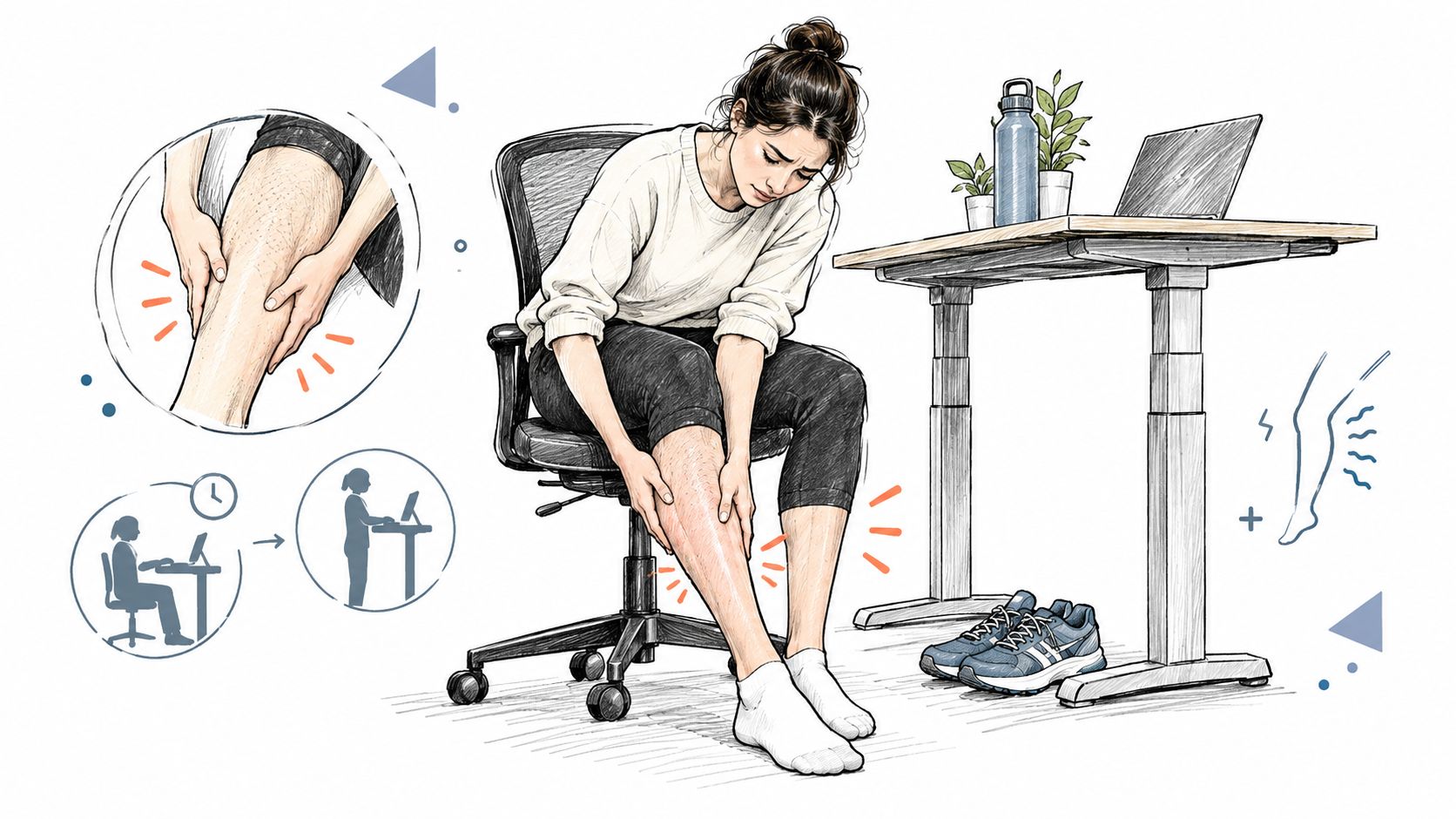
The important point is that this isn't a roller, percussion gun, or vibration device. It uses intermittent pneumatic compression, meaning a pump sends air into sections of a sleeve, applies pressure, then releases it. Your decision should therefore focus less on finding the strongest setting and more on understanding pressure, timing, fit, coverage, and comfort.
Some people want temporary relief after exercise. Others want a soothing routine after sitting or standing for long periods. An air compression massager may suit either purpose, but it isn't a cure for an underlying circulation problem, and recovery marketing can promise more than the evidence supports. The guide below will help you understand the mechanism, interpret product specifications, and choose a device responsibly.
Table of Contents
- Introduction to Air Compression Massagers and Why They Matter
- How an Air Compression Massager Works Inside
- Intended Uses for Recovery and Circulation Support
- Key Features to Evaluate Before You Buy
- Pros and Cons You Should Weigh Honestly
- Safety and Usage Tips for Comfortable Results
- How to Choose the Right Air Compression Massager for You
Introduction to Air Compression Massagers and Why They Matter
The basic idea has a long medical history. A recorded publication on pneumatic treatment of the extremities dates to 1834, and one early device resembling modern intermittent pneumatic compression was developed in Kassel in 1909, according to this historical overview of compression therapy. Later descriptions and commercial systems show how experimental pneumatic treatment gradually developed into standardized medical equipment.
Today's consumer products borrow that same general principle in a more convenient form. A sleeve may cover the foot, calf, thigh, arm, or several areas at once. When the pump inflates its chambers, the sleeve produces a moving squeeze rather than a single fixed pressure.
That distinction helps explain why people describe the experience differently. One user may enjoy a slow, wave-like sensation after a shift on their feet. Another may prefer a lighter setting after training because a firm squeeze feels distracting rather than soothing.
Start with your actual goal
Ask what you want the device to do for you:
- Recovery comfort: You want your legs to feel more settled after exercise, walking, or a demanding day.
- Heaviness support: You want a rhythmic sensation after sitting or standing for extended periods.
- Relaxation: You want a hands-free routine while reading, watching television, or resting.
- Targeted coverage: You need a sleeve for calves, feet, arms, or a broader section of the limb.
Those goals overlap, but they don't require identical designs. A compact calf sleeve may be easier to use consistently than a large full-leg system, while a multi-area model may make more sense if you want broader coverage.
The useful question isn't “How powerful is it?” It's “Can I use it comfortably, with the right fit, for the purpose I actually have?”
The sections ahead treat the device as a mechanical tool, not a wellness shortcut. You'll learn how the pump and chambers work, what recovery research can and can't support, which features matter at home, and how to recognize situations that call for professional advice instead.
How an Air Compression Massager Works Inside
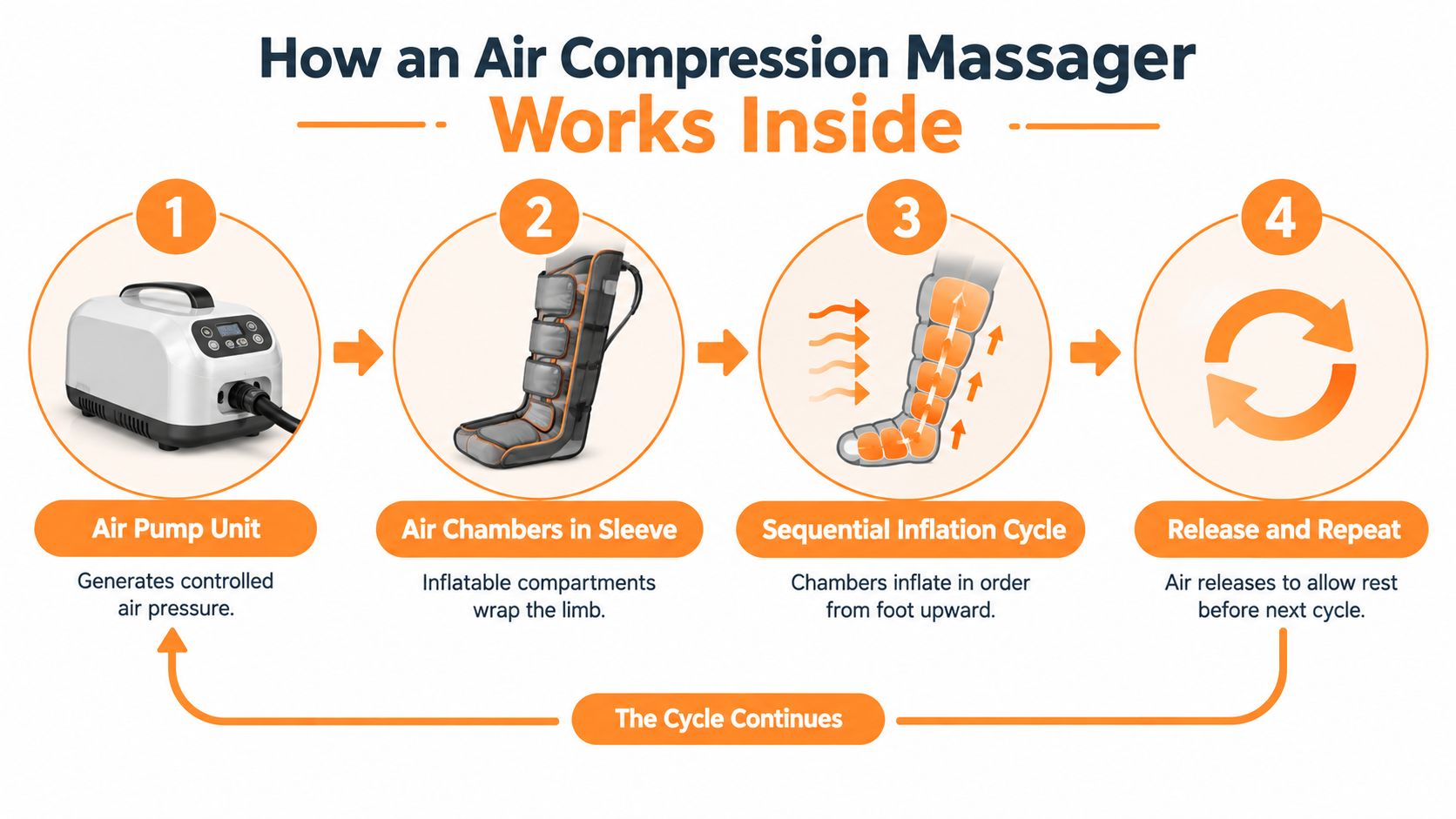
An air compression massager is easier to understand if you think of it as a programmable blood pressure cuff stretched across a limb. Instead of one inflatable bladder, the sleeve usually contains several air chambers. A small pump fills those chambers according to the selected mode, and valves control how quickly the air enters and leaves.
The device's operating cycle has four basic parts:
- The pump generates air pressure. The control unit moves air through connected tubes and regulates the selected intensity.
- The chambers receive air. Inflatable compartments inside the sleeve expand against the limb.
- The chambers inflate in sequence. Many systems start lower on the limb and progress upward, creating a moving wave.
- The air releases before the pattern repeats. Deflation gives the tissue a brief rest between compressive cycles.
Why the chambers inflate in order
Uniform pressure squeezes the whole sleeve at once. Sequential pressure behaves more like a traveling wave, moving from one section to the next. Clinical intermittent pneumatic compression devices commonly use this graded pattern because it better resembles the directional assistance associated with the calf-muscle pump.
The treatment dose has two main ingredients, pressure and timing. Published reviews describe common therapeutic settings in approximately the 30 to 120 mmHg range, with cycle timing often around 30 to 120 seconds, depending on the limb and protocol, as summarized in this review of intermittent pneumatic compression settings. The same source describes testing with pressures of 50, 80, and 120 mmHg and inflation or deflation times of 5, 20, or 50 seconds, showing why a pressure number alone doesn't describe the full experience.
A high setting with a short inflation may feel different from a lower setting held for longer. Chamber shape, sleeve tension, limb size, and valve control also change how the pressure reaches the body.
How to read a product mode
When you see “sequential,” look for the order and direction of inflation. When you see “intensity,” ask whether the setting controls pressure, inflation speed, hold time, or a combination. A useful mental model is simple: pressure tells you how firmly the chamber squeezes, while timing tells you how the squeeze moves and rests.
For a clearer comparison with hands-on fluid-movement techniques, you can also explore Spa Black's lymphatic drainage. The approaches aren't identical, but the resource can help explain why gentle, directional movement feels different from forceful deep-tissue pressure.
Intended Uses for Recovery and Circulation Support
An air compression massager is designed to create temporary mechanical assistance and comfort, not to repair every cause of tired or swollen limbs. The rhythmic squeeze can feel useful after long periods of immobility, demanding exercise, or hours spent standing. It may also provide a calming sensory routine because the pressure rises and falls predictably.
Consider three everyday examples. A desk worker might use a calf sleeve after sitting for much of the afternoon. A runner might use leg boots while resting after training. Someone who works on their feet might choose a foot and calf design for a quiet evening routine.
The same mechanism can be applied to other areas. An arm sleeve may appeal to someone whose work involves repetitive upper-limb activity, while a foot-focused device may feel more practical for people whose discomfort is concentrated around the feet. The correct coverage depends on where you feel the problem, not on how many chambers a product lists.
Recovery claims need careful interpretation
The evidence is more modest than many advertisements suggest. A 2025 review found moderate-certainty evidence that intermittent pneumatic compression didn't reduce muscle soreness at 24 hours, while a 2025 trial found pneumatic compression and a massage gun produced comparable recovery effects over 72 hours, according to this evidence-focused guide to air compression leg massagers.
That doesn't make the device useless. It changes the promise. You may feel more comfortable, relaxed, or less aware of heaviness for a while, but that isn't the same as proving faster tissue healing or superior athletic recovery.
Treat an air compression massager as a comfort and recovery accessory, not as a replacement for sleep, movement, nutrition, or medical care.
A sensible routine can combine compression with gentle movement breaks and a broader recovery plan. For readers building that foundation, sleep optimization at The Sleep Consultant offers context on the role of rest in performance and recovery. If your concern is persistent leg discomfort rather than occasional fatigue, review practical circulation habits in this guide to improving blood circulation, then discuss ongoing symptoms with a qualified clinician.
Key Features to Evaluate Before You Buy
A product page can make every model sound powerful. A better approach is to read it like a fit and usability checklist. The most valuable feature is usually the one that helps you use the device consistently without pain, confusion, or excessive setup.
Chamber layout and pressure control
Look for sequential chambers if you want a wave-like pattern that progresses along the limb. More chambers can create more zones of control, but they may also increase bulk, tubing, and setup complexity. A simple design may be preferable if your main goal is an easy evening routine.
Adjustable pressure matters more than a dramatic maximum. You should be able to begin gently and change the sensation without jumping straight to an aggressive squeeze. Also check whether the controls let you change pressure independently from the mode, since a preset that feels comfortable in one area may not suit another.
Timing, coverage, and fit
A cycle mode determines how long each chamber inflates, holds, and releases. Product descriptions don't always explain those details clearly, so look for a manual or specification sheet that identifies the sequence and available programs.
Measure the body area the sleeve will cover before ordering. Check calf or thigh circumference ranges, foot length, fastening adjustment, and whether the sleeve ends where you need it to end. A loose chamber may deliver uneven contact, while an overly tight sleeve can make a low setting feel much stronger.
Practical features for home use
Portability can decide whether the massager becomes part of your routine or stays in a cupboard. Homecare already represented an estimated 31.0% share in 2025, and market analysis projects it to grow at an 8.6% CAGR, with portable designs, smart pressure control, sequential compression, and home-based DVT prevention identified as major trends in this intermittent pneumatic compression devices market analysis.
| Feature | What to Look For | Why It Matters |
|---|---|---|
| Chamber design | Sequential inflation and clearly described zones | Produces a controlled moving pattern |
| Pressure | Several adjustable levels and transparent specifications | Helps you match intensity to comfort |
| Coverage | Accurate limb measurements and the target area you need | Reduces slipping and uneven contact |
| Power | Rechargeable battery or practical cord length | Determines where you can use it |
| Controls | Simple buttons, readable display, and useful presets | Makes repeat use less frustrating |
| Noise | A clearly stated operating-noise description when available | Matters during reading, calls, or rest |
| Cleaning | Removable or wipeable surfaces and care instructions | Helps maintain the sleeve |
| Compliance | Documented electrical and material safety information | Adds confidence in the product's construction |
The SunnyBay guide to massage tools for home can help you compare compression with other at-home massage formats. Think about storage too. A large multi-chamber system may offer a more elaborate sequence, while a lighter wearable device may win because it takes less effort to bring out and put away.
Pros and Cons You Should Weigh Honestly
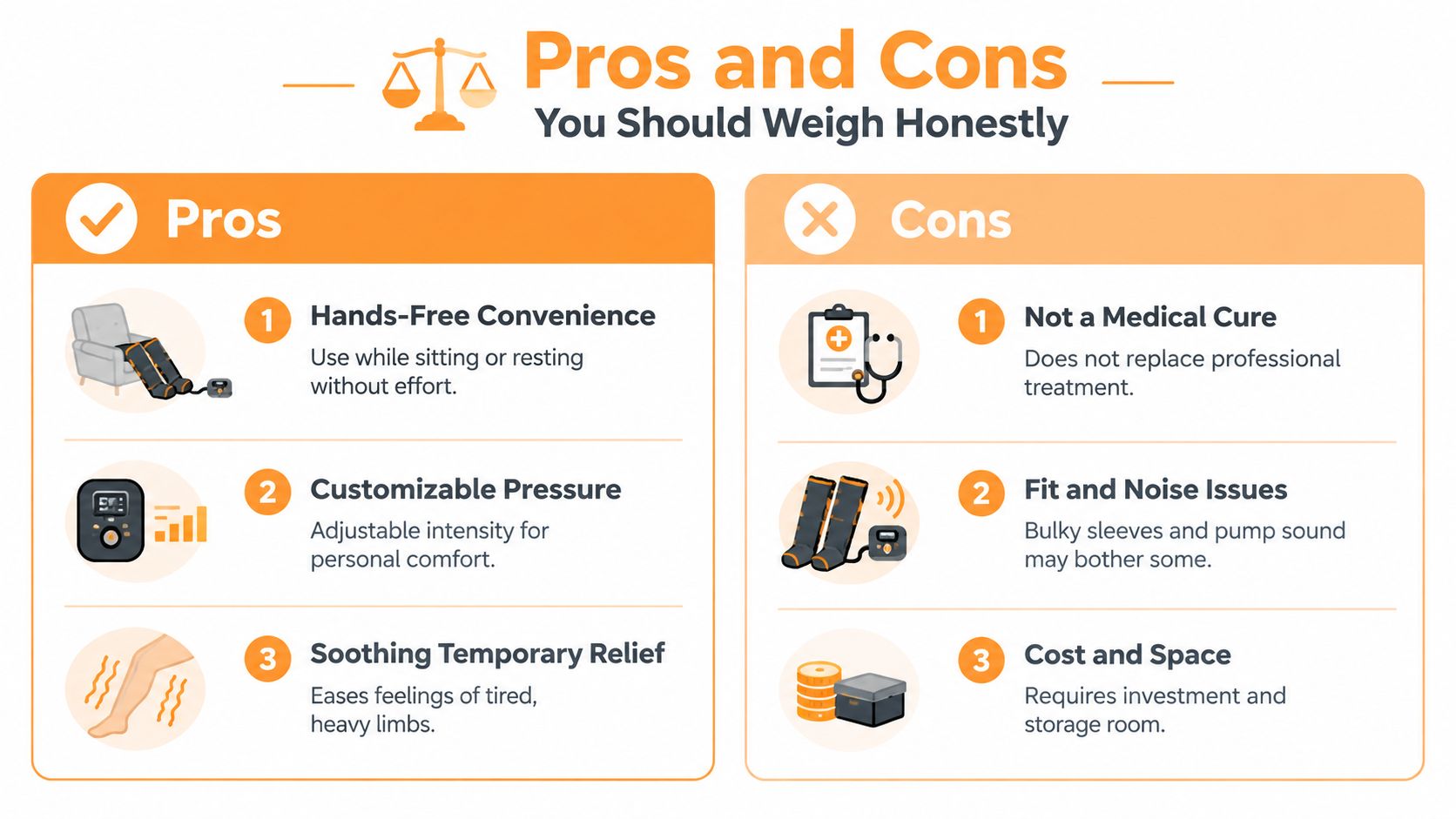
Air compression massagers have a clear appeal. You put on the sleeves, select a mode, and let the pump create the rhythm while your hands remain free. That convenience makes the device different from a handheld tool, which requires you to hold, position, and move it throughout a session.
Customizable pressure can also make the experience more personal. A gentle setting may suit quiet relaxation, while a firmer setting may feel more substantial after activity. The benefit is subjective, and the correct setting is the one that feels controlled rather than painful.
The trade-offs are physical and practical
The sleeves can be bulky, especially when they cover the feet, calves, and thighs. The pump may produce sound, the tubing can limit movement, and the controls may take time to learn. Fit is another concern. A device that suits one person's limb shape may press unevenly on someone else.
There is also a risk of confusing higher nominal pressure with better results. FDA-cleared consumer products don't necessarily have clinical-trial evidence behind every wellness claim. FDA summaries describe bench verification and substantial equivalence pathways, and one cleared model reported massage intensities of 23±2 kPa, 27±2 kPa, and 31±2 kPa, approximately 173, 203, and 233 mmHg, as shown in this FDA device summary. Those figures illustrate that a consumer device's stated pressure can exceed many commonly discussed therapy protocols, depending on calibration and chamber geometry.
| Potential advantage | Possible limitation |
|---|---|
| Hands-free use while seated | Sleeves and pump can take up storage space |
| Adjustable squeezing sensation | A strong setting may feel unpleasant |
| Wave-like compression pattern | The experience varies with fit and limb shape |
| Temporary comfort for tired limbs | Comfort isn't proof of faster healing |
| Useful for several target areas | A broader system may be harder to set up |
The device makes the most sense if you value passive, rhythmic pressure. If you prefer direct muscle contact, a handheld massage tool may feel more intuitive. Neither format automatically wins. Your target area, tolerance, and willingness to use the product regularly matter more than a headline feature.
Safety and Usage Tips for Comfortable Results
Begin with the lowest comfortable pressure and stay there long enough to understand the sensation. Increase gradually only if the sleeve feels even, controlled, and free from pain. More pressure isn't a requirement for a useful session.
Use a repeatable fit check
Before starting, run through this short checklist:
- Check the sleeve: Fasten it securely, but don't forcefully tighten it before inflation.
- Check the skin: Look for irritation, broken skin, rash, unusual heat, or tenderness.
- Check the position: Make sure chambers sit over the intended areas and that tubing isn't sharply bent.
- Check the sensation: Stop if you feel sharp pain, numbness, tingling, marked discoloration, or worsening discomfort.
- Check afterward: Remove the sleeve and inspect the skin before storing the device.
Use the manufacturer's instructions for session length, cycle selection, and cleaning. Keep the sleeve dry unless the manual specifically allows washing, and wipe contact surfaces according to the care directions. A clean, well-maintained sleeve is more pleasant and easier to use repeatedly.
Don't treat a massager as a substitute for movement. Stand up, change position, and take ordinary activity breaks when you can. If you use it after exercise, let comfort guide the pressure rather than trying to overpower soreness.
People with known or suspected circulation conditions, active clots, significant vascular disease, serious heart problems, unexplained swelling, infection, or acute inflammation should seek medical advice before using pneumatic compression. Stop and seek prompt professional guidance if a new symptom appears or an existing symptom becomes more intense. The device is for comfort support, not diagnosis.
How to Choose the Right Air Compression Massager for You
Choose by use case first, specifications second. If your discomfort is mainly in the calves after desk work, a compact calf-and-foot sleeve may be more practical than a full-leg system. If you want a broader recovery routine, examine thigh coverage, chamber order, and whether the controls remain easy to reach.
Your primary goal should narrow the field:
- For relaxation: Prioritize gentle adjustment, quiet operation, soft materials, and simple controls.
- For post-activity comfort: Look for secure fit, sequential modes, and coverage that matches the muscles you use most.
- For frequent travel or small spaces: Favor rechargeable power, lighter sleeves, and a compact storage design.
- For shared household use: Choose adjustable sizing, wipeable surfaces, and controls that different users can understand.
Don't assume pneumatic equipment is the only direction. A 2024 AVF-presented study reported that a novel non-pneumatic compression device achieved a larger limb-volume reduction than an advanced pneumatic device in lower-extremity lymphedema, a finding described in this report on portable non-pneumatic compression. That doesn't make every non-pneumatic option superior, but it does challenge the idea that a heavier pump or higher pressure is automatically the better choice.
For broader recovery ideas, review this guide to muscle recovery tools. If you prefer heat-based comfort for the neck, back, or shoulders, a reusable SunnyBay heat therapy product can complement a leg-focused routine, but heat and pneumatic compression address different sensations and body areas.
Shortlist two or three models. Compare their fit measurements, controls, pressure adjustment, power source, cleaning instructions, and return terms. Then choose the one you're most likely to use comfortably, not the one with the most intimidating maximum setting.
SunnyBay offers reusable heat therapy products, massage tools, and related comfort accessories for areas such as the neck, back, shoulders, eyes, and hands. Visit SunnyBay to compare those options with your recovery routine and find a practical complement to an air compression massager.


