


Reusable Shoulder Ice Pack Guide for Safe Relief
-
You wake up with one shoulder feeling hot, tight, and sore every time you reach for a cup or pull on a shirt. You don't want another medicine cabinet search or a leaking bag of frozen peas sliding down your arm. You want something you can refreeze, strap on, and take off after a short, watched session.
Table of Contents
- Why a Reusable Shoulder Ice Pack Matters
- How Cold Therapy Works on a Sore Shoulder
- Comparing Reusable Packs with Disposable Options
- When Cold Helps and When It Does Not
- Using a Reusable Shoulder Ice Pack Safely
- Real Situations for Shoulder Ice Packs
- Caring for the Pack and Your Next Step
Why a Reusable Shoulder Ice Pack Matters
You slept on one side too long, added weight at the gym, or spent the day hunched over a laptop. By evening your shoulder aches when you lift your arm, and you are standing in front of the freezer deciding what will stay in place.
A reusable shoulder ice pack is a contoured cold wrap or strap on pack shaped to sit over the rounded joint. Many designs include a soft cover and an adjustable band, so your hands stay free while the pack covers the front, side, and top of the shoulder.
Why a Flat Bag of Ice Often Fails
A kitchen bag of ice cubes is stiff, lumpy, and built for a flat surface. Your shoulder isn't flat. The bag touches one high spot, slides when you move, and leaves other sore areas warm, which makes people press harder or leave it on longer than they should.
A shaped reusable pack solves a different problem. It's not stronger medicine, it's repeatable contact. You freeze it, use it for a short session, return it to the freezer, and it's ready the next time soreness flares after work, exercise, or a poor night's sleep.
A Common Problem, Not a Niche One
Shoulder pain shows up across workers, older adults, and active people, not only athletes or surgical patients. A 2022 systematic review of shoulder pain prevalence covering 61 studies found a median community prevalence of 16.0%, with estimates ranging from 0.67% to 55.2% depending on country and method.
That wide range confuses readers, so here's the plain explanation. Studies that ask about pain today get lower numbers than studies that ask about pain over weeks or a full year. The same review reported prevalence of 2.0% to 34.2% over 7 days and 10.8% to 55.2% over 12 months or longer, which helps explain why shoulder products are everyday self care items.
A reusable pack matters because the need tends to return. The question isn't whether you'll ever use it again, it's whether you'll use it safely and for the right kind of soreness.
That distinction guides everything that follows. You'll learn what cold does in the tissue, how reusable designs compare with disposables, when ice is the wrong first move, and how to run one safe session without guessing.
How Cold Therapy Works on a Sore Shoulder
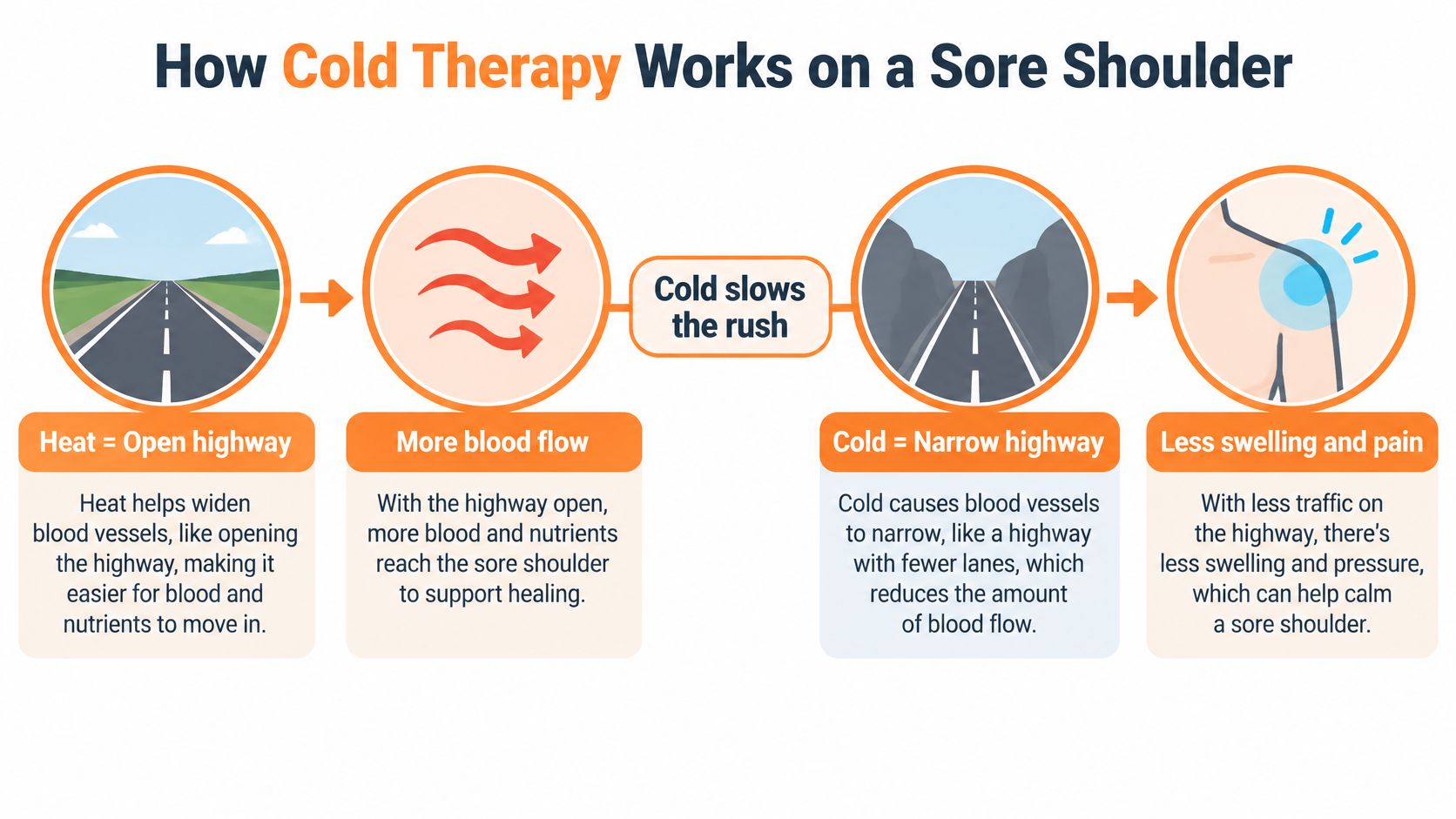
Think of blood flow like traffic on a highway. Heat opens more lanes, so blood and nutrients move in more easily and stiff tissue often feels looser. Cold briefly narrows the highway, slows local flow, dulls pain signals, and can take the edge off fresh swelling.
That narrowing is temporary and local. It doesn't repair a torn tendon, rebuild cartilage, or fix posture. For a shoulder, where skin, muscle, tendons, and nerves sit close together under a strap, that short calming effect is useful only if you control contact and time.
Designs You'll See in Stores
Most reusable options fall into a few practical groups.
- Flexible gel packs: A soft fill stays pliable when frozen and bends over the deltoid instead of bridging across it.
- Contoured wraps: A shaped panel follows the curve from neck to upper arm, spreading contact instead of leaving one icy lump.
- Strap systems: An elastic or adjustable band holds the pack while you sit, stand, or walk around the house.
- Dual purpose packs: Some products freeze for cold sessions and can also be warmed later when heat fits the problem better.
Materials matter for comfort, not magic. A conformable fill improves contact, a fabric cover slows the initial chill against skin, and a strap removes the need for a helper to hold the pack in place.
What the Evidence Supports and Where It Cautions You
A 2024 systematic review of postoperative shoulder cryotherapy with six randomized trials and 233 surgical patients concluded that cryotherapy generally reduced postoperative shoulder pain, although one study found no significant difference and the authors noted small samples and methodological limits. That's a measured result, not a promise for every shoulder.
There's also a trade off people miss. Cooling that dulls pain can temporarily dull position sense, the feeling that tells you where your arm is without looking. After icing, your shoulder may feel less painful but also less precise, which is why a pack belongs in recovery, not right before throwing, heavy lifting, or a rehab drill that needs accurate control.
In plain terms, a reusable shoulder ice pack is built for short, controlled cooling. It numbs and calms for a while. It doesn't make the joint stronger for the next set.
Comparing Reusable Packs with Disposable Options
Your best format depends on where you'll use it. A sideline, a hotel room, and your living room don't offer the same freezer access, privacy, or time.
Disposable chemical packs win on convenience when there's no freezer. You activate one, use it once, and discard it. The downside shows up if you ice several times a week, because cost and waste repeat with every session and the cold shape rarely follows a shoulder well.
Shoulder Cold Pack Formats Compared
| Format | Best for | Fit on the shoulder | Reuse and contents | Heat option |
|---|---|---|---|---|
| Disposable chemical pack | Travel or first aid kits | Often flat, needs holding | Single use, chemical activation | No |
| Basic reusable gel pack | Home use on a budget | Flexible, may need a towel wrap to stay put | Refreezable gel, reusable | Sometimes, check label |
| Contoured reusable wrap with strap and cover | Repeated home recovery | Shaped panel and band for hands free contact | Reusable construction, washable cover on some models | Often dual hot and cold |
Read the table as a match test, not a ranking. If you need cold once at a tournament, disposables make sense. If shoulder soreness returns after work or training, a contoured reusable design usually stays put better and spreads cold more evenly.
Where Dual Hot and Cold Products Fit
SunnyBay, a U.S. retailer and manufacturer serving shoppers since 2002, lists reusable hot and cold solutions in this category, including large ice bags with adjustable straps and shoulder joint heat wraps shaped for rotator cuff and frozen shoulder use. Its microwavable products use natural fills such as flax seed and lava sand, dual fleece and cotton covers, and elastic hands free fits, and some pieces can be frozen for cold use after serving as heat wraps.
That dual use matters when your shoulder problem changes. Fresh swelling may call for cold for a day or two, while later stiffness may respond better to warmth and gentle movement. For heat products, retention commonly up to 30 minutes is stated for those designs, but cold sessions should still stay short and supervised even if the pack feels comfortable.
People recovering from procedures sometimes compare home cold routines with broader postoperative advice, and resources such as Ideal Face & Body breast reduction recovery illustrate how recovery guidance varies by surgery and body area. For your shoulder, follow your own surgeon's instructions first, then choose a format you can position without tight pressure.
When Cold Helps and When It Does Not
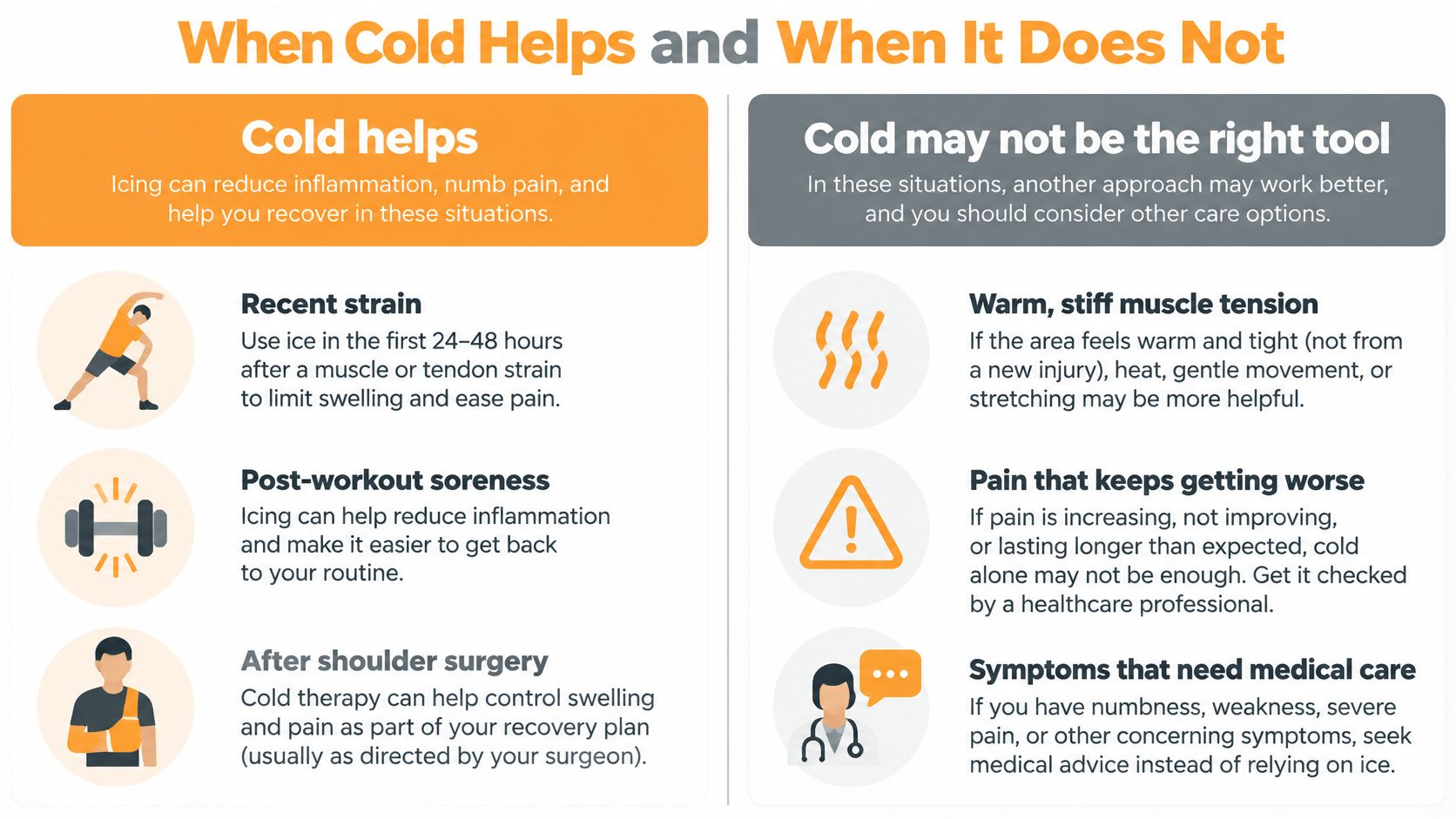
Ice is not a universal answer for rotator cuff pain, strains, stiffness, and surgery recovery. Treating every sore shoulder the same way is where many people get stuck, icing a stiff joint day after day and wondering why movement doesn't improve.
Start with what you feel and when it began. Fresh swelling, a recent strain, or a sharp flare after activity is the clearest home reason to use a reusable shoulder ice pack. The goal is short term comfort and calmer tissue while you rest the area and watch how it responds.
Sort the Problem Before You Reach for the Freezer
- Stiffness and a stuck feeling: A tight shoulder that won't reach overhead often needs warmth and gentle movement more than repeated cooling.
- Rotator cuff tendinopathy: Exercise based rehabilitation is the main work, and cold can sit beside that plan for comfort without replacing it.
- Nerve type symptoms: Tingling down the arm, weakness, or pain that keeps worsening calls for clinical review rather than another icing cycle.
- After surgery: Use cold only in the way your surgical team directs, because dressings, incisions, and sensation changes alter the risk.
The evidence for surgery is mixed. A 2025 systematic review of shoulder surgery cryotherapy studies found inconsistent pain benefits across six studies involving 311 patients, with some rotator cuff repair and shoulder arthroplasty trials showing no statistically significant pain reduction. That doesn't mean cold never helps after surgery, it means you shouldn't expect the same result in every case.
Readers who want a broader framework for persistent tissue pain may find Sunridge Medical's approach to soft tissue pain useful context for why ongoing symptoms deserve assessment beyond home remedies. If you're deciding between temperature options at home, SunnyBay's guide to heat therapy compared with cold therapy for pain relief can help you match warmth to stiffness and cold to fresh swelling.
Practical rule: Ice the flare, warm the stiffness, rehabilitate the tendon, and get reviewed when pain spreads, weakens the arm, or refuses to settle.
A pack can make a sore shoulder feel quieter for a while. It can't diagnose why the shoulder hurts, and it shouldn't be sold to you as a treatment for the underlying injury.
Using a Reusable Shoulder Ice Pack Safely
Assume you've decided cold is reasonable for a fresh, swollen, achy shoulder. Now run one session in order, without improvising the parts that protect skin and nerves.
First, inspect the pack. Squeeze seams gently, check for leaks or cracks, and confirm the strap and cover are intact. If gel is escaping or the surface is damaged, don't put it against your body.
One Safe Session From Start to Finish
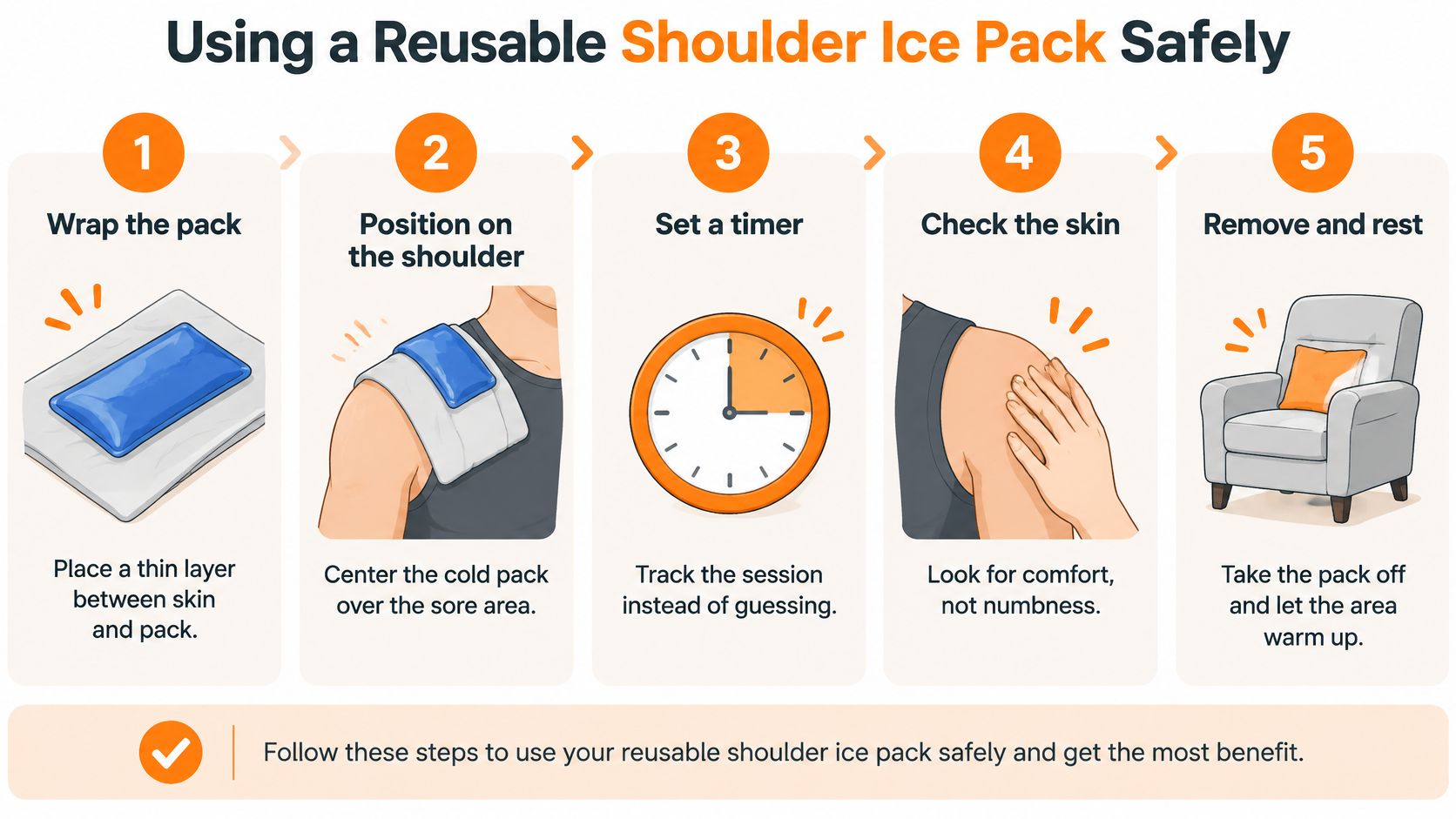
- Add a barrier: Place a damp cloth or thin towel between pack and skin, even if the pack has a cover.
- Position and strap gently: Center the cold area over the sorest region and set the band snug enough to hold contact, not tight enough to dent skin or make fingers tingle.
- Time it: NHS shoulder guidance recommends approximately 10 to 15 minutes per application, typically three to four times daily, as described in NHS guidance for soft tissue shoulder injury care.
- Check skin and feeling: Lift an edge partway through and look at color, then press a fingertip nearby to confirm normal color return and sensation.
- Remove and rewarm: Take the pack off on time and let skin return to normal warmth before considering another round.
Merck Manual guidance allows 10 to 20 minute cold sessions, 3 to 5 times daily during the first 24 to 72 hours, with at least an hour for rewarming, as set out in Merck Manual guidance on rehabilitative measures for pain and inflammation. Use the shorter end if you're new to icing, your skin is fair or thin, or the strap adds pressure.
Know the Difference Between Chill and Danger
A mild chill feels cold, then achy, then numb in a dull way that eases after removal. Dangerous overcooling feels different. Stop at once if skin turns white, blue, or blotchy, pain spikes sharply, or you develop heavy numbness or tingling that doesn't fade quickly.
Cold plus tight compression is the risky combination for nerves around the shoulder and upper arm. A timer alone won't protect you if the strap is tourniquet tight.
Skip home ice and ask a clinician first if you have poor circulation, reduced sensation, Raynaud's disease, peripheral vascular disease, cold urticaria, or sickle cell disease. Use extra caution when diabetes blunts your ability to feel tissue damage, and only ice intact skin.
If you want more detail on strap on formats, SunnyBay's article on using an ice bag for injuries covers positioning basics you can apply alongside the skin checks above.
Real Situations for Shoulder Ice Packs
The same pack can be right on Saturday and wrong on Monday. These everyday scenes show how the decision changes with the shoulder in front of you.
The image below shows how a contoured pack stays in place during ordinary seated and standing moments, which is the practical advantage people notice first at home.

After a Fresh Strain or Hard Match
You reach too far for a ball, feel a pull, and by evening the shoulder is puffy and sore. This is cold territory early on, aimed at swelling and ache while you pause the activity that caused it.
Don't ice and immediately go back to throwing to test it. In controlled research on 15 minutes of crushed ice applied to the shoulder, maximal voluntary isometric contraction fell by approximately 10% and joint position sense was impaired. Wait until warmth, feeling, and control seem normal, and notice whether comfort improves or pain returns stronger.
At a Desk, in Rehab, and With a Stiff Shoulder
An office worker ends the day with tight muscles between neck and shoulder, no swelling, and no single injury moment. Ice may numb it briefly, but warmth, posture breaks, and movement often fit that pattern better. If cold leaves stiffness unchanged every time, that's useful information, not a reason to ice longer.
A person in rotator cuff rehab uses the pack after prescribed exercises when the shoulder feels irritated. The exercises remain the treatment plan, and SunnyBay's overview of rotator cuff recovery and rehabilitation basics can help frame why the pack is only a comfort break between sessions.
The short video below demonstrates hands free positioning during daily activity, so you can see how a wrap differs from holding a flat pack in place.
With frozen shoulder stiffness, imagine someone who can't reach a seat belt comfortably. They warm the joint, do gentle prescribed motion, and save cold only for a separate flare with clear swelling. If reach keeps shrinking, night pain escalates, or weakness appears, the next step is a clinician, not a colder pack.
Caring for the Pack and Your Next Step
A reusable product only helps if it stays clean, intact, and flexible enough to fit. Build care into the same routine you use for icing, so inspection becomes automatic rather than an afterthought.
After each session, wipe the cover and let the pack return toward room temperature before refreezing if the product instructions require it. Wash removable fabric as directed, dry it fully, and store the pack flat if the label recommends that shape for even freezing.
Retire It Before It Fails on Your Skin
- Leaking seams or sticky residue: Stop using the pack and replace it.
- A strap that slips or digs in: A band you must overtighten to hold position is no longer giving you a gentle fit.
- Fill that stays rock hard: A rigid lump won't spread contact over a rounded joint and can concentrate cold in one spot.
- Torn cover: Replace the cover or the pack, because your barrier layer is part of the safety system.
Don't mend a leaking gel pack with tape and hope for the best. The savings aren't worth gel on irritated skin or uneven cooling during a session you can't fully feel.
Choose Based on Swelling or Stiffness
If fresh swelling is your main problem and you want repeat use at home, choose a contoured reusable shoulder ice pack with a protective cover and an adjustable strap. Freeze it in advance, use a cloth barrier, and keep each session short and watched on intact skin.
If stiffness is the bigger issue, look instead at a hands free heat wrap you can warm for daily use and, when the product allows, chill later for a separate flare. Online listings for strap on ice bags and joint wraps made for shoulder use note practical shopping details such as free shipping thresholds and a 30 day returns window on the retailer site, which helps if fit around your shoulder and upper arm isn't right.
Match the tool to the tissue in front of you today, swelling or stiffness, then reassess tomorrow instead of repeating the same temperature out of habit.
Your next step is simple. Sort the problem, pick the format that stays on your shoulder without tight pressure, and if pain persists, spreads, or weakens the arm, book a clinical review rather than extending your icing routine.
Visit SunnyBay to browse reusable shoulder heat wraps, strap on ice bags, and hot and cold accessories you can freeze or warm to match swelling versus stiffness. Choose a contoured, hands free option that fits your shoulder comfortably, then use it in short, watched sessions as part of your home recovery routine.


