


Natural Remedies for Pinched Nerve: Fast Relief and Lasting Healing
-
When you're dealing with a pinched nerve, natural remedies are often the best place to start. The goal is to combine rest, smart movement, and temperature therapy in a way that works for your body. The most effective strategies usually involve using heat or cold packs to calm down tight muscles and inflammation, doing specific, gentle stretches to take pressure off the nerve, and fixing your posture so you don't keep aggravating it.
Understanding What a Pinched Nerve Feels Like
Before we can get into fixes, it helps to understand what's actually happening inside your body when a nerve gets "pinched." The easiest way to picture it is to think of a garden hose. When the hose is lying flat and straight, water flows through it perfectly. But if you step on it or put a kink in it, the flow gets blocked or reduced to a trickle.
That's almost exactly what happens with a pinched nerve. Your nerves are your body's electrical wiring, sending signals back and forth from your brain. When nearby tissues—like a bulging disc, a tight muscle, or an inflamed tendon—press down on a nerve, they disrupt those signals. That compression is what triggers the shooting pain, tingling, numbness, or weakness you're feeling.
Common Trouble Spots and Their Unique Sensations
This nerve compression doesn't happen just anywhere. It's most common in areas where nerves have to travel through tight tunnels or around bony structures. Learning to recognize the unique sensations tied to each location can give you major clues about where your problem is coming from.
A classic example is a pinched nerve in the lower back, which often squeezes the sciatic nerve—the longest nerve in your body. This is what causes sciatica: that unmistakable sharp, radiating pain that can shoot from your low back, through your glutes, and all the way down one leg. It’s a perfect illustration of how pressure in one area can cause symptoms to show up somewhere else entirely.
The wrist is another frequent culprit. The median nerve has to pass through a narrow channel called the carpal tunnel. If that area gets inflamed, the nerve gets compressed, leading to numbness and that "pins and needles" feeling in your hand and fingers. It's a dead giveaway that the nerve's signals aren't getting through clearly.
The key takeaway is this: A pinched nerve is a mechanical problem. Something is physically pressing on the nerve. Therefore, the most effective natural remedies are those that address this pressure directly by creating space, reducing inflammation, and relaxing the compressing tissues.

This table can help you quickly connect your symptoms to a potential pinched nerve location, helping you target your relief efforts more effectively.
Common Pinched Nerve Symptoms by Location
| Nerve Location | Common Symptoms You Might Feel | Everyday Activities Affected |
|---|---|---|
| Cervical Spine (Neck) | Sharp pain in the neck; numbness, tingling, or weakness radiating into the shoulder, arm, or hand. | Turning your head, typing, lifting objects, or even getting a good night's sleep. |
| Thoracic Spine (Mid-Back) | Sharp, burning pain in your mid-back, chest, or ribs; can sometimes be mistaken for heart or lung issues. | Twisting your torso, deep breathing, or sitting for long periods. |
| Lumbar Spine (Low Back) | Sciatica—a shooting pain down the back of one leg; numbness or a "foot fell asleep" feeling. | Walking, bending over, sitting, or transitioning from sitting to standing. |
| Wrist (Carpal Tunnel) | Numbness, tingling, or burning in the thumb, index, and middle fingers; weakness in grip strength. | Typing, writing, holding a phone, or buttoning a shirt. |
| Elbow (Cubital Tunnel) | Numbness and tingling in the ring and little fingers; pain on the inside of the elbow. | Bending your elbow for long periods, like when talking on the phone or sleeping. |
Recognizing these patterns is the first step toward feeling better. Once you understand that the pain is coming from physical compression, it suddenly makes sense why remedies that release that pressure—like targeted heat therapy, gentle stretches, and self-massage—are so powerful. You're not just covering up the pain; you're getting to the root of the problem.
Using Temperature Therapy for Nerve Pain
When a pinched nerve sends those sharp, shooting pains through your body, one of the best first steps you can take is right in your own home: temperature therapy. It's a classic for a reason. This isn't just about comfort; it's about using heat and cold intelligently to manage your symptoms and help your body start healing.
The trick is knowing which one to grab and when. Think of cold as your immediate emergency response. For the first 48-72 hours after the pain flares up, a cold pack is your go-to. Applying cold constricts the blood vessels in the area, which is exactly what you want to dial down inflammation and swelling—often the main culprits behind nerve compression. It also provides a welcome numbing sensation that can take the edge off the worst of the pain.
This initial cool-down is all about calming things down. Once that acute, angry phase passes, it's time to bring in the soothing comfort of heat.
The Deep Relief of Heat Therapy
After the first couple of days, heat becomes the star of the show for longer-term relief and healing. While cold is great for that initial swelling, heat tackles the stubborn muscle tightness that often keeps the nerve trapped in the first place.
When you apply a good heat pack, it does the opposite of cold: it opens up the blood vessels. This process, called vasodilation, is like clearing a traffic jam on a major highway. For example, imagine the tight muscles in your neck are squeezing a nerve. Applying heat brings a rush of fresh, oxygen-rich blood to those muscles. This not only eases the painful stiffness but also helps flush out inflammatory waste products, speeding up repair and giving the nerve the space it needs to function properly.
"Applying heat doesn't just feel good—it makes the surrounding muscles more flexible and relaxed. Sometimes, that release is all it takes to ease the pressure off the compressed nerve, giving it the space it needs to finally heal."
Not sure if your pain is from a pinched nerve, a muscle strain, or a tendon issue? This quick decision guide can help you sort through your symptoms.
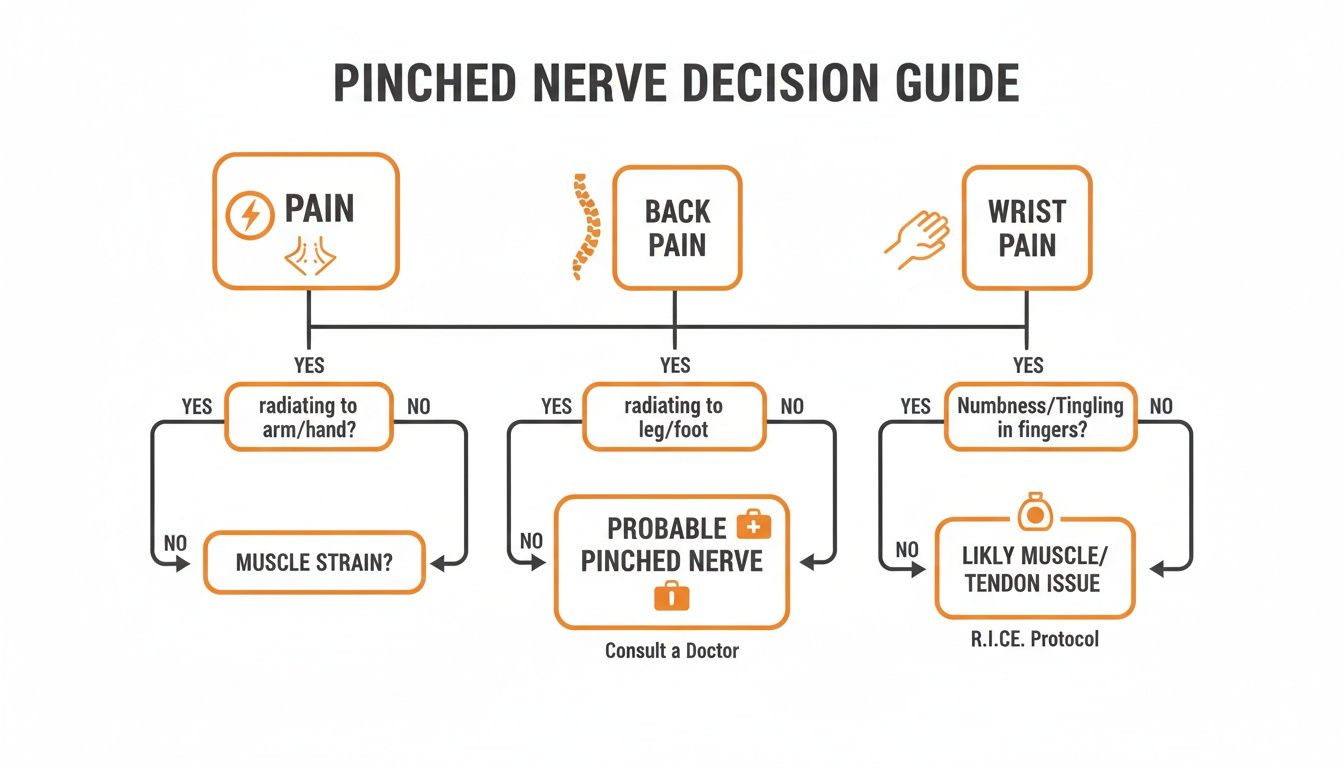
This chart helps you connect where you feel the pain—neck, back, or wrist—to the specific symptoms of a pinched nerve, pointing you toward the most effective kind of relief.
How to Alternate Hot and Cold for Maximum Effect
For a more dynamic approach, many experts recommend switching between hot and cold. Known as contrast therapy, this creates a "pumping" action in your circulatory system. The cold constricts blood vessels, and the heat expands them. This cycle is incredibly effective at flushing out inflammatory byproducts and drawing in a fresh supply of blood.
Here’s a simple routine to try:
- Start with cold. Apply a cold pack (wrapped in a thin towel to protect your skin) to the sore spot for 15-20 minutes.
- Take a break. Let the area return to normal temperature for at least 30 minutes.
- Bring on the heat. Use a quality microwavable heat pack or warm compress on the same spot for 15-20 minutes.
- Repeat as needed. You can run through this cycle a few times a day, especially when you feel stiff or before doing some gentle stretches.
Heat therapy is one of the most trusted natural remedies out there, widely recommended by chiropractors and physical therapists. In fact, conservative treatments like rest and temperature therapy are often all that's needed—about 90% of pinched nerve cases resolve on their own within 6 to 12 weeks.
Putting Heat Therapy Into Practice
Making heat a part of your daily routine doesn't have to be a hassle. The key is finding tools that fit your life, so you can get relief without being stuck on the couch.
For Neck and Shoulder Pain:
That familiar tension is creeping up your neck while you’re trying to work. Instead of just toughing it out, you can drape a weighted, heated neck wrap over your shoulders. The gentle pressure and steady warmth work together to melt away the muscle knots that could be squeezing a nerve in your neck.
For Lower Back Pain (Sciatica):
If a pinched nerve in your lower back makes sitting a misery, a lower-back heat pad with a strap is a game-changer. You can secure it right where you need it and wear it while you’re on the computer, watching TV, or even to relax your back muscles before climbing into bed. You can learn more about how heat is good for a pinched nerve in our detailed guide.
By using temperature therapy this way, you’re not just temporarily dulling the pain. You are actively creating an environment in your body that promotes healing, empowering you to take back control, one soothing session at a time.
Gentle Movements That Create Space and Relief
When a nerve gets pinched, your first instinct might be to stay perfectly still. Moving seems like the last thing you should do, but the right kind of movement is actually one of the most effective ways to find relief.
Think of it like untangling a delicate necklace. If you yank on it, the knot just gets tighter. But if you gently and patiently work to create a little space, the knot releases. These gentle stretches work the same way—they aren't about forcing anything. They’re about carefully creating space around the nerve to relieve that painful pressure.
Gentle movement coaxes the muscles and joints around the nerve to relax their grip. This not only eases the physical compression but also boosts circulation, bringing fresh, oxygen-rich blood to the area to help it heal and calm inflammation.
The golden rule here is to listen to your body. A mild, pulling stretch is good. A sharp, shooting pain is your cue to stop immediately.
Maximize Your Routine with Heat Therapy
Before you start stretching, give yourself a head start by applying a quality heat pack to the sore area. Just 15-20 minutes of heat will warm up your muscles, making them far more flexible and ready to stretch.
This simple pre-stretch ritual can be a game-changer. It relaxes the exact tissues you’re about to work on, allowing you to get a deeper, safer, and more satisfying release. It’s a small time investment that pays off big in terms of relief.
Simple Stretches to Release Nerve Pressure
Here are a few easy, low-impact movements you can do right at home. The key is to move slowly and deliberately.
1. Gentle Neck Tilts (For a Pinched Nerve in the Neck)
This is fantastic for releasing the tight muscles along the side and top of your neck (the scalenes and upper traps) that often cause nerve compression.
- Start by sitting or standing tall, letting your shoulders drop away from your ears.
- Slowly tilt your head, bringing your right ear toward your right shoulder. Stop when you feel a gentle stretch on the left side of your neck.
- Hold this for 20-30 seconds, taking deep, slow breaths. Don't pull or force it.
- Gently return to the center and repeat on the other side. Try to do 3 repetitions on each side.
2. Cat-Cow Pose (For a Pinched Nerve in the Back)
This classic yoga pose is wonderful for gently moving the entire spine. It helps create tiny bits of space between your vertebrae, which can be just what a compressed spinal nerve needs. For more specific stretches, especially for sciatica, check out our detailed guide on how to relieve sciatica pain naturally.
- Get on your hands and knees, with your hands directly under your shoulders and your knees under your hips.
- Cow Pose: As you inhale, let your belly drop towards the floor, lift your chest, and look forward.
- Cat Pose: As you exhale, round your spine up toward the ceiling, tucking your chin and tailbone.
- Flow gently between these two poses for 1-2 minutes, letting your breath guide the movement.
Gentle stretching isn't just a folk remedy; it's a cornerstone of natural nerve care. Consistently incorporating these movements strengthens the muscles that support your spine and joints, which can reduce the chance of a pinched nerve recurring by up to 50%.
A Sample 10-Minute Daily Routine
You don't need a long, intense workout. A consistent 10-minute routine every day can make a world of difference.
| Time | Activity | Focus |
|---|---|---|
| Minutes 0-2 | Gentle Warm-Up | Begin with slow shoulder rolls (both forward and backward) and easy torso twists to warm up your core. |
| Minutes 2-5 | Cat-Cow Pose | Move through this for 3 minutes, focusing on linking your breath to the spinal movement. |
| Minutes 5-8 | Neck Tilts & Rotations | Complete 3 sets of neck tilts per side. Then, slowly look left and right, and tuck your chin to your chest. |
| Minutes 8-10 | Child's Pose | Finish by resting in Child's Pose for 2 minutes. This allows your entire back to relax and decompress. |
By working these simple movements into your daily life, you become an active partner in your own healing. And remember, recovery isn't just about exercises; adopting effective posture exercises and habits is crucial for preventing future issues. You’re not just chasing away pain—you’re building a stronger, more resilient body.
Using Self-Massage to Release Muscle Tension
Beyond heat and stretching, you have another powerful tool right at your fingertips—literally. Self-massage can be a game-changer when you're dealing with a pinched nerve.
When a nerve gets compressed, the muscles around it tend to seize up in a protective spasm. This is the body's natural defense mechanism, but it often makes the problem worse by adding even more pressure. Self-massage helps you break that painful cycle.
The benefit of massage therapy is that you can directly address the muscle tension that’s contributing to the problem. For instance, if a tight muscle in your glute is squeezing your sciatic nerve, massage can manually soften that muscle, providing immediate relief from the pressure. This isn't just about feeling good; it's a direct, mechanical solution to the problem, and it also gets blood flowing to accelerate healing.

As a bonus, this process triggers the release of endorphins, your body’s own natural painkillers, giving you immediate, drug-free relief.
Finding and Releasing Trigger Points
The secret to effective self-massage lies in targeting what we call trigger points. These are small, hyper-irritable knots within a tight band of muscle. When you press on them, they not only feel tender but can also send pain to other parts of your body. That tingling down your arm, for instance, might actually be caused by a trigger point in your shoulder.
Finding these spots is pretty intuitive. Gently explore the sore muscle with your fingers, feeling for a spot that’s like a small, hard pea and is particularly tender when you press on it. Once you find one, you can get to work. For a deeper look at this approach, our guide explains what trigger point therapy is and how it works in more detail.
To release a trigger point, apply firm, steady pressure directly onto the knot. You can use your thumb, fingertips, or even a simple tool like a tennis ball. The key is to hold that pressure for 30-60 seconds. You'll actually feel the muscle start to "melt" or give way beneath the pressure. Remember to breathe deeply the entire time to help your muscles let go.
Self-Massage Techniques for Common Trouble Spots
You don’t need any fancy equipment to get started. Your own hands or a humble tennis ball will do the trick for most areas.
1. For Neck and Shoulder Tension
A pinched nerve in the neck often comes with major tightness in the upper trapezius muscles—the ones that run from your neck out to your shoulders.
- Technique: While sitting, use your right hand to feel for those tender knots on your left trap muscle. Once you’ve found a spot, press down gently with your fingers and hold. To deepen the release, slowly tilt your head away to the right while keeping the pressure on the knot.
- Example in Action: Imagine you've been hunched over a computer all day and that familiar ache starts radiating from your neck. Taking a moment to do this massage right at your desk can stop the pain in its tracks and prevent a full-blown tension headache.
2. For Sciatica and Lower Back Pain
The piriformis muscle, which is located deep in your glutes, is a common culprit behind sciatica-like symptoms. The sciatic nerve runs right under it (and for some people, right through it!), so when the piriformis gets tight, the nerve gets squeezed.
- Technique: Place a tennis ball on the floor and sit on it, positioning the ball in the fleshy part of one buttock. Gently roll around until you find a very tender spot. Once you’ve located it, simply rest your weight on the ball for 30-60 seconds, breathing into the sensation.
- Example in Action: If you get that shooting leg pain when standing up from a chair, try spending five minutes on a tennis ball first. Releasing the piriformis can give the sciatic nerve the space it needs, making movement far less painful.
Self-massage is about empowering you to take control of your pain. By learning to identify and release the muscle tension that contributes to nerve compression, you can provide yourself with on-demand relief, reduce your reliance on pain medication, and accelerate your overall recovery.
Building a Pain-Free Lifestyle with Simple Adjustments
Getting rid of the pain from a pinched nerve is one thing, but keeping it from coming back is another story entirely. It's about getting to the root of the problem. While many natural remedies give you that much-needed immediate relief, building a truly pain-free life means taking a hard look at your daily habits and making a few key changes. These small, consistent tweaks are what lay the groundwork for real healing and help you sidestep future flare-ups.
It all starts with the places you spend the most time: your desk and your bed. You might not realize it, but poor ergonomics at work and awkward sleeping positions are often the silent culprits behind chronic nerve compression. They put a constant, low-level strain on your spine and joints day after day.
Creating a Nerve-Friendly Workspace
If you’re chained to a desk for hours on end, your setup can be your best friend or your worst enemy. A poorly arranged workspace forces your body into awkward postures that strain your neck and back, which can directly lead to nerve irritation. The goal isn't complicated: create an environment that supports your body's natural, relaxed alignment.
Here are a few high-impact ergonomic fixes you can make today:
- Elevate Your Monitor: Your screen should be set up so the top of it is at or just slightly below your eye level. This simple adjustment stops you from craning your neck downward—a classic cause of pinched nerves.
- Support Your Lower Back: Make sure your chair has good lumbar support that fits the natural curve of your lower back. If it doesn't, don't sweat it. A rolled-up towel or a small cushion can make a world of difference.
- Keep Wrists Straight: When you're typing, your wrists should be in a straight, neutral line, not bent up or down. This is a crucial step in preventing issues like carpal tunnel syndrome.
- Take Movement Breaks: Set a timer on your phone to remind you to get up, stretch, and walk around for a few minutes every single hour. Movement prevents your muscles from getting stiff and tight.
A simple adjustment, like raising your computer monitor by just a few inches, can be the difference between chronic neck pain and lasting comfort. It’s a small change with a monumental impact on nerve health.
Optimizing Your Sleep for Spinal Alignment
We spend about a third of our lives sleeping, so it’s no surprise that your posture in bed has a massive impact on your nerve health. Sleeping in a twisted or awkward position can put sustained pressure on nerves in your neck, shoulders, and lower back, basically undoing all the good work you did during the day.
The secret is to keep your spine in a neutral, straight line all the way from your head to your hips.
If You Sleep on Your Back:
Try placing a small pillow under your knees. This simple trick helps your lower back maintain its natural curve, taking a ton of pressure off the sciatic nerve.
If You Sleep on Your Side:
Put a firm pillow between your knees. This stops your top leg from dropping forward and twisting your spine, which is a common trigger for pain in the lower back and hip.
For anyone looking for next-level comfort and more targeted relief, finding the best adjustable bed base can be a game-changer. It lets you customize your sleeping position by elevating your legs or upper body, so you can find that perfect, zero-pressure angle.
By consciously tweaking your daily environment, you shift from just managing pain to actively preventing it. These small, mindful changes are powerful natural remedies in their own right, empowering you to build a more resilient, pain-free body.
Knowing When It's Time to See a Doctor
While these natural remedies can work wonders for a pinched nerve, it's crucial to know when self-care isn't cutting it. Think of at-home treatments as your first line of defense, but some situations absolutely call for professional help. Learning to listen to your body and spot the red flags is key to a safe recovery.
Most of the time, a pinched nerve will get better with a little patience and the right self-care. But if your pain hasn't improved after a week or two—or worse, if it's getting more intense—that's your cue to see a doctor. This is your body telling you that the compression might be more serious than simple remedies can handle.
Red Flags You Should Never Ignore
Some symptoms are more than just standard nerve pain; they're warning signs of a potentially serious problem that needs immediate medical attention. Don't hesitate to get help if you experience any of these:
-
Serious Muscle Weakness: If you suddenly can't grip things or feel like a leg or arm is "giving out," it could mean the nerve's connection to the muscle is in jeopardy.
-
Spreading Numbness: A little tingling in one spot is one thing, but numbness that is spreading quickly or feels very dense is a major red flag.
-
Loss of Bladder or Bowel Control: This is a true medical emergency. It can be a sign of a rare but serious condition called cauda equina syndrome, which needs urgent treatment to prevent permanent damage.
-
Pain After a Serious Injury: If the pain started right after a bad fall, a car accident, or another major trauma, you need a professional to rule out a fracture or other structural damage.
Reaching out to a doctor doesn't mean your home remedies failed. It’s simply the smartest and safest next step to get a proper diagnosis, rule out anything more serious, and make sure you’re on the fastest track to a full recovery.
Your Questions Answered: Pinched Nerve Relief
When you're dealing with the pain of a pinched nerve, you're bound to have questions. Let's tackle some of the most common ones that come up on the road to recovery, building on the natural remedies we've already discussed.
How Long Does It Take for a Pinched Nerve to Heal Naturally?
Everyone’s healing journey is a bit different, but most people start feeling a real difference within a few days to a few weeks of consistent self-care. For a full recovery using methods like proper rest, targeted heat therapy, and gentle stretches, you're typically looking at 6 to 12 weeks.
If your pain isn't getting better—or if it's getting worse—after a week or two, it’s a good idea to check in with a doctor to make sure you're on the right path.
Is Heat or Cold Better for a Pinched Nerve?
Think of them as a one-two punch. For the first 48 hours after the pain starts, cold therapy is your go-to. An ice pack helps numb that sharp, initial pain and is brilliant for bringing down any immediate swelling and inflammation.
Once you're past that acute phase, it's time to switch to heat. Warmth is fantastic for easing the chronic muscle tightness and stiffness that can keep a nerve squeezed. Heat gets the blood flowing, which delivers oxygen and nutrients to the area and promotes lasting healing. This makes it a true cornerstone of natural relief.
What Stretches Should I Avoid with a Pinched Nerve?
Here’s the golden rule: if it hurts, don't do it. A gentle pulling sensation is good; a sharp, shooting, or worsening pain is your body's alarm bell telling you to stop.
More specifically, stay away from deep forward bends if you're dealing with sciatica, and avoid any aggressive or jerky neck rotations if the pinched nerve is in your cervical spine. The key is to listen to your body and back off immediately if a movement feels wrong.
Gentle, mindful movement is the goal. Forcing a stretch can easily make the inflammation worse and irritate the nerve even more, which will only set you back.
Can My Desk Job Be the Cause of My Pinched Nerve?
Without a doubt. Spending hours hunched over a keyboard or craning your neck to look down at a monitor puts a tremendous amount of sustained stress on your spine. Day after day, this can lead to the kind of inflammation and postural shifts that end up compressing a nerve.
Fixing your desk setup and being more mindful of your posture is one of the single most powerful things you can do to prevent this from happening again.
For over 20 years, SunnyBay has been a trusted source for clinic-grade, drug-free pain relief. Our microwavable heat wraps, designed right here in the USA, deliver targeted, hands-free comfort so you can get back to living your life. Find the perfect heat pack for your needs at https://sunny-bay.com.


