


Massage Heating Pad for Back Pain Relief Guide
-
You wake up stiff, swing your legs over the side of the bed, and your lower back argues with you before your feet even hit the floor. Or maybe it happens at 4 p.m., after hours in a desk chair, when standing up feels like unfolding a crumpled piece of paper. In that moment, a massage heating pad for back comfort sounds appealing because it promises two things people usually want at once. Warmth to settle the area down, and movement or pressure to loosen what feels stuck.
That appeal makes sense. Back discomfort often isn't just “pain” in a simple way. It can feel like tightness, guarding, soreness, stiffness, or a dull ache that spreads across the low back or creeps up between the shoulder blades. Different tools help different versions of that experience.
Table of Contents
- Introduction to Massage Heating Pads for Back Comfort
- How Heat and Massage Work Together to Ease Back Tension
- Understanding the Main Types of Back Heating Pads
- Key Features That Determine Comfort and Effectiveness
- Therapeutic Benefits and What Research Shows
- How to Use Your Massage Heating Pad Safely and Effectively
- Choosing the Right Massage Heating Pad for Your Needs
Introduction to Massage Heating Pads for Back Comfort
A massage heating pad sits in the middle ground between a basic heating pad and a more involved massage device. For many people, that middle ground is exactly what they need. Office workers use one after long periods of sitting. Older adults may like the gentle comfort of warmth without needing medication every time their back gets cranky. Active people often reach for heat and massage after yard work, workouts, or long drives.
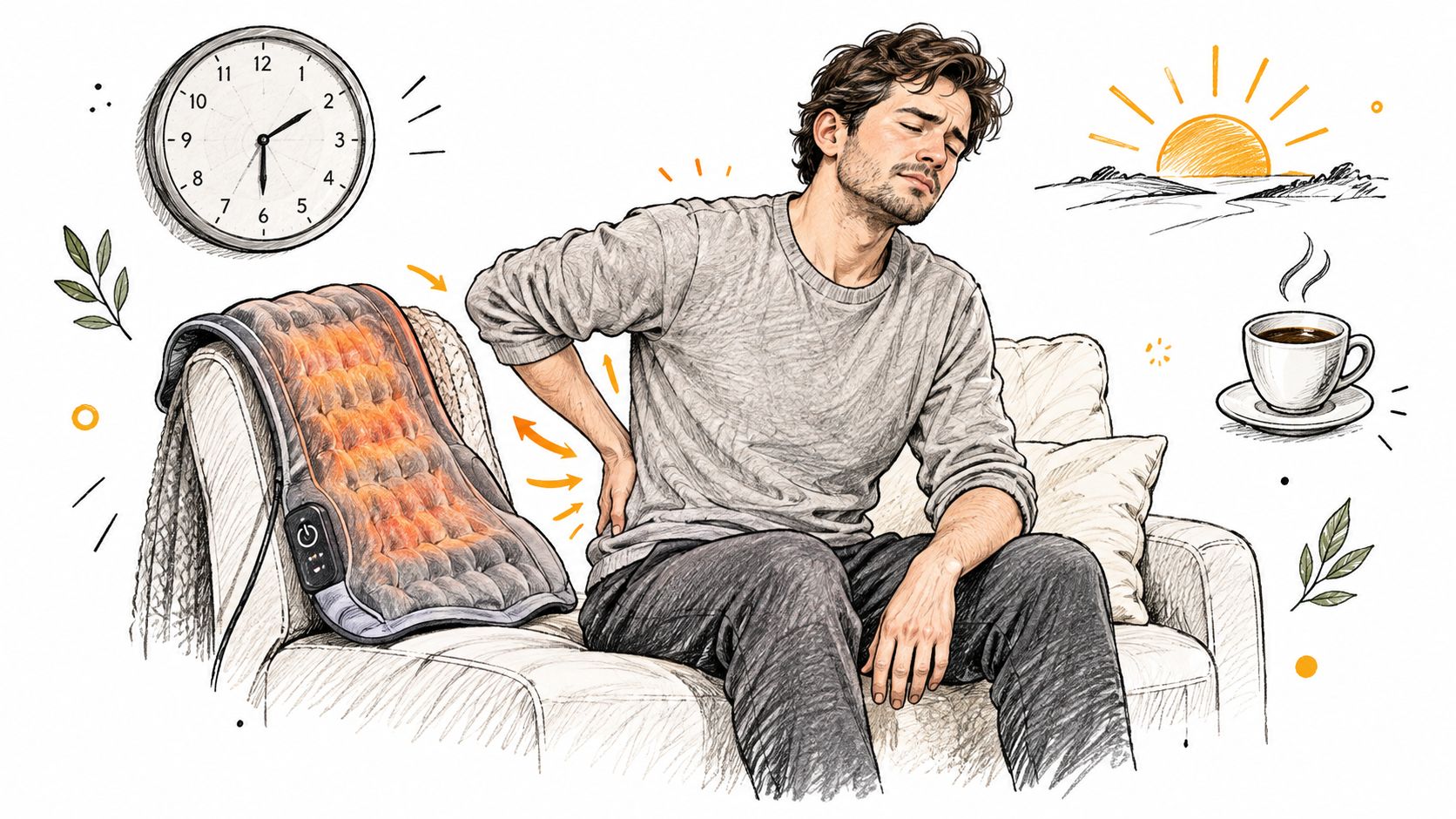
The tricky part is that people often buy the wrong kind of help for the wrong kind of back pain. Someone with simple morning stiffness may do well with plain heat. Someone with tense muscles that feel “knotted” may prefer added vibration or shiatsu-style pressure. And someone with pain that shoots into the leg may need to think beyond a pad alone. If that sounds familiar, this explanation of why leg pain persists and how to think about ongoing nerve-related symptoms can help you sort out when back discomfort may involve more than muscle tightness.
Who usually benefits most
A massage heating pad for back use tends to fit a few common situations:
- Desk-bound stiffness after computer work, meetings, commuting, or travel
- Post-activity soreness after lifting, gardening, sports, or house projects
- Age-related tightness when the back feels less flexible first thing in the morning
- Stress-related tension when the upper or lower back tightens during busy weeks
Practical rule: If your back mainly feels tight, guarded, or stiff, heat and massage often make more sense than if your main symptom is sudden weakness, numbness, or severe radiating pain.
People also get confused by marketing language. “Massage” might mean light vibration, rolling nodes, or deeper kneading. “Heat” might mean brief microwave warmth, low steady electric warmth, or a chair-style cushion with optional heat built in. Those aren't the same experience.
That's why the best choice isn't “Which one is fanciest?” It's “What problem is my back having, and what type of relief matches it?”
How Heat and Massage Work Together to Ease Back Tension
You get up after a long drive or a day at the computer, and your back does not feel injured so much as stubborn. It feels warm-sensitive, tight, and reluctant to move. In that situation, the useful question is often simple: is steady warmth enough, or would heat plus massage help the muscles let go?
What heat does first
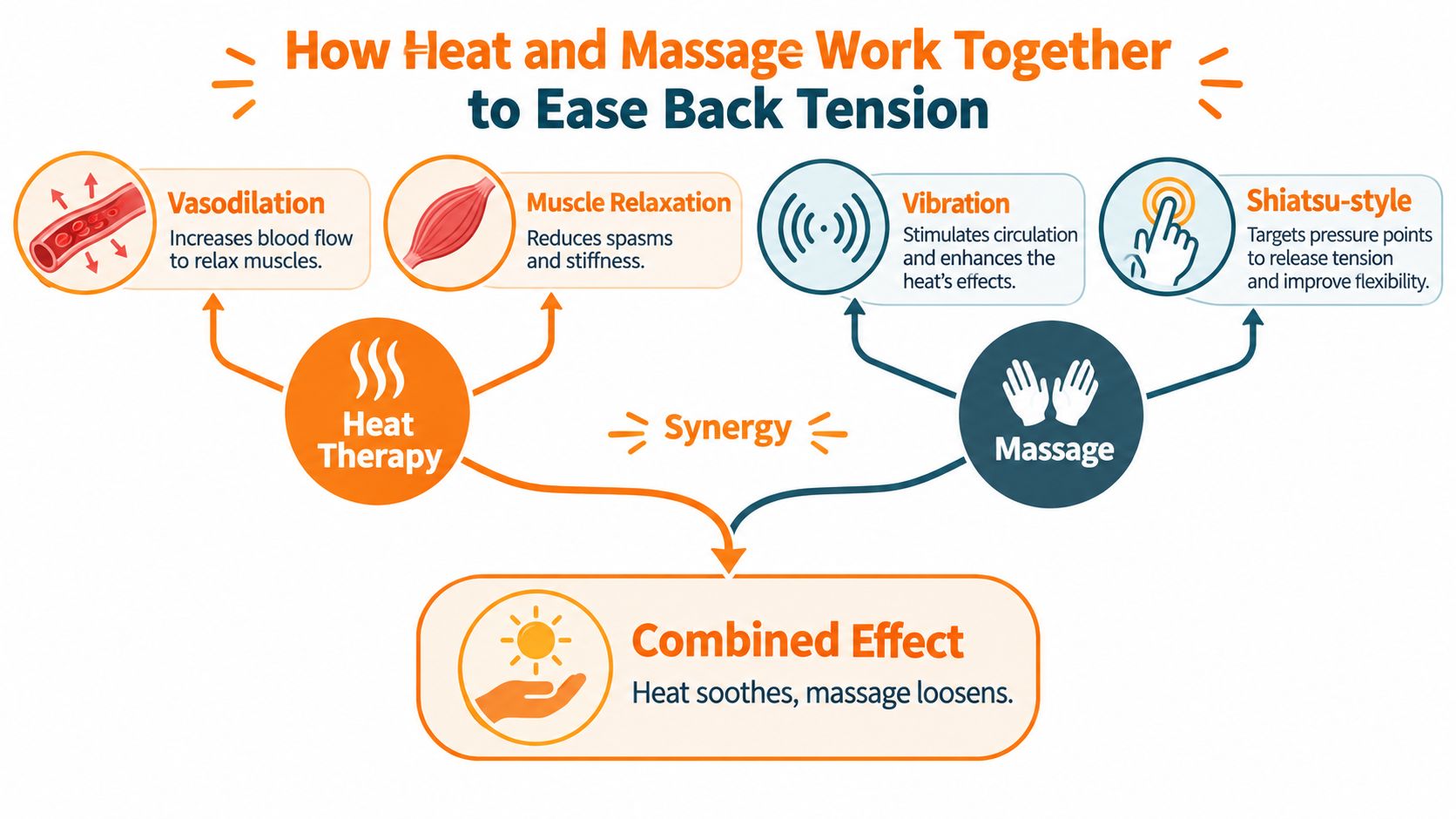
Heat is usually the first layer of relief. It works like loosening a stiff rubber band before you stretch it. As the area warms, the surface tissues relax, the back often feels less guarded, and easy movement tends to feel easier.
For home use, the main goal is gentle, skin-safe warmth, not intense heat. Guidance on back heat therapy commonly recommends keeping temperatures below about 45°C and limiting sessions to roughly 15 to 20 minutes at a time, with breaks between sessions to reduce irritation or burn risk (US Pain heat therapy guide).
That safety piece matters. More heat does not automatically mean more relief. If the pad feels hot enough that you want to shift away from it, the setting is probably too high or the session is too long.
What massage changes
Massage adds a different kind of input. Heat is passive. Massage gives the nervous system and the muscle a little more to respond to.
With a back pad, that usually means one of two sensations:
- Vibration, which feels like a light, repeated shaking
- Shiatsu-style pressure, which feels more focused and kneading
A simple way to understand the pairing is this: heat helps the muscle stop clenching, and massage helps it stop hanging on to that clenched pattern. If heat is like warming cold hands under running water, massage is like gently opening and closing the fingers afterward so they move more freely.
Heat-only vs heat-plus-massage
People often get better results by matching the tool to the feeling.
Choose heat-only when the back feels broadly stiff, mildly sore, or tired after sitting, travel, or routine activity. In that setting, basic warmth is often enough.
Choose heat plus massage when the area feels more bunched up, touchy, or locally tense, especially along the muscles beside the spine or across the upper back. The added vibration or kneading can make the session feel more targeted.
For a broader look at the different device styles that combine warmth with motion, this guide to massagers for neck and back with heat shows the formats people commonly compare.
A quick example helps. If your lower back feels dull and stiff after meetings all day, start with warmth alone. If the same area feels tight in small spots and seems to resist movement, a massage setting may add value.
Why the combination feels better for some people
Some backs want calming. Some want calming plus input.
That is why a massage heating pad for back tension can feel noticeably different from a basic pad. Warmth tends to soothe the whole area. Massage creates a more active sensation that some people find relieving because it interrupts the sense of bracing.
Still, more sensation is not always better. During a flare, a very tender back may prefer low heat without motion, or heat with the gentlest vibration setting. A good session should leave the area feeling looser and more comfortable, not overstimulated or sore afterward.
Understanding the Main Types of Back Heating Pads
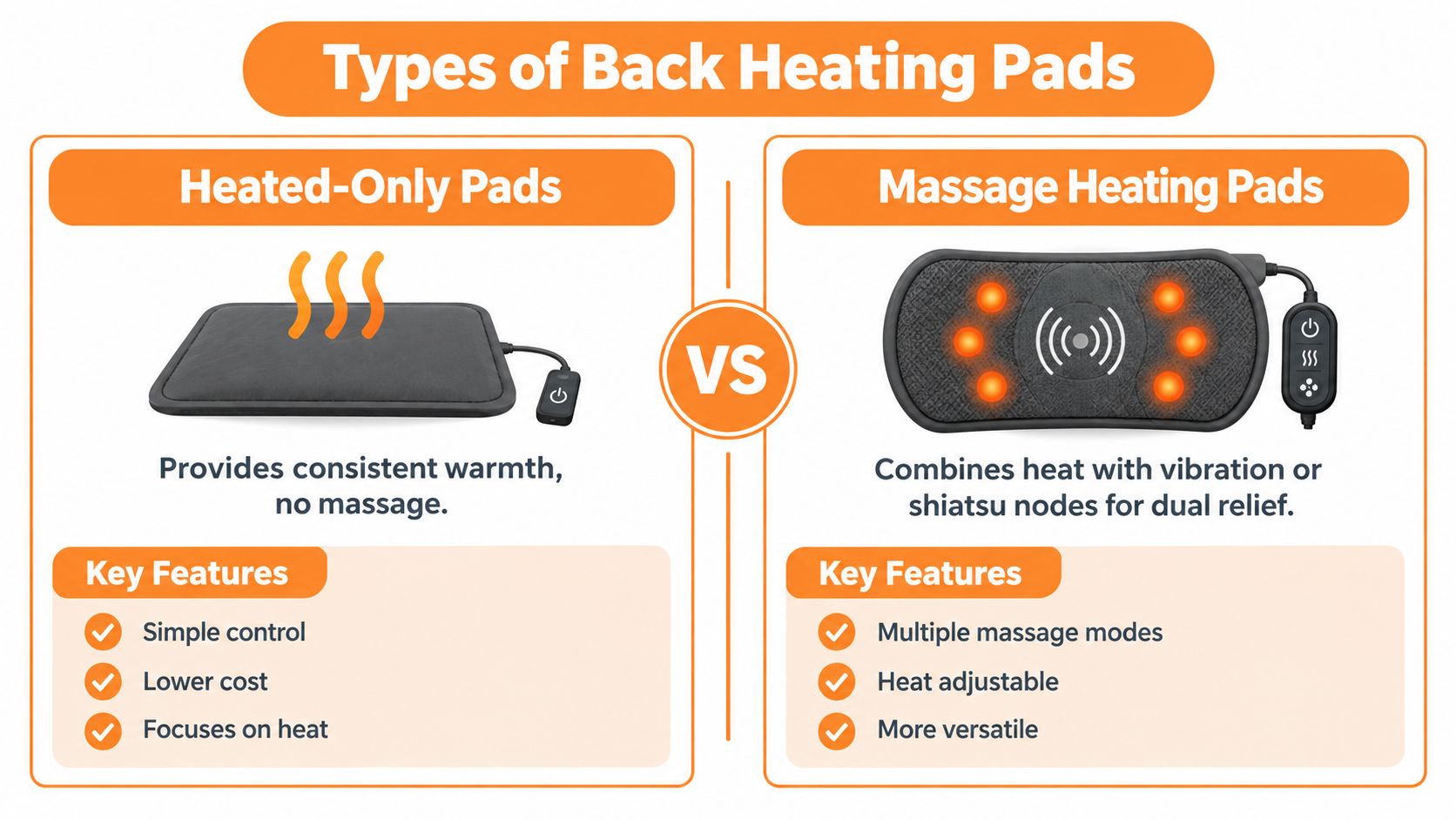
Most shoppers run into two broad categories. Heated-only pads and massage heating pads. Knowing the difference saves a lot of disappointment.
Heated-only pads
A heated-only pad focuses on warmth. It may be electric, microwavable, or air-activated. The experience is simple. You place it on the sore area, let the warmth settle in, and remove it when the session is done.
These work well for broad stiffness, low-effort comfort, and people who don't want moving parts. They're often quieter, lighter, and easier to store. A microwavable wrap can be especially handy if you want a reusable, chemical-free option without cords. Some products in this category use natural fills and shaped designs that drape over the upper or lower back.
One factual example from the broader market is that SunnyBay offers a microwavable neck, shoulder, and upper back heating pad intended for heat therapy and use on the back, along with disposable back heat patches for portable warmth.
Massage heating pads
A massage heating pad for back relief adds either vibration, rolling elements, or shiatsu-style nodes to the heat. These tend to feel more like a cushion, chair overlay, or structured wrap than a soft plain pad.
They can be useful when your discomfort is tied to muscle tension that feels local and stubborn. For example, after a long drive, some people don't just want warmth. They want something that feels like it's loosening the muscles on either side of the spine.
Here's a quick way to consider it:
- Choose heat only if you want simplicity, softness, and steady comfort
- Choose heat plus vibration if you like a gentle buzzing or loosening sensation
- Choose heat plus shiatsu-style pressure if you prefer more targeted kneading
A video can help make those differences easier to picture.
Portability and power matter more than people expect
Many buyers get surprised. A microwavable wrap travels well around the house, but it cools over time and doesn't massage. An electric pad offers sustained heat but needs a plug. A chair-style massage cushion may be ideal at a desk or recliner but awkward if you want to lie flat in bed.
If you want relief while moving around, a wrap-style heat product usually fits better. If you want a seated treatment session, a massage cushion often fits better.
The trade-off in plain language
Heated-only pads ask less from you. They're easier to use, easier to tolerate, and often enough for mild stiffness.
Massage models offer more sensation and more choices, but also more complexity. Controls, intensity, structure, and fit matter much more. If the massage hits the wrong spot, even a good device can feel disappointing.
Key Features That Determine Comfort and Effectiveness
Two pads can both claim “heat and massage” and still feel completely different on your back. Comfort depends less on the label and more on the details.
Coverage and shape
Start with where your discomfort usually lives. A small pad may be enough for a localized low-back ache. A broader shape works better if you feel stiffness from the waist up toward the shoulder blades.
Fit matters too. A flat pad on a curved body can leave hot spots and cool spots. A wrap, cushion, or contoured shape usually stays in place better and spreads the sensation more evenly.
Controls and materials
Temperature control isn't a luxury. It's part of safety and comfort. Some people need mild warmth because their skin is sensitive. Others want enough warmth to feel the muscles soften without the surface feeling too intense.
Fabric changes the experience more than most buyers expect. Softer covers feel better against the skin. A good outer layer also helps distribute warmth instead of creating one concentrated area. Reusable products with removable or washable covers are easier to keep in regular rotation.
Massage style and noise
Not all massage settings are equal. A person who likes subtle relief may hate aggressive kneading. Someone with thick, tense paraspinal muscles may find basic vibration too light.
Think about where you'll use it:
- At a desk or shared space means noise matters
- Before bed means gentler settings are usually better
- After activity means stronger settings may feel good, but only if they don't irritate the area
Here's a practical comparison to help narrow your priorities.
| Feature | What to Look For | Best For |
|---|---|---|
| Coverage size | Pad or cushion that matches your usual pain area | Broad stiffness or full-back tension |
| Shape and fit | Wraparound, contoured, or hands-free design | People who move during use or dislike readjusting |
| Heat control | Adjustable warmth with comfortable, steady output | Sensitive skin or daily users |
| Fabric and cover | Soft-touch material and even-feeling surface | Comfort-focused home use |
| Massage type | Vibration for gentler stimulation, nodes for targeted pressure | Different tolerance levels for massage |
| Intensity options | More than one massage feel if possible | Mixed symptoms from day to day |
| Ease of cleaning | Wipeable surface or removable cover | Frequent use |
| Portability | Cordless, microwavable, or chair-based depending on routine | Commute, office, couch, or bedside use |
A simple filter for real life
If you want a device you'll use, ask three questions:
- Will it reach the area that bothers me most?
- Can I tolerate the massage sensation on a sore day?
- Is it easy enough that I won't avoid setting it up?
A great feature on paper doesn't help if the product stays in a closet.
Therapeutic Benefits and What Research Shows
You sit down after a long day, place a warm pad on your back, and within minutes the area feels less guarded. That feeling is real. The better question is what kind of relief you can reasonably expect, and whether heat alone is enough or heat plus massage adds something useful.
What research supports most clearly
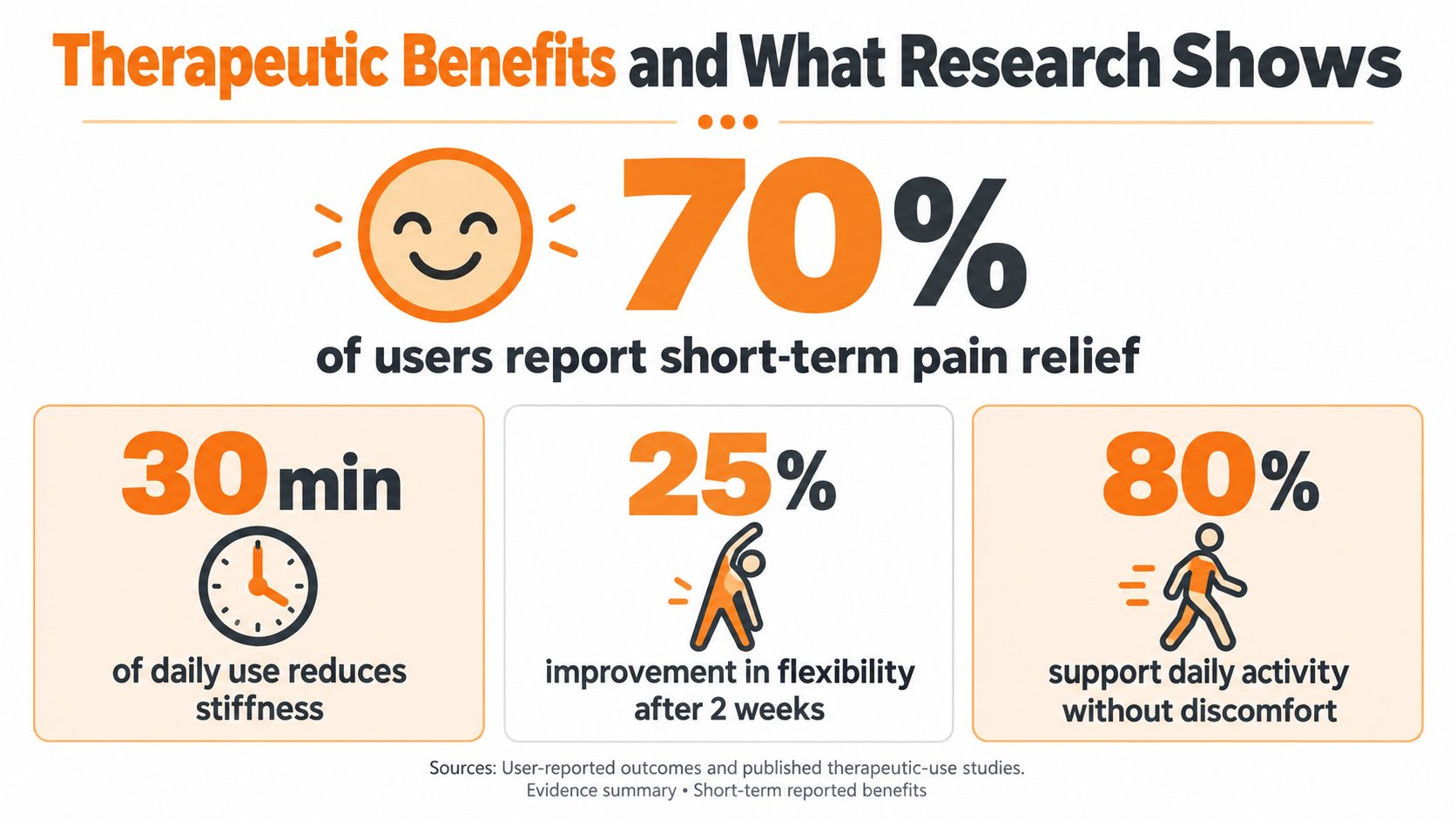
The strongest short-term evidence is for superficial heat. A Cochrane review covering 9 trials and 1,117 participants found that heat can help acute and subacute low back pain over the short term, with studies of heat wraps showing pain relief after several days of use and better results than no heat in the near term (Cochrane review summary).
A separate randomized multicenter study of 371 people with acute low back pain found that a continuous low-level heat wrap worn for 8 hours per day at 40°C for two days produced significantly greater pain relief on Day 1 than acetaminophen or ibuprofen, with benefits extending into Days 2 through 4. The same trial reported reduced muscle stiffness, improved flexibility, and less disability (PMC review discussing the trial).
That helps explain why a heating pad often feels useful so quickly. Warmth increases local blood flow and helps tense muscles loosen, much like warming stiff wax makes it easier to bend.
Heat-only vs heat-plus-massage
This is the choice that matters for buyers.
Heat-only is often enough when your back feels generally stiff, achy, or tired, especially if the area is sensitive and does not want much stimulation. Heat-plus-massage can add value when the muscles feel knotted, restless, or hard to relax even after they are warm. In those cases, light vibration or gentle shiatsu may help the nervous system stop holding so much protective tension.
More recent research points in that direction. A study summarized in a recent review found that combined approaches such as heat plus vibration provided better immediate relief than heat alone or vibration alone, while the same review notes that classic heat wrap evidence still fits short-term relief for mild to moderate pain (Frontiers review).
The practical takeaway is simple. Start by asking, “Do I need warmth, or do I need warmth plus movement?” If plain heat settles the area, a basic pad may be all you need. If warmth helps but the back still feels clenched or guarded, massage may be the extra nudge that makes the session more useful.
What benefits are realistic
For many people, the benefits are modest but meaningful:
- Less stiffness after sitting, driving, or sleeping
- Easier movement for the next few hours
- Reduced muscle guarding, meaning the back feels less braced
- Temporary symptom relief that can make walking or routine tasks easier
A massage heating pad works best as a symptom-relief tool. It can calm pain and tension. It usually does not fix the reason the pain started.
If your soreness is linked to exercise or overuse, a broader recovery plan often helps. This guide on natural recovery for strained muscles pairs well with sensible home heat use. For a plain-language refresher on how warmth affects sore tissue, this overview of understanding the basics of heat therapy is a helpful companion read.
One last point matters. More features do not automatically mean better relief. The right choice is the one that matches your back on that day, with safe warmth, a tolerable massage setting, and a session length your skin and muscles handle comfortably.
How to Use Your Massage Heating Pad Safely and Effectively
Good technique matters almost as much as the device itself. Many people either use too much heat, too much massage, or leave the pad on so long that comfort turns into irritation.
A simple home routine
Start with the lowest comfortable setting. Place the pad over the area that feels tight, not directly over broken or irritated skin. If the heat feels sharp instead of soothing, add a thin fabric barrier or lower the setting.
Use a short, deliberate session. General back-pain heat guidance commonly recommends about 15 to 20 minutes at a time, repeated as needed with breaks between sessions, while keeping the operating range below about 45°C for skin safety (heat therapy safety guidance).
How to combine heat and massage
Don't assume more is better. Try this sequence:
- Begin with heat first for a few minutes if your device allows separate controls.
- Add light massage once the area feels less guarded.
- Increase only if it still feels soothing, not because you think stronger must be more effective.
- Stop if the muscles start to feel irritated, twitchy, or overly sensitive.
For some backs, especially during a flare, heat alone feels better than heat plus motion. That's normal. On another day, the exact same person may enjoy added vibration.
If you catch yourself bracing against the massage, turn it down or turn it off. A helpful session should make your body soften, not fight the device.
Common mistakes to avoid
A few habits cause most problems:
- Falling asleep on the pad increases the chance of staying in one position too long
- Using high heat on bare skin can irritate the surface before the muscles benefit
- Placing intense massage directly on a very acute sore spot can feel aggravating
- Ignoring unusual symptoms like numbness, spreading weakness, fever, or severe night pain
Easy ways to make it part of the day
Use your pad during a work break, while reading in a supportive chair, or in the evening before gentle stretching. A brief session often works better than waiting until your back is extremely tight.
Reusable, chemical-free options can fit well into a daily routine because there's little setup and no medication timing to think about. The goal is consistency, not intensity.
Choosing the Right Massage Heating Pad for Your Needs
The easiest way to choose is to match the tool to the pattern.
When basic warmth is enough
Choose a simple heating pad or wrap if your back mostly feels stiff, achy, or tired. This is often the right call for morning tightness, broad soreness after chores, or those “I sat too long” days. A larger wrap or microwavable pad can be plenty if you mainly want comfort and ease.
When heat plus massage adds real value
Choose a massage heating pad for back relief if your muscles feel bunched up, restless, or resistant to movement even after warmth starts to help. Vibration can be a good middle option for people who want a gentle loosening effect. Shiatsu-style pressure makes more sense if you like a firmer, more targeted sensation and usually sit in one place while using it.
A short decision checklist
- Pain pattern: Diffuse stiffness often favors heat. Local muscle tightness may favor heat plus massage.
- Frequency: If you'll use it often, prioritize comfort, washable materials, and easy controls.
- Portability: For travel or office use, lighter wraps and patches make more sense than bulky cushions.
- Tolerance: Sensitive backs usually do better starting with plain heat or very gentle vibration.
- Routine: If setup feels annoying, you probably won't use the device consistently.
If you're still unsure, start simpler than you think you need. You can always move from heat-only to a combination device later. For more ideas on everyday self-care habits, this guide on how to relieve back discomfort offers practical recovery suggestions that fit well alongside heat use.
The right choice is the one your body welcomes and your routine supports. Relief tools work best when they're easy to reach for before the back gets angry.
If you're looking for reusable heat therapy tools that fit everyday back care, SunnyBay offers microwavable heating pads, wraps, massage tools, and portable heat options designed for targeted comfort. If your back tends to respond well to warmth, it's a practical place to compare wrap styles, sizes, and materials that match how and where you like to use heat.


