


How to Keep Hands Warm Without Gloves: Methods That Work
-
Your keys slip out of your fingers at the truck door. Your knuckles feel stiff, your fingertips have lost their grip on small screws or a phone screen, and you're stuck outside or in a drafty space with bare hands. Blowing on your palms or rubbing your fingers together gives ten seconds of relief before the chill bites back harder.
Figuring out how to keep hands warm without gloves isn't about finding a single magic trick. Cold fingers are usually a circulation problem first and an insulation problem second. I'd always rewarm the torso, get the forearms warm, and build metabolic heat through movement before reaching for external heat. Add a safe portable heat source only when those steps aren't enough, and recognize the point where bare-hand tricks hit a hard medical limit.
Table of Contents
- Hand Warming Options Compared at a Glance
- Using Portable Heat Sources Safely on Bare Hands
- How to Warm Your Hands Without Gloves Step by Step
- Keep Your Core Warm So Your Hands Follow
- Why Some Hands Stay Cold Anyway
- Build Your Cold-Hand Plan for the Next Cold Day
Hand Warming Options Compared at a Glance
When your fingers are already stiff, tucking bare hands against your torso or into your armpits is the fastest zero-gear fix you have.
| Method | Warm-up time | Holds heat for | Best setting | Main drawback |
|---|---|---|---|---|
| Hands tucked into armpits or against the torso | Within minutes | While hands stay covered | Desk, commute | Brief rewarming only |
| Walking or large-muscle movement | 10 to 20 minutes | While moving | Outdoor work, walks | Needs room to move |
| Warm forearms under a sleeve | Minutes after placement | Duration of the wrapped pack | Cold workplaces | Needs a safe heat source |
| Wrapped warm water bottle | Immediate once filled | Short sessions before cooling | Car, office | Cools quickly |
| Microwavable flax seed wrap | Several minutes in a microwave | Tens of minutes | Commute, sitting | Must reheat |
| Disposable air-activated heat patch | About 20 minutes | 6 to 12 hours by size | Sports, outdoor work | Single use |
| Chemical hand warmer | Minutes after activation | Multi-hour outdoor shifts | Hiking, ice fishing | Cost per use |
Matching the Method to Your Setting
No single row in that table wins every job. Free body-heat options work right away because they pull warmth straight from your trunk, yet they drop off as soon as you pull your hands back into cold air. Reusable options like microwavable hand warmers shine on a cold commute or at a chilly desk because you can reheat them daily without burning through disposable packets, though they lose usefulness once you're away from a microwave.
Active wearable heat sits at the high-tech end of the spectrum. In a 2024 randomized crossover trial published in Springer Nature's European Journal of Applied Physiology, 22 healthy participants spent 90 minutes at 5°C while researchers tested 14.8 watts of electric heating applied to the hands to preserve finger temperature and manual dexterity without gloves. If you're weighing specialized textiles before buying powered gear, comparing infrared fabric versus standard compression helps clarify how different sleeve materials handle circulation and warmth.
Start fast, then layer up: If your fingers are already numb, begin with torso contact or a brisk walk to wake up blood flow, then add a longer-lasting heat patch or warmer for sustained cold.
Using Portable Heat Sources Safely on Bare Hands
The most common burn mistake in cold weather is pressing a freshly activated warmer or a hot pack directly against freezing, bare fingertips. Cold dulls nerve endings, so skin can cook before your brain registers pain. You don't need direct contact on numb fingers to get them working again, and putting intense heat straight on bare skin trades cold discomfort for tissue damage.
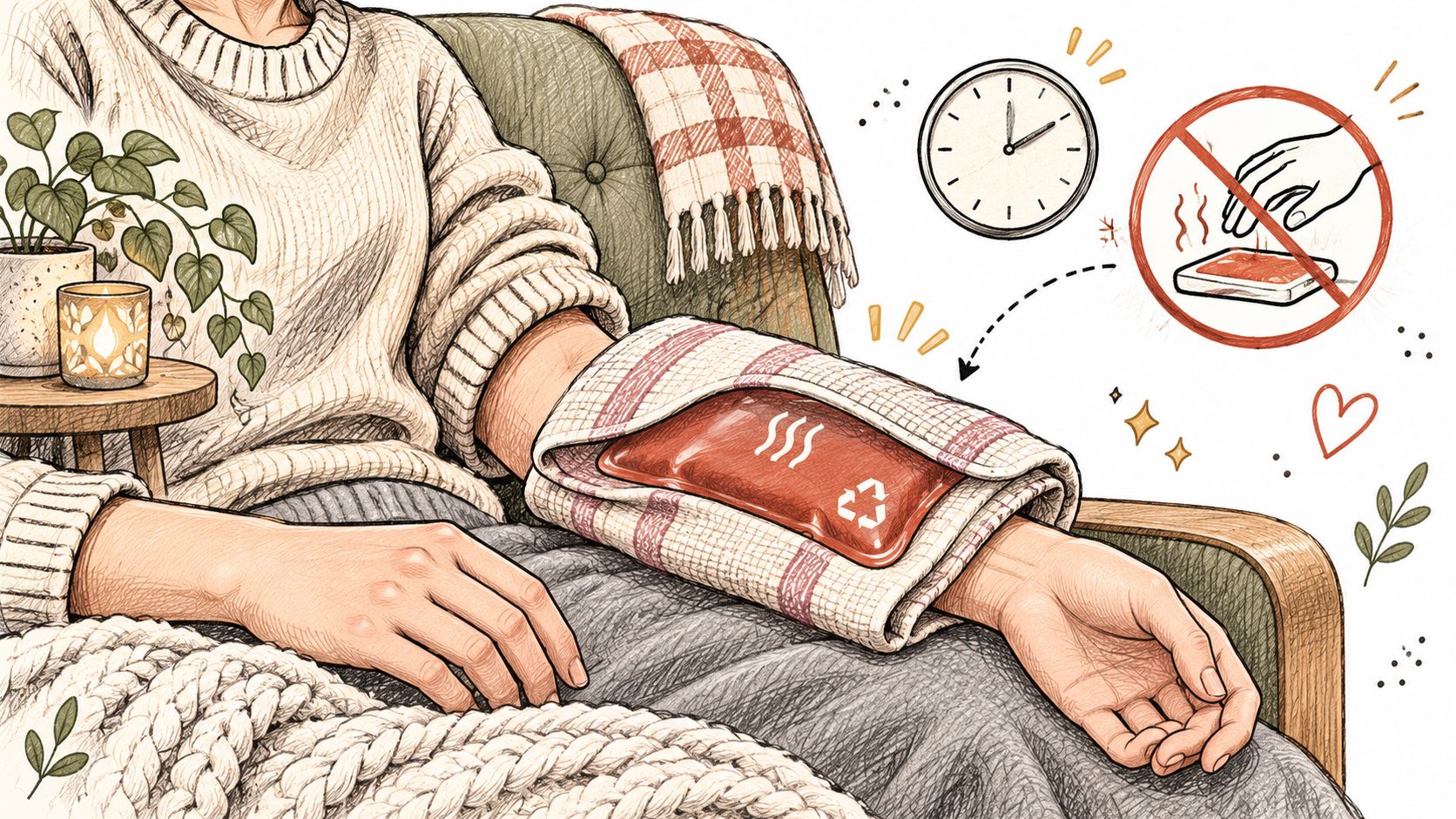
A 2009 peer-reviewed comparison of disposable chemical warmers tracked commercial hand and foot packets from several hours to more than a day, measuring peak heat, time to exceed 37°C, and how long each unit stayed above 30°C. Output varied widely across brands, with hand and body warmers generally running longer than foot and toe models. That unpredictability is why placement and barriers matter more than raw heat output.
Placement Rules Before Any Heat Touches You
Warming the blood upstream beats scorching cold fingertips. According to U.S. Army cold-weather research, localized forearm heating in a controlled 0°C test raised finger temperature, grip strength, and manual dexterity even when bare hands stayed uncovered, and starting heat after finger temperatures had already dropped worked just as well as starting immediately. Follow these placement rules before using any portable warmer:
- Keep heat on the forearm or near the hands: Rest a wrapped pack against the inner forearm or inside a jacket pocket rather than clutching a bare warmer with numb fingers.
- Wrap every reusable source in fabric: Put a dry cotton towel, fleece cover, or shirt layer between the heat source and your skin, and test the temperature against the back of your wrist first.
- Heat microwavable wraps evenly: Fold the wrap, microwave it for 1 to 2 minutes, and flip it halfway through so hidden hot spots in the fill don't scald you, then let it cool completely before reheating.
- Follow disposable patch labels strictly: Wear air-activated patches inside clothing to trap warmth, and stick to the package instructions instead of taping them straight onto cold skin.
Why Numb Skin Hides Burns
Say a site inspector steps into a truck cab with stiff hands, tucks a reheated wrap directly under a cuff for ten minutes, and feels comfortable warmth the whole time. An hour later, bright red patches show up along the wrist because cold-numbed nerves missed the early warning sting. That's also why CDC guidance referenced in the Army report warns against placing numb or frostbitten hands near radiators, stoves, heating pads, or other intense direct heat, recommending body heat or warm (never hot) water instead.
Check your skin every 10 minutes under any portable heat source. Shorten the session if skin turns painfully red or numb, and pull the warmer off at once if blisters or sharp pain appear.
Motorized cold-weather work pushes these risks even higher because wind chill strips heat off bare fingers faster than a pocket warmer can keep up. Riders who need reliable fingertip control on winter trails often turn to dedicated machine-mounted heat to keep hands warm on the ATV rather than juggling loose packets near numb skin.
How to Warm Your Hands Without Gloves Step by Step
When your hands are already stiff and fumbling, random tricks waste valuable minutes. Follow a staged sequence that stops heat loss first, restores core-driven circulation next, and only then brings in gentle movement and localized warmth.
This visual summarizes the core bare-hand warming sequence when you need a quick reminder on the go.
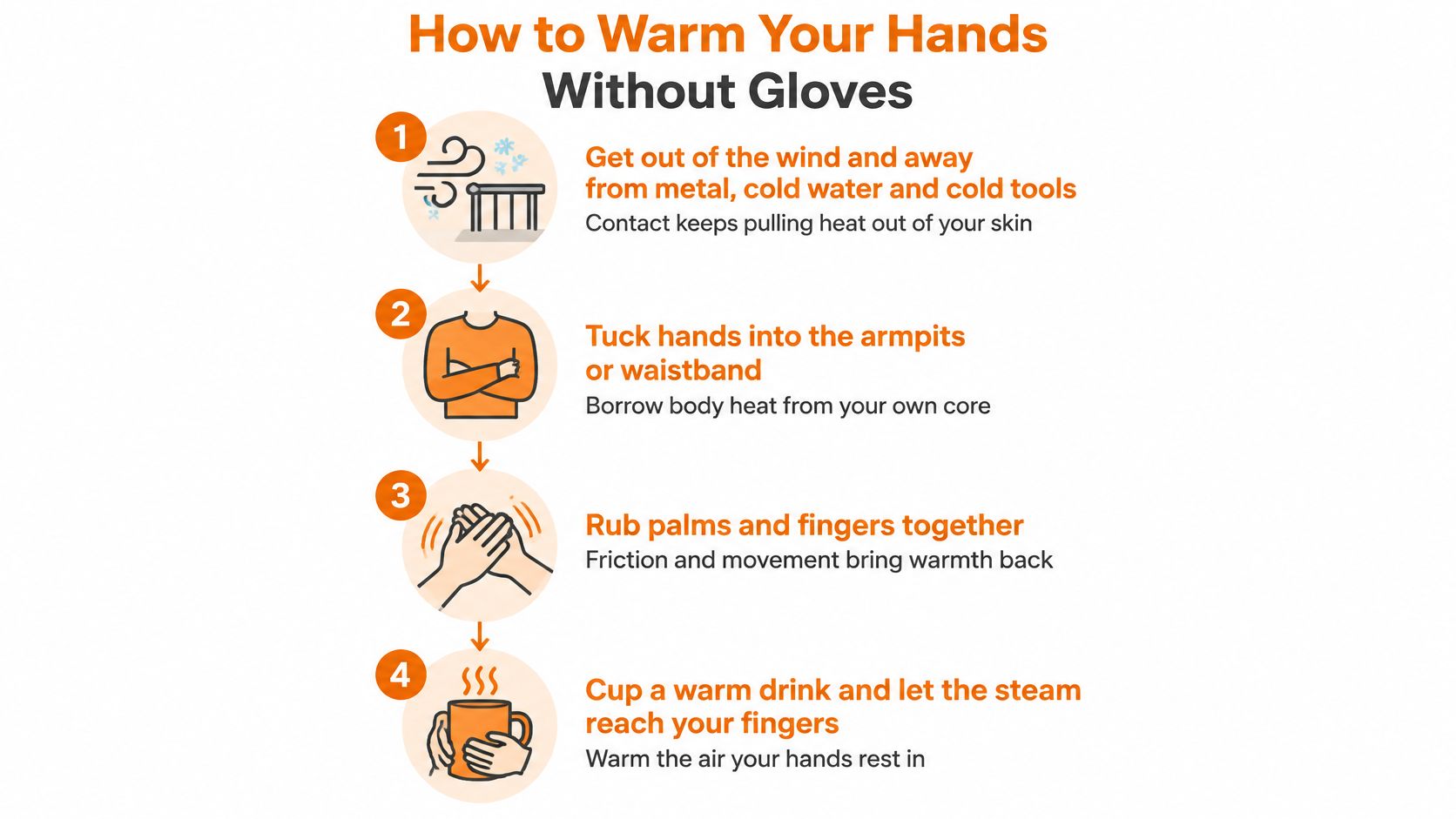
- Break contact with wind, cold metal, and water. Conduction pulls warmth out of bare skin far faster than cold air alone, so step behind a windbreak, set down cold steel tools, and dry wet skin right away. The most common slip here is keeping one hand on a cold railing or wet strap while trying to warm the other, which cancels out any progress.
- Tuck your hands against your torso or into your armpits. Your trunk stays several degrees warmer than your extremities, making it your safest built-in heater. Slide both bare hands inside your jacket against your ribs or under your arms for two to three minutes, and don't skip straight to rubbing your fingers before your palms pick up some baseline warmth.
- Swing your arms in slow, wide circles. Gravity and centrifugal motion help push warmed blood down toward constricted vessels in your palms. Stand clear of coworkers or walls and make smooth shoulder-driven circles for a minute; jerking your arms wildly only tenses your shoulders and wastes energy.
- Walk or engage large leg muscles for 10 to 20 minutes. Whole-body movement generates metabolic heat that signals peripheral blood vessels to reopen. In controlled cold-exposure trials indexed on PubMed, exercise raised finger skin temperature to roughly 19.6 ± 9.0°C and partly restored manual function, while 10 minutes of rewarming at 22 to 23°C lifted grip strength and dexterity by 30 to 50%. Keep your coat zipped while you walk so wind doesn't strip away the trunk heat you're building.
- Apply wrapped warmth to your inner forearms. Blood flows through shallow vessels near the inner wrist and forearm on its way to your fingers. Wrap a warm (not scalding) container or pack in fabric, test it on the back of your wrist, hold it against the inner forearm rather than bare fingertips, and inspect the skin at the 10-minute mark for excess redness.
- Open and close your fists gently and wiggle each finger. Light joint motion keeps fresh blood moving through small vessels without damaging cold tissue. Avoid vigorous rubbing or clapping when your skin is numb, since friction can abrade fragile skin before you feel it tearing.
- Run a simple dexterity check before touching fine tools. Cold fingers can stop hurting before full motor control returns, and the PubMed cold-exposure data notes greater dexterity loss below 22.9°C, making above 23°C a practical recovery benchmark. Pick up a pen or turn a small key; if you still fumble, stay in rewarming mode instead of rushing back to precision work.
Watch this short demonstration to see how arm swings and posture cues help restore warmth to stiff fingers without extra gear.
Healthy Rewarming Versus Red-Flag Symptoms
Normal recovery follows a clear pattern. Pale skin shifts back to pink, a mild pins-and-needles tingle passes through the fingertips, and your grip stops feeling wooden.
If fingers remain white, gray, or blue, or if deep aching pain and clumsiness won't fade after gradual warming, stop cold exposure and get medical help instead of piling on stronger heat.
Keep Your Core Warm So Your Hands Follow
Your body runs a strict survival triage whenever temperatures drop. To protect your heart, lungs, and brain, your nervous system narrows blood vessels in your fingers and toes, a process called peripheral vasoconstriction, trapping warm blood inside your torso. That's why your hands can feel frozen even when your chest feels mildly cool.
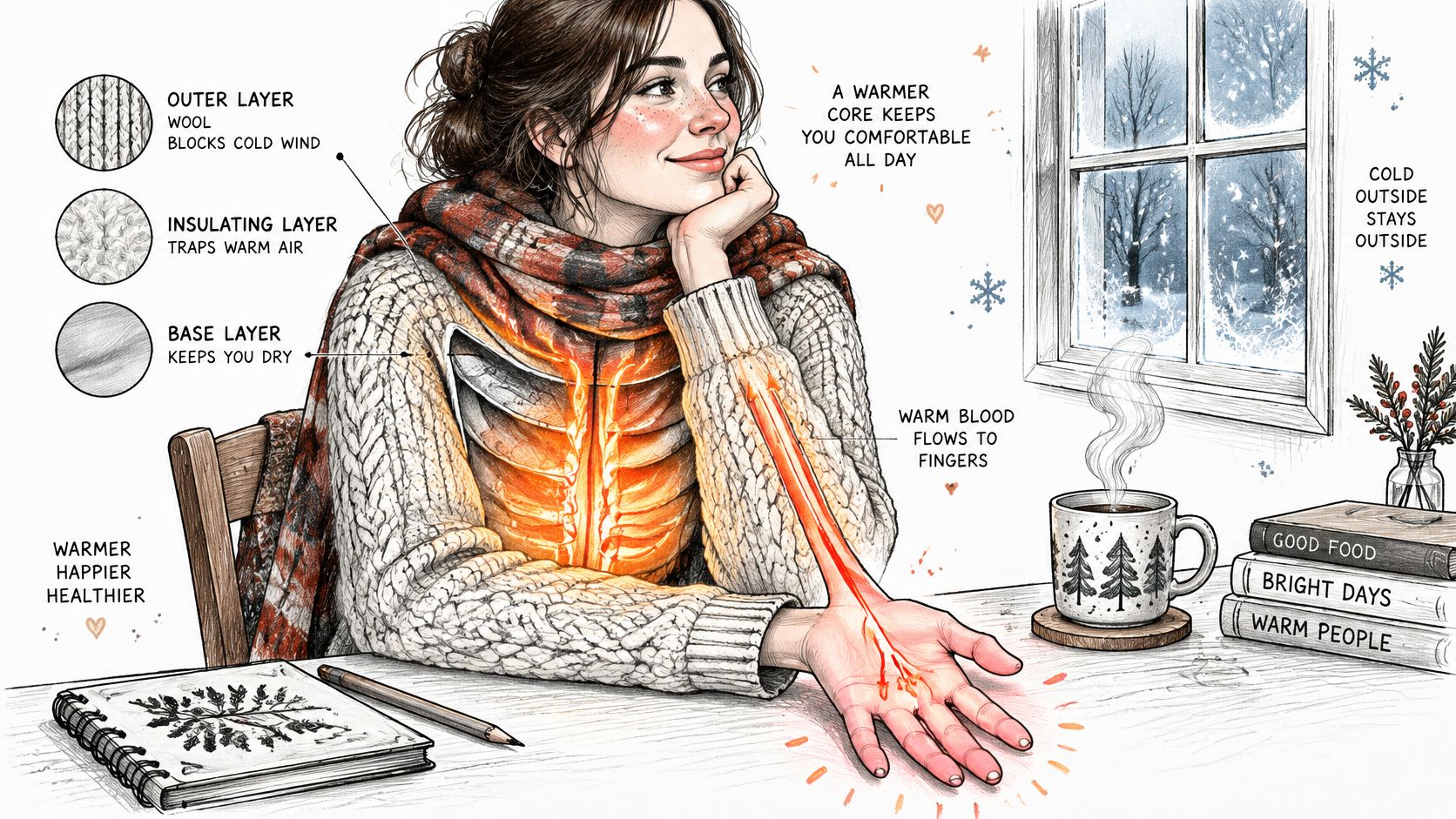
Flipping that survival switch back requires heating the center, not just the edges. In a controlled Journal of Applied Physiology study, researchers applied torso heating during a 3-hour exposure to −15°C air and kept finger and toe comfort intact for an extended stretch by raising core heat enough to trigger vasodilation, widening extremity vessels so warm blood reached the hands.
Core Habits and Their Real Limits
Every core-warming habit helps, yet each one stops short of invincibility. Knowing both the payoff and the ceiling keeps you from pushing too far on a bare-hand shift.
- Layer the chest and upper back under a windproof shell: Trap warm air over your ribs with a moisture-wicking base layer, fleece mid-layer, and wind-blocking outer jacket, sealing drafts at the neck and wrists. Even heavy torso insulation won't stop frostbite if bare fingers stay exposed to extreme wind chill for long stretches.
- Drink warm non-alcoholic fluids before and during cold spells: Hot tea, broth, or warm water adds internal heat and keeps blood volume steady. Skip alcohol completely, because it widens surface vessels and makes your core lose heat faster while fooling you into feeling warm.
- Take scheduled warm breaks indoors: Step into a heated room or truck cab before your fingers go stiff, aligning with CDC cold-weather guidance that cold can drain heat faster than your body makes it. Short breaks reset mild cooling, though they can't compensate for prolonged exposure without proper hand protection.
- Remove tight rings, watch bands, and snug cuffs: Even slight mechanical pressure across the wrist or finger base chokes off already narrowed vessels and accelerates cooling. Loosening cuffs frees circulation, but it only works when your trunk has warmth to spare.
Take a dog walker heading out for 40 minutes in a windy park without gloves. Wearing a thin sweatshirt with a snug wristwatch usually leaves their leash hand numb by minute fifteen. Switching to a wind-blocking vest over a fleece top, pulling off the tight watch band, and drinking a mug of hot broth before walking out the door keeps core heat high enough that their fingers stay functional far longer.
Outdoor athletes face the exact same core-versus-grip trade-off during winter rounds where thick mitts ruin feel. Practical layering tactics from 2ndShotMVP's cold weather golf guide and broader seasonal tips for protecting yourself during winters both emphasize protecting the trunk and sealing collar drafts first.
The 15 to 20 Minute Check
Use your torso as a diagnostic gauge. If your chest feels warm and comfortable yet your bare hands stay icy after 15 to 20 minutes of movement or indoor rest, core warmth alone isn't cutting through the constriction. That's your cue to bring in safe forearm or pocket heat, and if you notice waxy skin, confusion, or uncontrolled shivering, treat it as a medical emergency rather than a comfort snag.
Why Some Hands Stay Cold Anyway
Plenty of old-school job-site advice claims you can "toughen up" bare hands by working cold until your body adapts. The evidence says otherwise. A 2025 human study indexed on PubMed exposed 10 healthy adults to 8°C air for two hours a day across eight consecutive days and recorded no improvement in hand skin temperature, thermal comfort, or manual dexterity.
Deliberate cold suffering doesn't build meaningful hand acclimatization. At best, you get briefly used to complaining less while your grip strength and nerve function still drop. Conditions near freezing punish bare skin even harder: a 2024 study in the International Journal of Occupational Safety and Ergonomics tested −1°C and 5°C for 1 hour and found that −1°C produced the steepest drop in hand and skin temperature, even when participants wore single gloves. Once air hovers around freezing, one quick hack won't save you; you need the full layered plan.
Why Recovery Speed Varies From Person to Person
Even inside the same room, two people can warm up at completely different speeds. The 2025 population study cited in the PubMed research linked body surface area, physical-activity volume, sex, and menstrual-cycle stage to differences in how quickly hands rewarmed after cold stress. That explains why your coworker's hands bounce back after a quick walk while yours still ache.
Tailor your routine to how your body and daily environment behave:
- Office and remote workers: Long stretches of stillness at a keyboard let peripheral blood flow stall even in a heated building. Stand up every hour for a brisk two-minute hallway walk, keep a warm mug nearby, and check out practical ways for improving circulation naturally.
- Outdoor workers: Wind and contact with cold tools drain heat faster than movement replaces it. Schedule regular cab or shelter warm-ups, wear a windproof shell over a warm core layer, and stage wrapped forearm warmth for static inspection tasks.
- Older adults: Slower baseline circulation and thinner skin raise both chill and burn risks. Stick to milder wrapped heat sources, inspect skin carefully, and prioritize indoor warmth over toughing out drafts.
- People with cold-sensitive circulation: Strong vasoconstriction can make fingers stay cold even after you start moving. Pre-warm your torso before stepping into chilly air, block wind at the wrists, and track any color shifts closely.
Ordinary Cold Discomfort Versus Suspected Frostbite
Aching fingers that pink up smoothly indoors are routine cold discomfort. Persistent numbness, white or bluish-gray skin, blisters, open sores, or sharp throbbing pain point toward frostbite or a circulation disorder, not a minor annoyance.
Never rub, massage, or blast suspected frostbite with intense heat. Move indoors, strip off wet clothing, warm the area gradually, and get prompt medical care.
Unusually severe or lingering cold hands are a health question first. Treat them that way early rather than hoping another pocket trick will fix reduced circulation.
Build Your Cold-Hand Plan for the Next Cold Day
Scrambling for warmth after your fingers turn clumsy always costs you time and comfort. Set up a simple three-layer system the night before a cold forecast so every tool has a clear job.
Layer One Core and Wind Protection
Lay out a breathable base layer, an insulating mid-layer across your chest and back, and a windproof outer shell with snug (not tight) cuffs. Fill an insulated thermos with hot tea or broth before you walk out the door so your core starts the shift ahead of the chill.
Layer Two Movement and Forearm Warmth
Build short movement breaks into stationary work, aiming for a brisk walk every hour or two before stiffness sets in. For long still tasks at a chilly bench or desk, pair those breaks with a fabric-wrapped forearm pack that warms blood heading toward your palms.
Layer Three Matched Portable Heat
Pick one external heat option that fits where you'll be. Reusable microwavable wraps fit commutes, home offices, and workspaces with kitchen access: a heat wrap stays warm for approximately 20 to 30 minutes, and covering it with a blanket or towel helps it hold heat longer. For long outdoor shifts where power or a microwave is limited, SunnyBay offers microwavable neck and hand wraps alongside disposable air-activated patches; remember that disposable heat patches should be aired out every hour to avoid burns.
Run a 20-Minute Field Test
Before you rely on this setup for a long shift, wear all three layers on a 20-minute cold walk and note how fast your fingers stay loose or bounce back afterward. Set a firm stop rule right now: if your hands fail to recover after 20 minutes of gradual warming, or if color changes, pain, or numbness linger, stop cold exposure and seek medical advice. Start by locking in Layer One tomorrow morning, because no pocket warmer on earth can outwork a chilled core.
When core layering and movement need safe backup, SunnyBay carries reusable microwavable flax-seed hand and neck wraps for desks and commutes plus air-activated heat patches built for long cold-weather shifts away from a microwave. Every option is designed for practical, everyday heat therapy that pairs cleanly with the placement and safety habits above. Explore the full lineup of cold-weather wraps and patches at SunnyBay.


