


What Causes Muscle Knots and How to Find Relief
-
You know that nagging, tender spot in your neck, back, or shoulders? The one that feels like a small, hard marble under your skin? While we call it a "muscle knot," it's not actually a knot at all.
What you're feeling is a small patch of cramped muscle fibers that have forgotten how to relax. The technical term is a myofascial trigger point, and it's a very common reaction to both physical and emotional stress.
Untangling the Mystery Behind Muscle Knots
Think of a muscle knot as a tiny, stubborn traffic jam on the highway of your muscle tissue. A small cluster of fibers gets stuck in a contracted state, creating a blockage. This is what causes that all-too-familiar sensation of pain, tightness, and restricted movement.
It's not a literal knot you could untie, but rather a dysfunctional segment of muscle that’s locked up and causing trouble.
This physiological hiccup is far more common than you might think. In fact, studies show that even among young adults with no pain symptoms, roughly 50% already have latent (non-painful) trigger points just waiting in their shoulder muscles. That number only climbs as we age or deal with musculoskeletal pain.

Why Understanding Knots Matters
Getting to the bottom of what causes these knots is the first step toward finding real, drug-free relief. When these trigger points become chronic and widespread, they can evolve into a more complex condition. You can learn more about in our guide to myofascial pain syndrome. When you understand the root cause, you can stop just masking the pain and start truly fixing the problem.
The global impact of this issue is staggering. Low back pain, which is often tied to these trigger points, affected an astonishing 619 million people globally in 2020. This makes it the single leading cause of disability worldwide. The full picture is even more stark when you explore the global burden of musculoskeletal conditions.
The key takeaway is that muscle knots are more than just a minor annoyance; they are a sign that your muscles are under duress. Addressing them directly can prevent them from escalating into more chronic pain patterns.
By digging into the science, pinpointing the everyday culprits, and adopting practical solutions, you can learn how to clear that muscular traffic jam for good. Simple, effective methods like targeted heat therapy and massage can break the cycle of tension, restore healthy muscle function, and help you get back to feeling your best.
How a Muscle Knot Actually Forms in Your Body
To really get to the bottom of what causes muscle knots, we have to look past the simple idea of "tight muscles." It’s a bit more complex than that. Think back to that traffic jam analogy—now, let's zoom in on the molecular level to see what’s really causing the gridlock. The whole process was brilliantly explained by doctors Janet Travell and David Simons, who called it the "energy crisis hypothesis."
Imagine a tiny section of your muscle fibers has its own light switch. When that muscle is overworked or strained, the switch flips on, telling the fibers to contract. But here's the problem: the switch gets stuck in the "on" position. A chemical messenger called acetylcholine just keeps flooding the area, telling the fibers to contract over and over again, with no "off" signal in sight.
This is where the real trouble begins.
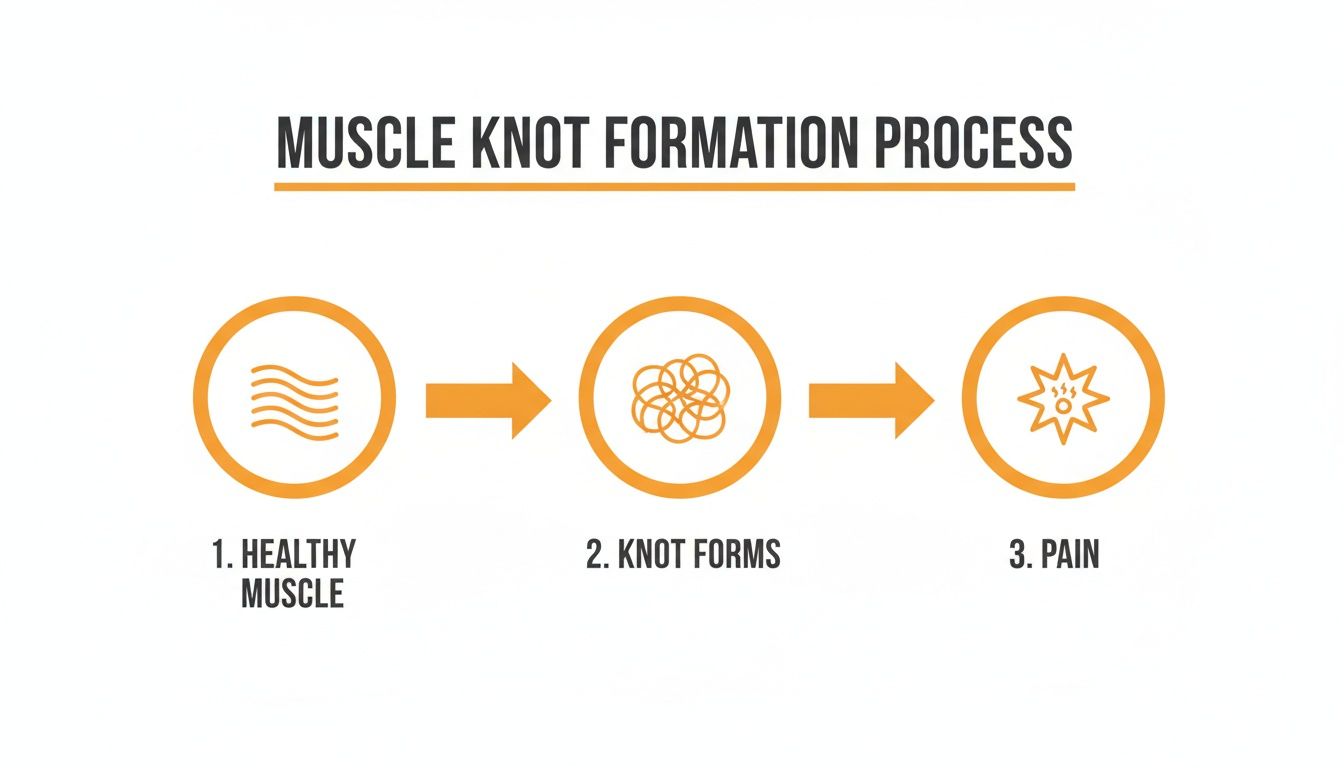
This constant, unending contraction starts to squeeze the tiny blood vessels (capillaries) that run through the muscle. It’s like a boa constrictor tightening its grip, cutting off its own blood supply. This self-imposed blockade stops fresh, oxygen-rich blood from getting in and prevents all the metabolic waste from being flushed out.
The Vicious Cycle That Keeps Knots "Stuck"
This chain reaction creates a self-perpetuating loop of dysfunction. It's a vicious cycle that feeds on itself, making it incredibly difficult for the muscle to recover on its own.
Here’s a step-by-step look at how this energy crisis unfolds.
| Stage | What Happens Inside the Muscle | The Resulting Problem |
|---|---|---|
| 1. Over-Contraction | A small band of muscle fibers receives a continuous signal to contract and can't relax. | The fibers are essentially "stuck" in the on position. |
| 2. Reduced Blood Flow | The perpetually tight muscle fibers squeeze surrounding capillaries, restricting circulation. | Oxygen and vital nutrients can't get in, and metabolic waste can't get out. |
| 3. Energy Shortage | Without oxygen, the muscle can't produce enough ATP—the energy molecule needed to release a contraction. | The muscle is trapped. It has no energy to let go, so it stays contracted. |
| 4. Waste Buildup | Metabolic byproducts, like lactic acid, accumulate in the area, irritating nerve endings. | This buildup creates that deep, aching pain and inflammation associated with a knot. |
This ongoing crisis is what creates that hard, ropey, and exquisitely tender lump you feel. It's not just a tight muscle; it's a localized zone of metabolic distress, starved of resources and swimming in its own waste.
Why This Science Empowers You
Understanding this energy crisis model is a game-changer because it proves that simple therapies are often the most powerful. The core of the problem is a lack of circulation and a resulting energy deficit. Therefore, any therapy that kickstarts blood flow isn't just a band-aid—it's a direct solution.
This is precisely why heat therapy is so incredibly effective. Applying a warm compress isn't just about feeling good; it’s a direct intervention. Heat triggers vasodilation—the widening of your blood vessels—which re-opens those choked-off supply lines. Fresh blood rushes in, delivering the oxygen needed to produce energy, while flushing out all that pain-causing waste. The benefit isn't just temporary relief; it's the start of true healing.
Massage therapy works on a similar principle but with a mechanical approach. The physical pressure breaks up stuck fibers and manually pushes stagnant fluid out of the area, helping to reset pain signals and encourage the muscle to finally relax. When you understand what causes muscle knots at this level, you can see that treatments like heat and massage are targeted solutions that reverse the very mechanism that created the problem.
You can learn more about specific techniques in our comprehensive guide to trigger point therapy and see how they directly interrupt this cycle.
The Everyday Habits That Create Muscle Knots
So, we've looked under the hood at the "energy crisis" that locks a muscle knot in place. Now, let's connect that science to what you do every single day. The reality is, our modern lives are almost perfectly engineered to create these stubborn, painful spots. What causes muscle knots usually isn't one big, dramatic injury, but rather the slow, creeping stress from habits you might not even realize you have.
Think about the classic "tech neck" posture from scrolling on your phone, or how your shoulders instinctively hike up to your ears during a stressful day at work. These are small, unconscious physical reactions, but they're the primary culprits behind most trigger points. From the chair you’re sitting in right now to how you sleep at night, your daily routines are constantly shaping your muscle health for better or worse.
Poor Posture: The Silent Contributor
One of the biggest offenders, without a doubt, is sustained poor posture. When you spend hours slouching at a desk or craning your neck forward to stare at a screen, you're forcing certain muscles to do a job they weren't designed for. The muscles of your upper back, neck, and shoulders end up under a constant, low-level strain just to hold your head up.
It’s not like lifting a heavy weight, but it’s relentless. Over hours, days, and eventually weeks, this chronic overuse leads directly to that energy crisis we talked about. The muscle fibers never get a real chance to rest and recover, creating the perfect environment for a trigger point to form and set up shop.
How This Helps You: Let's think about Sarah, an office worker who spends eight hours a day leaning just slightly forward. The muscles in her upper back are firing non-stop to keep her from slumping completely. This constant tension chokes off blood flow, leading to that deep, nagging knot between her shoulder blades that never seems to go away. By simply raising her monitor and using a chair with better lumbar support, she can break this destructive cycle and prevent the knot from returning. Learning about the importance of good posture for pain relief is a game-changer for preventing these kinds of knots.
Repetitive Strain and Overuse
Another major cause is simply doing the same thing over and over again. This isn't just for athletes. It could be a cashier scanning groceries, a musician practicing for hours, or even a weekend warrior painting a room. Any time you repeat the same motion, you risk overloading a specific muscle group.
This repetitive strain causes tiny micro-tears in the muscle fibers. Your body tries to repair the damage, but sometimes this process can create adhesions and trigger points, especially if you don't build in enough rest and recovery time.
In fact, poor recovery habits are a huge contributing factor. Pushing yourself too hard without adequate downtime is a recipe for muscle knots. Building in smarter recovery strategies, like adding some light activity on your days off, can make a world of difference in preventing overuse.
A key insight here is that knots often form not from one major event, but from the cumulative effect of thousands of small, repeated actions that push a muscle beyond its capacity for repair.
Acute Injury and Sudden Strain
While chronic habits are the slow burn, a sudden injury can light the fuse instantly. Trying to lift a heavy box with your back, taking a hard fall, or experiencing a whiplash injury in a car accident can immediately overload your muscles.
That sudden, intense demand for a forceful contraction can be more than the muscle fibers can handle. This causes immediate damage and dysfunction that can quickly snowball into a painful trigger point as the body instinctively "locks down" the injured area to protect it.
The Hidden Impact of Stress and Dehydration
Finally, we have to talk about the powerful link between your mind and your muscles. Emotional and psychological stress is a direct contributor to what causes muscle knots.
When you feel stressed or anxious, your body kicks into "fight or flight" mode. This causes an unconscious, sustained tightening of your muscles—especially in your jaw, neck, and shoulders. You probably don't even notice you're doing it, but that constant tension is a fast track to creating trigger points.
On top of that, something as simple as dehydration can have a huge impact. Your muscle fibers need water to glide smoothly past one another. When you're dehydrated, your tissues become stickier and less flexible, making them far more prone to irritation, cramping, and knotting up.
How to Recognize the Signs of a Muscle Knot
Lots of us walk around with nagging aches and pains, blaming a "sore back" or "stiff neck" without ever realizing a tiny, specific muscle knot is the real troublemaker. Identifying that precise trigger point is the single most important step toward getting relief. It’s less about just noticing a tender spot and more about becoming a detective for your own body.
These signs are your body’s distress signals. They’re telling you that a small patch of muscle fibers is stuck in that "energy crisis" we talked about, which sets off a chain reaction of pain and stiffness. When you can pinpoint the source, you can finally apply targeted, effective relief right where it's needed.
The Core Symptoms to Look For
So, how can you tell if that ache is just run-of-the-mill soreness or a true myofascial trigger point? There are three big clues that, when they show up together, are a dead giveaway that a muscle knot is at the root of your problem.
- A Deep, Aching Pain: This isn't a sharp, stabbing feeling. It’s more of a persistent, deep ache that might be constant or only flare up when you move a certain way. The whole area just feels weak and heavy.
- A Palpable Nodule: If you gently press into the sore spot, you can usually feel a distinct, hard lump right under your skin. People often describe it as a small marble or a tight, ropey band of tissue that feels different from the muscle around it.
- Restricted Range of Motion: The muscle with the knot will often feel stiff and tight, making it hard to move the way you normally would. For instance, a knot in your neck can stop you from turning your head all the way to one side.
The Mystery of Referred Pain
Now for one of the weirdest and most misunderstood signs of a muscle knot: referred pain. This is the bizarre phenomenon where pressing on a trigger point in one spot makes you feel pain somewhere else entirely.
It's like having faulty wiring in your house—you flip a switch in the kitchen, but the light that flickers is in the hallway.
The knot itself is the source of the problem, but it sends pain signals along shared nerve pathways, tricking your brain into feeling the pain in a different location. Understanding this is key to solving pain puzzles that otherwise make no sense.
This happens because the constant irritation from the trigger point can make the central nervous system overly sensitive. The brain gets confused and misinterprets where the pain signal is actually coming from, assigning it to another area that shares the same nerve root.

Real-World Examples of Referred Pain
Learning to trace this referred pain back to its source is a complete game-changer. You start to realize that many common complaints are actually just symptoms of a hidden muscle knot.
Example 1: The Headache Imposter
- The Symptom: You get recurring tension headaches, the kind that feel like a tight band squeezing your temples or forehead.
- The Hidden Cause: More often than not, a trigger point in your upper trapezius muscle (that big muscle between your neck and shoulder) is the real culprit. Press on that knot, and you’ll likely feel that exact headache pain light up.
- How This Helps You: Instead of reaching for a painkiller, you can use a heat pack on your shoulder to treat the source of the headache, providing more effective and lasting relief.
Example 2: The Phantom Toothache
- The Symptom: You have a deep, throbbing ache in your jaw or a tooth, but your dentist insists everything looks perfectly fine.
- The Hidden Cause: A knot in the masseter muscle, your main chewing muscle, can refer pain directly into your teeth, perfectly mimicking a dental problem.
- How This Helps You: Knowing this, you can try gently massaging the outside of your jaw or applying gentle warmth to see if it eases the "tooth" pain, saving you a trip to the dentist and addressing the real issue.
Once you learn to spot these signs, you can stop chasing symptoms and start fixing the root cause. This knowledge gives you the power to use self-care like heat and massage not just randomly, but on the precise spot that will finally bring you lasting relief.
Finding Lasting Relief with Heat and Massage
Knowing what causes a muscle knot is one thing, but figuring out how to get rid of it for good is the real goal. The good news is that some of the most effective, science-backed solutions are simple, drug-free, and easy to do right at home. We're going to dive into two of the cornerstones of knot relief: heat therapy and massage therapy.
These aren't just feel-good remedies for temporary comfort. Think of them as targeted interventions. They work by directly addressing that "energy crisis" we talked about earlier, restoring blood flow and releasing that stubborn tension right at the source. The benefits go far beyond simple pain relief—they help restore muscle health, improve flexibility, and prevent future knots.

The Proven Benefits of Heat Therapy
Applying warmth to a knot does more than just soothe the ache; it kickstarts a powerful physiological response that promotes healing. Imagine the knot as a traffic jam on a highway, preventing vital supplies from getting through. Heat acts like the traffic controller, clearing the lanes and getting everything moving again. This simple act can reduce stiffness, increase flexibility, and provide profound, lasting relief.
When you apply a heat pack, that warmth sinks into the muscle tissue and causes the blood vessels to widen—a process called vasodilation. This immediately cranks up the circulation to the starved, contracted area. That fresh rush of blood is like a lifeline, delivering two crucial things:
- Oxygen and Nutrients: It brings in the energy (ATP) the muscle fibers are screaming for, finally giving them the fuel they need to let go and relax.
- Waste Removal: It flushes out all the junk—the metabolic byproducts and pain-causing chemicals that have been building up and irritating your nerves.
This one-two punch gives the stuck muscle fibers the resources they need to release, breaking the vicious cycle that was keeping the knot locked in place.
The Unmatched Power of Massage Therapy
While heat tackles the problem from a circulatory angle, massage provides the direct, mechanical solution. It’s the perfect partner to heat, working to physically persuade the knot to release its grip. Investing in regular massage isn't a luxury; it's a powerful tool for managing chronic pain and improving your overall quality of life.
The targeted pressure from a massage tool or a therapist's hands manually breaks up the tiny adhesions that have formed between the tightly wound muscle fibers. This pressure accomplishes several things at once: it separates those stuck-together fibers, pushes stagnant fluid out of the area, and helps to calm the overactive nerve signals that are telling the muscle to stay tense. When you combine this with the increased blood flow from heat, the results are even better.
The synergy between heat and massage is undeniable. Heat prepares the muscle by making it more pliable and receptive, while massage provides the focused pressure needed to release the core of the trigger point.
Putting These Therapies into Practice
The best part about heat and massage is how accessible they are. You don't need a special appointment or expensive gadgets to start feeling better. Here’s how you can easily make these therapies a part of your routine.
Example 1: The Desk Worker's Companion
- The Problem: That classic, nagging knot in your neck and shoulder from hours spent hunched over a computer.
- The Solution: Drape a microwavable neck and shoulder wrap over the area while you work. That gentle, consistent heat will keep the muscles relaxed, preventing tension from building into a full-blown knot by the end of the day. This simple habit can transform your workday from painful to productive.
Example 2: The Post-Workout Recovery Tool
- The Problem: After a tough lifting session, you feel a tight, painful knot forming in your upper back, right between your shoulder blades.
- The Solution: First, apply a heat pack for 15-20 minutes to warm up the muscle tissue and make it more pliable. Then, grab a massage ball (a tennis ball works great, too), place it between your back and a wall, and gently roll over the knot. This proactive recovery step helps you bounce back faster and prevents soreness from turning into a chronic issue.
By consistently using these simple but powerful techniques, you can get a handle on existing muscle knots and stop new ones from forming. It puts you back in control of your pain, so you can get back to doing what you love.
Frequently Asked Questions About Muscle Knots
Even with a good grasp of the science, you've probably still got some practical questions. It’s totally normal. These stubborn spots of tension can be confusing, and figuring out how to deal with them in your day-to-day life is what really matters for finding relief. Let's clear up some of the most common things people ask.
Getting these specifics sorted out will help you build a self-care routine you can actually feel confident about, turning that knowledge into real results.
How Long Does It Take for a Muscle Knot to Go Away?
This is the big one, isn't it? And the honest-to-goodness answer is: it really depends on the knot. The timeline hinges on how long it’s been there and what’s causing it.
If you have a fresh, minor knot from a one-off activity—like helping a friend move all weekend—it might clear up in just a few days. A little heat, some gentle stretching, and some self-massage can often get the job done pretty quickly.
But a chronic knot from months of slumping at a desk or dealing with constant stress? That’s a whole different beast. Those deep-set trigger points have had a long time to dig in and create their own dysfunctional pain patterns. Getting them to release could take several weeks of dedicated work, and you might even need a professional’s help to fully break the cycle. In these cases, consistency is the most important factor.
Can I Just Ignore a Muscle Knot?
You can, but it’s not a great idea. Think of a muscle knot as a check-engine light for your body. It's flagging an underlying issue, and if you just ignore it, you’re setting yourself up for bigger problems down the road.
When one muscle is all balled up, other muscles around it have to work overtime to compensate. This creates a domino effect, leading to new knots and spreading the pain. For instance, a nagging knot in your shoulder that you ignore could easily morph into chronic tension headaches or even start limiting how well you can move your arm.
Ignoring a knot is like letting a small fire smolder. It might not seem like a big deal at first, but it has the potential to spread and cause a lot more damage. Tackling it early with something as simple as a heat pack can stop it from getting worse.
Is It Good When Massaging a Knot Hurts?
The feeling you get when you’re working on a trigger point is key. There's a world of difference between productive discomfort and straight-up pain. A good, therapeutic massage on a knot should cause what many call a "good hurt"—it’s intense, for sure, but in a way that feels relieving and like you’re getting somewhere. It shouldn't be sharp or make you want to jump off the table.
You should feel the pressure zeroing in on that tight spot, but it shouldn't make you wince or tense up your whole body in response. If the pain is sharp, stabbing, or just too much, you’re pushing too hard. That can actually backfire, causing the muscle to guard itself and tighten up even more.
A good strategy for self-massage is to use heat for 15-20 minutes before you start. This warms up the tissue, makes it more pliable, and helps you work on the knot more effectively with less pain. A little more heat afterward can also soothe any tenderness and lock in the benefits.
Will Muscle Knots Ever Go Away Permanently?
Absolutely, they can go away for good! But there's a catch: you have to fix what caused them in the first place. Just treating the knot itself without changing the habits that created it is like bailing water out of a leaky boat without patching the hole. Sure, you’ll get temporary relief, but the problem will just keep coming back.
Permanent relief requires a two-pronged attack:
- Release the Existing Knot: Consistently use heat, massage, and stretching to break up the trigger point and get blood flowing normally to the muscle again.
- Address the Underlying Cause: This is the game-changer. You have to identify and change the habits that contribute to what causes muscle knots. That could mean fixing your desk setup, finding better ways to manage stress, drinking more water, or just getting up to move around more often.
By combining direct treatment with preventative changes, you can not only get rid of the knots you have now but also create an environment where they’re much less likely to show up again.
Ready to stop the cycle of muscle pain and find effective, drug-free relief? The simple power of targeted heat can make all the difference. At SunnyBay, we design clinic-trusted, U.S.-made microwavable heat packs that deliver deep, soothing warmth right where you need it most. Explore our collection of hands-free wraps and versatile pads to get back to the life you love. Find your perfect solution at https://sunny-bay.com.


