


Neck Cold Pack Wrap: How Long to Use It Safely
-
Use a neck cold pack wrap for 10 to 20 minutes on, at least one hour off, with a cloth barrier between the pack and skin, and never while asleep. Counterintuitively, the aim isn't to keep your neck cold until it feels numb, it's to finish a brief session while you can still judge your skin's response.
Think of a hands-free wrap as a timer you wear, not a treatment you leave running. Its convenience makes the stopping point more important, not less.
Table of Contents
- How Long a Neck Cold Pack Wrap Should Stay On
- Cold or Heat for Your Neck Symptom Pattern
- Why Cold Eases Neck Pain and Where It Stops
- How to Position and Secure a Hands-Free Wrap
- Skin Warning Signs and Who Should Avoid Cold
- Choose the Right Wrap by Size, Fill and Cover
How Long a Neck Cold Pack Wrap Should Stay On
Set a short limit before fastening the wrap, then remove it and check your skin. Cold is a short-term comfort measure, and feeling less pain is not a reason to extend the session.
A randomized neck-pain study tested an initial cold application, while a clinical review of cryotherapy discusses intermittent use. Neither source establishes the session lengths or rest intervals below. Treat the ten-minute start and one-hour rest as conservative practical guidance, not a schedule proven by those studies.
| Situation | Practical limit | Before another application | Key rule |
|---|---|---|---|
| First use | Start with 10 minutes | Wait at least 60 minutes | Check your skin when you remove the wrap |
| Familiar strain or flare | No more than 10 to 20 minutes | Wait at least 60 minutes | Stop sooner if your skin changes |
| Reduced sensation or older age | Seek medical advice before use; if advised, keep the first session to 10 minutes or less | Wait at least 60 minutes | Check your skin during use |
| Sleeping or dozing | Do not wear the wrap | Not applicable | Remove it before resting |
| Ongoing discomfort | Use another short session only if needed | Wait at least 60 minutes | Stop repeating sessions as symptoms settle |
These limits are cautious guidance, not a guarantee of safety. If discomfort has eased, leave the wrap off. The timer reaching its end does not mean another application is needed.
Make the stopping point unavoidable
A hands-free wrap can stay in place while you answer messages, watch television, or rest. That convenience can make it easy to lose track of time.
Set a phone timer before fastening the closure, and note when the session starts. Keep the phone close enough to hear the alarm. If you have reduced sensation, do not rely on discomfort alone to tell you when to stop. Check the skin during the session, and remove the wrap if you notice a concerning change.
Practical rule: When the timer sounds, remove the wrap before deciding whether it helped.
Let your skin recover between applications rather than extending one session or joining sessions together. A conservative interval is a safety measure, not evidence that a particular daily schedule speeds recovery.
Neck pain may interrupt work, but hands-free relief does not show that someone can work more effectively while wearing a wrap. A study of occupational neck pain examines neck pain and work-related effects; it does not establish that a cold wrap improves performance.
Cold or Heat for Your Neck Symptom Pattern
Cold is most relevant to a recent injury or swollen flare, not every stiff neck. Guidance commonly favors cold during the first 48 to 72 hours, with heat considered afterward, as outlined in Mayo Clinic's neck-pain treatment guidance. That doesn't mean every new neck symptom is safe to manage at home.
For familiar desk-related stiffness without swelling, warmth or gentle movement may be a more useful starting point. A cold wrap is optional, not something you need to tolerate because it's marketed for neck pain.
Match the tool to the pattern
My practical preference is to reserve cold for discomfort after a flare or activity, rather than using it as a warm-up. Don't use temporary relief as permission to repeat an exercise that keeps provoking pain.
Alternating heat and cold isn't a requirement. Choose according to the symptom pattern and comfort, allow recovery between applications, and avoid switching immediately from one extreme to another. This guide to choosing ice or heat offers a useful way to organize that decision.
Arm symptoms deserve a different response from ordinary muscle soreness. Cold might feel soothing, but radiating pain, weakness, or numbness shouldn't become a reason to keep experimenting with packs.
If headache is the main complaint, don't assume a neck wrap addresses it. For product comparison rather than diagnosis, Evo Dyne Products' resource lets you compare migraine relief products for 2026.
| Symptom pattern | Cold wrap | Heat or movement | Medical assessment |
|---|---|---|---|
| Recent injury or visible swelling, during the early period above | Short sessions | Not the first choice while swollen | If trauma or symptoms worsen |
| Stiffness without swelling, desk-related tension | Optional short trial | Often preferred | If persistent or recurrent |
| Soreness after exercise or a flare, no warning signs | Short sessions after activity | Consider heat once swelling settles | If there's no improvement |
| Irritated nerve pattern with arm symptoms | May help briefly | Ask a clinician first | Recommended |
| Radiating pain, weakness, numbness, fever, or trauma | Don't rely on self-treatment | Don't rely on self-treatment | Seek assessment promptly |
Why Cold Eases Neck Pain and Where It Stops
Cold can briefly reduce how strongly pain registers. Cooling the area slows activity in local sensory nerves, which can dampen pain signals for a time. A neck-pain trial cited earlier found a statistically significant immediate reduction in pain after cold-pack treatment. Its participants had acute muscle pain without radiating nerve symptoms, so the result does not establish that cold helps every type of neck pain.
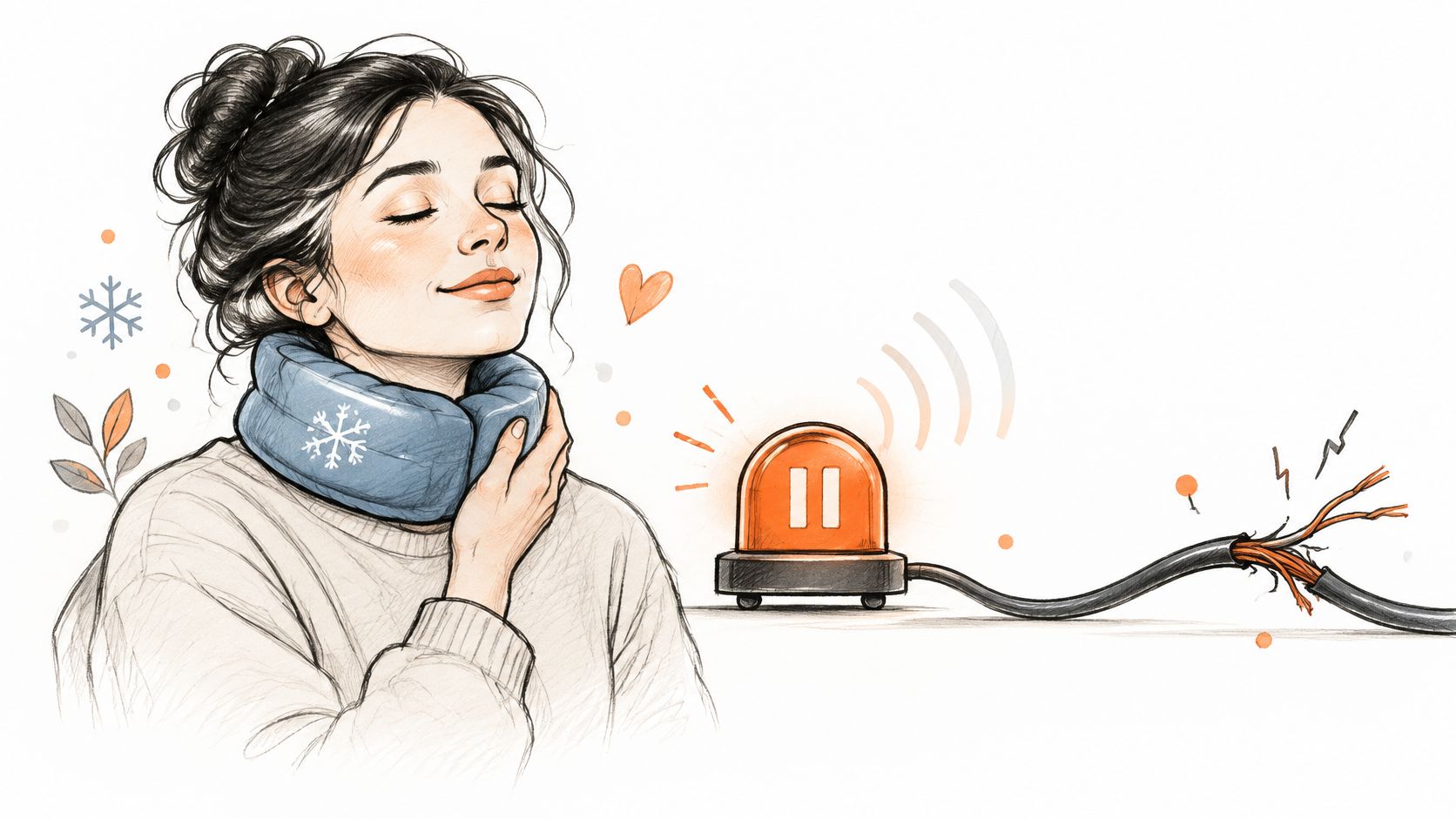
The wrap is a timer you wear, not a treatment you apply and forget. Hands-free contact makes it easy to leave cooling in place, so follow the time limits described earlier and check your skin rather than waiting for discomfort to remind you.
The illustration captures the difference between temporary comfort and fixing a cause.
What temporary relief actually means
The trial measured immediate effects, not lasting recovery or tissue healing.
Relief from cold means the pain signal is quieter, not that the cause is gone.
A commuter with neck ache after a long drive may find brief cooling makes the afternoon more comfortable. That does not address driving posture, muscle loading, or recurring symptoms. If the ache keeps returning, review the cause instead of adding more cold sessions. A broader approach to back and neck pain relief can put a comfort tool in context.
A gym-goer who uses a wrap after a tweak should judge the next step by how normal movement feels. If an exercise still aggravates the neck, cooling the area to get through it can mask a reason to modify activity.
These are decision examples, not promised outcomes. Stop using the wrap if your skin shows warning signs, and reassess the plan if you repeatedly need cooling for ordinary activities. Cold can offer a short window of comfort; it cannot confirm that the underlying problem has resolved.
How to Position and Secure a Hands-Free Wrap
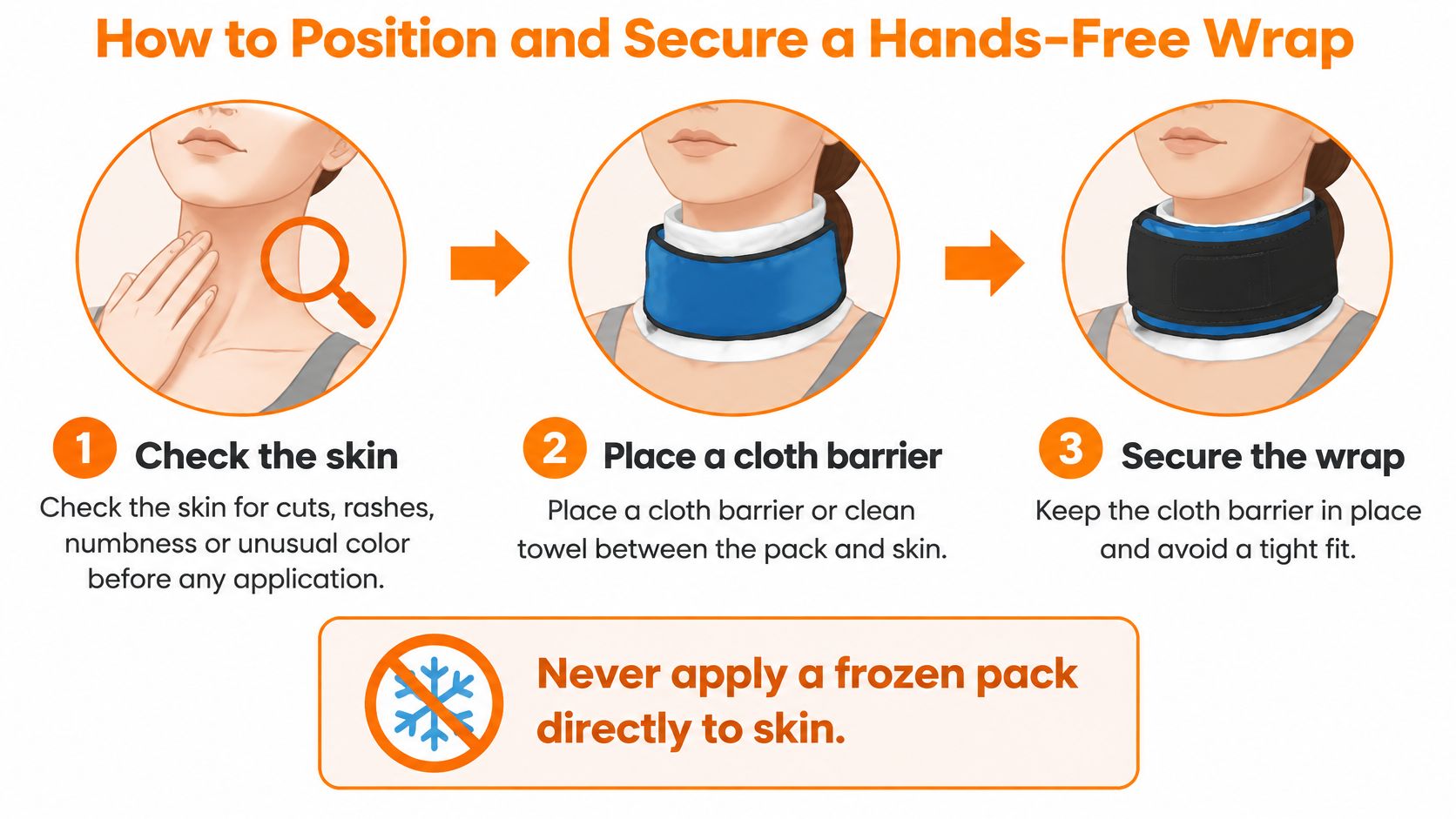
An adjustable fit matters more than a tight fit. The intermittent-use guidance cited earlier supports a barrier and non-constricting contact, not prolonged compression around the neck.
Use this visual as a reminder of the basic setup, then check the fit on your own body.
Prepare the size before fastening
Before application, measure the intended coverage. Follow the curve from the base of your skull across the back of the neck toward the top of each shoulder, and compare that span with the manufacturer's sizing information. This is a practical fitting check, not a validated clinical measurement.
Choose coverage that lies flat without folding over itself. If you have to bunch the pack or pull the fastening hard to position it, try another shape or size instead.
- Inspect the skin. Look for cuts, rashes, unexplained color changes, or areas that don't feel normal. Don't cover an area you can't reliably inspect or feel.
- Place a clean cloth barrier. Keep the towel or protective cover flat between the cold material and your skin. A folded edge or displaced cover can leave uneven contact, so check the underside as well as the visible edges.
- Center the pack behind the neck. Let its sides rest toward the lateral neck and upper shoulders, with the front of the throat clear. Aim for broad, comfortable contact rather than pushing a hard frozen section into a small sore spot.
- Fasten without pulling tight. The closure should hold the pack, not compress your neck. You should be able to slip fingers beneath the edge comfortably, but that isn't a substitute for checking that breathing, swallowing, and head position feel unrestricted.
- Start the timer and stay attentive. Use the session limit established above, and remain awake where you can remove the wrap easily. As a practical precaution, don't wear it while driving or operating machinery, when checking the skin and responding promptly would be difficult.
- Remove, inspect, and rest. Check both color and sensation after taking it off, then observe the full rest interval. Don't immediately refasten it because discomfort returns.
For an additional demonstration, watch the video alongside the written precautions, not instead of them.
A hands-free design should reduce the effort of holding the pack. It shouldn't reduce your attention to the application.
Skin Warning Signs and Who Should Avoid Cold
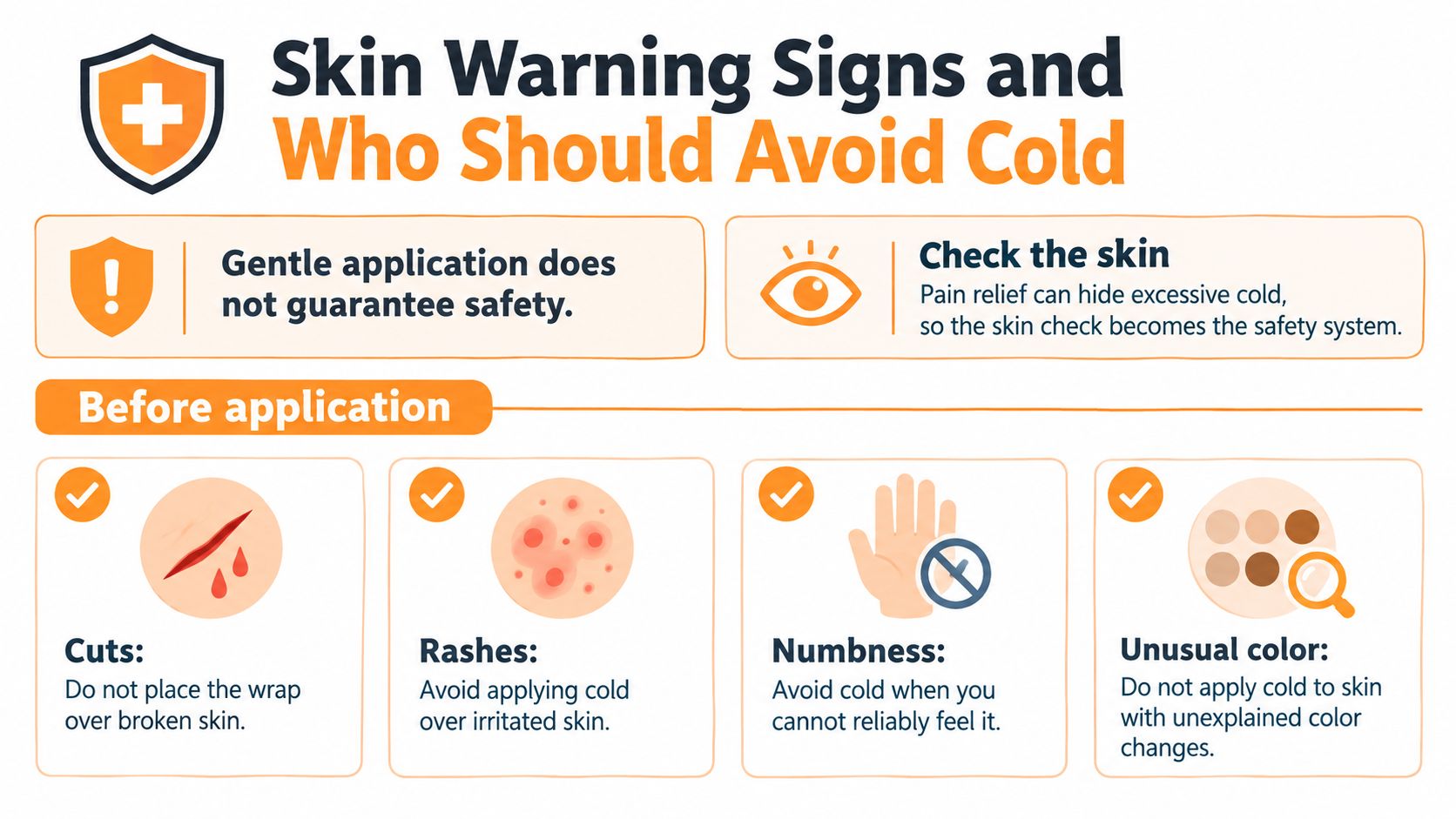
The skin check is the key safety system. Gentle pressure doesn't guarantee safe cooling, especially when pain relief makes excessive cold less obvious.
The NHS neck-pain advice supports protected, limited applications and cautions around vulnerable skin, sensation, and circulation. Don't judge safety only by whether the neck pain feels better.
Stop rules you can act on
| Sign | What it suggests | Action |
|---|---|---|
| Mild pinkness that fades promptly | Can be a normal response to cold | Stay within the time limit and keep checking |
| Burning or stinging | Exposure may be too intense | Remove the wrap now |
| Marked pallor or white patches | Possible circulation compromise | Remove now and let the area warm gently |
| Numbness that persists after removal | Ongoing sensation loss | Keep the wrap off and seek medical advice if it lasts |
| Blistering or an open wound | Possible cold injury or damaged skin | Remove and seek care |
| Worsening swelling or pain | Needs reassessment | Stop and seek assessment |
Don't try to “push through” burning because you've been told cold can feel uncomfortable initially. Marked pallor, persistent numbness, blistering, or worsening symptoms deserve medical advice, not another attempt with a tighter wrap.
Use this checklist before putting the pack on.
Get advice before using cold
Don't use cold without medical guidance if you have numb skin, open wounds, poor circulation, diabetes-related sensory loss, Raynaud's disease, cold allergy, peripheral vascular disease, or sickle-cell disease. Older adults also need particular caution, especially when they can't reliably detect or communicate skin changes.
A wrap can hold contact and pressure more steadily than a loose bag of ice. That's convenient, but it removes the natural interruption of repositioning or putting the pack down, which makes dozing especially unsuitable.
Keep a clean, washable barrier against sweaty skin, and follow the cover's washing instructions. Don't reuse a damp, soiled cover just because the pack itself has been returned to the freezer.
Choose the Right Wrap by Size, Fill and Cover
Compare coverage, weight, fastening, and the protective layer before choosing by softness or appearance. A neck cold pack wrap that needs constant tightening isn't a good hands-free fit.
The comparison below is a practical buying guide, not a ranking of clinically proven treatments. For fills and fabrics, confirm the actual product's construction and approved uses rather than assuming that every version behaves alike.
| Feature | What to check | Best fit for the decision | Trade-off |
|---|---|---|---|
| Standard neck wrap | Coverage across the back of the neck and upper shoulders | More localized coverage | The band must hold without tightening |
| Extra-long wrap | Whether the added length reaches the intended shoulder area | Broader coverage | More material may feel cumbersome |
| Flax seed fill | Whether it settles comfortably along your neck curve | A conforming, draped fit | Check weight and whether the fill shifts |
| Lava sand fill | Whether its weight feels comfortable without extra tension | Users who prefer a weighted feel | May feel heavy on a sensitive neck |
| Gel pack | Flexibility when frozen and the specified barrier | A dedicated cold-pack option | Frozen surfaces require careful insulation |
| Fleece cover | Softness, cleanliness, and washing instructions | Users who prefer a softer surface | Check how it handles sweat and drying |
| Cotton cover | Thickness and whether it provides the required protection | A different fabric feel against the skin | Don't assume a thin cover is enough |
| Dual heat-and-cold use | Explicit approval for both methods | Households wanting a reusable multipurpose wrap | Heating and cooling instructions aren't interchangeable |
Fit the wrap to your neck, not your neck to the wrap
Start with the coverage measurement used during setup. A wider or longer pack isn't automatically more helpful, particularly if it folds, slides, or needs a firmer closure to stay put.
Check the weight while sitting in the position where you'll use it. If you're lifting your shoulders, bracing your neck, or leaning back to support the pack, a smaller or lighter option may be more practical.
Fill choice should come after fit. Don't assume flax seed, lava sand, or gel provides better pain relief just because the material sounds therapeutic; the neck-pain evidence discussed earlier doesn't establish a winner among those constructions.
Buying check: A pack should stay where you place it without making you brace, bunch the fabric, or tighten the closure.
A strapped ice bag is another format worth comparing if a filled wrap doesn't suit your shape. This guide to ice bags for injuries provides context for that alternative, but the same attention to contact, timing, and skin protection still applies.
Read the label before using the freezer
A microwavable wrap isn't automatically approved for freezing. Likewise, don't heat a cold-only pack or improvise preparation instructions because another product looks similar.
Before buying, confirm:
- Secure placement: The closure holds without neck compression.
- Reliable protection: The barrier stays between the pack and skin.
- Suitable coverage: The pack lies flat over the intended area.
- Manageable weight: You can relax without supporting it.
- Clear labeling: The manufacturer states whether it's for cold, warmth, or both.
- Practical cleaning: The cover can be cleaned according to the care instructions.
A removable cover is useful only if you'll wash it and refit it correctly. Keep the instructions available rather than relying on memory when switching between warm and cold use.
Ultimately, the right wrap is a comfort and symptom-management tool, not a diagnosis. If the warning symptoms described earlier are present, stop self-treating and arrange assessment rather than buying a stronger or larger pack.
SunnyBay offers reusable microwavable neck wraps, hands-free designs, and hot/cold accessories for targeted comfort. Visit SunnyBay to compare coverage, covers, and fastening options, and check the individual label for cold-use instructions before choosing a wrap.


