


Large Back Ice Pack Guide for Safe Pain Relief
-
Your back seizes when you stand up from the chair. Or you tweak something reaching into the car, and your first move is the same one many make. You open the freezer and start looking for anything cold.
That instinct isn't wrong. It's just incomplete.
A large back ice pack can be useful, but only if you match the pack to the kind of pain you have, use it for the right amount of time, and stop treating cold like a test of toughness. A lot of people either under-size the pack, leave it on too long, or use cold for the wrong problem and then decide icing “doesn't work.”
If your pain started during running or training, it also helps to look at movement causes, not just symptom control. This piece on VitzAi.com back pain advice is a practical companion if you're trying to connect back discomfort with activity, mechanics, and return-to-exercise decisions.
Table of Contents
- When Your Back Hurts and You Reach for the Freezer
- What Counts as a Large Back Ice Pack
- Materials and Construction Compared
- Cold Versus Heat for Back Pain
- How to Use a Large Back Ice Pack Safely
- Choosing the Right Size and Fit
- Two Real-World Ways to Use It
- Common Mistakes and What to Do Instead
When Your Back Hurts and You Reach for the Freezer
The back is a confusing place to self-treat because the pain often feels bigger than the actual tissue problem. A small calf strain usually stays small. Back pain doesn't. It can spread across the belt line, creep into the mid-back, or make the whole area feel guarded and stiff.
That's why people often grab whatever cold pack is nearby and hope for relief. The problem is that a tiny lunchbox gel pack on a broad, aching back usually cools one patch of skin and misses the larger muscle area that feels irritated.
Four questions that matter first
Before you buy or use a large back ice pack, sort out these questions:
- What counts as large enough for a back?
- What kind of pack stays flexible against a curved torso?
- Is cold the right choice, or would heat fit your symptoms better?
- How long should you use it before cold turns from helpful to irritating?
Those answers matter because back pain isn't one thing. Some people have a fresh strain after lifting. Others have an end-of-day ache from sitting, driving, or repetitive bending. The same cold tool won't feel equally helpful in every situation.
Practical rule: The goal of icing your back is short-term symptom relief. Not proving you can tolerate more cold than you should.
A good guide should leave you with fit criteria, timing rules, and a way to decide when cold makes sense. Not just a list of products.
What Counts as a Large Back Ice Pack
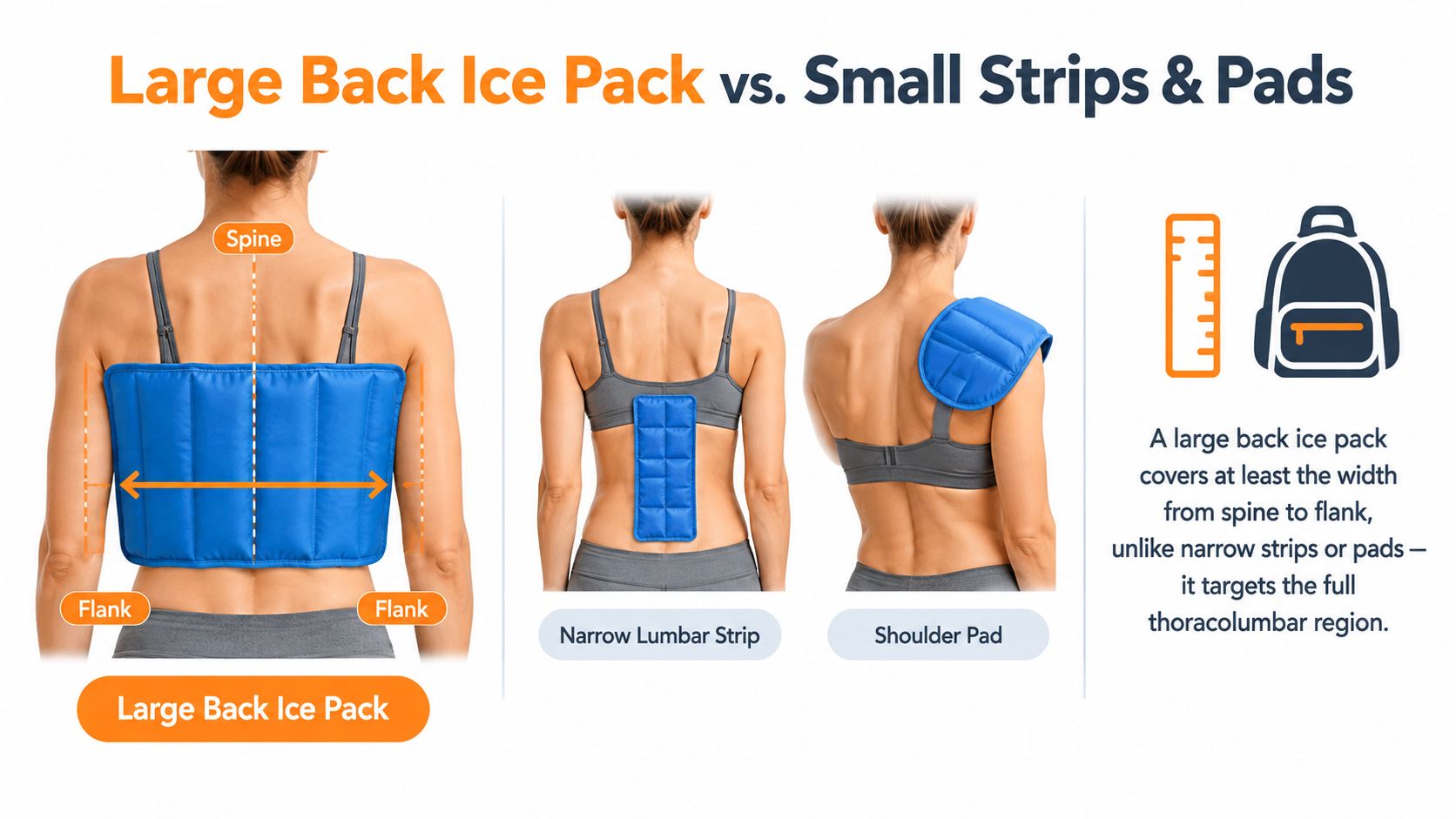
A large back ice pack is bigger than the small rectangle many people already own for knees, elbows, or headaches. For the back, “large” means the pack covers a broad treatment zone instead of one sore point.
Think of your torso like a backpack panel, not a doorknob. If the painful area spans the muscles on both sides of the spine, a narrow strip won't do much except create one cold lane down the middle.
Coverage matters more than the label
Commercial full-back wraps commonly range from about 13 x 21 inches to 26.37 x 21.25 inches according to a market example for a full-back cold wrap on Amazon. That range tells you something useful. Brands may all say “large,” but the difference is whether the pack reaches enough of your upper, middle, or lower back to make stable contact.
A true large pack should cover more than the spine itself. It should extend into the paraspinal muscles and broader soft tissue where many people feel the ache.
A small pack still has a place
Small packs aren't useless. They're just a different tool.
- For one trigger spot: A mini gel pack can work if you only have a very local sore point.
- For travel: Smaller packs are easier to freeze and carry.
- For broad pain: They usually fall short when the discomfort spreads across the low or mid-back.
The back also has curves. A flat pack that's technically wide enough can still leave air gaps near the lumbar curve. Those gaps warm up fast and reduce the cooling effect.
A large back ice pack should treat the area that hurts, not just touch the center of it.
Marketing names can mislead. Measurements, shape, and how the pack sits on your torso tell you much more than the word “large” on a box.
Materials and Construction Compared
Material changes how cold reaches your back. Two packs can measure the same size, yet feel completely different after 10 minutes because the fill, cover, and shape control how the cold spreads and how well the pack follows the curves of your body.
For a first-time buyer, it helps to sort these products by the job they do. Some aim for stronger surface cooling. Others trade some intensity for comfort and better contact.
How the common materials differ
| Material | Flexibility | Cold Retention | Skin Contact | Mess Level |
|---|---|---|---|---|
| Reusable gel pack | Usually conforms well, but can stiffen if very cold | Steady cooling for a typical home session | Can feel very intense and may develop frosty hard spots | Low |
| Clay-bead or bead-filled wrap | Often stays pliable and drapes better over curves | Gentler, more gradual cooling | Usually feels softer and less sharp against the body | Low |
| Traditional ice bag | Molds well when filled and positioned carefully | Strong, direct cold early in the session | Wet, colder-feeling surface if not wrapped well | Higher |
Gel packs
Gel packs are the standard option because they are simple to store and reuse. They often cool the broadest area evenly at first, which helps if your soreness spreads across the low or mid-back rather than sitting in one small spot.
The tradeoff shows up straight from the freezer. Some gel formulas become rigid, especially at the edges. That can create the cold-spot problem. One patch presses hard and feels painfully sharp while another area barely touches your back. For people with a pronounced lumbar curve, that matters more than the label on the box.
Bead and clay-style wraps
Bead and clay-style wraps usually feel gentler on contact. They act more like a bag of chilled grains than a flat frozen slab, so they settle into the hollow of the lower back more easily.
That softer drape is not just a comfort feature. Better contact often means more consistent cooling across the sore muscles next to the spine. If someone stops after two minutes because the pack feels too harsh, a milder material can be the more usable choice.
Traditional ice bags
A traditional ice bag still has a place. Filled with crushed or small ice, it can mold well and get cold quickly.
Its weakness is setup. On the back, especially if you are upright, an ice bag can slide, sweat, and leave moisture between the pack and your clothing or towel. A factual example in this category is the SunnyBay large ice bag with strap, which is designed so ice or hot water can be applied to areas including the back.
Construction details buyers overlook
The shell matters almost as much as the fill. A soft fabric cover usually feels less harsh than bare plastic or slick vinyl, and it can reduce the shock of first contact.
Then look at the seams and the weight. Large packs carry more stress across a wider area, so weak seams and uneven fill show up faster. Weight matters too. If the pack is heavy, it may sag away from the lower back unless you are lying down or using a strap to hold it close.
A useful way to choose is this. Pick gel if you want broader, stronger cooling and can tolerate a firmer feel. Pick beads or clay if you care more about drape and comfort. Pick an ice bag if you want adjustable cold and do not mind a little setup.
Cold Versus Heat for Back Pain
You tweak your back, head to the freezer, then stop and wonder if warmth would feel better. That hesitation is reasonable. For back pain, the question is not "ice or heat?" in the abstract. It is "what kind of back pain are you dealing with right now?"
The evidence is less clear-cut than many product roundups suggest. A 2006 review hosted in the NIH literature found that research on cold treatment for low back pain was very limited, with only a few poor-quality studies, while the evidence base for superficial heat was more developed for this condition (NIH review summary).
So the practical choice usually starts with the pattern of symptoms.
When cold usually fits better
Cold tends to make more sense when the back feels recently irritated. Examples include a strain after lifting, a flare after an awkward twist, or soreness that feels sharp, hot, or reactive. In those situations, the goal is not to "fix" the injury with cold. The goal is short-term pain calming.
A simple way to picture it is this: cold works like turning down the volume on an overactive alarm. It can reduce pain signaling for a while and may feel settling when the area feels aggravated.
A broader review in musculoskeletal care notes that cryotherapy is used to reduce pain, local blood flow, swelling, inflammation, muscle spasm, and tissue metabolic demand after injury (cryotherapy review in the National Library of Medicine).
When heat often fits better
Heat usually fits the opposite pattern. The back feels stiff getting out of a chair. It loosens only after you move around. It feels guarded, tight, or "stuck" rather than freshly irritated.
That is one reason heat is often preferred for end-of-day stiffness or pain linked to long periods of sitting. Warmth does not mean stronger treatment. It means a different job. Instead of quieting an irritated area, it often helps tense muscles relax and makes movement feel easier.
A high-level review indexed in PubMed also reported that evidence was still insufficient to draw firm conclusions about cold for low back pain, while some summaries suggested acute low back pain may respond similarly to cryotherapy or thermotherapy (PubMed review abstract).
A simple way to decide
Use the symptom pattern, not the product category.
| Modality | Best Match | What it usually helps with | Evidence picture |
|---|---|---|---|
| Cold | Recent strain, flare-up, irritated soreness | Short-term pain relief and calming of an aggravated area | Mixed for low back pain overall, more defensible for acute symptoms |
| Heat | Stiffness, muscle guarding, pain after inactivity | Relaxation, easier movement, less tightness | Better developed than cold for nonspecific low back pain |
| Either | Mild acute low back pain where symptoms are not clearly one pattern | Comfort and short-term symptom relief | Some people respond similarly to either one |
If you want a plain-language consumer guide, this article on when to ice and when to heat for pain relief gives a helpful overview.
A good first rule is simple. Use cold for a back that feels newly aggravated. Use heat for a back that feels stiff and reluctant to move. If both seem to help, the safer takeaway is comfort-based symptom relief, not proof that one method is universally better.
How to Use a Large Back Ice Pack Safely
Your back flares up after lifting something awkward, so you grab the coldest pack in the freezer and strap it on. That instinct is common. The problem is that “colder” and “longer” do not automatically mean “better.”
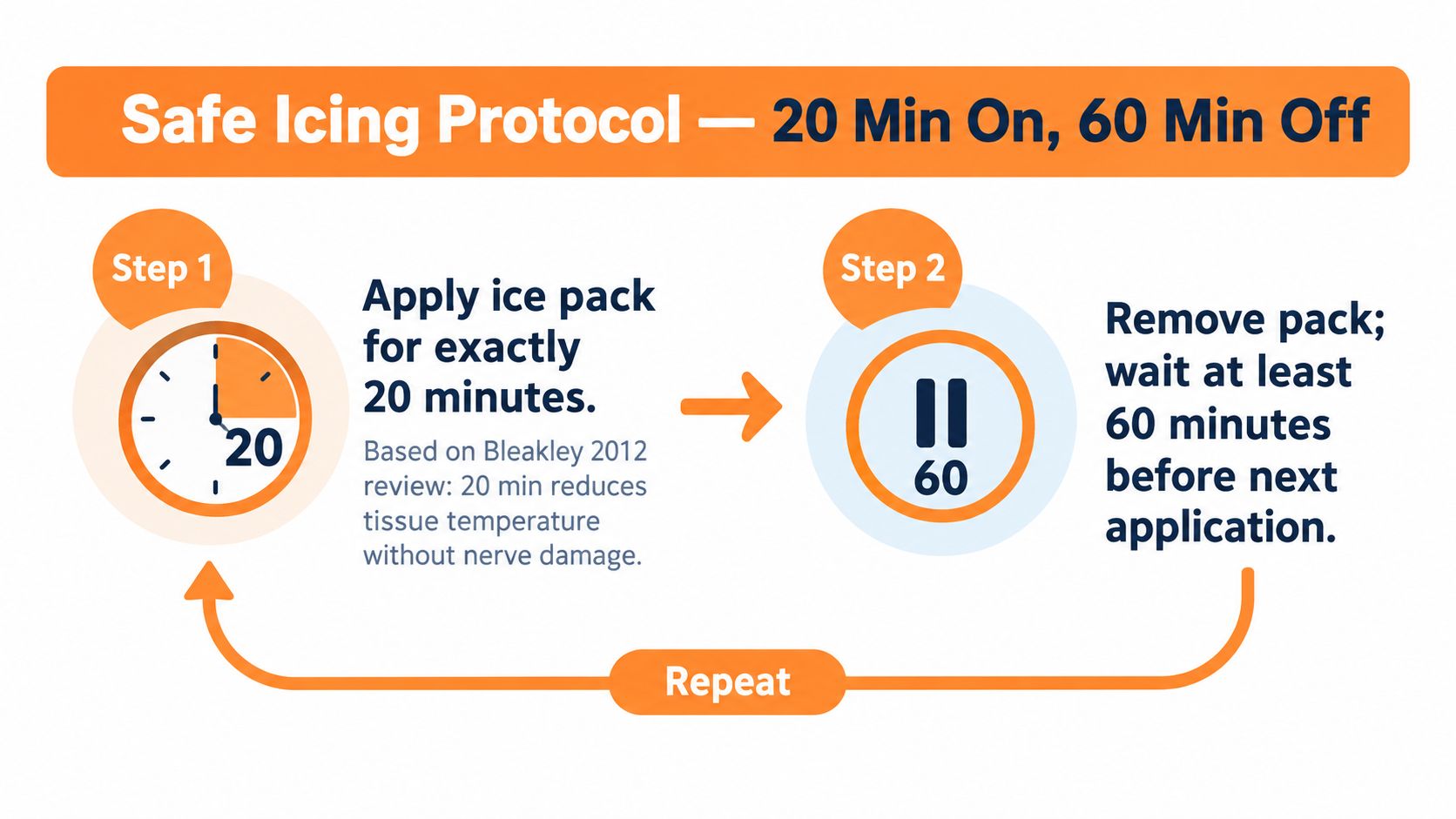
Safe use comes down to three things. Keep the session short, put fabric between the pack and your skin, and give the area time to warm back up before you repeat. Gloucestershire Hospitals NHS guidance summarizes the usual home rule as about 10 to 20 minutes at a time, with close attention to how the skin feels.
For a visual summary, this protocol is the one to follow at home.
The timing rule that keeps people out of trouble
A large pack covers more tissue than a small gel pack, so it can cool a broad area quickly. That wider coverage is useful for a back flare, but it also means you should be more disciplined about timing.
A good home routine is simple:
- Put a thin cloth barrier on the skin first. A T-shirt, pillowcase, or thin towel works.
- Apply the pack for up to 20 minutes.
- Take it off and wait at least an hour before another round.
- Check the skin and comfort level before you repeat.
That pause matters. Skin can feel numb before deeper tissues have fully recovered, and numb skin is harder to monitor accurately. If you lose track of time, set a phone timer before the pack goes on.
Position and setup
Your setup changes how safe the pack feels. A reclined or supported seated position usually works better than standing, because the pack can rest against the back instead of pulling on the straps and shifting around. Better contact also means fewer cold spots and fewer gaps where the pack slips.
If you are using a soft ice bag rather than a wrap-style pack, this guide to an ice bag for injuries can help with placement and basic handling.
This video can also help you picture safe setup and cold-therapy habits before you start.
When to stop immediately
Cold therapy should calm an irritated back, not create a skin problem on top of it.
Remove the pack right away if you notice:
- Increasing numbness
- Burning or stinging
- Blotchy, pale, or unusual skin color
- Pain that ramps up instead of settling
Skip cold over open wounds. Use extra caution, or ask a clinician first, if you have poor circulation, reduced sensation, Raynaud's, diabetes-related nerve changes, or a history of strong cold sensitivity. For a first-time buyer, that safety checklist matters as much as size or fill material.
Choosing the Right Size and Fit
A large back ice pack only helps if it contacts the area that hurts. Shoppers often focus on the measurements listed on the package, but fit matters just as much as size. The back is curved, the waist narrows, and the sore spot is not always centered.
Start by locating your pain pattern. A broad band of soreness across the low back usually calls for more width, so the pack reaches the muscles on both sides of the spine. A smaller hot spot higher up may need more vertical reach instead. Coverage should match the problem, the same way a bandage should cover the whole scrape rather than just the middle.
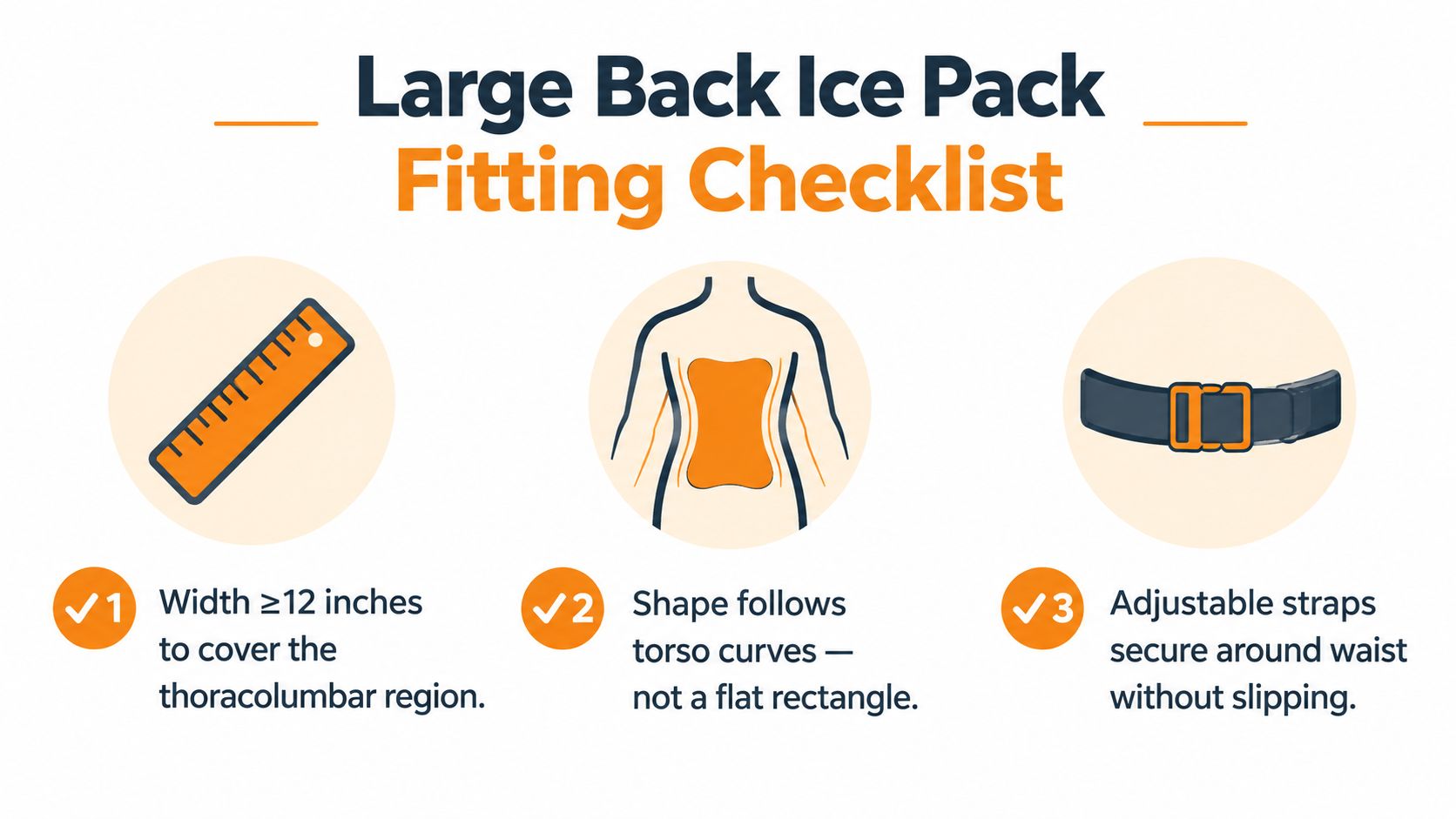
A simple fitting checklist
- Check width first: Look for a pack that reaches beyond the spine into the paraspinal and side muscles if that is where your soreness spreads.
- Match height to the pain zone: A pack for low-back flare-ups does not need the same top-to-bottom coverage as one meant for mid-back tension.
- Choose a shape that bends with you: A flexible wrap usually maintains contact better than a flat, stiff panel.
- Study the strap design: Adjustable straps help the pack stay in place without needing to be pulled too tight.
- Notice the skin-side fabric: A soft cloth backing often feels more comfortable against the body than a slick, plastic-like surface.
Contact is the goal. If a pack bridges over the lumbar curve or lifts away near the ribs, those gaps fill with air and the cold effect fades faster. People then blame the temperature, when the actual problem is poor contact.
This is why two packs with similar dimensions can feel completely different on the body. One may drape and stay put. The other may slide, bunch, or pull from the strap. For buyers comparing hands-free options, a large ice bag with strap for back use shows the general format some people find easier to secure while resting.
Body size also changes the fit. A pack that wraps well on a smaller torso may cover only the center of a broader back. If you are between sizes or shopping online, compare the stated width and height to the actual area you want to cool, not just to the word "large" on the label.
Stable contact beats extra bulk. A slightly smaller pack that molds to your back often works better than a bigger one that sits flat and shifts around.
Two Real-World Ways to Use It
The same large back ice pack can fit very different routines. What changes is the reason for using it and what you do around the icing session.
The weekend lifter
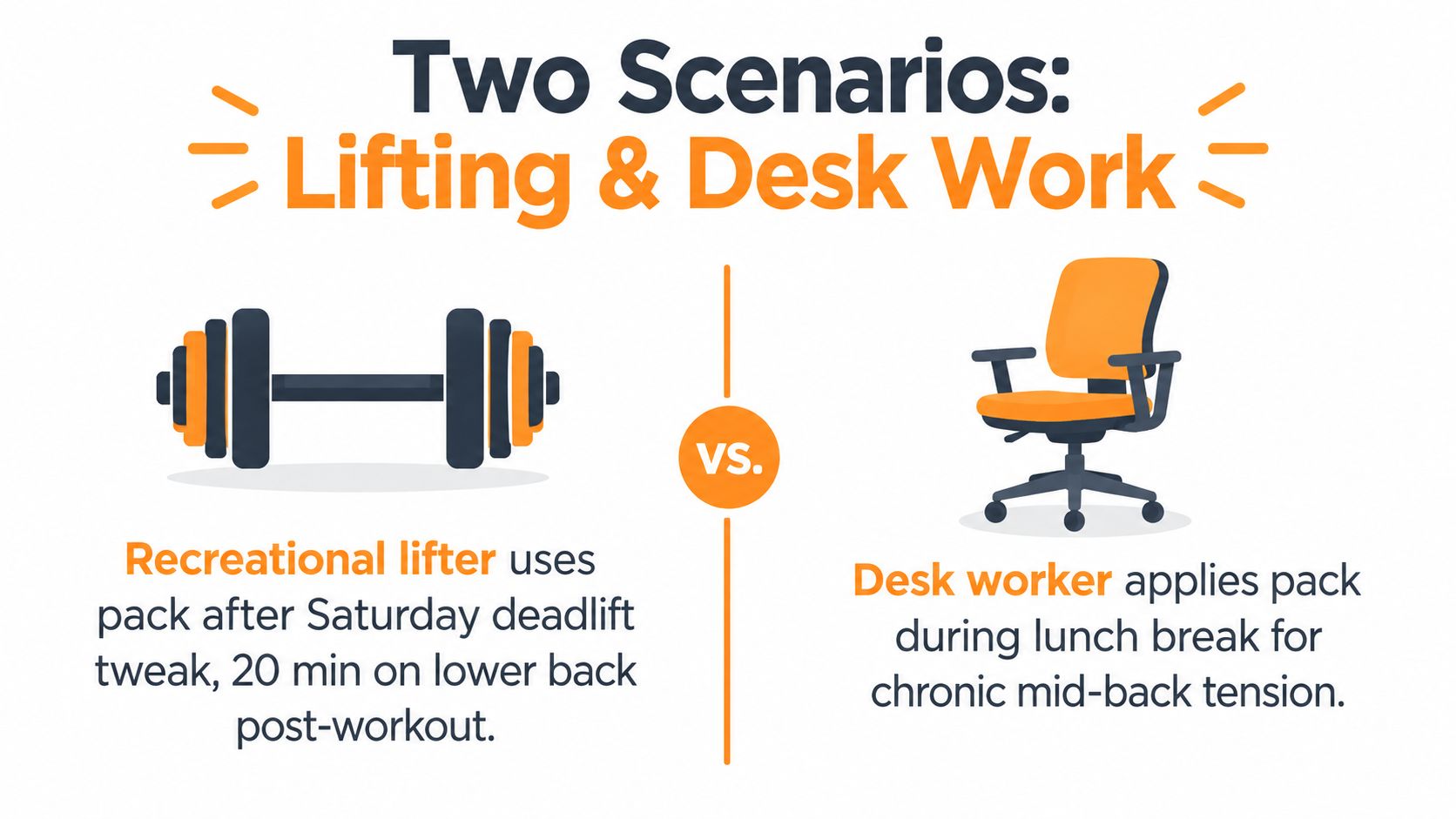
A recreational lifter tweaks the lower back during a deadlift. The area feels sharp, protective, and irritated the same day. This is the kind of situation where a short cold session often makes practical sense.
They recline, place a thin barrier under the pack, use a brief icing session, then get up later for easy walking and gentle movement rather than locking into bed rest. The next day, they judge the response by stiffness, pain with bending, and whether symptoms are calming or spreading.
The desk worker
A desk-based professional finishes a long day with a band of mid-back soreness. This discomfort isn't from one obvious injury moment. It builds from posture, low movement variety, and muscle tension.
For this person, a large back ice pack may feel useful as a brief reset, but it's rarely the whole answer. Pairing symptom relief with movement usually makes more sense. If they need ideas for gentle trunk work after the area settles, these Swiss ball exercises from Gym Membership Tips can be a reasonable starting point for exploring low-load back and core movement.
What changes between the two
- The lifter uses cold as an acute recovery tool after a specific aggravation.
- The desk worker uses it more selectively and may find heat or movement just as important.
- Both should watch the next-day response rather than assuming one session settles the whole problem.
That's the useful mindset. Don't ask whether a large back ice pack is universally good. Ask how it fits the pattern of your pain.
Common Mistakes and What to Do Instead
Most problems with icing don't come from buying the wrong product. They come from using a decent product badly.
Sleeping on the pack
Don't fall asleep with a cold pack on your back. People do this because they assume a long session means deeper relief.
Do set a timer and treat 20 minutes as a ceiling for a single application, not a suggestion. The back can go numb before your judgment catches up.
Skipping the barrier
Don't place frozen gel or ice directly on skin, especially over a broad area where you're less likely to monitor every inch closely.
Do use a thin towel, pillowcase, or similar cloth layer. This is one of the easiest ways to lower the risk of skin irritation and cold injury.
Treating overnight icing as harmless
Don't wear a large back ice pack overnight. A long cold exposure may leave the area feeling more stiff and irritated by morning instead of better.
Do use short, deliberate sessions and then let the tissue rewarm normally. Relief should come from controlled dosing, not from hours of exposure.
Applying cold over the wrong spot
Don't aim all the cooling directly at the bony spine if your pain is mostly in the muscle bands beside it.
Do place the pack so it contacts the broader muscular region that feels sore or reactive. Many people need width more than center-line intensity.
Reusing a frozen pack without checking it
Don't pull a pack straight from the freezer and slap it on just because you're in a hurry.
Do check for hard ridges, frosty areas, or uneven stiffness first. A pack that feels smooth and pliable will usually sit better and feel safer.
Ignoring red flags after icing
Don't keep repeating sessions if the area looks strange or the symptoms are moving in the wrong direction.
Stop and get clinical input if you notice:
- Worsening numbness
- Skin discoloration
- Pain that escalates after icing instead of easing
- Symptoms that keep intensifying rather than settling
A large back ice pack works best when you treat it like a measured tool. Short session, proper barrier, correct target area, then reassess. That's what protects the skin and gives you the best shot at useful relief.
SunnyBay offers hot and cold therapy tools that fit many of the situations covered here, including strap-style ice bags and back-focused wraps for home use. If you want to compare practical options for sizing, materials, and wear style, visit SunnyBay.


