


Hot Hand Glove Guide: Warmth, Relief, and Smart Choices
-
You're scraping frost from a windshield, trying to fasten a coat with stiff fingers, or sitting at a desk while your knuckles ache every time you type. A hot hand glove sounds like one simple answer, but the right choice depends on the problem you're trying to solve. A glove that keeps a skier warm may be too bulky for typing, while a soft microwavable mitt that eases stiffness won't necessarily protect a construction worker through a long outdoor shift.
The useful question isn't “Which glove is hottest?” It's “What job do I need this glove to do?” You may want outdoor warmth, short-term pain relief, better dexterity, or support for hands that feel persistently cold. Those jobs overlap, but they aren't identical, and one product rarely handles all of them equally well.
Table of Contents
- What a Hot Hand Glove Does
- How Glove-Style Warmers Generate and Hold Heat
- Microwavable, Air-Activated, or Battery Powered
- Where Hot Hand Gloves Help the Most
- Getting the Size, Fit, and Materials Right
- What the Evidence and Buyers Often Get Wrong
- Safe Use, Heating, and Care Basics
- Choosing the Right Hot Hand Glove for You
What a Hot Hand Glove Does
You are scraping ice from a car, settling in at a desk with aching knuckles, or heading outside for a cold commute. A hot hand glove can help in each situation, but it will not solve every hand-warming problem in the same way. Its purpose is to place warmth around the hand, using stored heat, a chemical reaction, or electricity rather than relying on body heat alone.
The job changes with the setting. Indoors, gentle warmth may ease stiff fingers while you rest. Outdoors, insulation must hold heat as wind and moisture pull it away. During typing or other detailed tasks, a bulky glove can make movement harder, so comfort and flexibility may matter more than the highest available temperature.
For background on how warmth can support comfort and function, see this guide to understanding the basics of heat therapy. Heat may be useful for comfort and mobility, but it is not a universal treatment for every cause of cold or painful hands.
Four jobs a glove may need to do
A shopper may be choosing between four different goals:
- Outdoor warmth: Keep hands comfortable during commuting, winter sports, outdoor work, or travel.
- Pain or stiffness relief: Provide steady warmth around sore joints and tight muscles.
- Dexterity: Keep fingers usable when cold makes them clumsy.
- Cold-hand support: Make unusually cold hands feel more comfortable, including for people who connect cold exposure with Raynaud's symptoms.
These goals can conflict. Thick insulation preserves warmth but can limit finger movement. Tight compression may feel supportive while leaving less room for heat or swelling. A strong heating element can warm the hand quickly, yet insulation determines how long that warmth remains useful.
Three warming styles
Microwavable glove-style warmers hold heat in a reusable filling and suit short, stationary sessions. Air-activated warmers are portable pouches placed inside another glove. Battery-heated gloves use rechargeable power and can provide adjustable warmth while you move.
Choose the job first, then the heat source. This keeps a feature list from deciding for you when the central question is how and where you will wear the glove.
How Glove-Style Warmers Generate and Hold Heat
The heat source is only half the story. A warm insert inside a thin, damp glove can lose its benefit quickly, while a moderate heat source surrounded by good insulation may feel comfortable for much longer.
Microwavable warmth
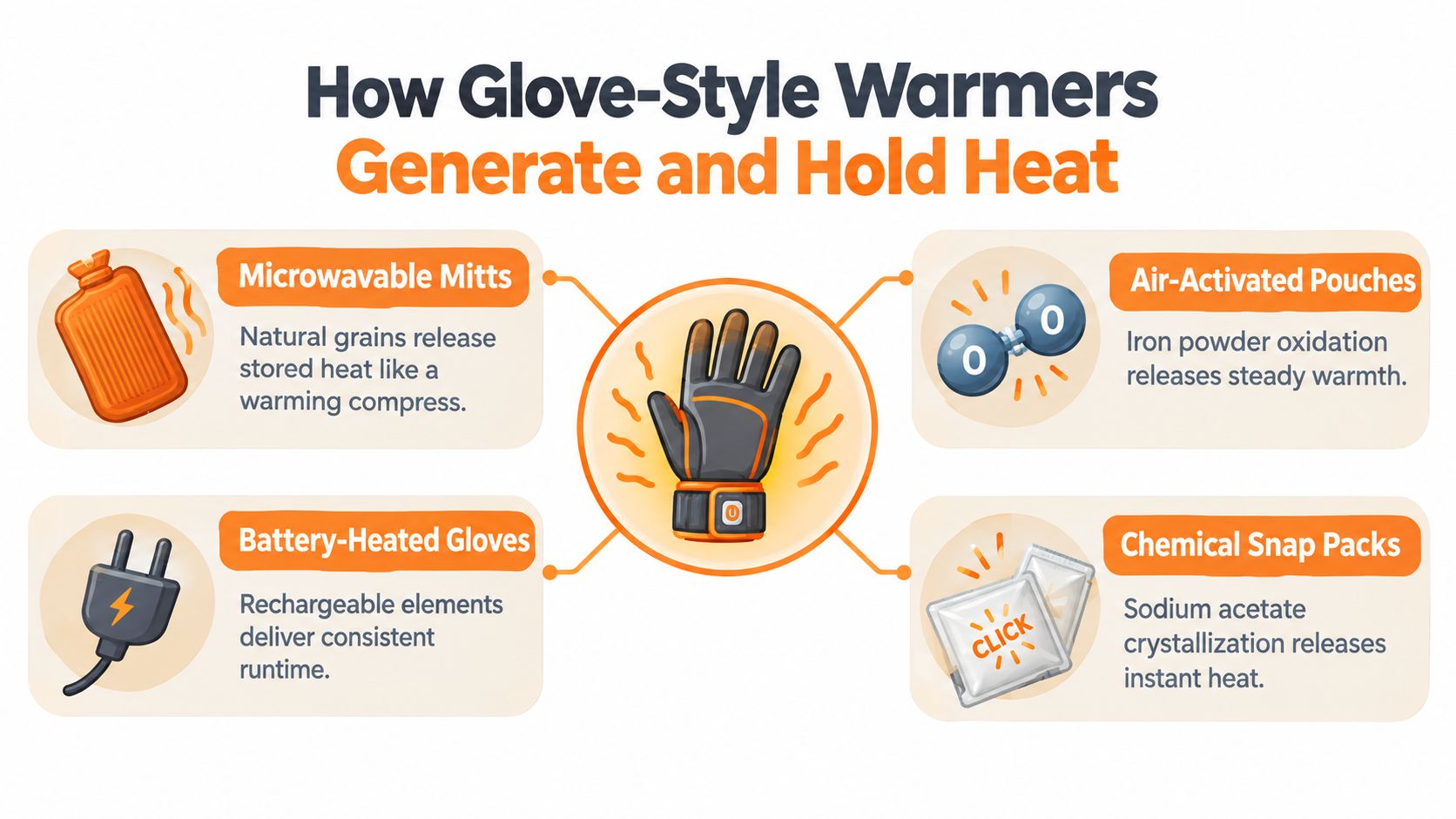
A microwavable mitt works much like a small hot-water bottle. Natural fillings such as grains or seeds absorb microwave energy, then release that stored warmth gradually into the surrounding fabric and your hand.
Think of a baked potato cooling on a kitchen counter. It starts hot, then transfers heat to the air and anything touching it. A microwavable hand warmer follows the same basic pattern, except the fabric helps distribute the warmth around the hand.
The benefit is simple, reusable warmth without a battery or chemical packet. The limitation is that the heat fades as the fill cools, so this style works best when you can warm it before use and remain somewhere comfortable.
Air-activated pouches
Disposable hand warmers use an oxidation reaction. Iron powder inside the pouch reacts with oxygen after the packet is exposed to air, releasing heat gradually.
The rust analogy is useful. Rust forms when iron reacts with oxygen, while an air-activated warmer manages a similar chemical process inside a controlled pouch. You open the packet, allow air to enter, and place it where the manufacturer recommends.
These pouches are convenient outdoors, but they add material inside an existing glove. A tight glove can leave less room for your fingers and may reduce dexterity.
Battery-powered heating
Battery-heated gloves use resistive wires or carbon-fiber elements. Electrical current passes through the element, which converts that energy into heat, much like a small electric blanket wrapped around the hand.
The advantage is control. You can often choose a lower or higher setting rather than accepting the fixed output of a chemical warmer. The trade-offs are weight, charging, battery condition, and the need to protect the wiring during storage.
Some people also combine hand warmth with other topical comfort routines. For example, those exploring Tiger Balm in Ireland should treat topical products and heated gloves as separate choices, checking each product's instructions rather than assuming that combining heat and topical ingredients is automatically appropriate.
Heat retention decides comfort
Insulation slows heat loss by trapping air. Fleece, wool, and other soft insulating materials can help retain warmth, while a wind-resistant outer layer reduces the cooling effect of moving air. Moisture matters too. Damp fabric conducts heat away from the hand and can make a warm glove feel ineffective.
For heated gloves, consumer reviews commonly report usable runtimes of roughly 2 to 8 hours, depending on heat setting and battery capacity, as summarized by NBC Select's heated glove guide. Treat runtime as a range, not a guarantee, because temperature, fit, battery age, and activity all affect the experience.
Microwavable, Air-Activated, or Battery Powered
A person warming stiff hands at a desk needs a different glove from someone gripping ski poles in wind. Match the heating method to the job: outdoor warmth, hand comfort, dexterity, or circulation support. One glove rarely handles all four equally well.
| Feature | Microwavable | Air-Activated | Battery Powered |
|---|---|---|---|
| Best setting | Home, desk, recovery, or rest | Outdoor activities and travel | Work, commuting, skiing, or extended activity |
| Heat control | Warm before use, then cools gradually | Fixed chemical output | Adjustable on many models |
| Reuse | Reusable | Single-use | Reusable with charging |
| Dexterity | Can feel bulky if mitten-shaped | Adds a pouch inside another glove | Depends on wiring, insulation, and fit |
| Main requirement | Microwave and safe heating routine | Air exposure and a suitable outer glove | Charger, charged battery, and battery care |
| Main limitation | Heat fades as the fill cools | Creates waste and can crowd the glove | Higher upfront complexity and weight |
When microwavable makes sense
Microwavable warmers work well for short, quiet sessions. You can heat one before watching television, working at a desk, or resting after time outdoors. The gradual cooling suits comfort around stiff hands, yet it offers little help once you need to keep moving.
Heat the mitt before use, then place it where warmth feels useful. A fill that spreads heat across the palm may feel more even than a small hot spot. A glove-style warmer also works like a warm compress, so it is better suited to rest than to continuous outdoor activity. Our guide to microwavable hand warmers explains how heating method, fill, and placement affect the choice.
When air-activated packets make sense
Air-activated pouches suit situations where portability matters more than reusability. Open a packet during a football match, commute, hike, or work task, then place it inside an existing glove. There is no microwave or charger to carry.
The packet needs air to produce heat, and the fixed output gives you little control once it starts warming. It can also take up palm space. In a close-fitting glove, that extra layer may press against the hand or limit finger movement. Test the packet and glove together before a long activity.
When battery power makes sense
Battery-heated gloves fit people who need warmth while their hands remain active. Motorcyclists, skiers, outdoor workers, and people with cold-sensitive hands may prefer adjustable heat during repeated exposure.
This option adds a routine. Charge the batteries, inspect the wiring and fabric, and plan for the possibility that power will run low. Weight and insulation can also affect dexterity. For a brief indoor session, that preparation may add little value. For sustained movement in cold conditions, adjustable heat can make the trade-off worthwhile.
Choose based on the job: a brief period of relief or sustained warmth while moving. Consider comfort, hand movement, and the time you can spend managing the warmer, rather than choosing by heating method alone.
Where Hot Hand Gloves Help the Most
A glove-style warmer can feel very different depending on what brought you to it. Someone with stiff knuckles at a desk needs a different design from someone holding ski poles in wind.
Arthritis and Raynaud's-related cold sensitivity
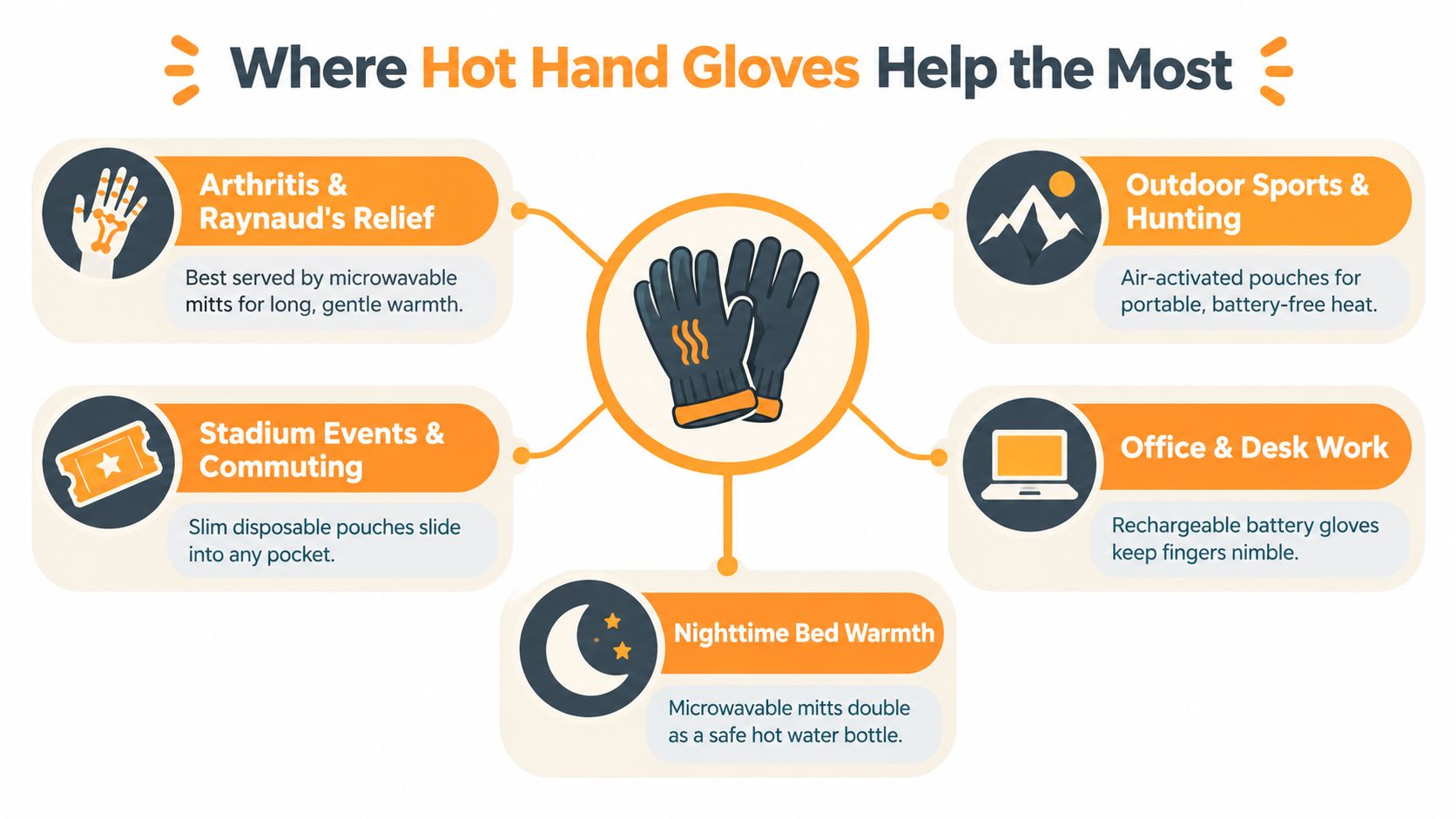
For hand pain or stiffness, gentle and sustained warmth may be more useful than an intense hot spot. A microwavable mitt can surround the hand while you rest, and a soft fabric design may feel less restrictive around tender joints.
Heat can help function in the short term, but it isn't a cure. A 2026 meta-analysis found that heat therapy for hand osteoarthritis improved pain and grip strength, while multimodal approaches performed better than heat-only glove-style therapy. The reported effects were pain SMD = –0.85 and grip strength SMD = 0.55, with moderate-to-low-quality evidence supporting short-term relief, according to the 2026 clinical review.
People with Raynaud's or another condition involving cold-sensitive hands should focus on warmth, dryness, and fit. If sensation is reduced, ask a clinician how to use heat safely.
Outdoor work and winter sports
Hunters, skiers, delivery workers, and construction workers need warmth that survives movement and exposure. Air-activated packets work well when access to power is limited. Battery-powered gloves are more suitable when you need adjustable heat and don't want to replace a packet during the activity.
An insulated outer shell remains important. Heat from a wire or pouch can't compensate fully for wind entering through seams or cuffs.
Sports, commuting, and desk work
Cyclists, runners, and golfers often need targeted warmth without losing grip. A slim liner, pocket-style warmer, or design that leaves fingertips more available may be more useful than a thick mitten.
At a desk, a fleece mitt paired with a nearby warm pack may solve the problem without wiring or bulky batteries. The simplest setup can be the easiest to use consistently.
A glove that works beside a laptop may be unsuitable for a ski lift, and a glove built for a ski lift may make typing frustrating. Match the form to the task rather than treating every cold hand as the same problem.
Getting the Size, Fit, and Materials Right
A warming glove can only work well if it stays in contact with your hand without squeezing it. Measure across the knuckles with your hand flat, then compare that measurement with the brand's own chart. Don't rely on your usual clothing size, because glove proportions vary.
Use a practical fit check
A good fit should feel close enough to transfer warmth but loose enough to allow normal movement. Your fingers shouldn't curl involuntarily, and the cuff shouldn't leave a gap where cold air can enter.
Before heating or activating anything, try this quick check:
- Make a fist: Confirm that the fabric doesn't pull sharply across your knuckles.
- Open your hand: Look for pressure, tingling, or tight seams.
- Grip an object: Hold a mug, phone, or handle to test dexterity.
- Check the warmth path: Make sure the insert or heating element sits where your hand needs warmth.
Swelling can change the fit during the day. For arthritis or puffy joints, stretchy four-way fabric and open-finger designs may be more comfortable than a rigid, fully enclosed glove.
Choose materials for the environment
Fleece traps warm air and feels soft against the skin. Cotton blends breathe and are easy to live with, but they may feel cold when damp. Neoprene-style outer materials resist moisture more effectively, although they can feel warm and less breathable during activity.
Outdoor users should look for a moisture-wicking inner layer and a wind-resistant exterior. Wet insulation loses much of its comfort advantage, even when the heating source continues to operate.
If visible hand veins or swelling raise concerns beyond ordinary cold sensitivity, a medical resource such as the Southern California vein treatment advice from Vein and Wound Institute can help you identify questions to discuss with a clinician. A warming glove shouldn't be used to diagnose or manage an unexplained circulation problem.
What the Evidence and Buyers Often Get Wrong
Many shoppers assume a specialty glove must outperform a cheaper ordinary glove because it carries a medical-sounding label. The evidence is less dramatic. In an NIHR trial summary, specialist arthritis gloves were no better than ordinary looser-fitting gloves for reducing pain and stiffness. A related qualitative study found that both intervention and placebo gloves offered some symptom relief from warmth, as reported in the NIHR evidence summary on arthritis gloves.
That doesn't mean warmth has no value. It means the useful part may be insulation, comfort, and a manageable fit rather than a premium label or elaborate construction.
| Common Assumption | What Evidence and Testing Suggests |
|---|---|
| A specialty arthritis glove will always work better | A looser ordinary glove may provide similar pain and stiffness outcomes |
| Hotter is automatically better | Moderate, steady warmth is easier to tolerate and reduces the risk of excessive heat |
| A warming glove treats arthritis | Heat may support short-term comfort and function, but it isn't a cure |
| A circulation claim proves improved circulation | Marketing language doesn't establish a clinical benefit for every user |
| More features mean better performance | Features help only when they match the user's actual task |
| A heat source matters more than insulation | Wind resistance, liner material, fit, and moisture control determine how well warmth stays around the hand |
Separate the four jobs
Ask what you're buying before comparing brands:
- Heat retention: Does the glove keep warmth around the fingers outdoors?
- Pain relief: Does it provide gentle contact around stiff joints?
- Dexterity: Can you type, grip, fasten, or operate controls?
- Circulation support: Is a medical condition involved that deserves clinical guidance?
A glove can be excellent at one job and disappointing at another. A large heated mitten may keep your hands warm but make detailed work difficult. A thin compression glove may preserve movement but provide little warmth in wind.
Buyer's question: What specific problem is this product solving, and what evidence supports that use?
The most sensible purchase is often the one with the clearest job description, not the longest feature list.
Safe Use, Heating, and Care Basics
Treat a hot hand glove like any other heat therapy product. Follow the manufacturer's instructions first, then use a routine that makes overheating, moisture, and battery damage less likely.
Microwavable products
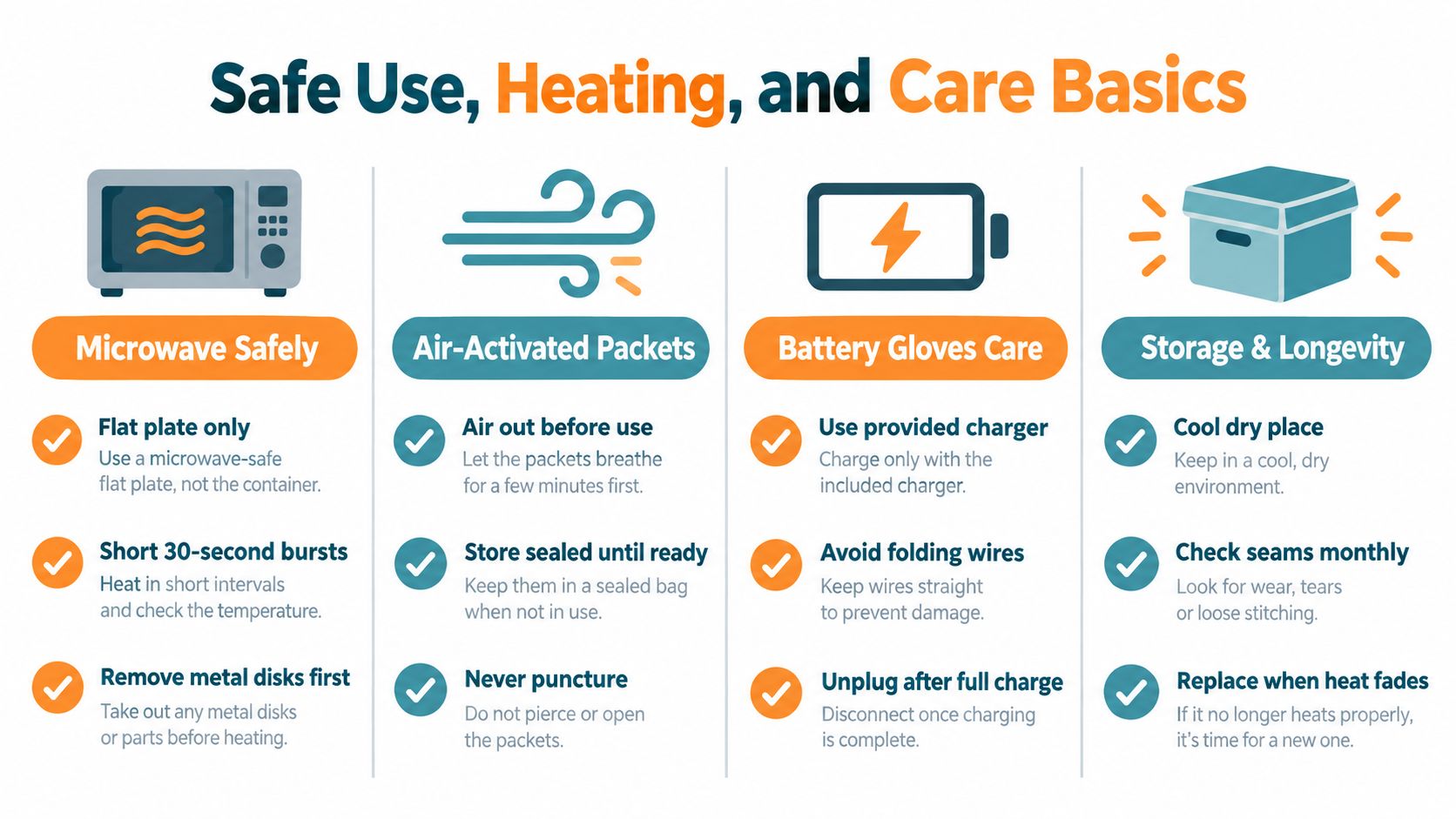
- Heat on a flat plate: Keep the warmer evenly positioned so one area doesn't become much hotter than another.
- Use short bursts: Heat gradually rather than assuming the maximum setting is appropriate.
- Remove metal components: Take out metal disks or other removable pieces before microwaving.
- Check the surface: Test the warmer against your inner wrist before putting it around your hand.
- Keep it dry: Don't microwave a damp insert unless the instructions specifically allow it.
For broader heat-pad guidance, review this practical resource on heating pad safety.
Air-activated packets
Keep packets sealed until you're ready to use them. Once opened, they need air to warm, so don't open several “just in case.” Never puncture, cut, or sleep with an activated packet, and stop using it if it becomes uncomfortably hot or damaged.
Battery-heated gloves
Use the supplied charger or the charger specified by the manufacturer. Inspect wires, connectors, and battery compartments before use. Don't fold the glove sharply over heating elements, and unplug the battery when charging is complete if the instructions recommend doing so.
Research on heated glove performance in extreme cold found that electrically heated gloves produced the highest starting and ending temperatures in the tested conditions. It also found that placing chemical warmers at the wrist could reduce effectiveness by increasing heat loss around the exposed area, according to this study of glove and mitten protection.
Skin and storage checks
Check your skin regularly during use, especially if you have diabetes, neuropathy, reduced sensation, or difficulty noticing temperature changes. Don't sleep while wearing an active heated glove, and ask a clinician for personalized advice when sensation or circulation is impaired.
Spot-clean grain or gel inserts unless the care label says they can be washed. Let every component dry fully before storage, keep reusable warmers in a cool, dry place, and replace covers or gloves with frayed seams, exposed wiring, or damaged insulation.
Choosing the Right Hot Hand Glove for You
The best choice becomes clearer when you return to the four jobs.
For warmth outdoors
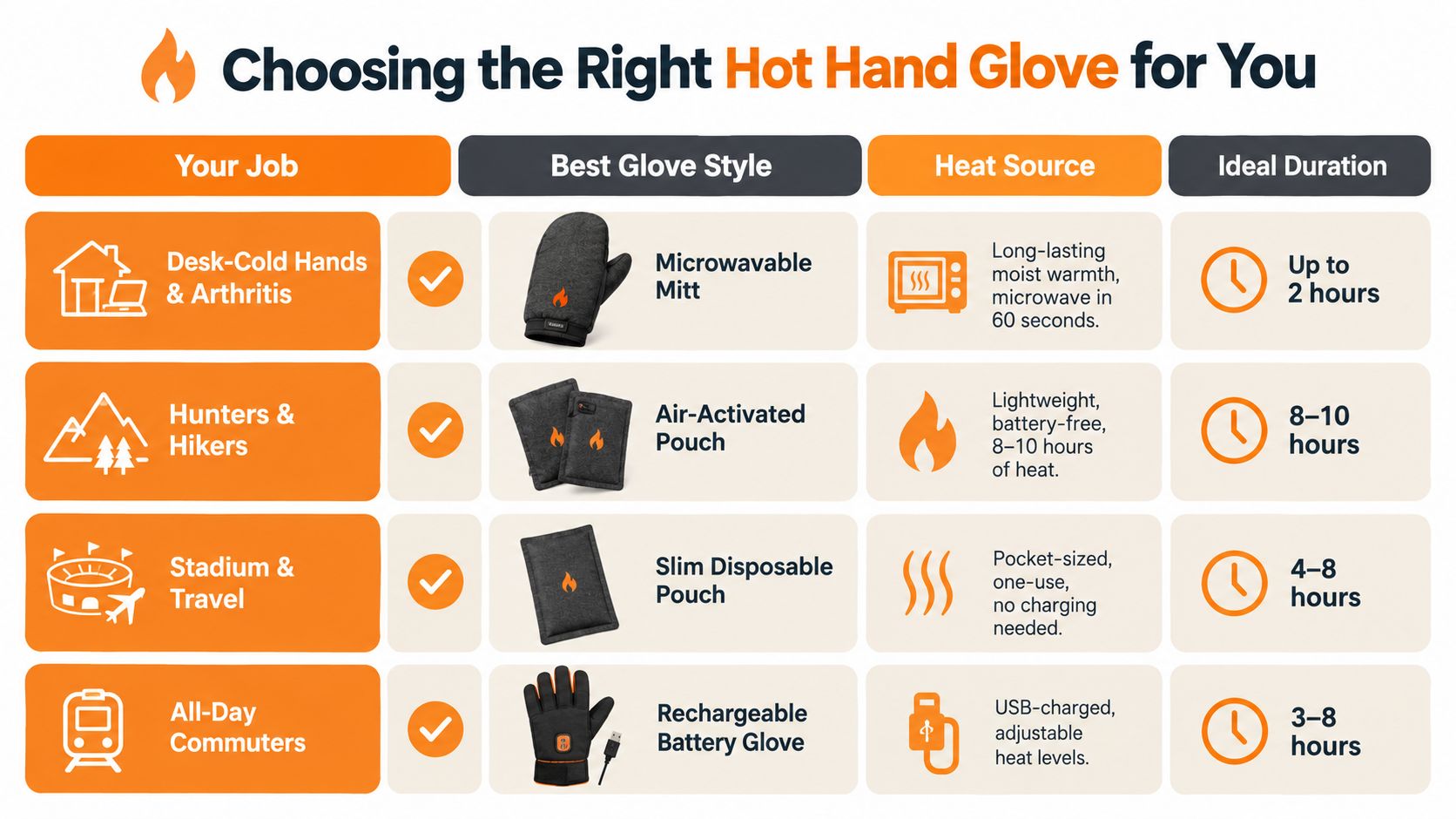
Choose a battery-powered heated glove when you'll spend extended time outside and need adjustable heat while moving. Choose an air-activated pouch when you want a lightweight, battery-free option for travel, events, hiking, or occasional outdoor work.
The deal-breaker is usually runtime or bulk. A battery glove that runs out during a shift may be less useful than a simpler packet you can carry as a backup. A pouch that crowds your fingers may undermine the dexterity you need for tools or controls.
For pain and stiffness
Choose a microwavable mitt when you want gentle warmth while resting at home. The design should feel supportive rather than tight, with enough room for natural swelling and comfortable movement.
Clinical evidence supports heat as a short-term aid, particularly when paired with exercise or mobility work rather than used alone. If pain persists, changes, or limits normal activity, a glove shouldn't replace professional assessment.
For dexterity
Choose a thin liner, fingerless design, or targeted pocket warmer when typing, crafting, cycling, or handling small objects matters. The warmest option may not be the most functional if it prevents you from opening a zipper or using a phone.
Open fingertips improve access but expose the areas that often feel coldest. That's the central compromise, and it's better to accept it consciously than discover it after purchase.
For cold-sensitive hands
If your hands regularly become unusually cold, prioritize insulation, dryness, and a comfortable fit. Battery heat may help during exposure, but unexplained circulation concerns deserve medical advice rather than a stronger heating setting.
SunnyBay offers reusable microwavable hand warmers and glove-style products designed to warm fingers and hands, including fleece-covered options with natural fill. They're one possible fit for short, stationary heat sessions, alongside ordinary fleece gloves, air-activated packets, and rechargeable heated gloves.
Before buying, check three things:
- The job: Are you solving outdoor cold, stiffness, dexterity, or cold-sensitive hands?
- The setting: Will you sit still near a microwave, or move outside without access to power?
- The trade-off: Can you accept bulk, charging, disposable packets, reduced fingertips, or limited heat duration?
One hot hand glove rarely solves all four problems. Choose the design that fits your main situation, then use layering or a second simpler warmer when your routine changes.
SunnyBay offers reusable microwavable hand warmers and other heat therapy products for targeted comfort at home or on the move. Visit SunnyBay to compare glove-style warmers and choose a heat option that matches the way your hands get cold.


