


Back Massage Heat Pad: A Complete Relief Guide
-
You finish a long day at your desk, stand up, and feel your lower back resist every movement. After training, the same area may feel tight rather than injured, while someone living with persistent pain may be searching for a tool that offers relief without requiring an appointment. A back massage heat pad can help in these moments, but it works best when you understand what it can do, what it can't do, and when heat may be unsafe.
A useful pad should support short-term symptom relief and easier movement, not replace an assessment for serious or persistent symptoms. The massage function may feel relaxing, yet current evidence doesn't show that it automatically makes heat therapy more effective than basic heat or conventional treatment. Choosing well means looking beyond comfort and marketing claims.
Table of Contents
- Understanding the Back Massage Heat Pad
- The Science Behind Heat and Muscle Relief
- Comparing Microwavable, Gel, and Air-Activated Designs
- How to Choose the Right Size, Weight, and Coverage
- Safety Rules, Contraindications, and Daily Care
- Evaluating Heat Pads Against Alternative Therapies
- Building Your Daily Pain Management Routine
Understanding the Back Massage Heat Pad
A back massage heat pad combines two sensations that many people find soothing: localized warmth and some form of pressure, vibration, kneading, or weighted contact. Unlike a loose heating blanket, it's usually shaped to sit against the lumbar or upper-back area. Some designs wrap around the body, while others rest on a chair and let your body provide the pressure.
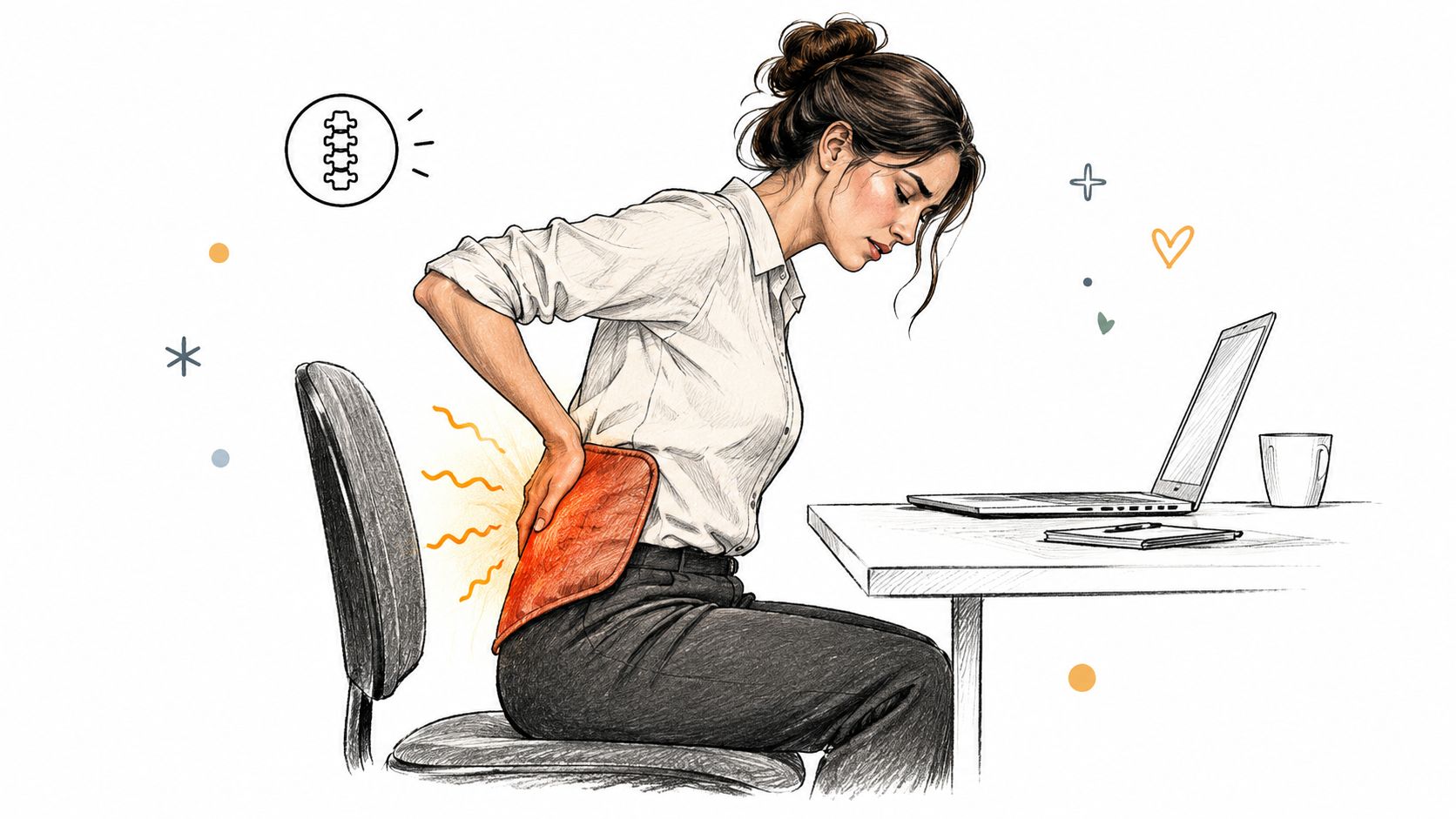
Consider an office worker who spends the afternoon leaning toward a laptop. Their discomfort may come from sustained muscle loading, limited movement, and a stiff-feeling back rather than one single dramatic injury. A contoured pad placed over the tense area can provide warmth while encouraging the person to pause, change position, and move more comfortably.
What makes it different from ordinary heat
A standard heating blanket warms a broad area, but it may slide away from the painful spot. A back-specific design may offer:
- Ergonomic shaping, which follows the curve of the lower or upper back.
- Weighted contact, which can feel grounding and gently compressive.
- Massage settings, such as vibration or mechanical kneading.
- Hands-free straps or elastic sections, which help keep the pad in place.
- Reusable construction, particularly in microwavable or washable-cover designs.
These features address convenience and comfort. They don't automatically prove superior clinical results. The important question is whether the pad helps you tolerate movement, relax guarding muscles, or complete a useful recovery routine.
Comfort versus treatment
Heat can be a sensible self-care option for muscle stiffness and some recent episodes of non-specific low-back pain. It isn't a cure for every cause of back pain, and a massage setting may be uncomfortable if the area is acutely irritated, bruised, numb, or unusually sensitive.
Practical rule: Choose the simplest setting that gives you comfortable warmth and leaves you moving more easily afterward.
For an overview of how heat fits into broader pain-relief decisions, see this guide on when to ice and when to heat. The right choice depends less on the number of features and more on the pattern of your symptoms.
The Science Behind Heat and Muscle Relief
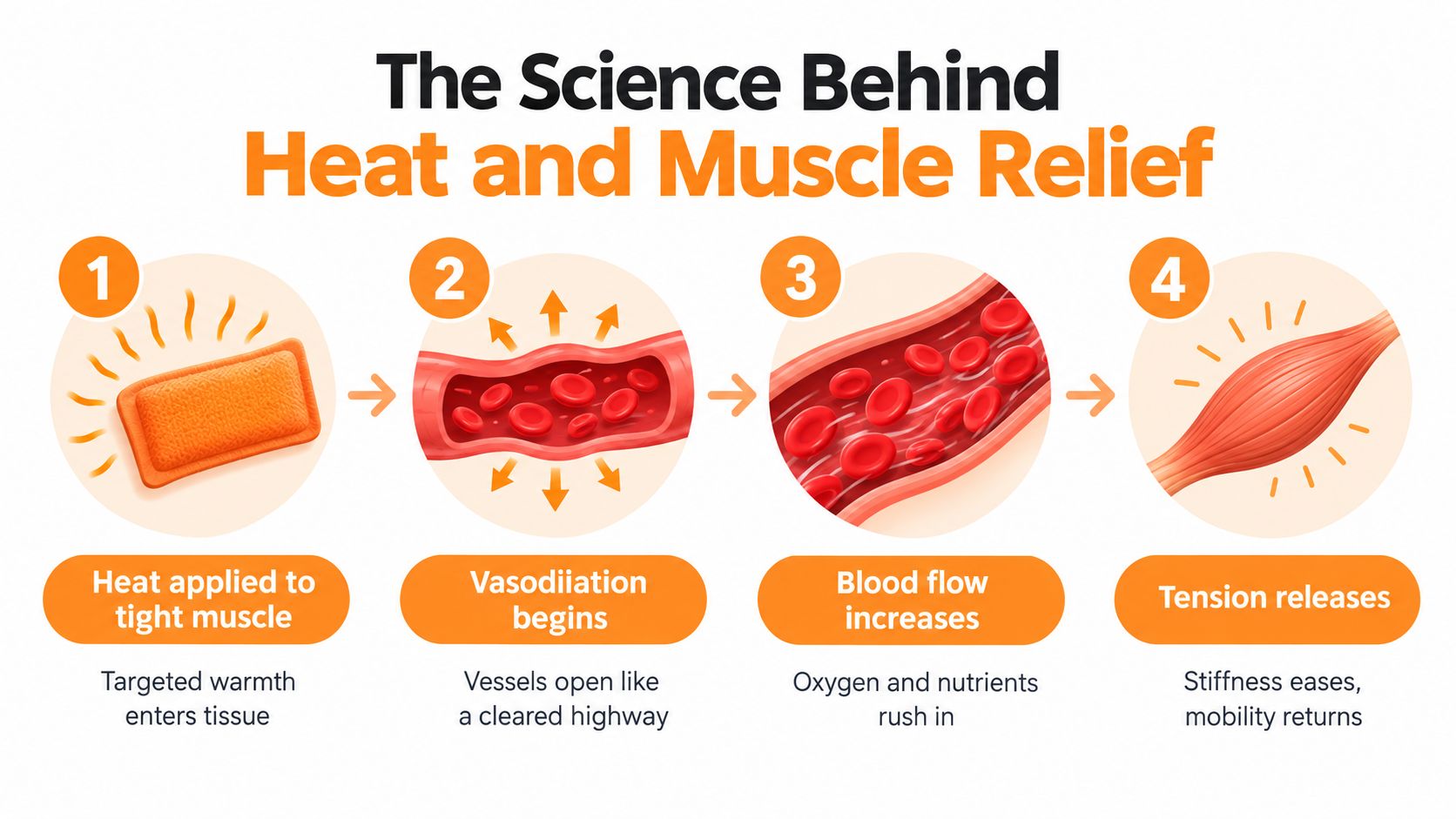
After hours in one position, a stiff back can feel guarded before you even start moving. Comfortable surface heat may reduce that protective response by warming the skin and nearby tissues. As tissue temperature rises, local blood vessels can widen, a process called vasodilation. The effect resembles opening extra lanes on a congested road, allowing more blood to pass through the area and helping transport oxygen, nutrients, and metabolic by-products.
Heat can also change how strongly pain signals are felt. The warmth competes with some pain input and may reduce the sensation of muscle tension. That can make a short walk, position change, or gentle mobility exercise feel more manageable after sitting or a minor strain.
Massage or vibration adds pressure and sensory input, but a stronger sensation is not automatically a stronger treatment. The available research on heat wraps does not show that adding massage produces a measurable benefit beyond heat alone. Use the massage function only when it feels comfortable and leaves the area easier to move, not more irritated.
What controlled evidence shows
A Cochrane review of superficial heat for low-back pain included 9 trials with 1,117 participants. In two trials involving 258 people with acute or subacute low-back pain, heat-wrap therapy reduced pain after 5 days by a weighted mean difference of 1.06 points on a 0-to-5 scale compared with oral placebo.
The result supports a measurable short-term pain-relief effect for some people. It does not mean every back problem responds to heat, or that heat treats chronic, unexplained, or worsening pain.
The American College of Physicians lists superficial heat as a first-line nonpharmacologic option for acute and subacute non-specific low-back pain. Its moderate-quality evidence summary reports moderate improvement in pain and disability compared with placebo in its clinical practice guideline for noninvasive treatments.
Turning warmth into useful recovery
Apply comfortable warmth for a focused session, then use the easier movement window to walk, change position, or perform gentle mobility work. If you want additional ideas for movement after training, this resource explains how to recover faster after workouts.
Avoid heat over numb skin, damaged skin, or an area where you cannot reliably judge temperature. Stop if pain, skin redness, dizziness, or neurological symptoms increase, and seek professional assessment when symptoms are worsening or unusual.
A heat pad should support movement, not replace evaluation or encourage you to push through warning signs.
Comparing Microwavable, Gel, and Air-Activated Designs
The heat source changes how a pad feels, how long it remains useful, and where you can use it. No design wins in every situation. A person relaxing at home may value reusable warmth and a contoured fit, while a traveler may prioritize portability and independence from a microwave or electrical outlet.
Microwavable natural-fill pads
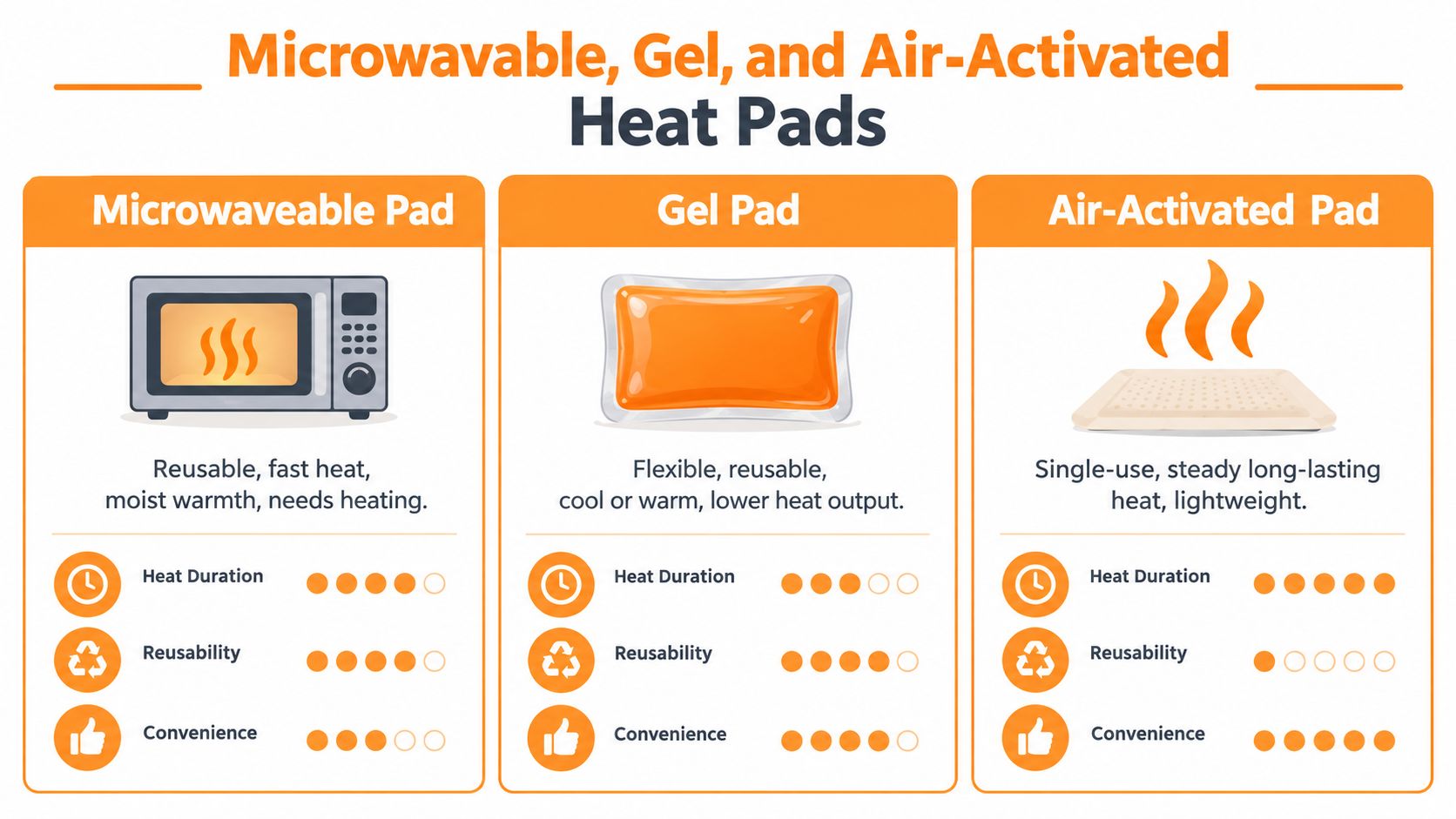
Microwavable pads use a heatable filling, such as flax seed or lava sand, inside a fabric cover. They can feel substantial against the body and may conform better than a flat gel pouch. Some also work as cold packs after freezing, which gives one product more than one role.
Their main limitation is preparation. You need a microwave, and you must follow the manufacturer's heating instructions carefully. Uneven heating can create hot spots, while overheating may damage the filling or cover. The pad also cools gradually, so it's most practical when you can remain in one place for a focused session.
Gel packs
Gel packs are flexible and commonly reusable for either warmth or cold. They're easy to store and can be useful for a specific small area. Their drawbacks include a tendency to feel less supportive against a curved back, and some lose their useful warmth relatively quickly.
A gel pack may suit someone who wants a simple option for occasional use. Look for a protective cover or use a fabric barrier, especially if the pack feels hot directly after warming.
Air-activated patches
Air-activated patches generate warmth when exposed to air. They're lightweight, portable, and convenient when you're commuting, working outdoors, or don't have access to a microwave. Many are designed for extended wear, but they're generally single-use, so they create more ongoing waste than reusable options.
| Design | Most useful for | Main limitation |
|---|---|---|
| Microwavable pad | Home sessions, reusable warmth, hands-free comfort | Requires careful heating |
| Gel pack | Flexible hot or cold application | May feel rigid or cool sooner |
| Air-activated patch | Travel and portable warmth | Usually single-use |
Matching the design to your routine
For a person who wants a weighted pad while seated at home, a reusable microwavable wrap may feel more comfortable than a disposable patch. For someone moving between locations, an air-activated design may be more practical. If you switch between hot and cold care, a suitable gel or microwavable pack can offer greater flexibility.
The best material is the one you can use safely and consistently. A technically advanced pad that stays in a drawer won't help as much as a simpler design that fits your habits.
How to Choose the Right Size, Weight, and Coverage
A back massage heat pad can only warm the area it contacts. Before buying, identify whether your symptoms sit in the upper back, between the shoulder blades, the lumbar region, or across a broad section of the trunk. A small pad may work for a focused muscle area, while a larger body pad can cover more of the lower back.
Start with the target area
For lower-back soreness, look for enough length and width to cover the muscles on both sides of the spine without forcing the pad onto the abdomen. For upper-back or shoulder tension, a wrap with shoulder extensions may stay in place better than a flat rectangle.
A guide to choosing the right size and shape of heating pad can help you compare coverage before choosing a format.
Consider how you'll use it
Your daily activity should influence the shape:
- Desk use: A chair-compatible pad or wrap should remain stable while you sit upright.
- Evening relaxation: A heavier design may feel soothing when you're lying down or reclining.
- Travel: A compact pad or air-activated patch is easier to carry.
- Post-activity use: A broad, reusable pad may cover a larger area of general stiffness.
Weight affects comfort, but heavier isn't always better. A weighted pad may provide gentle pressure that feels massage-like, yet excessive pressure can irritate a sensitive area or make it harder to adjust your posture. You should be able to remove it easily and breathe, sit, and move without restriction.
Look for secure contact
Hands-free straps, elastic bands, shaped edges, and a washable cover can matter more than extra massage modes. A pad that slips forces you to adjust it repeatedly, while one that stays in contact can deliver more even warmth.
| Feature | Why it matters |
|---|---|
| Contoured shape | Helps the pad follow the body's curves |
| Adjustable strap | Supports hands-free use |
| Moderate weight | Adds pressure without making movement awkward |
| Soft outer fabric | Improves comfort and helps reduce direct skin contact |
| Washable cover | Makes repeated use easier to keep hygienic |
Check the manufacturer's dimensions and care instructions rather than assuming that “one size” will suit every body. Fit is a safety feature as well as a comfort feature, because a stable pad is less likely to bunch up and create a concentrated hot spot.
Safety Rules, Contraindications, and Daily Care
More heat and more time don't necessarily produce more relief. They can increase the chance of burns, skin irritation, or tissue injury, especially if you fall asleep, place the pad directly on skin, or can't accurately sense its temperature.
Use a controlled session
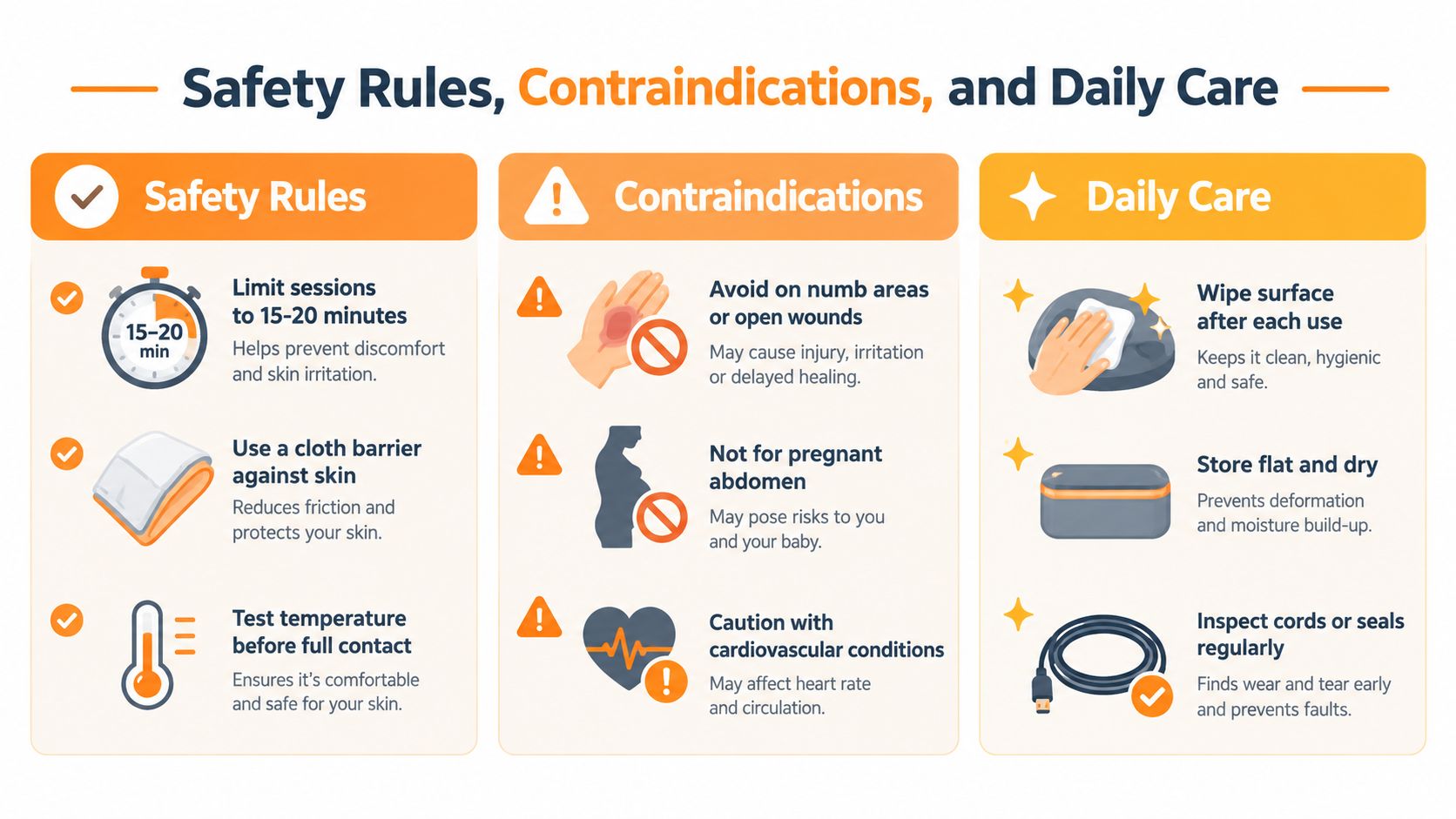
Canadian family-medicine guidance recommends not applying superficial heat directly to the skin and limiting use to 15 to 20 minutes, particularly for people with reduced protective sensation, as described in this low-back-pain guideline. Australian guidance notes that heat therapy is often used for about 30 minutes, while some low-level heat wraps are designed for much longer continuous wear, including 8 hours.
Those different recommendations show why the product label matters. Don't treat an all-day disposable wrap and a hot microwavable pad as interchangeable. Use the duration, temperature, barrier, and positioning instructions supplied for that specific product.
Before every session:
- Inspect the pad. Look for damaged seams, exposed heating elements, leaking gel, frayed cords, or a deteriorated cover.
- Test the temperature. Check it with your hand before placing it over the full area.
- Use a fabric barrier. Keep a layer of clothing or clean fabric between the heat source and your skin unless the manufacturer explicitly provides different instructions.
- Stay awake and aware. Don't sleep with a heated pad unless the product is specifically designed and labeled for that use.
- Stop at warning signs. Remove it if you feel burning, sharp pain, numbness, marked redness, dizziness, or worsening symptoms.
Who needs extra caution
People with diabetes, poor circulation, reduced sensation, nerve problems, skin disease, open wounds, or fragile skin may not detect excessive heat quickly enough. Independent guidance also highlights burn and skin-ulcer risks and recommends extra caution for people with poor sensation or diabetes in its discussion of heat therapy for low-back pain.
Ask a qualified clinician before using heat if you're unsure whether you can safely feel temperature in the area. Avoid applying heat over an open wound, active skin infection, or an area that is already hot and swollen. Seek medical advice for back pain with significant weakness, loss of bladder or bowel control, fever, major trauma, or unexplained systemic symptoms.
Keep reusable pads clean
Follow the care label. If the cover is washable, remove it before cleaning and allow it to dry fully before reheating. Don't soak an electrical product, and don't microwave anything that isn't explicitly designed for microwave use.
Store a microwavable pad flat or as directed, in a dry place away from sharp objects and pets. For a broader review of precautions, use this heating pad safety guide.
Evaluating Heat Pads Against Alternative Therapies
A heat pad is best viewed as one tool in a recovery plan. It can be convenient for a short warming session at home, while physical therapy can provide assessment, exercise progression, movement retraining, and advice about how to manage a recurring problem. Professional massage may help some people relax and temporarily reduce muscle tension, but it also depends on access, scheduling, and the practitioner's approach.
Active movement often gives heat its practical value. If warmth lets you walk more comfortably, practice prescribed exercises, or change position without guarding, it may support function. If you use it only while remaining still for long periods, you may feel temporary comfort without addressing the habits or capacity contributing to repeated stiffness.
Does massage add measurable benefit?
The word “massage” can make a product sound more therapeutic than a basic heating pad, but the evidence is more nuanced. A 2023 study found that heat massage was not superior to conventional physical therapy alone after four weeks, as reported in this clinical review of low-back-pain guidance. That result suggests the massage feature may not be the decisive driver of outcomes for many users.
This doesn't make vibration, kneading, or pressure useless. Those functions may improve relaxation or make a session more pleasant. They shouldn't be treated as proof that the product will outperform basic heat, exercise, or individualized care.
A better test: Does the pad help you move, sleep, or complete your normal activities more comfortably without increasing symptoms afterward?
Build a layered approach
Use the pad for a specific purpose, then reassess the result. For example, you might warm the lower back before a gentle walk, use prescribed mobility exercises after the session, and reserve professional care for symptoms that persist or limit daily function.
Footwear and lower-limb comfort can also influence how some people experience back strain during standing or walking. If that applies to you, browse the Insoles.com back pain collection as one separate factor to consider, not as a replacement for clinical assessment.
The most sensible comparison isn't “heat pad or physical therapy.” It's often “how can comfortable heat help me participate in the movement and care I need?”
Building Your Daily Pain Management Routine
Start with the symptom you want to change. Morning stiffness, post-workout tightness, and end-of-day desk discomfort may all respond differently, so use the pad as a targeted support rather than an automatic all-day habit.
A simple routine
In the morning, use gentle warmth only if stiffness is the main problem and your skin sensation is normal. Afterward, stand, walk, and perform comfortable movements instead of returning immediately to the same static position.
After work, place the pad over the most affected muscle area while sitting with your feet supported. Keep the session controlled, then adjust your chair, screen, or working position so the same load doesn't continue unchecked.
After exercise, use warmth when the muscles feel tight and movement feels restricted, not as permission to train through sharp or escalating pain. If the area appears swollen, feels unusually hot, or your symptoms don't behave like ordinary muscle soreness, ask a clinician whether heat is appropriate.
A broader resource on weight management and joint health may be relevant if body loading and joint comfort are part of your long-term goals. It should complement, not replace, individualized medical or exercise advice.
Keep a short personal checklist
- Location: Does the pad cover the area that feels tense?
- Temperature: Is the warmth comfortable rather than intense?
- Duration: Are you following the product's instructions?
- Skin: Does the area look and feel normal afterward?
- Movement: Can you move more easily after the session?
- Response: Do symptoms settle, stay unchanged, or worsen later?
Choose microwavable, gel, or air-activated construction according to where you use it. Match the size and weight to your body and routine, and treat massage as an optional comfort feature rather than a guaranteed clinical advantage.
SunnyBay offers reusable microwavable heating pads and wraps, massage tools, and air-activated heat patches for targeted back, neck, shoulder, and other relief applications. Visit SunnyBay to compare formats and choose a heat therapy product that fits your symptoms, routine, and safety needs.


