


Preventing Repitive Strain Injuries: Simple Ergonomic Tips for Daily Work
-
That dull ache in your wrist after a long day at the keyboard or that nagging tightness in your neck? That's not just a sign of a hard day's work. It's your body's early warning system, and it’s time to listen.
Preventing a repetitive strain injury starts with a simple realization: these problems don't come from a single, dramatic event. They build up from the small, everyday motions we barely think about. Once you see the risks hiding in plain sight, you can start making smart changes to protect yourself for the long haul.
The Hidden Costs of Everyday Strain
Repetitive Strain Injuries (RSIs) are sneaky. They develop from the most normal-seeming tasks, whether it's the constant click-and-drag of a mouse or the repetitive motions of working on an assembly line. These are cumulative injuries, which means the damage from thousands of tiny, seemingly harmless movements slowly adds up. Eventually, you hit a tipping point, and what was once a minor annoyance becomes chronic pain, numbness, or weakness.

This slow burn is precisely what makes RSIs so deceptive. You can feel perfectly fine for months or even years, and then one day, you're faced with a persistent pain that torpedoes not just your comfort, but your productivity and quality of life.
More Than Just Physical Pain
An RSI isn't just about a sore wrist or shoulder; it can fundamentally change your life. It affects your ability to do your job, enjoy your hobbies, and even handle simple day-to-day tasks.
Think about these common scenarios I see all the time:
- The Software Developer: Spends endless hours coding with a standard keyboard and mouse. A slight tingle in the fingers gradually turns into a constant, dull ache up the forearm. Before they know it, it's full-blown carpal tunnel syndrome, forcing them to rethink their entire workflow and seek medical help.
- The Cashier: The repetitive motion of scanning items and lifting goods, day in and day out, leads to nagging shoulder pain. That strain eventually becomes rotator cuff tendonitis, where every movement hurts and makes it nearly impossible to work effectively.
These examples show just how common—and disruptive—this problem is. It’s a massive issue with a staggering economic cost. Job-related RSIs are estimated to cost the U.S. economy $20 billion a year in workers' compensation alone. When you factor in lost productivity, that number jumps to an eye-watering $100 billion. For a deeper dive into the numbers, you can explore the financial impact of repetitive stress on tdi.texas.gov.
The most important thing you can do to prevent an RSI is to accept that small, repeated stresses on your body add up to big problems over time. Pushing through the initial warning signs is a gamble you don't want to lose.
At the end of the day, recognizing the risk is half the battle. When you understand how your daily habits contribute to strain, you can finally take control, break the cycle of damage, and protect your well-being before a minor issue becomes a major one.
Design Your Pain-Free Workspace
Your workspace, whether it’s a dedicated home office or the corner of your kitchen table, should be working for you, not against you. So much of preventing repetitive strain injuries comes down to making simple, intentional changes to your environment. These aren't just about comfort; they're your first line of defense against pain.

It’s amazing how much unnecessary strain we put on our bodies just because our setup forces us into awkward positions. The goal is to find your neutral posture—that sweet spot where your joints are naturally aligned and your muscles can finally relax. This takes the pressure off your muscles, tendons, and spine.
Think about it this way: if you're constantly looking down at your laptop, you're putting a tremendous amount of force on your neck. Over a full workday, it's like asking your neck to balance a bowling ball for eight hours straight. Pain and stiffness aren't just possible; they're practically guaranteed.
Getting the Foundation Right: Your Chair and Desk
Everything starts with your chair. It’s the foundation of your posture for the entire day. If you're serious about avoiding strain, investing in one of the best ergonomic office chairs with good adjustability is a must.
Here’s what you’re aiming for with your chair setup:
- Your feet should be flat on the floor (or a footrest if you need one).
- Your knees need to be bent at about a 90-degree angle, either level with your hips or just a tad lower.
- You should feel the chair's lumbar support gently pressing into your lower back.
Nailing these three points takes a huge load off your lower back and encourages a healthy, natural curve in your spine. For a deeper dive into this, our guide on how to improve posture at your desk has even more practical tips.
Arranging Your Tools of the Trade
With your chair set, the next step is arranging your monitor, keyboard, and mouse to keep that great posture going. This is where small tweaks can prevent a world of hurt in your neck, shoulders, and wrists.
The most important rule to remember is the "eye-level rule." Your monitor needs to be directly in front of you, with the top edge of the screen sitting at or just below your eye level. This simple adjustment stops you from craning your neck without even realizing it. If you primarily work on a laptop, do yourself a favor and get an external monitor or at least a laptop stand. It's a game-changer.
Next, bring your keyboard and mouse in close. Your elbows should be able to hang comfortably by your sides, bent at that same 90-degree angle. Keep your wrists straight and relaxed—not angled up, down, or sideways.
A very common mistake I see is people placing their keyboard too far away. This forces them to reach, creating a ton of tension in the shoulders and upper back. Just pull it closer until your arms can relax.
Your Ergonomic Workspace Checklist
Use this quick checklist to make immediate, impactful adjustments to your desk setup and reduce strain.
| Workspace Element | The Right Adjustment | Why It Prevents RSI |
|---|---|---|
| Monitor Height | Top of the screen is at or slightly below eye level. | Prevents neck craning and upper back pain. |
| Chair Height | Feet are flat on the floor, knees at a 90° angle. | Reduces strain on the lower back and legs. |
| Keyboard/Mouse | Positioned close enough to keep elbows by your side. | Stops you from reaching and creating shoulder tension. |
| Wrist Position | Wrists remain straight and neutral, not bent. | Minimizes pressure on the carpal tunnel and tendons. |
| Lumbar Support | Chair's curve fits snugly into your lower back. | Supports the natural S-curve of your spine. |
Making these small changes really adds up. You're not just getting more comfortable; you're actively building a defense against long-term injury.
Beyond the Traditional Desk
Ergonomics isn't just for people sitting at computers all day. These principles apply to any job with repetitive motions.
- If you work on your feet: An anti-fatigue mat is essential. The cushioning it provides dramatically reduces the strain on your feet, legs, and back from standing on hard floors.
- If you work with manual tools: Look for tools with cushioned, ergonomic grips. They can seriously reduce the force you need to exert, helping to prevent conditions like tendonitis in your hands and forearms.
Building a workspace that fits your body is one of the most powerful, proactive things you can do for your health. It’s less about spending a ton of money and more about making smart adjustments that protect you from the wear and tear of daily work.
Unlock Relief with Daily Movement and Stretches
Even the most perfectly ergonomic setup can't do it all. The most powerful tool you have for preventing repetitive strain injuries is something much simpler: consistent movement. Our bodies simply weren't built to hold a single position for eight hours a day. When we stay static, blood flow slows down, muscles tighten up, and we put a constant, low-level strain on our tendons and nerves.
The best defense is to pepper your day with what I like to call 'movement snacks.' Forget blocking out an hour for the gym—we're talking about simple, two-minute micro-breaks. These quick interruptions are incredibly effective at breaking up muscle fatigue and getting blood flowing right where you need it most. Turning these small actions into a regular habit is one of the best things you can do to prevent long-term damage.
Your Two-Minute Desk Routine
Think of this little routine as a reset button for your body. If you can manage to do these every 30 to 60 minutes, you'll actively counteract the strain that builds up from hours of sitting. These movements specifically target the most common RSI hotspots: the neck, shoulders, and wrists.
- Gentle Wrist Flexor Stretch: Hold one arm straight out, palm facing the ceiling. Use your other hand to gently bend your wrist downward until you feel a light stretch. Hold it for about 15-20 seconds. This is the perfect antidote to the tension that comes from constant typing and mouse use.
- Shoulder Rolls: Sit up straight and simply roll your shoulders up toward your ears, then back and down in a smooth circle. Do this five times, then switch directions for another five. It’s a fantastic way to release that tension that always seems to creep into the upper back and shoulders.
- Chin Tucks: While sitting tall and looking forward, gently tuck your chin in toward your chest. You should feel a nice, easy stretch along the back of your neck. This little move helps realign your neck and fight the forward-head posture that screen time encourages.
The goal here isn't a deep, painful stretch. The real magic is in the frequency. A light, 20-second stretch done ten times throughout the day is far more beneficial for preventing RSIs than one long, intense stretching session at the end of a painful week.
Pairing these movements with a proper workspace setup creates a powerful one-two punch against pain. The image below is a great visual reminder of the ergonomic fundamentals.
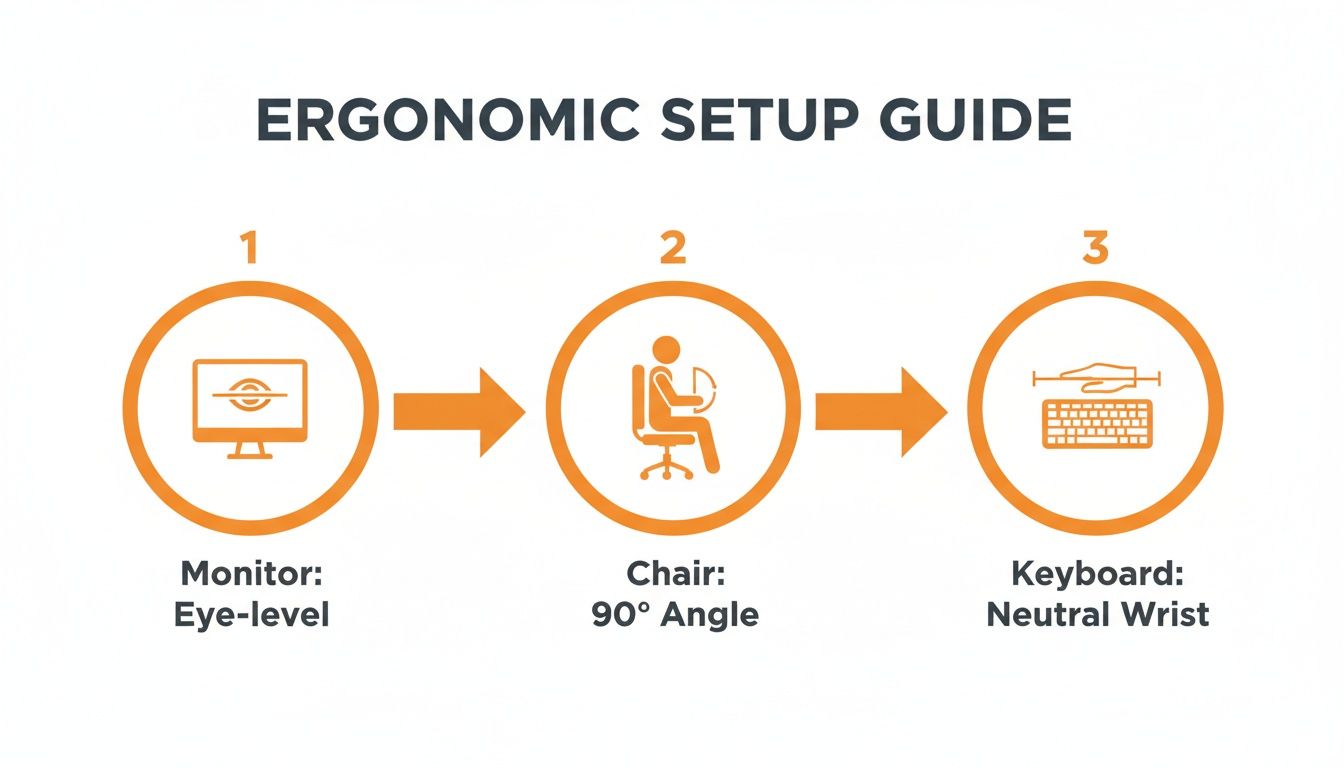
As you can see, keeping your monitor at eye level, your chair at a 90-degree angle, and your keyboard positioned for neutral wrists is the foundation for a sustainable, pain-free workday.
The Power of Proactive Movement
When you weave these little movements into your day, you're taking a proactive stance. You're addressing the root cause of many RSIs, not just reacting to the pain after it shows up. And this is a much bigger issue than most people think.
A 2021 CDC report revealed that 9.0% of U.S. adults—that’s around 23 million people—had suffered from a repetitive strain injury in the past three months alone. The report also stressed that prevention comes down to simple, proven steps like regular stretching and ergonomic adjustments. You can find more details in the full National Health Statistics Report.
By making movement a non-negotiable part of your workday, you shift from a reactive mindset to an active, preventative one. If you need a little more inspiration, our guide on 10 simple ways to get moving in everyday life has plenty of ideas to help you build this healthy habit.
Using Heat and Massage for Proactive Muscle Care
Think of ergonomics and stretching as the foundation of your RSI prevention plan. But what about the day-to-day muscle care that keeps everything running smoothly? This is where you can add another powerful, and frankly, more relaxing layer to your defense: proactive heat and massage.
This isn't about damage control after you’re already in pain. It’s about regularly giving your muscles a chance to unwind, recover, and stay resilient. A little bit of targeted therapy can make a huge difference in keeping those nagging aches and pains from ever starting.
Why Heat Therapy Works Wonders
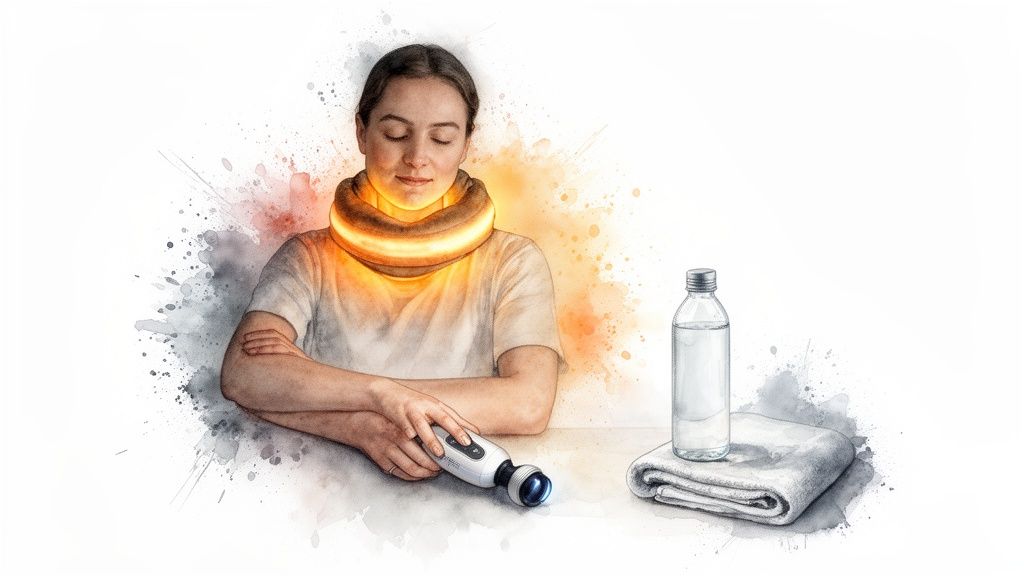
When you apply warmth to a tense area, like your neck or forearms, you're kicking off a helpful physiological response. The heat gently boosts blood circulation, bringing a fresh supply of oxygen and nutrients right where your muscles need it most. This helps them relax and repair.
This process also makes your muscle tissue more pliable. Think about trying to stretch a cold, stiff rubber band—it’s not very flexible and might even snap. A warm rubber band, on the other hand, is much more elastic. Your muscles are much the same.
Heat therapy is an incredibly effective and accessible tool for daily muscle maintenance. Just 15-20 minutes of targeted warmth can dissolve the tension accumulated during a long workday, stopping minor stiffness from becoming a chronic problem.
Here's a real-world example: Imagine you're a writer on a tight deadline, hunched over your keyboard for hours. By the end of the day, your neck and shoulders feel like a solid block of concrete. By simply wrapping a heated neck pillow around your shoulders for 20 minutes while you decompress, you're not just finding comfort—you're actively preventing that stiffness from turning into a chronic strain that could sideline you for days. The warmth penetrates deep, loosening knots and improving blood flow so your muscles can recover overnight instead of staying tight.
To dig deeper into this, you can learn more about the benefits of heat therapy in our detailed guide.
Integrating Targeted Self-Massage
Massage is the perfect partner to heat therapy. While heat preps the muscles by increasing blood flow, a good massage can manually break up the knots and adhesions that cause pain and limit your movement.
The best part? You don't need a professional appointment every week to get these benefits. A few minutes of targeted self-massage can be incredibly effective.
- For your forearms: After hours of typing or mousing, the muscles here can feel like tight ropes. Gently use your opposite thumb to press and rub along these muscles, working your way from the elbow down to the wrist.
- For your hands: Pay attention to the fleshy part at the base of your thumb. It takes a beating from mouse use. Use your other thumb to gently massage this area in small circles.
- For your shoulders: Those knots between your shoulder blades can be tough to reach. A simple tool like the SunnyBay Dual-Hand Massager lets you apply direct pressure right where you need it.
This hands-on approach allows you to address tension the moment you feel it. For instance, a cashier scanning items all day puts immense repetitive stress on their forearms and hands. Taking a five-minute break to use a handheld massager on those tight forearm muscles isn't just a luxury; it's a preventative measure. It breaks up the micro-trauma from repetitive movements, preventing the cumulative damage that leads to conditions like tendonitis. It's the difference between feeling a little sore at the end of a shift and developing a long-term, debilitating injury.
By making these therapies a regular part of your self-care routine, you're taking a powerful, proactive step toward keeping repetitive strain injuries out of your life.
Listen to Your Body's Warning Signs
Your body is an incredibly smart communicator. Long before a repetitive strain injury becomes a full-blown problem, it sends out quiet signals—a nagging ache, a little tingle, maybe a bit of weakness when you try to grip something. The absolute key to staying healthy is learning to treat these early warnings as important data, not just minor annoyances to push through.
Ignoring these signals isn't something to take lightly. The median time someone has to take off work for an RSI is 14 days. That's a good deal longer than the nine-day average for other kinds of work-related injuries. In some places, like Ontario, these issues are behind more than 40% of all lost-time workers' compensation claims, which is a massive blow to both people's lives and company productivity. You can find more details about the impact of RSIs in the workplace in this great overview.
Translating Your Body's Signals
Catching an RSI early is the best way to stop it in its tracks. The trouble is, the symptoms often start so small that they’re easy to dismiss. But they are direct clues that you're putting too much stress on specific muscles, nerves, and tendons.
Here are some of the most common signals and what they're likely telling you:
- Tingling or Numbness: That "pins and needles" sensation in your fingers or hand, especially after a long session with the mouse, often points to nerve compression. It's a classic early sign of things like carpal tunnel syndrome.
- Dull Aches: A persistent, low-grade ache in your shoulder, neck, or forearms is a clear message that those muscles are overworked and tired.
- Weakness or Clumsiness: Ever find yourself struggling to hold your coffee mug or dropping things for no reason? That could be a sign of muscle fatigue or nerve issues creeping into your hands and arms.
- Stiffness: Waking up with a stiff neck or finding your wrist doesn't move as freely as it should are tell-tale signs of inflammation and reduced flexibility.
Think about it this way: if your hand feels a bit numb every time you wrap up a two-hour work block, don't just shake it out and move on. That’s a direct prompt from your body to act. It's telling you to adjust your mouse, take more breaks, or do some simple wrist stretches.
When to See a Professional
For early-stage discomfort, self-care is a powerful tool. All the things we’ve talked about—stretching, ergonomic fixes, heat therapy—can make a huge difference. But there comes a point where you need to bring in a professional.
It's crucial to know the difference between normal muscle soreness after a tough day and an injury that's getting worse. If your symptoms are sticking around, intensifying, or starting to mess with your daily life, it’s time to see a doctor or physical therapist.
Don't wait to get medical advice if you experience any of these red flags:
- Pain that is sharp, shooting, or severe.
- Symptoms that don't get better after a few days.
- Noticeable swelling or redness in the area.
- Discomfort that’s bad enough to wake you up at night.
Taking control of your health really starts with listening. When you can recognize these early signs for what they are and know when to act, you give yourself the power to fix a small issue before it ever becomes a major, debilitating problem.
Your Questions About RSI Prevention, Answered
Putting a prevention plan into action is great, but it's natural for questions to pop up along the way. Getting clear answers is the key to confidently using these strategies to protect your long-term health.
Many of the most common questions we see are tied to specific high-risk jobs, like caregiving. For those in the field, a solid guide to safe patient transfer techniques provides indispensable, practical steps to minimize physical strain.
Let’s tackle a few of the other frequent questions we hear.
How Often Should I Really Take a Break From My Computer?
To truly head off muscle strain, you need to get up and move every 30 minutes. Seriously.
It doesn’t have to be a major interruption—just 60 to 90 seconds is enough. Stand up, stretch out your wrists, roll your shoulders back, or take a quick walk around the room. These micro-breaks are incredibly powerful for restoring blood flow and stopping the tiny traumas that accumulate into a full-blown RSI.
I'm Already Feeling Some Pain. Is It Too Late to Prevent RSI?
Absolutely not! If you're experiencing that initial twinge or ache, it's actually the perfect time to act. Think of it as your body sending you a clear signal that something needs to change.
By immediately focusing on proper ergonomics, incorporating daily stretches, and using supportive therapies, you can often halt the problem in its tracks and even reverse the symptoms.
Expert Tip: Applying gentle heat to a sore area can work wonders. It helps soothe inflammation and relax tight, overworked muscles, creating the ideal environment for your body to recover. Just remember, if the pain is sharp, constant, or getting worse, it's time to see a healthcare professional.
For instance, think of a graphic designer who starts noticing wrist soreness after long days. A simple routine of applying a heated pad to their forearm after work can bring significant relief. The warmth boosts circulation, eases the tension built up from hours of mouse work, and helps the muscles heal. This small, proactive step can be the difference between minor soreness and a chronic condition like carpal tunnel syndrome.
Don't underestimate the power of self-massage, either. Gently working on those tight forearm muscles or the base of your thumb can help break up the knots that repetitive motions create. When you combine this kind of targeted care with heat therapy, you give your body the active support it needs to bounce back.
Are Ergonomic Keyboards and Mice Actually Worth the Investment?
For many people, they are a complete game-changer. Ergonomic tools, like a vertical mouse that positions your hand in a "handshake" pose or a split keyboard, are designed with one goal: to keep your hands and wrists in a more natural, neutral posture.
This small change dramatically reduces the strain on the delicate tendons and nerves that are so susceptible to RSI. While they aren't a magical cure for bad habits, they are a powerful component of a comprehensive prevention strategy, especially if your job keeps you at a computer all day.
At SunnyBay, we're firm believers in simple, effective solutions for muscle care and pain prevention. Our clinic-trusted heat wraps and massagers are designed to deliver targeted relief, helping you dissolve daily tension before it has a chance to become a chronic problem. Explore our collection of U.S.-made wellness products and start building your proactive routine for a pain-free life. Find your perfect heat therapy solution at https://sunny-bay.com.


