


How to Prevent Muscle Soreness And Train Smarter
-
That familiar, satisfying ache you feel a day or two after a really good workout? That's Delayed Onset Muscle Soreness, or DOMS, and it’s actually a good sign. It means you’ve challenged your muscles enough to trigger them to adapt and get stronger.
This happens when you introduce a new exercise or ramp up the intensity, creating tiny, microscopic tears in your muscle fibers. While it’s a totally normal part of getting fitter, you don't have to let the pain put you on the sidelines.
Why Your Muscles Get Sore After a Workout
When you ask your muscles to do more than they’re accustomed to—whether that's lifting a heavier dumbbell or trying a new yoga class—you’re creating that microscopic damage. This isn't a bad thing at all. In fact, it's the very stimulus your body needs to kick off its repair process, which is what ultimately rebuilds those muscle fibers bigger and stronger than before.
That's why you start to feel that characteristic ache anywhere from 12 to 48 hours after your session. The soreness is just a byproduct of the body's natural inflammatory response as it gets to work healing those tiny tears. Think of it as a construction zone: your body sends extra fluid and nutrients to the area to clear out the debris and start rebuilding. This causes some temporary swelling, stiffness, and discomfort.
What Triggers Muscle Soreness
Not all exercises are created equal when it comes to DOMS. One of the biggest culprits behind that next-day pain is eccentric muscle contraction. This is the "lengthening" phase of a movement. A deeper understanding of eccentric muscle contraction is key, because this type of muscle work puts the most stress on the fibers and is a primary driver of soreness.
For a real-world example, think about the "down" part of a bicep curl, or the motion of slowly lowering yourself into a squat. Those controlled, negative movements put a lot more strain on the muscle than the lifting (or concentric) phase. It's why a workout heavy on controlled descents will almost always leave you feeling more tender than one focused on explosive, upward movements.
Turning Pain into Progress
Look, some soreness is a badge of honor—it shows you put in the work. But if the pain is so severe that it kills your motivation for the next session, you're losing momentum. The goal isn't to eliminate soreness completely, but to manage it so you can stay consistent with your training.
This guide is all about giving you a complete strategy to do just that. We'll cover everything from prepping your body beforehand to supercharging your recovery afterward, helping you keep that post-workout ache in the sweet spot.
Takeaway: Instead of seeing soreness as a roadblock, think of it as feedback. It's your body telling you it's been challenged to grow. The trick is responding with smart recovery.
We’ll also dig into how simple, effective tools like targeted heat therapy can completely change your recovery game. Applying a little heat boosts blood flow, which rushes oxygen-rich blood to the area to speed up repairs and help flush out metabolic waste. It’s a simple step that can turn post-workout pain from a problem into a manageable part of your fitness journey.
Your Pre-Workout Preparation Plan
How you kick off your workout is just as important as the main event. A smart pre-workout routine is your first, and arguably best, defense against that all-too-familiar muscle ache. Just jumping straight into heavy lifts or an all-out cardio session without prepping your body is practically asking for debilitating stiffness and even injury.
Think of it like this: you wouldn't start your car on a frigid morning and immediately slam the gas pedal to the floor. Your muscles need that same gentle wake-up call. A proper warm-up sets the stage for a great workout and, more importantly, a much smoother recovery.
Embrace Dynamic Movements
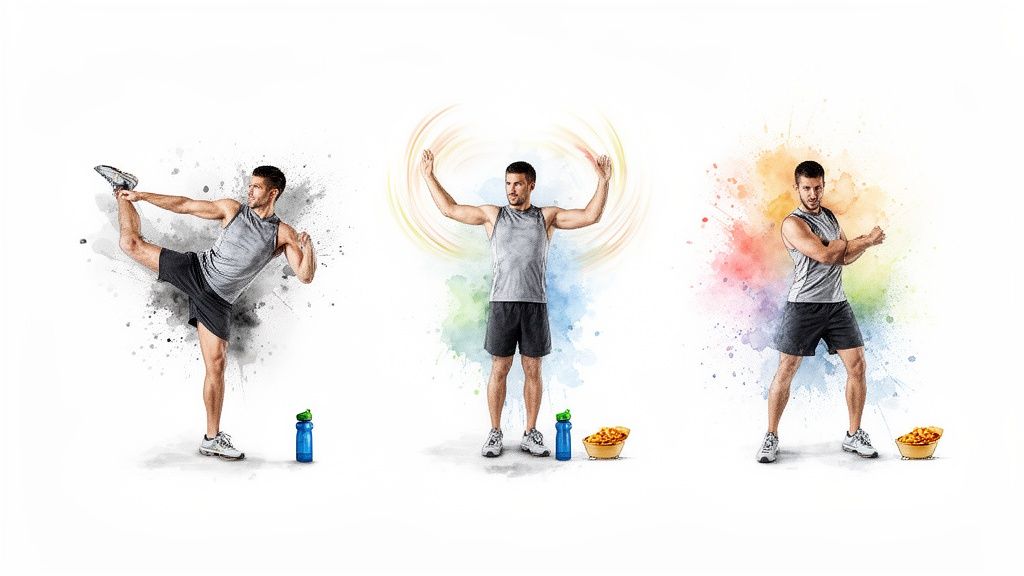
The old-school advice to hold static stretches before a workout has been largely debunked. Your goal right now isn't to lengthen and relax your muscles; it's to get the blood pumping and prime your nervous system for action. That’s where dynamic stretching comes in.
Dynamic movements are all about active, controlled motions that take your joints and muscles through a full range of motion. They essentially mimic the exercises you're about to do, sending a clear signal to your body that it's go-time.
A few of my go-to dynamic warm-ups include:
- Leg Swings: Grab onto a wall or post for balance and swing one leg forward and back, then side to side. This is fantastic for opening up the hips.
- Arm Circles: Make big, sweeping circles with your arms, both forwards and backward, to get the shoulder joints ready.
- Torso Twists: With your feet about shoulder-width apart, gently twist your upper body from side to side.
For a more detailed routine, check out our complete guide on how to warm up before exercise. It provides specific movements that can help you build a solid pre-workout habit.
Fuel and Hydrate for Success
What you eat and drink before you train directly influences how you perform and how you recover. Hitting the gym on an empty stomach can leave you feeling weak and can actually cause your body to break down muscle for energy—the exact opposite of what you’re trying to achieve.
Try to grab a small snack with both carbs and protein about 30 to 60 minutes before your workout. The carbs give you that quick-access energy to push through, while the protein provides the initial building blocks your muscles will need for repair later.
Some easy pre-workout snack ideas:
- A banana with a spoonful of peanut butter
- A small bowl of oatmeal
- A piece of toast topped with avocado
Don't forget to hydrate! Dehydration is a surefire way to make muscle soreness worse and drag out your recovery time. Start sipping on water well before you even head out the door.
Harness the Power of Pre-Workout Heat
Here's a pro tip that many people miss: apply gentle heat to your primary muscle groups for 5 to 10 minutes before you even start your dynamic stretches. It sounds simple, but this can make a world of difference in your workout and soreness levels.
Heat therapy works by boosting circulation, flooding your muscle tissues with oxygen-rich blood. This makes the muscles more pliable and ready for action, lowering the risk of strains. For example, if it's leg day, try resting a heat pack on your quads or lower back while you're getting your gear on. You'll feel a noticeable improvement in your mobility and readiness. This proactive step is a true game-changer.
Train Smarter to Minimize Post-Workout Pain
How you tackle your workout is every bit as important as what you do for recovery afterward. To really get a handle on muscle soreness, you have to find that sweet spot: challenging your body enough to make progress without completely wrecking it. It’s a bit of an art, but mastering it is the key to consistent gains and less time spent wincing.
The whole game revolves around a principle called progressive overload. All this means is that you gradually ask a little more of your muscles over time. Instead of making a huge jump in weight or intensity—a guaranteed recipe for debilitating soreness—you focus on small, sustainable steps. A good rule of thumb is to aim for a 5-10% increase in either weight or reps each week.
This slow-but-steady method gives your muscle fibers, tendons, and ligaments the chance to adapt and get stronger. When you go too hard, too fast, you cause excessive micro-trauma, leading to the kind of pain that makes you dread your next session.
Ease Into New Movements
Anytime you bring a new exercise into your routine, you need to be extra careful, especially with movements that have a long eccentric (or lowering) phase. Think about that slow, controlled descent in a squat or the negative part of a bicep curl. These are famous for causing soreness because they really stretch the muscle under tension.
So, instead of jumping in headfirst, give yourself a one- to two-week adaptation period. Start with a lighter weight or do fewer sets than you think you can manage. This lets your neuromuscular system get the hang of the movement pattern, which reduces the shock to your muscles and minimizes the ache you'll feel later.
Key Takeaway: The goal is to stimulate your muscles, not annihilate them. Smart progression is what separates productive soreness that signals growth from the counterproductive pain that warns of a looming injury.
Here’s a practical example of how you can apply progressive overload to a core exercise like the barbell squat.
Example Progressive Overload Plan (Barbell Squat)
This table illustrates a practical way to increase intensity over four weeks, promoting strength gains while managing muscle soreness effectively.
| Week | Sets x Reps | Weight | Focus |
|---|---|---|---|
| 1 | 3 x 10 | 135 lbs | Establishing baseline, perfecting form |
| 2 | 3 x 10 | 145 lbs | +10 lbs. Small, manageable weight increase |
| 3 | 3 x 12 | 145 lbs | +2 reps. Increasing volume at the same weight |
| 4 | 3 x 8 | 155 lbs | +10 lbs. Increasing intensity, lower reps |
By making one small change each week, you give your body time to adapt, build strength, and avoid excessive soreness.
Listen to Your Body’s Feedback
One of the most valuable skills you can develop is learning to tell the difference between the "good burn" of a tough workout and the sharp, stabbing pain that signals something is wrong. Pay close attention to how you feel, both during your workout and in the hours and days that follow. If a movement causes a sharp, localized pain, stop what you're doing immediately.
Interestingly, research shows that while starting a progressive strength program can cause some initial pain, it ultimately leads to significant relief over time. It’s a classic case of the right kind of activity curing what it causes. This is especially critical for athletes who should ease into new or intense training at the beginning of a season to stay healthy. You can dig into the specifics of this in a study about how progressive training reduces muscle pain over time.
For a complete picture, our guide on how to speed up muscle recovery dives deeper into strategies that help you bounce back faster. When you train smarter and tune into your body’s signals, you can build strength sustainably and hit your goals without needless setbacks.
Your Essential Post-Workout Recovery Ritual
What you do in the hour after that last rep can make or break how you feel for the next 48 hours. Think of this as your golden window—the prime time to jumpstart the healing process and get a handle on soreness before it really sets in.
Nailing a simple, consistent post-workout ritual is one of the smartest things you can do to prevent that dreaded, can't-walk-down-the-stairs feeling.
The first order of business is a proper cool-down. This isn't the time for the high-energy movements of your warm-up; now, it’s all about static stretching. Gently ease into stretches for the muscles you just worked, holding each for about 20-30 seconds. This does more than just improve flexibility—it helps downshift your nervous system, telling your body the hard work is over and it's time to repair.
Refuel to Rebuild
With your muscles relaxed, the next focus is nutrition. You've probably heard of the "anabolic window," and while the exact timing is debated, the principle holds true: your muscles are incredibly receptive to nutrients right after a workout. They’re like sponges, ready to soak up what they need to repair those microscopic tears you just created.
Your goal should be a snack or meal that packs a punch of both protein and carbohydrates.
- Protein is the building block. It supplies the amino acids necessary to patch up and strengthen muscle fibers.
- Carbohydrates are your fuel. They restock the glycogen stores you burned through during your session.
Finding the right post-workout meal is a game-changer. You can check out some of the best post-workout recovery foods to get ideas that work for your taste and goals. And don't forget to rehydrate! Water is absolutely essential for flushing out metabolic waste and keeping your muscles happy.
Nutrients and Heat for Deeper Relief
Beyond the basics of protein and carbs, certain micronutrients can give you an extra edge. Magnesium, for example, is getting a lot of attention for its ability to help reduce muscle soreness. When you pair smart supplementation with something like heat therapy, you create a powerful combo for fighting off aches.
This all ties back to the core principles of smart training: start slow, progress gradually, and always pay attention to what your body is telling you.

Listening to your body is key, and that extends right into your recovery. While magnesium works from the inside out to relax muscles, you can double down on that effect from the outside in.
Applying a heat pack from SunnyBay, for instance, provides a soothing warmth that boosts blood flow. This improved circulation helps rush those vital nutrients to your tired muscles while carrying waste away, offering immediate relief and kickstarting a more effective recovery.
Using Heat and Massage for Deeper Recovery
Okay, so you’ve got your training and cooldowns dialed in. That’s your first line of defense against serious muscle soreness. But when you want to take your recovery to the next level, a couple of old-school, science-backed tools can make a world of difference: heat therapy and massage.
Used together, they’re a powerhouse duo for soothing tired muscles, knocking out stiffness, and getting you back to your workouts feeling strong and ready to go.
Why Heat Works So Well
Heat therapy is one of the simplest and most effective ways to kickstart your body's natural healing process. When you apply warmth to a sore area, it triggers vasodilation—a fancy word for widening your blood vessels. This boost in circulation is a game-changer. It rushes a fresh supply of oxygen and nutrients to your muscles, which they desperately need to repair.
At the same time, that increased blood flow helps flush out the metabolic waste products that build up during exercise and contribute to that achy, stiff feeling.
Think about it. You just crushed a tough leg day, and you can already feel your glutes and lower back starting to tighten up. Instead of just gritting your teeth and waiting for the soreness to peak, you could wrap a hands-free heat pad around your lower back while you relax. That targeted warmth feels amazing, of course, but it’s also actively speeding up the repair process from the inside out.
The Power of Targeted Heat
A quick hot shower is nice, but for deep, therapeutic relief, you need something that delivers sustained, targeted heat right where you need it. This is where high-quality, microwavable heat packs really shine. They provide a comfortable, moist heat that penetrates muscle tissue more effectively than the dry heat from a standard heating pad. It's like getting clinic-grade relief right at home.

The key is finding ergonomic wraps designed for specific body parts, whether it’s your neck, shoulders, or lower back. The hands-free convenience lets you go about your evening while your body is actively recovering. You can learn more about the science behind the many benefits of heat therapy and how it fits into a well-rounded routine.
Adding Massage to the Mix
Massage is the perfect partner for heat therapy. While heat brings fresh blood to the muscle, massage physically works on the muscle. A good massage helps manually break down the adhesions and tight knots, or trigger points, that form in overworked muscle fibers. This not only relieves pain but also helps restore your flexibility and range of motion.
And this isn't just a hunch—the science is solid. A massive meta-analysis that looked at 99 different studies found that massage was the most effective recovery tool out there for fighting delayed onset muscle soreness (DOMS). It significantly lowered how sore people felt after tough workouts. For anyone who trains consistently, that’s huge. It means a little bit of massage could be your secret weapon for minimizing downtime.
Pro Tip: Try this for a seriously effective recovery session. Apply a heat pack for 15-20 minutes before you foam roll or use a massage gun. The warmth relaxes the muscle tissue, which makes the massage much more effective and a lot less painful.
Ultimately, preventing muscle soreness is about having a complete strategy. By bringing dedicated recovery tools like heat packs and massage into your routine, you give your body the support it needs to bounce back faster and stronger. It turns recovery from something you just wait for into an active, empowering part of your fitness journey.
Still Have Questions About Muscle Soreness? Let's Clear Them Up.
Even the best-laid plans can leave you with a few lingering questions. Let's tackle some of the most common things people ask about keeping muscle soreness in check so you can get your recovery dialed in.
How Long Should I Use a Heat Pack for Muscle Soreness?
When you're dealing with that general, post-workout achiness, a sweet spot for heat application is about 15 to 20 minutes. That’s long enough to boost circulation and get those healing nutrients flowing to your muscles, but not so long that you risk irritating your skin.
Microwavable heat packs are fantastic for this because they naturally hold a really therapeutic temperature for about that length of time. For instance, after a heavy leg day, you can drape one over your quads or lower back while you're unwinding. Just make sure to wrap it in a towel or cloth to protect your skin.
Is Heat or Ice Better for Muscle Soreness?
For the kind of delayed soreness that shows up a day or two after a workout (what we call DOMS), heat is definitely your ally. It gets the blood moving, which is exactly what your muscles need to repair themselves and ease that stiff, locked-up feeling.
Now, ice has its place, but it's really for acute injuries—think a freshly pulled muscle or a sprained ankle where you see immediate swelling. For that everyday post-workout recovery, gentle warmth will do a much better job of soothing those tired muscles.
Can I Still Work Out When I Am Sore?
Absolutely. In fact, you probably should! A little bit of light movement, what we call "active recovery," can actually speed things up. Think a brisk walk, a casual swim, or some gentle yoga. This gets blood flowing to the sore areas without causing more damage.
The trick is to avoid another intense workout that hammers those same sore muscles. It’s all about listening to your body. If you're feeling it, opt for lighter activity or just work on a completely different muscle group.
Real-World Example: Let's say your legs are fried from squats on Monday. On Tuesday, a light 20-minute walk or a focused upper-body day is the perfect way to keep moving without pushing your recovering muscles over the edge.
How Can I Tell Soreness from an Actual Injury?
This is a big one. Normal muscle soreness feels like a dull, spread-out ache. It often affects both sides of your body (like both quads) and tends to peak around the 48-hour mark after your workout.
An injury, on the other hand, usually presents as a sharp, localized pain. You might even remember the exact moment it happened during a lift. Injuries often come with friends, too—like swelling, bruising, or a sudden inability to move a joint through its full range. If the pain is sharp, specific, and doesn't go away, it's time to back off and get it checked out by a pro.
Ready to make targeted heat a serious part of your recovery game? The hands-free, microwavable wraps from SunnyBay are designed to deliver that deep, soothing warmth that helps melt stiffness and speed up healing. Check out our collection of USA-made heat packs and see how simple, effective relief can completely change your post-workout routine. Find your perfect recovery tool at https://sunny-bay.com.


