


How to Recover faster After Workout and Boost Your Gains
-
If you want to recover faster after a workout, you can't just cross your fingers and hope for the best. Recovery isn't passive; it's an active, strategic part of your training. It unfolds in phases, starting with immediate actions right after your last rep, moving into short-term strategies over the next 24-72 hours, and finally, building long-term habits that make you more resilient.
When you nail this timeline, recovery stops being a waiting game and starts becoming your secret weapon for getting stronger.
The 24-72 Hour Workout Recovery Timeline
That deep ache you feel after a great workout? It's a sign you’ve pushed your muscles to grow. But when that soreness lingers for days, it can kill your motivation and sabotage your next session.
Smart recovery is about actively helping your body repair and refuel. Think of it as being just as crucial as the workout itself. The whole process breaks down into a few key phases, and knowing what your body needs at each stage is the key to bouncing back faster. This isn't just about feeling better; it's about minimizing that dreaded delayed-onset muscle soreness (DOMS) so you're ready to go again.
Understanding The Three Recovery Phases
Your body's needs shift dramatically from the moment you finish your workout to the days that follow. Let's break down what's happening and what you should be doing.
- The Golden Window (0-2 Hours Post-Workout): This is your first and best opportunity to kickstart recovery. The goal here is simple: switch your body out of a high-stress state and into repair mode. What you do right now—like a proper cooldown and getting in some initial fuel—has a huge impact on how you'll feel tomorrow.
- The Repair Shop (2-48 Hours Post-Workout): Over the next two days, the focus is all on muscle repair and replenishing your energy stores. This is prime time for quality sleep, strategic nutrition, and recovery tools like heat therapy or a massage gun to calm inflammation and ease soreness.
- The Foundation (Beyond 48 Hours): This phase is all about consistency. It’s where your long-term habits, like scheduled rest days, regular mobility work, and a lifestyle that supports your training, really pay off. This is how you build a body that can handle tough workouts and recover like a pro.
That muscle soreness that peaks 12 to 48 hours after you train is called DOMS. It’s a totally normal reaction to the microscopic tears you've created in your muscle fibers. A smart recovery plan doesn't eliminate it, but it does shorten the duration and turn that hard work into real strength, faster.
The timeline below gives you a bird's-eye view of the entire recovery process, from the moment your workout ends to the days that follow.
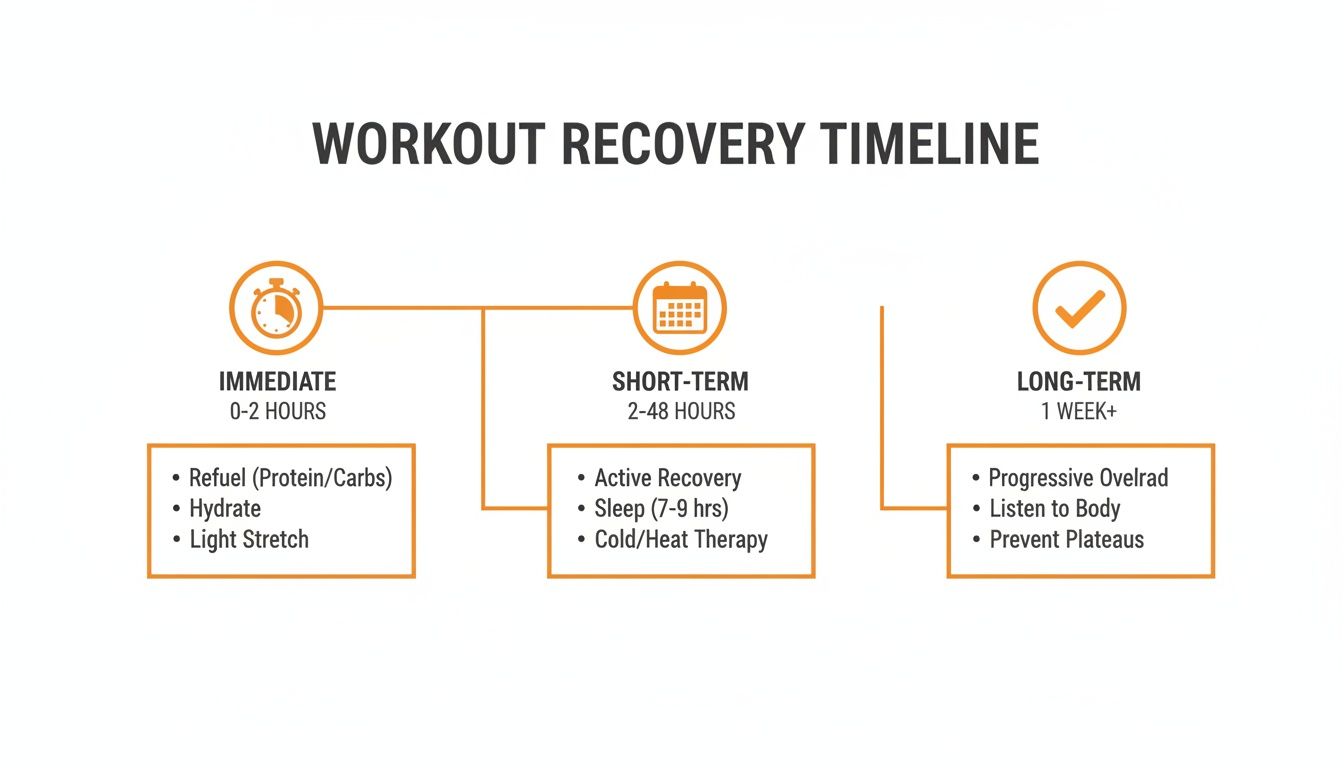
To help you visualize exactly what to do and when, here’s a simple table breaking down the timeline.
The Three Phases of Effective Workout Recovery
| Recovery Phase | Timeframe | Primary Goal | Key Actions |
|---|---|---|---|
| Immediate | 0–2 Hours Post-Workout | Transition from stress to repair | Cooldown, static stretching, rehydrate, consume protein & carbs |
| Short-Term | 2–48 Hours Post-Workout | Reduce inflammation & begin muscle repair | Quality sleep, balanced meals, hydration, light activity, heat therapy |
| Long-Term | 48+ Hours Post-Workout | Build resilience & prevent overtraining | Active recovery, mobility work, scheduled rest days, consistent sleep |
This table shows that recovery is a journey, not a single action. By following this roadmap, you give your body exactly what it needs, right when it needs it.
For a deeper dive into all the components that go into a great recovery plan, check out these essential elements for comprehensive post-workout recovery. Adopting a structured blueprint like this is how you stop feeling constantly sore and start getting back to your training with more energy and strength.
Mastering the First Hour After Your Workout
What you do in the first 60 minutes after that final rep can make all the difference in how you feel tomorrow. This isn't about some complicated, pro-level routine; it's simply about signaling to your body that the hard work is done and it's time to start the repair process.
So many people crush their last set, grab their keys, and head straight for the door. I get it, you're tired. But that abrupt stop is a jolt to your system. Your heart rate is still jacked up and your muscles are swimming in metabolic byproducts. A proper cooldown is your way of gently guiding your body back to baseline and kickstarting recovery right away.
Why Active Recovery Beats Crashing on the Couch
It’s tempting to collapse on the sofa after a tough session—you've earned it, right? But believe it or not, that's one of the least effective things you can do. The real secret is to keep moving, just at a much, much lower intensity. We call this active recovery.
Think of your circulatory system as a cleanup crew. A hard workout leaves behind metabolic "debris," like lactate, in your muscles. Lying still is like telling that crew to go on a coffee break. Light movement, on the other hand, keeps your blood flowing. This helps shuttle all that waste out while delivering fresh, oxygen-rich blood to start patching things up.
This isn't just gym-bro wisdom; it’s backed by science. Studies have shown that just 10–20 minutes of light aerobic activity right after a workout speeds up physiological recovery and can seriously cut down on muscle soreness compared to just sitting around. If you want to dive into the research, here's a great paper on post-exercise recovery strategies. It's a small time investment that pays off big.
Your Cooldown Blueprint
A great cooldown doesn't need to be long or fancy. You're just aiming for gentle movement to gradually bring your heart rate down and keep the blood flowing without adding any more stress to your muscles.
Think of it as the reverse of your warmup. Instead of ramping your body up for intense work, you're carefully guiding it back down to a state of calm. This also helps prevent blood from pooling in your legs, which is what can make you feel dizzy or lightheaded after a particularly brutal session.
A proper cooldown can slash delayed-onset muscle soreness (DOMS) by up to 30%. It’s one of the simplest and most powerful tools you have for managing post-workout pain.
Here’s what this looks like in the real world.
Cooldown Routine Examples:
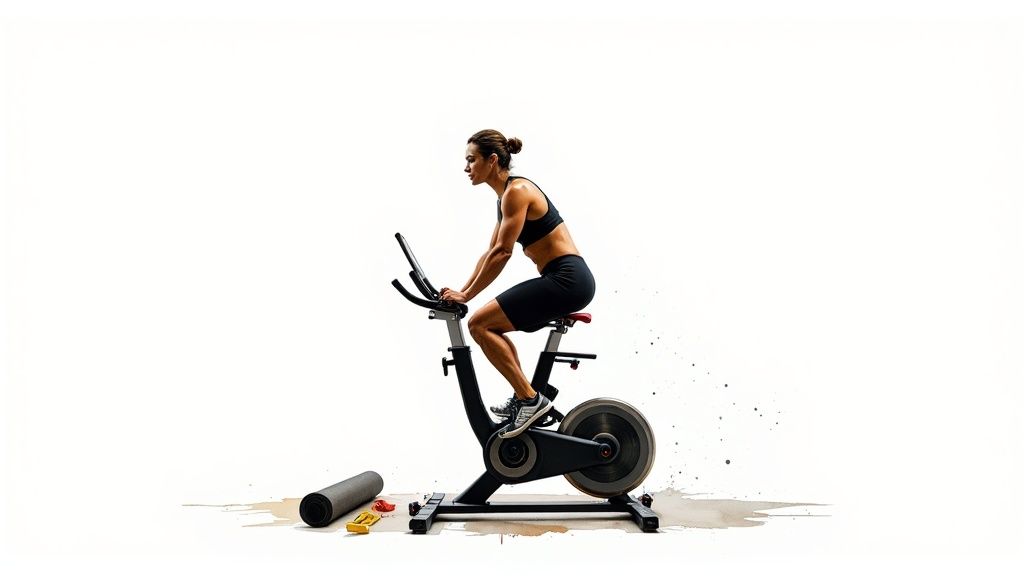
- After a Heavy Leg Day: Don't just stumble to the showers. Hop on a stationary bike for 10 minutes with basically zero resistance. The goal is just to keep your legs spinning to help flush out all that junk from your quads, hamstrings, and glutes.
- Following a HIIT Session: Your heart rate is through the roof, so you need to bring it down slowly. A 5-10 minute brisk walk on the treadmill, gradually decreasing your speed every couple of minutes, is perfect. It lets your cardiovascular system return to normal safely.
- Post-Long Run: The worst thing you can do is stop dead. Instead, transition to a slow jog for the last quarter-mile, then walk for another 5-10 minutes. This prevents your leg muscles from seizing up.
The Role of Gentle Stretching
Once your heart rate is back in a normal range, now is the time for some static stretching. Your muscles are warm and pliable, making this the ideal window to release tension. This isn't about becoming a gymnast; it's about gently coaxing your muscles to relax after they’ve been contracting for an hour.
Zero in on the major muscle groups you just trained. Hold each stretch for a good 20-30 seconds. Breathe into it, and never push to the point of pain or start bouncing.
- For Lower Body: Hit your hamstrings, do some quad pulls, and don't forget your calves.
- For Upper Body: A good doorway stretch for your chest is a classic for a reason. Make sure to stretch your lats and triceps, too.
This combination of light cardio and smart stretching is a powerful one-two punch in that first hour. It sets the stage for everything else—your nutrition, your sleep—to work that much better.
Fueling Your Recovery with Smart Nutrition
You don't build muscle in the gym; you build it in the kitchen. I can't stress this enough: what you eat after a tough workout is just as critical as the reps you put in. The right nutrition provides the raw materials your body desperately needs to repair muscle, restock energy, and calm inflammation. It's the secret to bouncing back faster and stronger.
Think of your body like a construction site. Your workout is the demolition phase, creating tiny tears in the muscle fibers. Now, it's time to bring in the rebuilding crew. The food you eat acts as the lumber, steel, and concrete needed to build everything back up, better than before.
The Protein and Carb Partnership
For a long time, protein got all the attention. The common wisdom was to just slam a protein shake and get on with your day. While protein is absolutely essential, it can't do the job alone. It needs a partner: carbohydrates.
Protein delivers the amino acids that kickstart muscle protein synthesis—the technical term for the repair-and-rebuild process. But carbs? Their job is to refuel. They replenish the muscle glycogen you torched during your workout, which is the primary fuel source your body will need for the next session.
Skipping the carbs is like trying to build a house with a pile of bricks but no mortar to hold them together. You have the blocks, but you lack the energy to actually put them in place. This powerful synergy is what truly drives an efficient recovery.
Perfecting Your Post-Workout Plate
Good news: you don't need complicated formulas or a cabinet full of expensive supplements to get this right. The goal is simple—combine a quality protein source with a carbohydrate that's easy for your body to digest.
Here are a few go-to options I've seen work for countless people:
- When You're in a Rush: A smoothie is your best friend. Blend a scoop of whey protein with a banana and some milk. Another fantastic choice is a simple bowl of Greek yogurt topped with fresh berries and a bit of honey.
- For a Proper Meal: If your workout falls right before lunch or dinner, sit down for something more substantial. Think grilled chicken with quinoa and roasted veggies, or a beautiful fillet of salmon next to a baked sweet potato.
- Plant-Based Power: You have great options here, too. A smoothie with plant-based protein powder, a handful of spinach, and a frozen banana is perfect. For a full meal, you can't go wrong with a classic combination of lentils and brown rice.
If you want to dive deeper into your food choices, this guide on what foods help muscle recovery is a great resource.
Timing Is Everything
You might have heard about the "anabolic window," a strict 30-minute period to refuel. While the science shows that window is a bit more flexible than we once thought, timing still matters. Your muscles are incredibly receptive to nutrients in the 1 to 2 hours right after you finish exercising.
If you wait too long, you miss out on this prime opportunity to kickstart the repair process. Consuming protein and carbs soon after your workout leads to real, measurable improvements. Research shows that a combination of ~20–40g of protein with 0.5–1.0g of carbohydrate per kilogram of body weight within that two-hour window can significantly speed up muscle repair and reduce how tired you feel.
Key Takeaway: Don't obsess over hitting that 30-minute mark perfectly. Just make it a habit to get a protein-and-carb-rich snack or meal in within two hours of your cool-down. Consistency always wins over perfection.
Finally, don't forget your other best friend: water. You lose a ton of fluid and electrolytes through sweat, and replacing them is non-negotiable for recovery. Dehydration makes muscle soreness worse and slows everything down. Sip water all day long, not just when you feel thirsty. Certain anti-inflammatory foods can also give you a major edge. We cover that in more detail in our guide on reducing inflammation naturally.
Using Heat and Massage to Speed Up Healing
Once you’ve got your active recovery and nutrition dialed in, you’ve built a solid foundation. But if you want to really supercharge your recovery and bounce back faster, it's time to bring in two of my favorite tools: heat therapy and massage. These aren't just spa-day luxuries; they're targeted strategies that work on a deep physiological level to ease soreness and kickstart muscle repair.
Think of your muscles after a tough workout like a congested highway. Metabolic waste is causing a traffic jam, and the nutrients needed for repair can't get through. Heat and massage are like the traffic cops that come in to clear the gridlock and get everything flowing smoothly again.

How Heat Therapy Unlocks Faster Recovery
Applying heat to sore muscles is about more than just comfort—it triggers a powerful process called vasodilation. In simple terms, this means your blood vessels widen, which dramatically increases blood flow to the area.
This rush of fresh blood is the real game-changer. It acts like an express delivery service, bringing a flood of oxygen and nutrients straight to your tired, damaged muscle tissues. At the same time, it helps flush out the junk that causes soreness, like lactic acid and other metabolic byproducts.
Here’s a real-world example: It’s the day after a brutal leg day, and your quads are so tight you’re dreading the stairs. Applying a heating pad for 15-20 minutes doesn't just feel good; it actively tells your muscle fibers to relax, easing stiffness and jumpstarting the healing process. You'll find it's much easier to move, and that recovery window gets a whole lot shorter.
Heat is your best friend for tackling that delayed-onset muscle soreness (DOMS) that really kicks in 24-48 hours after a workout. By boosting circulation and improving your tissue elasticity, it can seriously cut down on pain and help you get your full range of motion back.
Still not sure whether to grab an ice pack or a heating pad? We've got you covered. Check out our detailed guide on when to ice and when to heat an injury to make the right call.
The Power of Massage and Myofascial Release
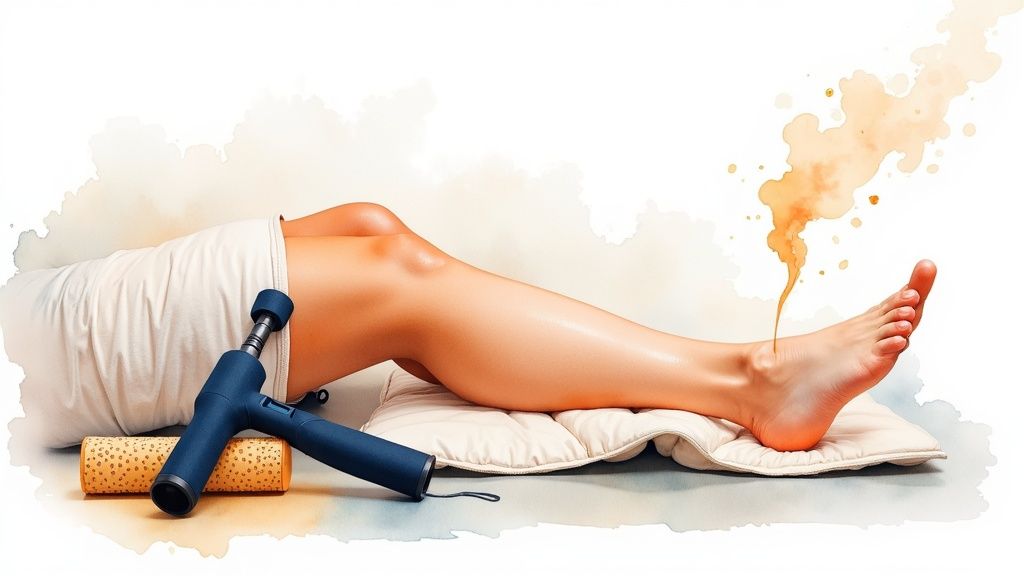
A professional massage is fantastic, but you don't need an appointment to get similar benefits. With tools like foam rollers and massage guns, you can perform self-myofascial release (SMR) right at home. This is just a fancy term for a technique that breaks up knots and sticky spots in your muscles and the connective tissue around them, known as fascia.
These knots, or trigger points, are tiny, cramped-up bands of muscle that can be surprisingly painful and really limit your movement. SMR is all about applying pressure to release that tension, break up the adhesions, and get your muscles working properly again.
Here's how you can put this into practice:
- Foam Rolling: After a long run, your IT bands and calves can feel like concrete. Just 5-10 minutes of slowly rolling these areas can release that tightness, improve flexibility, and even help prevent future injuries.
- Massage Gun: Smashed a new bench press PR? Your pecs and shoulders might be screaming tomorrow. A massage gun lets you apply deep, targeted pressure to those specific sore spots, breaking up knots and boosting blood flow right where it's needed most.
This targeted pressure doesn't just feel good—it helps quiet inflammation and makes the muscle tissue more pliable. It’s like untangling knots in a rope; once they’re gone, the rope moves freely. Your muscles are no different.
Putting It All Together in Your Routine
To really make these tools work for you, timing is everything. Don't just use them randomly; build them into your post-workout schedule with purpose.
A smart approach is to use a foam roller or another SMR tool for 10-15 minutes as part of your cooldown, right after you’ve done some static stretching. This helps your muscles start to relax and lengthen immediately after you've pushed them hard.
Then, save the heat therapy for later that day. Applying a heating pad in the evening while you’re winding down, or even the next day when the soreness really sets in, is a perfect way to manage that lingering stiffness. This one-two punch—immediate massage followed by targeted heat—creates the perfect environment for healing and helps you recover faster so you're ready for your next workout.
Why Sleep and Rest Days Are Non-Negotiable
You can have the perfect cooldown, the best nutrition plan, and all the right recovery gadgets, but if you're skimping on sleep and skipping rest days, you're building a house on a shaky foundation. The hard work you put in at the gym is what creates the potential for growth, but the real magic—the actual repair and rebuilding—happens when you’re resting.
Think of it this way: sleep and rest are the non-negotiable pillars that support everything else. Without them, you're just constantly tearing your body down without ever giving it the chance to fully come back stronger. This is a trap so many people fall into, pushing harder and harder while ignoring the most powerful recovery tools they have.
Sleep: Your Ultimate Muscle Repair Cycle
Sleep is anything but passive. When you hit those deep stages of sleep, your body flips a switch and goes into full-on repair mode. Your brain signals the pituitary gland to release a surge of human growth hormone (HGH), which is basically the foreman of your body's construction crew for tissue repair.
This powerful hormone gets to work repairing the microscopic muscle tears from your workout, building new muscle tissue, and even strengthening your bones. When you cut sleep short, you're directly short-changing this vital process, which stalls your progress and slows down your recovery.
Aiming for 7-9 hours of quality sleep a night is one of the single most effective things you can do to recover faster. Consistently missing that mark can spike cortisol, a stress hormone that actively works against you by breaking down muscle tissue.
To make the most of this nightly repair session, you need to focus on good sleep hygiene. It's not just about the number of hours you're in bed, but the quality of those hours.
Tips for Better Sleep Hygiene
- Keep a Consistent Schedule: Go to bed and wake up around the same time every day—yes, even on weekends. This helps lock in your body's internal clock, or circadian rhythm.
- Dial in Your Environment: Your bedroom should be a cave: cool, dark, and quiet. Blackout curtains or a white noise machine can be game-changers.
- Power Down an Hour Before Bed: The blue light from screens (phones, TVs, laptops) can mess with your body's production of melatonin, the hormone that signals it's time to sleep.
Struggling to wind down is incredibly common. For a few more ideas on improving your nightly routine, check out our five tips for going to sleep quicker.
Redefining Your "Day Off" with Active Rest
When most people hear "rest day," they picture a full day spent parked on the couch. While complete rest certainly has its place, active rest is often a much smarter strategy for speeding up recovery.
Active rest means doing low-intensity activities that get your blood flowing without putting more stress on your taxed muscles. Think of a long walk, a gentle yoga session, or a light swim. This boost in circulation helps deliver fresh nutrients to your muscles and flush out metabolic waste, which can actually knock down soreness more effectively than staying completely still.
This approach turns your "day off" from a passive waiting game into a proactive part of your recovery strategy.
Complementary Tools for Rest and Recovery
You can give your body an extra hand during these rest periods with tools designed to enhance circulation and calm inflammation. One of the simplest is compression gear.
Slipping on compression garments after a tough workout can improve blood flow back to the heart and reduce swelling. Research has shown that using compression tights or socks for a few hours post-exercise can lead to real, measurable reductions in both swelling and soreness, helping you get your explosive power back much faster. You can dig into the data for yourself and read the full research on how compression supports post-exercise recovery.
Common Questions About Workout Recovery
When it comes to workout recovery, it feels like everyone has a different opinion. Sorting through all the conflicting advice can be frustrating, leaving you wondering if you're actually doing what's best for your body. Let's cut through the noise and answer some of the most common questions with straightforward, practical advice.
Ice or Heat for Muscle Soreness?
This is the age-old debate, and the honest answer is: it depends on why you're hurting.
If you’ve just rolled your ankle or tweaked something and it’s swelling up, ice is your go-to. It helps constrict blood vessels to reduce that immediate inflammation and numb the pain.
But for that deep, achy muscle soreness that sets in a day or two after a tough workout (what we call DOMS), heat is usually your best friend. Applying warmth does the opposite of ice—it opens up your blood vessels, a process called vasodilation. This boosts circulation, sending a fresh supply of oxygen-rich blood to your tired muscles to speed up repair and help flush out the waste products that make you feel stiff.
Think about it: your lower back is tight and achy the day after a heavy deadlift session. Applying a heating pad for 15-20 minutes will feel amazing because it helps relax those seized-up muscles and restores your mobility. In this case, ice would just make things tighter.
How Soon After a Workout Should I Eat?
For years, we’ve been told about the "anabolic window," this magical 30-minute period where you had to get your protein in. While we now know it's not that rigid, timing your post-workout nutrition is still incredibly important.
Aim to get a meal or snack with both protein and carbs in your system within 1 to 2 hours after you finish training. Right after a workout, your muscles are like sponges, primed to soak up nutrients. This is the ideal time to refill the glycogen (energy) stores you just burned and give your body the amino acids it needs to start repairing muscle tissue.
This doesn't have to be complicated. A simple protein shake with a banana right after your session works great. Then, an hour or two later, follow it up with a solid meal like grilled chicken, rice, and broccoli.
The real goal here is consistency, not perfection. Don't stress over a 30-minute countdown. Just focus on building the habit of refueling with quality protein and carbs within that two-hour timeframe. Your body will thank you.
Is It Okay to Work Out If I’m Still Sore?
This is where you really have to learn to listen to your body. The answer hinges on the type and level of soreness you're feeling.
If you're dealing with sharp, specific pain or your range of motion is seriously compromised, that’s your body screaming for a rest day. Pushing through that kind of pain is a one-way ticket to a bigger injury.
However, if it's just that typical, dull muscle ache from DOMS, some light activity can actually be one of the best things for you. Gentle movement is fantastic for working out the stiffness.
- Go for a walk: A 20-minute walk is perfect for getting blood flowing without adding more stress.
- Hop in the pool: A light swim offers no-impact movement that can ease muscle tension.
- Focus on mobility: Think gentle, dynamic movements like leg swings, cat-cows, and arm circles.
This kind of "active recovery" increases circulation, helping to clear out metabolic byproducts and reduce stiffness much faster than sitting on the couch. A good rule of thumb is to start your warmup and see how you feel. If the soreness starts to fade as you get moving, you're probably good to go with a lighter workout. If the pain gets worse, pull the plug and take a proper rest day.
Ready to make heat therapy a cornerstone of your recovery routine? The team at SunnyBay has spent over 20 years perfecting simple, effective, and drug-free pain relief solutions. Our microwavable heat packs are designed and made in the USA, providing targeted warmth to soothe sore muscles and accelerate your healing. Discover the difference at https://sunny-bay.com.


